Yamalak Sarısı: the local table cultivar of Aydın
A local cultivar of Aydın counted among Turkey's most important table olives, and the subject of a phenotypic characterisation study.
Yamalak Sarısı is one of the local olive varieties of Aydın province. The word "local" matters here: the variety belongs to a particular district, has not spread across the country, but is well established where it grows.
Even so, Yamalak Sarısı is counted among Turkey's most important table olive varieties.
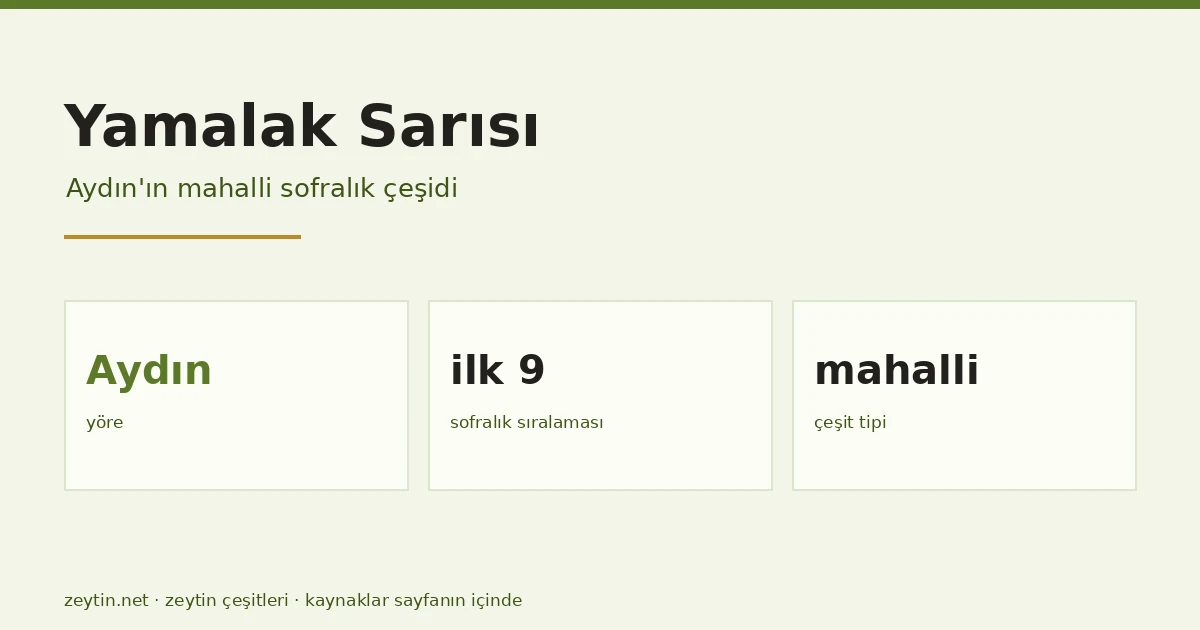
Yamalak Sarısı in numbers
| Property | Value | Note |
|---|---|---|
| Main use | table olive | |
| Place in the table-olive ranking | top nine | Canözer classification |
| Region | Aydın | local variety |
| Scientific study | yes | phenotypic characterisation |
Why local varieties matter
Turkey's olive production rests on a narrow base: Memecik (45%), Ayvalık (19%) and Gemlik (11%) together make up three quarters of the country. The remaining 25% is spread across dozens of local varieties.
That narrow base carries two risks:
- Disease risk. Large areas that are genetically similar let a disease spread quickly.
- Climate risk. If three varieties have similar chilling requirements and frost tolerance, a shift in climate hits all of them at once.
This is why local varieties like Yamalak Sarısı are not merely a question of regional taste — they are a genetic reserve. If they disappear, so does some trait that may be needed later: drought tolerance, a low chilling requirement, disease resistance.
Phenotypic characterisation
One of the studies on the variety deals directly with describing the phenotypic traits of the Yamalak Sarısı local olive variety grown in Aydın province.
Work of this kind is the first step in putting local varieties on record: fruit and leaf measurements, tree structure, ripening time and similar traits are documented. With so many local varieties named in inventories but never measured, being characterised makes Yamalak Sarısı relatively fortunate.
A similar situation exists in the southeast: the unnamed olives of southeastern Turkey.
Missing data
No accessible source was found giving fruit weight, oil content, flesh-to-stone ratio or chilling requirement for Yamalak Sarısı. This page will be updated when the detailed results of the phenotypic study are obtained.
In short
Yamalak Sarısı is Aydın's local table variety and is counted among Turkey's most important table olives. Its real value lies not in how widespread it is, but in being part of the genetic diversity of a country whose production base has narrowed to three varieties.
Note on sources
The pomological and chilling values on this page come from a comparative trial of Turkish and foreign olive varieties conducted under Adana conditions. Properties without a measurement have not been filled in by estimation; they are left blank.
Turkey's full variety distribution and comparative tables: olive varieties.
Registered names built on this variety
The registration covers the product of a defined area — not this variety wherever it is grown.
- Aydın Yamalak Sarısı Zeytini designation of origin · reg. no 732
Where it stands among measured varieties
Kaya H., Tekintaş F.E. (2006), ADÜ Ziraat Fak. Derg. 3(2):69-76 — Yamalak Sarısı pomolojik tanımlama (2004-2005 ort.) — bu çeşidin ölçüm takımı bu çalışmadan (2 kaynak arasından)
Kaya H., Tekintaş F.E. (2006), ADÜ Ziraat Fak. Derg. 3(2):69-76 — Yamalak Sarısı pomolojik tanımlama (2004-2005 ort.)
Kaya H., Tekintaş F.E. (2006), ADÜ Ziraat Fak. Derg. 3(2):69-76 — Yamalak Sarısı pomolojik tanımlama (2004-2005 ort.) — bu çeşidin ölçüm takımı bu çalışmadan (2 kaynak arasından)
Kaya H., Tekintaş F.E. (2006), ADÜ Ziraat Fak. Derg. 3(2):69-76 — Yamalak Sarısı pomolojik tanımlama (2004-2005 ort.) — bu çeşidin ölçüm takımı bu çalışmadan (2 kaynak arasından)
Kaya H., Tekintaş F.E. (2006), ADÜ Ziraat Fak. Derg. 3(2):69-76 — Yamalak Sarısı pomolojik tanımlama (2004-2005 ort.)
Values are those published on each variety's own page; the comparison covers only varieties with a measured figure, so it is a comparison of what is known — not of every Turkish variety. See the full ranking and how it is built →
One rating per visitor; you can change yours at any time. Ratings are real reader votes — no seeded or default scores.
Related
 Article
Geographical Indication Olives and Olive Oils of Turkey
Türkiye's registered olive and olive oil geographical indications: which product, which locality, under what conditions — and what registration means.
Article
Geographical Indication Olives and Olive Oils of Turkey
Türkiye's registered olive and olive oil geographical indications: which product, which locality, under what conditions — and what registration means.
 Article
Manzanilla olive: Spain's table variety
The world's most widely planted green table variety and the international standard for stuffed olives. It is grown in Türkiye too.
Article
Manzanilla olive: Spain's table variety
The world's most widely planted green table variety and the international standard for stuffed olives. It is grown in Türkiye too.
 Article
Hojiblanca olive: Spain's oil and table variety
Spain's third-largest variety and genuinely dual-purpose: it goes to black table olives and to oil alike.
Article
Hojiblanca olive: Spain's oil and table variety
Spain's third-largest variety and genuinely dual-purpose: it goes to black table olives and to oil alike.
 Article
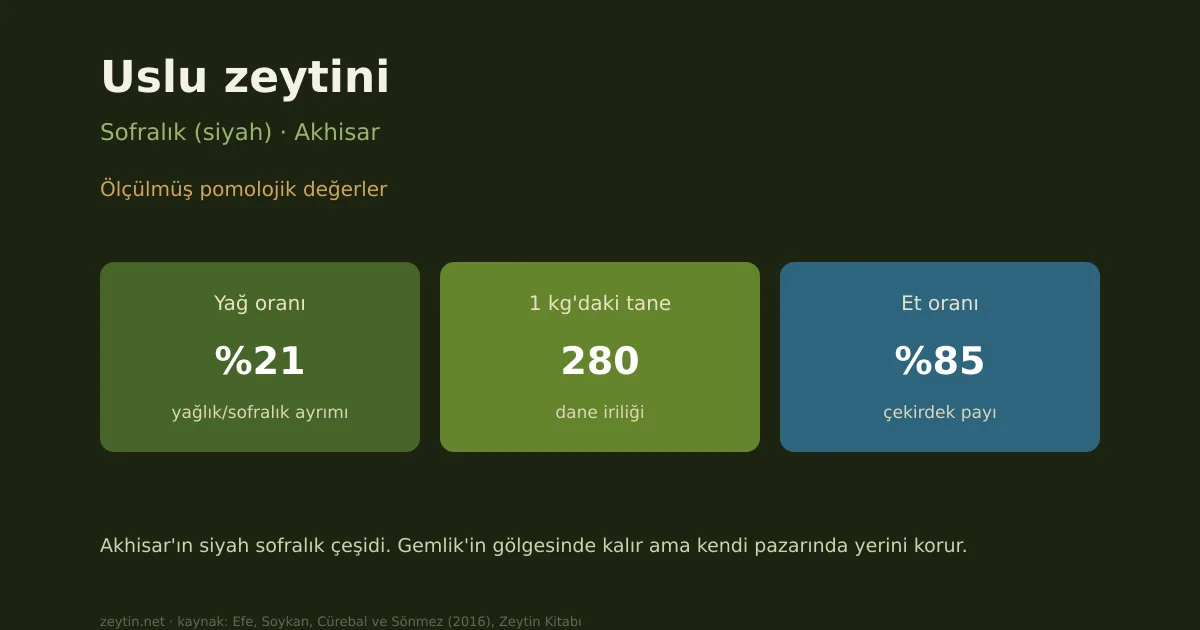
Uslu olive: characteristics, oil content and growing areas
Akhisar's black table variety. Overshadowed by Gemlik, yet holding its own market.
Article
Uslu olive: characteristics, oil content and growing areas
Akhisar's black table variety. Overshadowed by Gemlik, yet holding its own market.