Oleotourism: a grove's second income
What is olive oil tourism, how does it work elsewhere, and why has it not developed in Türkiye? Oleotourism, from the literature.
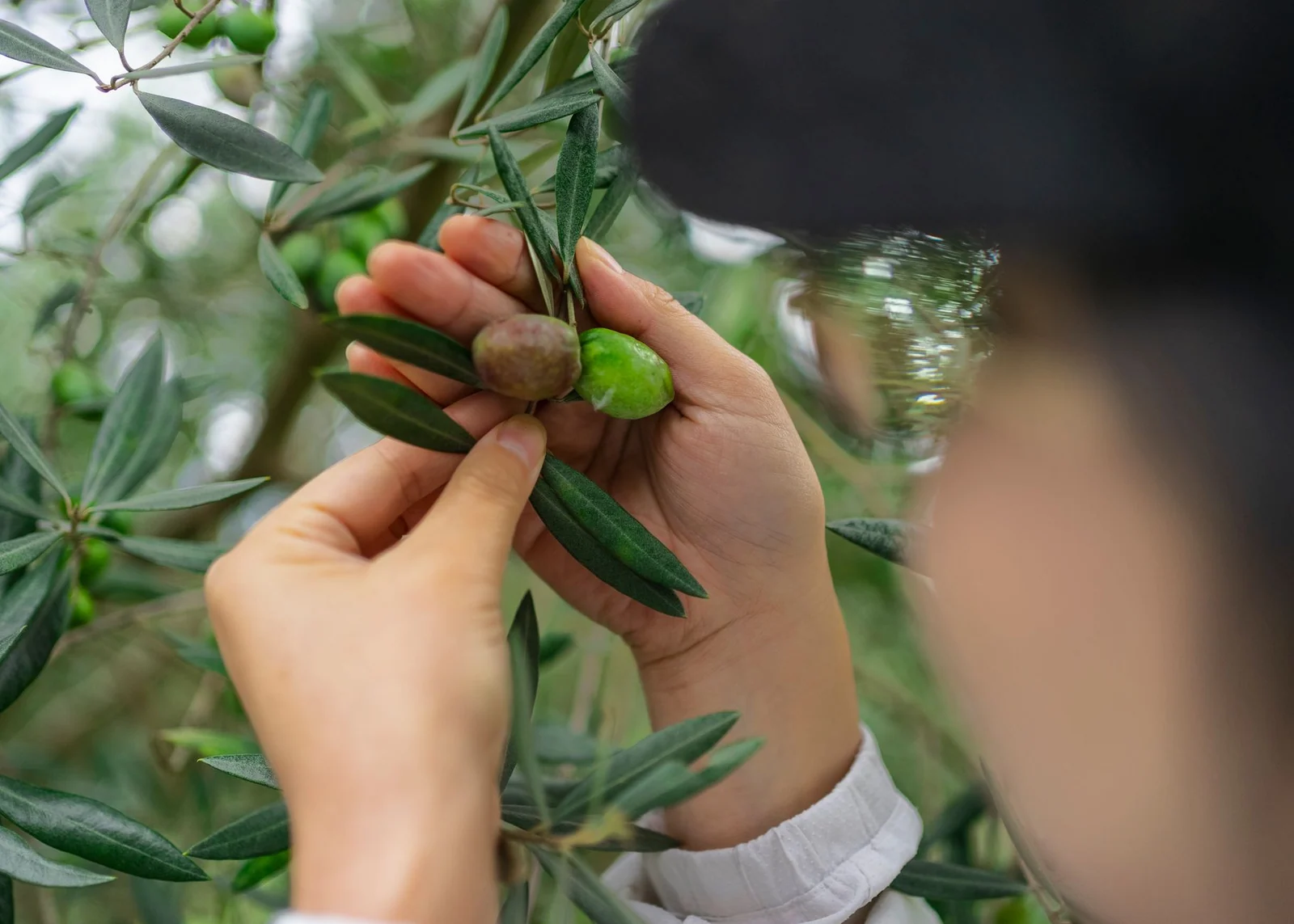
A grove's income is not limited to the kilos of oil it produces. The same trees, the same mill and the same harvest, arranged well, generate a second revenue line: visitors.
The literature calls it oleotourism, or olive oil tourism. It is only now being discussed in Türkiye; in Spain and Italy it has thirty years behind it.
This article covers what it is, what it consists of, where it is practised in the world and in Türkiye, and what it means for a grower.
What is oleotourism?
The definition: a branch of rural tourism that develops where the olive tree, the fruit and the oil carry cultural and economic weight, combining education, experience and leisure.
In practice it means the visitor meets the product not on a shelf but at its source: under the tree, inside the mill, at the tasting table.
Tourism literature places the emergence of oleotourism in the late twentieth century, in Italy and Spain. The rise of rural tourism and travellers' appetite for new experiences turned the grove from a place of production into a destination as well.
What does it consist of?
The main components named in the sources:
| Component | What it offers the visitor |
|---|---|
| Grove and mill visits | Seeing the harvest first-hand, watching the pressing |
| Oil tasting | Comparing varieties, hearing from an expert |
| Gastronomy | Olive-oil cooking, classes |
| Museums | Historic tools, the history of production |
| Workshops | Soap making, curing, tasting courses |
| Accommodation | Themed lodging within the grove |
| Festivals and routes | Harvest celebrations, itineraries linking several stops |
| Spa | Olive-oil-based treatments |
What these share is that each turns assets the grove already has into income. No new factory is required; the trees, the mill and the knowledge are already there.
Olive oil museums in Türkiye
The most visible arm of oleotourism in Türkiye is its museums. Those listed in the academic literature:
| Museum | Area |
|---|---|
| Adatepe Olive Oil Museum | Küçükkuyu, Çanakkale |
| Köstem Olive Oil Museum | Urla, İzmir |
| Oleatrium Olive and Olive Oil History Museum | Aydın |
| EGEA Olive Oil Museum | Aegean |
| Evren Ertür Historic Olive Oil Tools Museum | Ayvalık, Balıkesir |
| Ayvalık Olive Gallery | Ayvalık, Balıkesir |
| Altınözü Tokaçlı Olive Museum | Altınözü, Hatay |
Source: Uzun and Çeken, "Olive Oil Tourism" chapter, Table 3. Opening conditions may change; check before travelling.
Note the distribution: almost all are in the Aegean, with one in Hatay. The southeast — the Gaziantep-Kilis-Nizip line, where olive production is dense — does not appear on this map at all. The region growing Türkiye's oiliest varieties is unrepresented on the tourism side.
Around the world
Spain and Italy have institutionalised this. Some of the stops named in the literature:
- Museo del Olivo y del Aceite — Baena, Andalusia
- Centro del Olivar de Sierra — Adamuz, Córdoba
- Territorio del Sénia — a route of thousand-year-old olive trees on the Catalonia-Valencia border
- Hacienda Guzmán — Seville
- Museo dell'Olivo (Fratelli Carli) — Imperia, Italy
What stands out in the Spanish model is the emphasis on routes rather than isolated museums: itineraries linking several mills, museums and places to stay. The visitor spends several days in a region rather than half a day at one stop.
The "thousand-year-old olive trees" route is the most elegant example: what is sold there is not oil but time.
What it means for a grower
We have measured a problem repeatedly on this site: Türkiye sells its olive oil largely in bulk, and the bulk price is set by the world market. In our value chain article we counted six stops and said the last one — the shelf — is the one we are missing.
Oleotourism offers a way around that missing stop.
Why? Because the price of oil sold to a visitor is not tied to the bulk price. A grower running tastings in their own grove sells at a multiple of the exchange price — and does so directly, without an intermediary.
A second benefit: the calendar. The olive harvest falls in November and December, which is the dead season for Mediterranean tourism. The months when hotels stand empty are the months when a grove is at its most alive. Oleotourism puts a product into tourism's weakest window.
A third: economically difficult choices like early harvesting start to make sense with tourism attached. Recovering the yield loss through bulk sales is close to impossible; but a grower who can say at the tasting table "this oil is early harvest, that is why it is bitter" captures that premium.
A realistic frame for anyone starting
A few cautions, because this is no magic wand:
- Visitors need infrastructure. Roads, toilets, parking, insurance, a guide. Opening a gate is not enough.
- Harvest time is both opportunity and burden. Hosting visitors while doing the year's heaviest work is a separate job.
- A story is required. Visitors do not come to see trees, they come to hear something. The variety's name, the family's history, the reason behind the method — that is what is being sold.
- It cannot be done alone. What the Spanish example shows is the logic of the route: without neighbouring growers, restaurants and lodging working together, a single grove does not become a destination.
Summary
- Oleotourism turns a grove into a destination as well as a production site; it emerged in Italy and Spain in the late twentieth century.
- Components: grove and mill visits, tasting, gastronomy, museums, workshops, lodging, festivals, spa.
- Türkiye has seven notable museums, almost all in the Aegean — the southeast is absent.
- Its real value to a grower is opening a sales channel independent of the bulk price.
- The harvest coincides with the Mediterranean's dead season — not a drawback but a gap to move into.
What can be done: the academic recommendations
A 2023 study lists five concrete headings for advancing olive oil tourism in Turkey:
- Attention to infrastructure and superstructure in areas where olive-based farming takes place
- Coordinating all stakeholders in the destination — growers, businesses, municipalities, hotels
- Building awareness among both residents and visitors through education and promotion
- Organising festivals and workshops in producing regions, foregrounding local olive-growing motifs
- Hotels in the region offering services built around olive oil — from promoting local olive oil dishes
to olive oil-based treatments
The study's key point is that oleotourism does not fit into a single category: it can be pursued
simultaneously as gastronomic, cultural, special-interest, agricultural, sustainable and experiential
tourism.
The economic loop works like this: the additional demand tourism creates helps the product find its true
value, which in turn improves grower welfare and interest in olive growing. Oleotourism is therefore seen
as a way out not only for the visitor but for the producer stuck in bulk selling.
That Mediterranean countries are almost the sole custodians of this heritage gives them a solid means of
differentiation against otherwise comparable destinations.
Sources
t; Uzun, B. and Çeken, H. Zeytinyağı Turizmi [Olive Oil Tourism]. In Turizmde Değişim ve Gelişim (book chapter) — Table 3: olive oil routes and museums in the world and in Türkiye.
t; Arıkan Saltık, I. and Yıldız, M. (2019). Kültür Turizminin Yeni Meyvesi: Zeytinyağı Müzeleri Üzerine Bir Araştırma. Journal of Recreation and Tourism Research, 6(2): 147-160.
t; Büyük, Ö. and Can, E. (2020). Zeytinyağı Kültürel Rotalarının Turizm Potansiyeli Açısından Değeri ve Türkiye'de Uygulanabilirliği. AHBVÜ Journal of Tourism Faculty, 23(1): 191-210.
Related reading: Tree to shelf: the value chain · Early harvest: expensive or valuable? · Olive varieties · The olive calendar
One rating per visitor; you can change yours at any time. Ratings are real reader votes — no seeded or default scores.
Related
 Article
The energy burned at the field edge: olive pruning residue
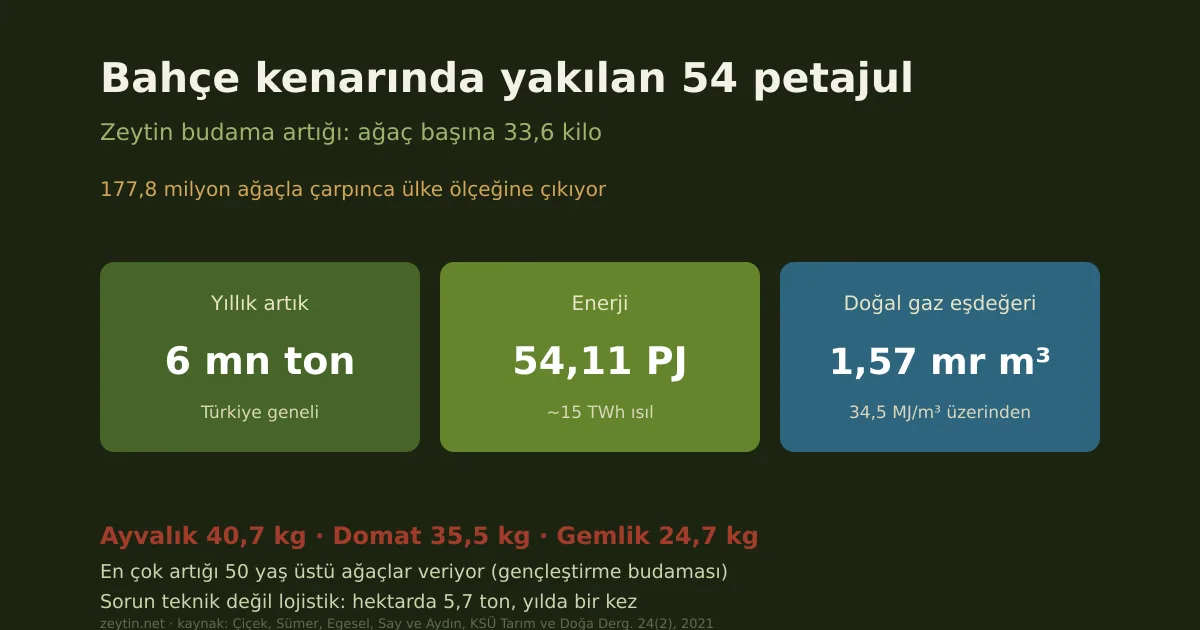
One olive tree yields 33.6 kg of prunings a year. Across 177.8 million trees that is 6 million tonnes of residue and 54.11 PJ of energy — equivalent to 1.57 billion m³ of natural gas.
Article
The energy burned at the field edge: olive pruning residue
One olive tree yields 33.6 kg of prunings a year. Across 177.8 million trees that is 6 million tonnes of residue and 54.11 PJ of energy — equivalent to 1.57 billion m³ of natural gas.
 Article
Did olive oil go up 13.5 times, or 1.6 times?
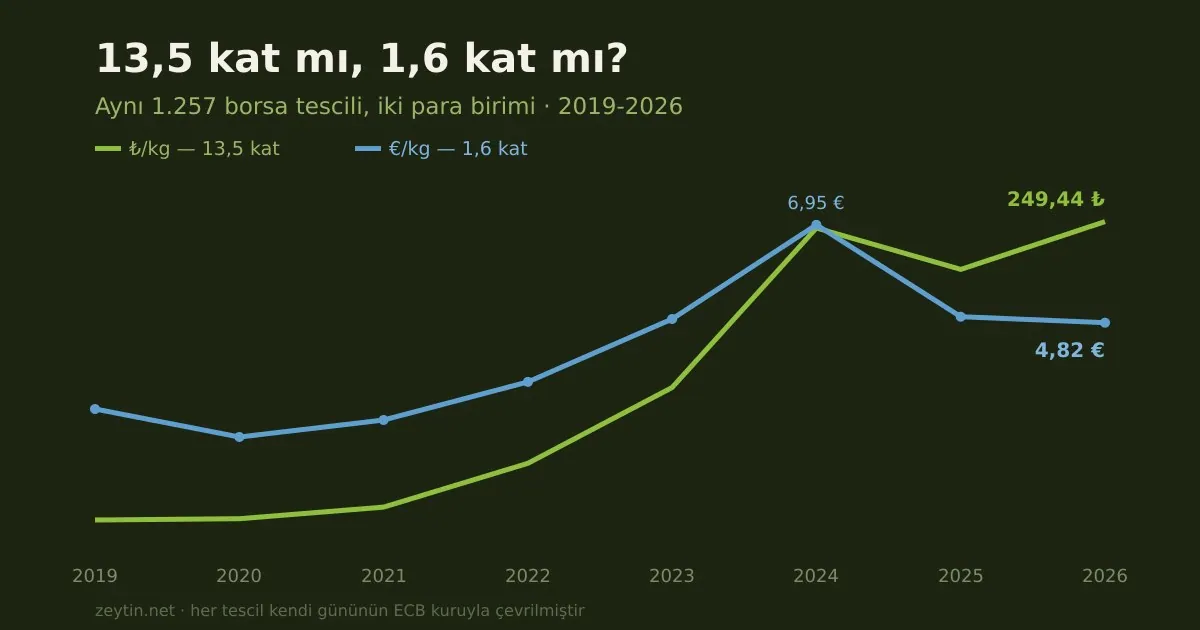
Up 13.5 times in lira, 1.6 times in euros. The same 1,257 registrations, each converted at its own day's ECB rate.
Article
Did olive oil go up 13.5 times, or 1.6 times?
Up 13.5 times in lira, 1.6 times in euros. The same 1,257 registrations, each converted at its own day's ECB rate.
 Article
Vegetation water and pomace: olive oil's waste problem
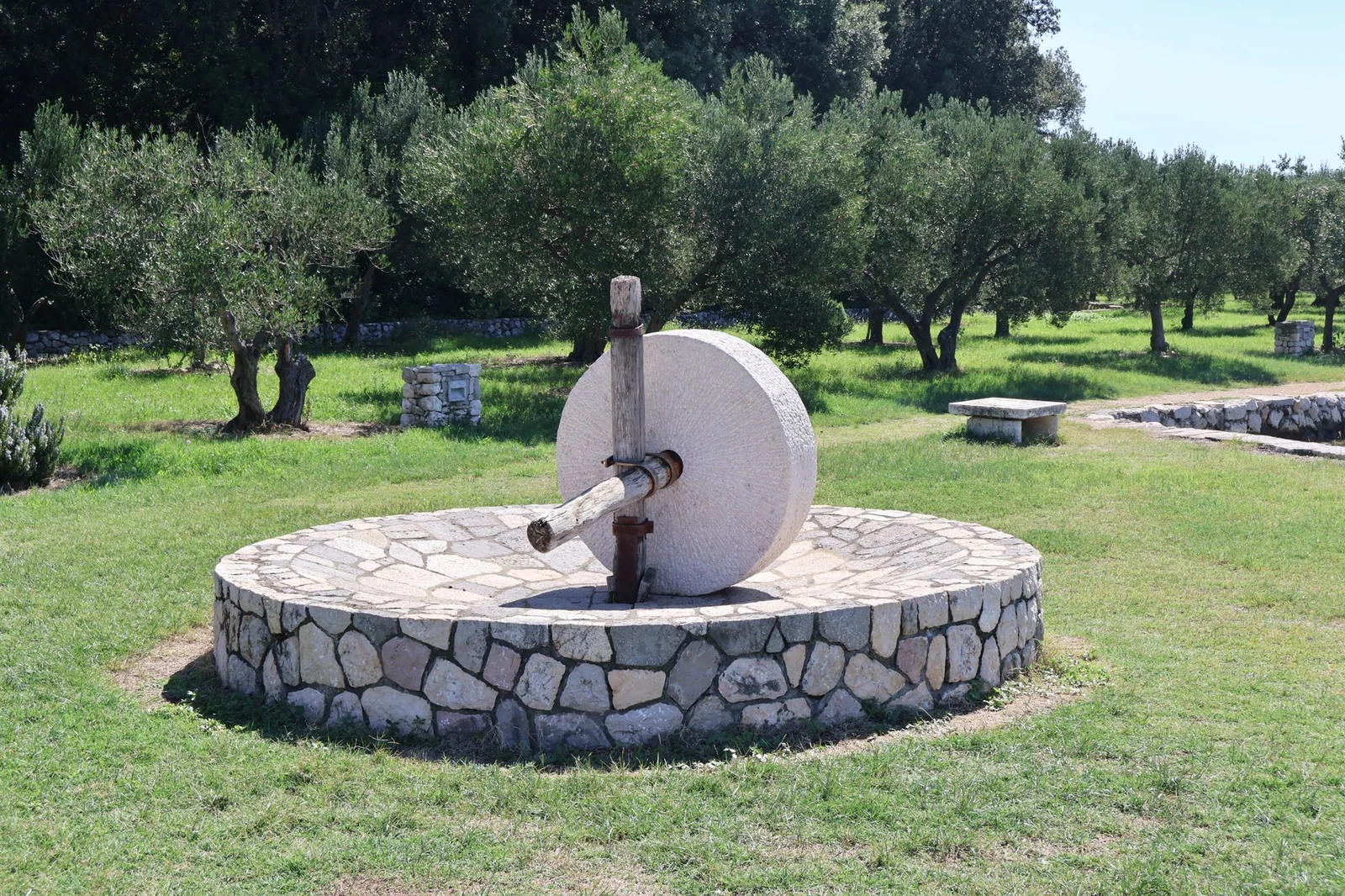
Processing 1.5–2 million tonnes of olives yields 1 million tonnes of vegetation water and 1 million tonnes of pomace. Waste, or resource?
Article
Vegetation water and pomace: olive oil's waste problem
Processing 1.5–2 million tonnes of olives yields 1 million tonnes of vegetation water and 1 million tonnes of pomace. Waste, or resource?
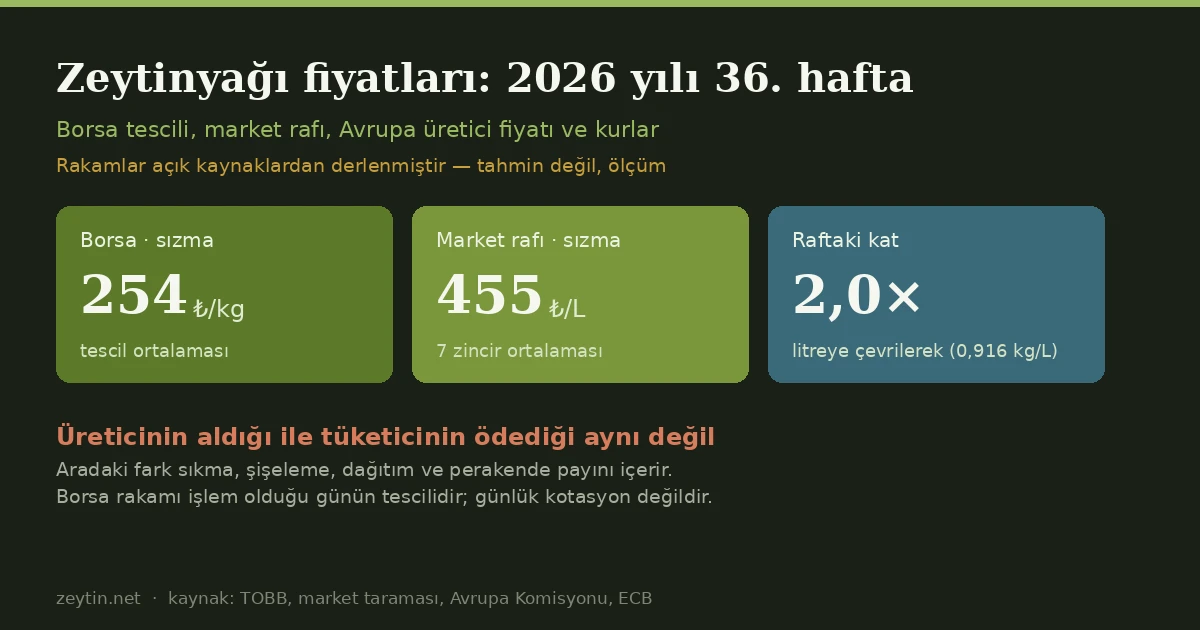 Article
Olive Oil Prices: Week 36 of 2026
Week 36 of 2026: Turkish exchange prices, European producer prices and exchange rates side by side.
Article
Olive Oil Prices: Week 36 of 2026
Week 36 of 2026: Turkish exchange prices, European producer prices and exchange rates side by side.