Olive groves and mining: the legislative record from Law 3573 to Law 7554
A dated record of the rules opening olive groves to mining: Article 20 of Law 3573, the March 2022 regulation and its annulment by the Council of State, and Law 7554 in force since 24 July 2025. Impact estimates are set against the national total and one circulating figure is fact-checked.
Opening olive groves to mining is one of Turkey's loudest arguments. Both sides quote their own numbers, and most of the figures in circulation carry no source.
This article takes no side. It does one thing: keep the record. What the law said, what changed and when, what the courts ruled, how many trees. Every figure is attributed; nothing that could not be sourced was written.
What the law said
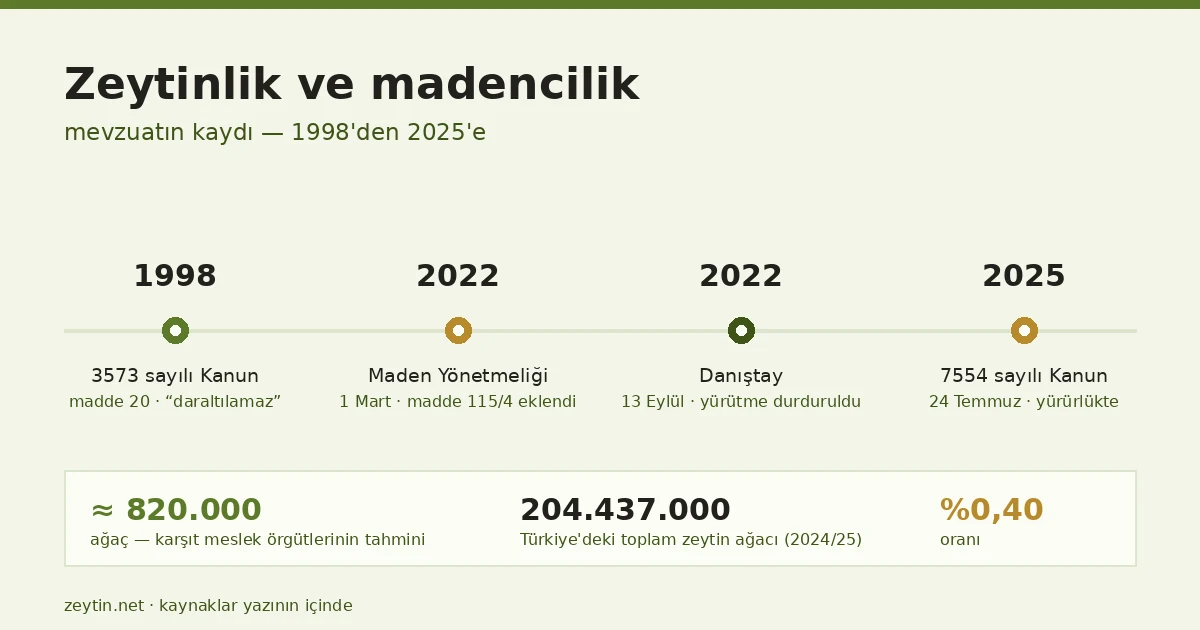
Protection of olive groves dates back to 1939, but the text in force is Law No. 3573 on the Improvement of Olive Cultivation and the Grafting of Wild Olives. The entire argument turns on its Article 20:
t; Within olive grove areas and within at least 3 kilometres of them, no facility leaving chemical waste or emitting dust and smoke that would impede the vegetative and generative development of olives may be built or operated, with the exception of olive oil mills. (…) Olive cultivation areas may not be reduced.
The second half of the article governs the trees themselves: an olive tree may not be felled or uprooted without absolute necessity; anyone doing so without permission is fined per tree, and the felled trees are confiscated.
Two clauses matter. One sets a distance (3 kilometres); the other protects area ("may not be reduced"). Twenty years of legal argument have been about how those two clauses might be got around.
2022: the door opened by regulation
On 1 March 2022 an amendment published in the Official Gazette (no. 31765) added a fourth paragraph to Article 115 of the Mining Regulation. It permitted mining in olive grove areas where the activity served the country's energy needs, conditional on a rehabilitation commitment after the activity and on the relocation of the olive trees.
The amendment was challenged the same day. On 13 September 2022 the 8th Chamber of the Council of State (Danıştay) suspended it and subsequently annulled it. The reasoning was hierarchical rather than technical: a regulation cannot widen a boundary drawn by statute. Where Law No. 3573 says "may not be reduced", a subordinate regulation cannot permit reduction.
That ruling set the direction of what followed: if the door could not be opened by regulation, it could be opened by statute.
2025: the door opened by statute
On 19 July 2025 the Turkish Grand National Assembly passed the measure by 255 votes to 199. It was published in the Official Gazette of 24 July 2025 (no. 32965) as Law No. 7554 Amending Certain Laws, and entered into force the same day.
The law has 21 articles and is not limited to olive groves: it amends the Mining Law, the Olive Cultivation Law, the Forest Law and the Environment Law, and covers special environmental protection zones, national parks, wetlands, wildlife reserves and heritage sites. It eases the Environmental Impact Assessment (EIA) process for licence holders, who may now obtain other permits while the EIA is still running.
One detail of timing stands out: Turkey's Climate Law came into force on 9 July 2025. Fewer than ten days later, the same parliament passed a law opening protected areas to mining.
The numbers
How many trees? There is no single official answer; most of the circulating figures are estimates by professional bodies opposing the law. Reporting them with attribution is more honest than presenting them as official data.
| Item | Figure | Source / status |
|---|---|---|
| Olive grove area affected | ≈ 4,255 ha | Estimate by opposing professional bodies |
| Trees to be relocated or lost | ≈ 820,000 | Same estimate |
| Total olive trees in Turkey | 204,437,000 | 2024/25 crop data |
| Of which bearing fruit | 171,913,000 | Same data |
| Estimate as share of national total | 0.40% | 820,000 ÷ 204,437,000 |
Four in a thousand. That ratio can be read two ways, and the honest thing is to say both: it looks small, because at national scale it is small; but it is not small locally — 820,000 trees can mean the entire olive stock of the districts where they stand. A national average does not measure a village's livelihood.
A circulating figure: "12.5 million hectares"
During the debate the headline "12.5 million hectares of olive groves will be affected" circulated widely. For olive groves that figure is impossible.
The check is simple: Turkey has 204 million olive trees, and traditional planting puts 15-25 trees on a dekar (our planting-density calculation). Taking 20, the country's olive groves come to roughly 10.2 million dekars, or 1.02 million hectares. Twelve and a half million hectares would be twelve times Turkey's entire olive area — and more than a sixth of the country's land surface.
The headline most likely arose from confusing dekars with hectares, or from attributing an area of some other scope to olive groves. Inflating a figure does not help the case it is meant to support: a verifiable 820,000 trees is a stronger argument than an unverifiable 12.5 million hectares.
The arithmetic of "they will be relocated"
Both the 2022 regulation and the 2025 law repeat the same promise: the trees will be relocated, and the site rehabilitated once the activity ends. The technical meaning of that sentence lies in the biology of the olive.
An olive tree does not come back in a season the way a field crop does. After planting, first fruit takes four to five years, economic yield eight to ten, full yield fifteen to twenty. What that means in income we calculated decare by decare in a separate article: cutting down an olive grove — the arithmetic of a ten-year decision.
Relocation itself is not guaranteed either. No large-scale published monitoring study exists in Turkey on the survival rate of mature olive trees uprooted and replanted elsewhere; how many relocated trees are in yield after how many years is not a tracked figure. "Will be relocated" is therefore a commitment, not a measured outcome.
This is not to say relocation fails. It is to say it has not been measured — and in a legislative argument the difference between those two matters.
What to watch
The law is in force, but the argument is not over. Three things are worth following:
1. Constitutional Court and Council of State proceedings. The 2022 reasoning (norm hierarchy) does not apply to a statute; this time the argument will run on constitutional protection and property rights.
2. Implementing regulations. How much of the law takes practical effect will emerge in the secondary legislation.
3. The number on the ground. How many licences, how many hectares, how many trees — when these stop being estimates and become records, this page will be updated.
What this article is not
It is not legal advice; it is based on statutory texts and official publications, without interpretation. Nor is it a political appeal. Its purpose is that someone researching the subject should find the dates, the figures and the sources in one place.
When the figures change or a new ruling is issued, this page will be updated; the update date appears at the foot of the page.
One rating per visitor; you can change yours at any time. Ratings are real reader votes — no seeded or default scores.
Related
 Article
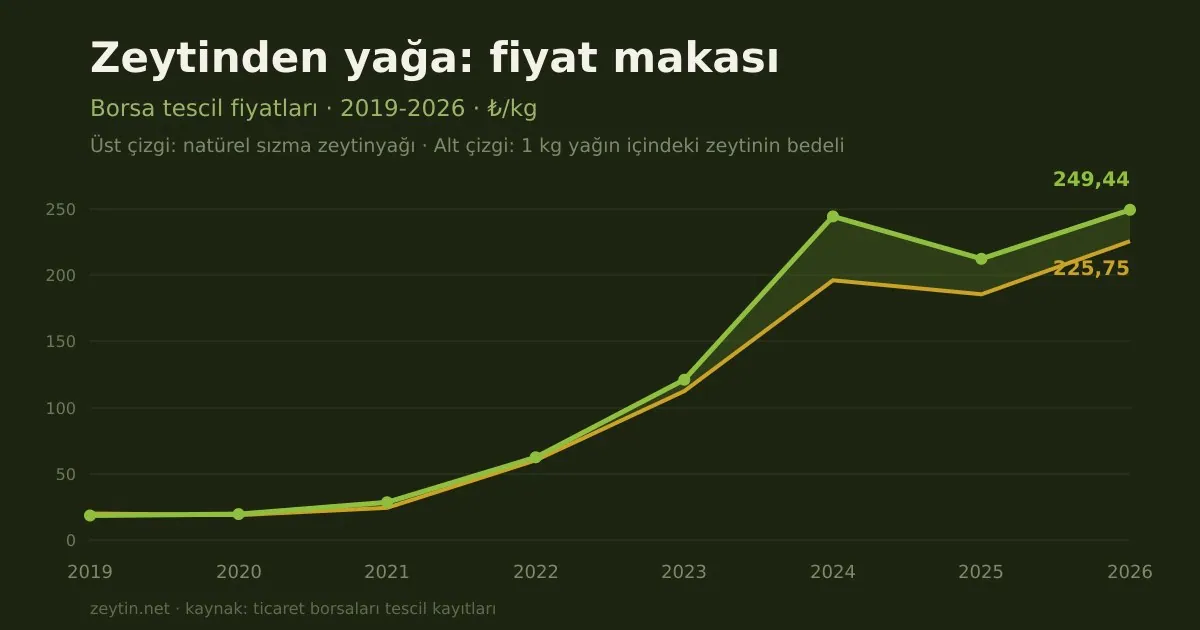
From olive to oil: the price gap, 2019-2026
The gap between a kilo of olives and a kilo of oil, measured from exchange registrations. Why it widens, and who gains.
Article
From olive to oil: the price gap, 2019-2026
The gap between a kilo of olives and a kilo of oil, measured from exchange registrations. Why it widens, and who gains.
 Article
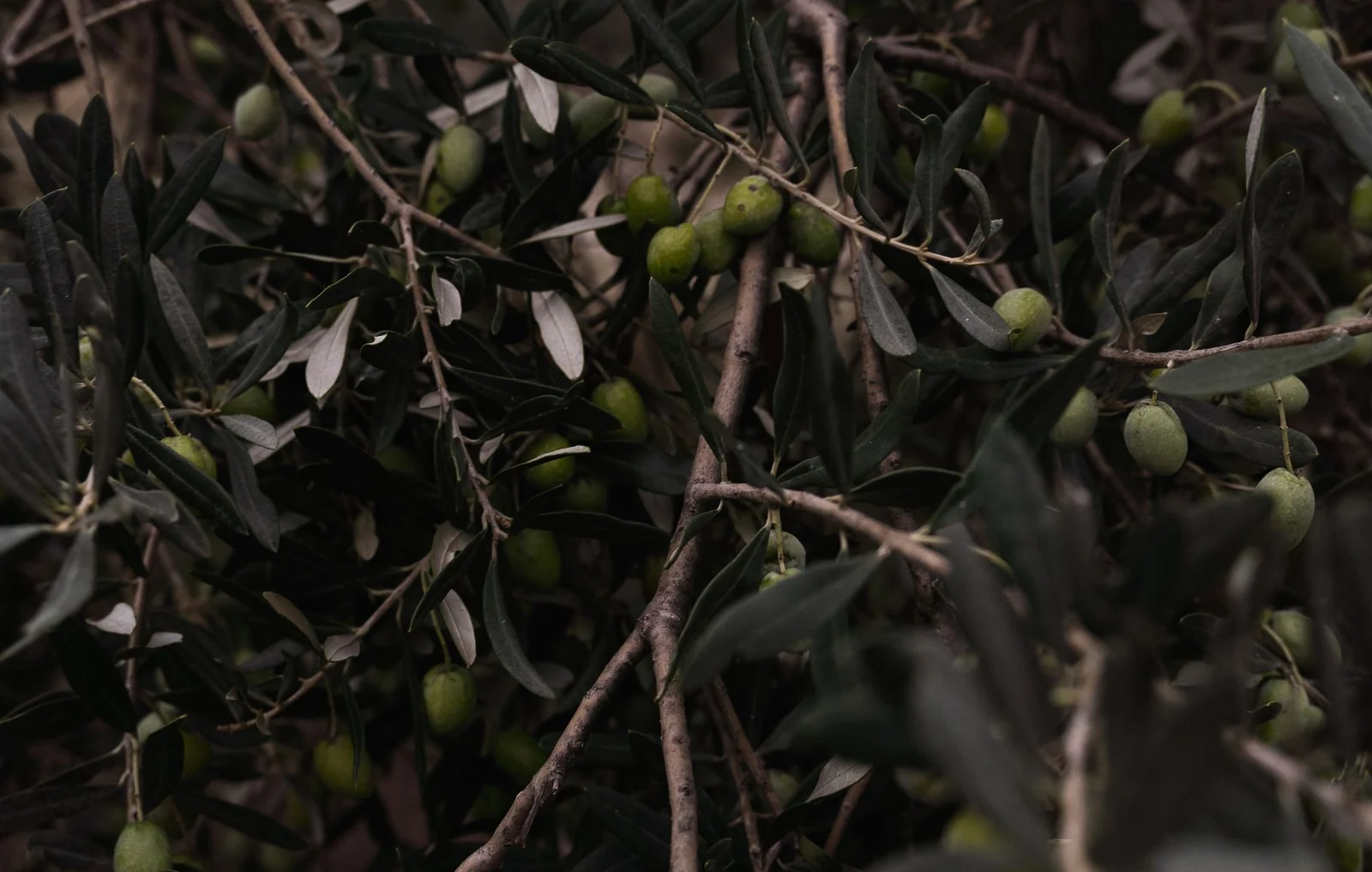
Alternate bearing: one year yes, one year no
Olive oil output can swing from 40,000 to 200,000 tonnes. Why alternate bearing happens, how it breaks prices and exports, and how its amplitude can be reduced.
Article
Alternate bearing: one year yes, one year no
Olive oil output can swing from 40,000 to 200,000 tonnes. Why alternate bearing happens, how it breaks prices and exports, and how its amplitude can be reduced.
 Article
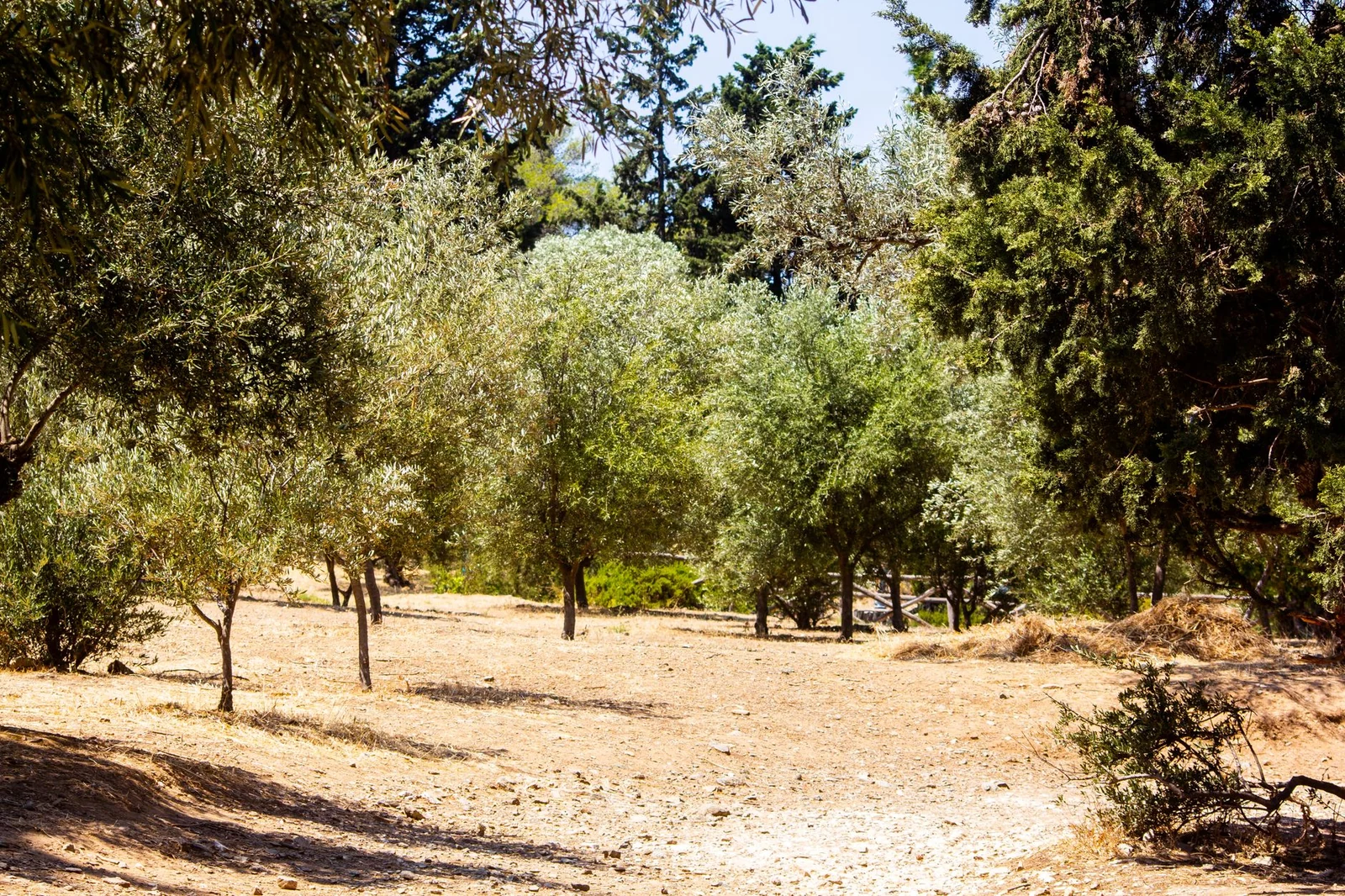
The olive grove beside the factory: Bursa soils measured
43 PCB congeners measured in 7 Bursa olive groves: 5.82-18.71 ng/g against a 200 ng/g limit. No serious pollution — but the point near the steel works reads three times the rural one.
Article
The olive grove beside the factory: Bursa soils measured
43 PCB congeners measured in 7 Bursa olive groves: 5.82-18.71 ng/g against a 200 ng/g limit. No serious pollution — but the point near the steel works reads three times the rural one.
 Article
The nameless olives of southeast Anatolia: Mardin, Şırnak and the pollinator problem
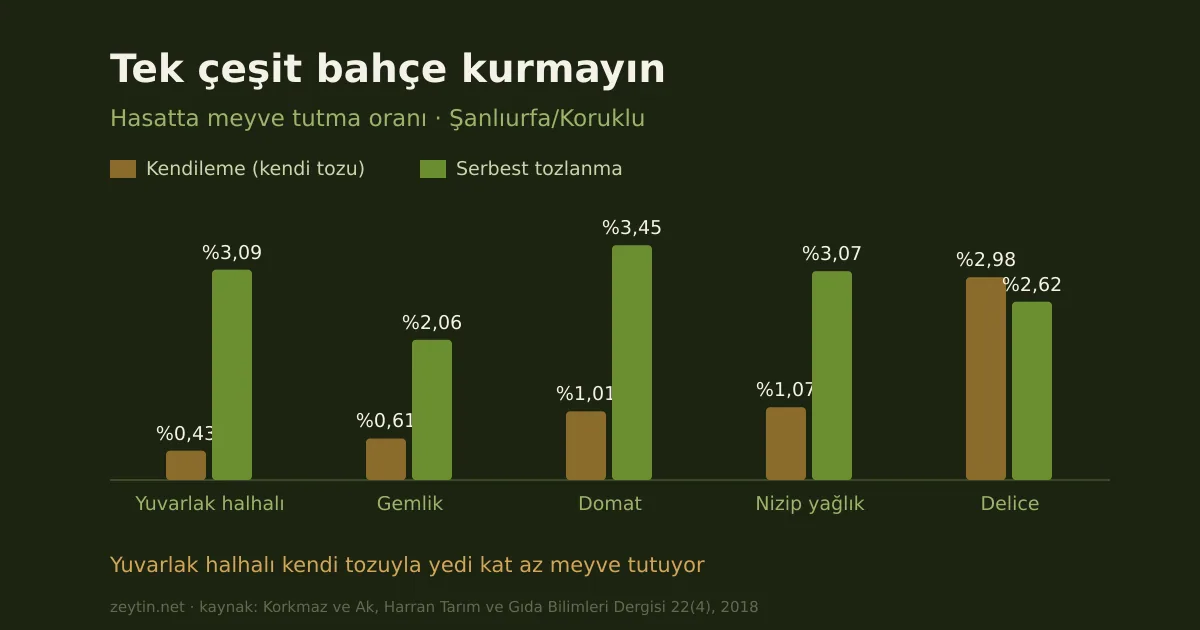
Kumçatı and Derik genotypes beat Ayvalık and Gemlik on flesh ratio. Yuvarlak halhalı sets only 0.43% of its flowers with its own pollen.
Article
The nameless olives of southeast Anatolia: Mardin, Şırnak and the pollinator problem
Kumçatı and Derik genotypes beat Ayvalık and Gemlik on flesh ratio. Yuvarlak halhalı sets only 0.43% of its flowers with its own pollen.