The 43 olive oil workshops of Antiokheia: two thousand years of continuity in Hatay
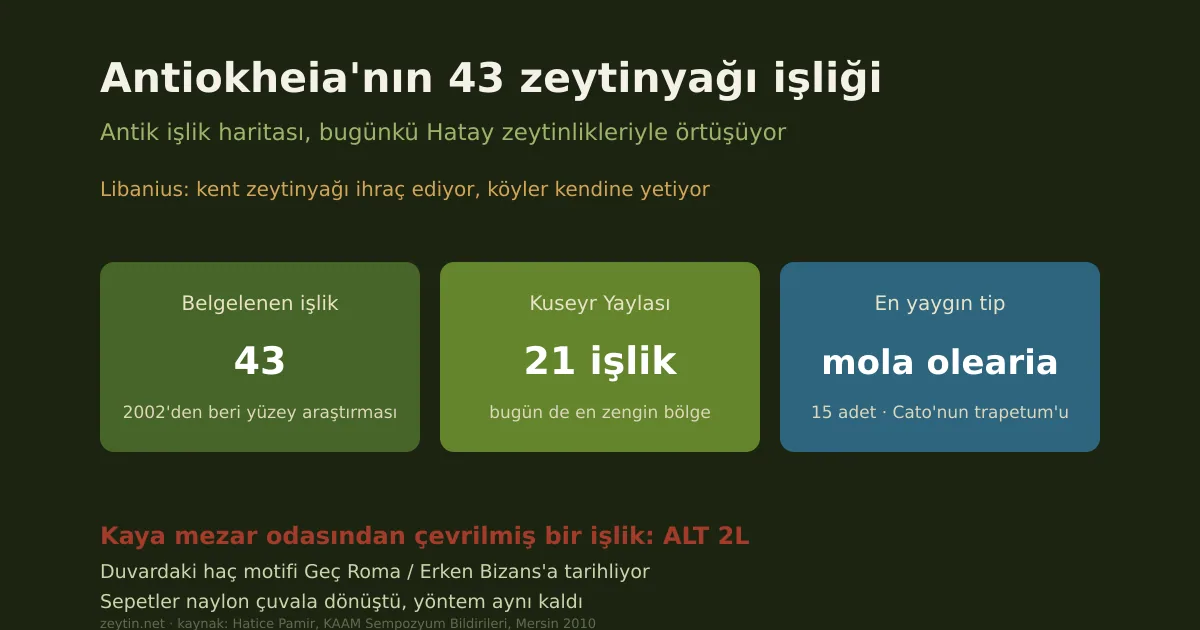
Forty-three ancient workshops documented across Antakya, Altınözü, Yayladağı and Samandağ map onto today's groves. Twenty-one sit on the Kuseyr Plateau — still Hatay's richest olive district.
Wherever olives grow in Hatay today, they grew two thousand years ago. That is not a guess but a measured finding: surface surveys running since 2002 across the districts of Antakya, Altınözü, Yayladağı and Samandağ have documented 43 ancient olive oil workshop remains. Map them, and they fall almost exactly on today's grove map.
Where was Antiokheia?
Antiokheia ad Orontes — Antakya on the Orontes — was founded in 300 BC and became, alongside Alexandria, the most important city of the Eastern Mediterranean throughout the Roman period. It was the empire's eastern administrative centre. It grew rapidly from the 2nd century AD until earthquakes, wars and invasions ended that growth in the mid-7th century.
The southern half of the city's Roman-era territory lies inside Syria today; the northern half covers the stretch of Hatay running south from the Amik Plain.
The olive's relationship with this geography is far older than the city. Archaeological evidence points to the Levant — the eastern shores of the Mediterranean — as the region where the olive was first domesticated. Cultivation began in the Chalcolithic; by the Middle and Late Bronze Ages it had spread across the Levant, Anatolia, Crete and Cyprus. Production and trade at industrial scale began in the Iron Age and peaked under Rome.
What do the written sources say?
The 4th-century author Libanius writes that Antiokheia exported olive oil and that self-sufficient, prosperous villages surrounded it.
A second line of evidence comes from Tchalenko's survey of the North Syrian Limestone Massif: between the 4th and early 6th centuries the number of small villages in the region rose, and the principal driver of that rise was the expansion of olive plantations. The olive was not merely a crop here; it shaped the settlement pattern itself.
Where do the 43 workshops cluster?
| Area | Workshops | Today |
|---|---|---|
| Kuseyr Plateau | 21 | Hatay's richest olive district today |
| Seleukeia Pieria and its villages | most of the rest | Vakıflı, Yoğunoluk, Hıdırbey — villages still inhabited |
| Orontes valley and delta | few | Modern settlement and farming largely erased them |
| Urban area of Antiokheia | 1 | The area turned agricultural after the city was abandoned |
The striking figure is the Kuseyr Plateau: 21 of the 43. And it remains the richest olive-producing district in Hatay today. A 1937 record describes the plateau as "olive groves from end to end, with some 200 villages". The same ground has been doing the same job for two millennia.
The single workshop inside Antiokheia's own urban area tells its own story: after the earthquakes and invasions of the 6th century, the city's original site fell out of favour, settlement shifted south, and the vacated ground turned into farmland. That one workshop postdates the city's collapse.
How did the workshops work?
Ancient olive oil production had the same three stages as today: crushing, pressing, clarifying. The documented remains break down accordingly:
| Stage | Type | Count |
|---|---|---|
| Crushing | Mola olearia (animal-driven crushing stone) | 15 |
| Open rock-cut floor (hand-rolled cylindrical stone) | 11 | |
| Pressing | Screw press | 8 |
| Weight/press stones | 6 | |
| Lever-beam press | 3 | |
| Clarifying | Rectangular prismatic basins | 5 |
The mola olearia is the region's most common type. It has two parts: a wide cylindrical basin (mortarium) with a central post (miliarium), and a cylindrical crushing stone that turns around that post under animal power. Cato, writing on agriculture in Rome, calls the device a trapetum; Varro calls it a mola olearia. Its earliest examples go back to 5th-century BC Olynthos.
The field measurements show how standardised the type had become: local limestone basins with internal diameters of 1.02 to 1.78 m and external heights of 0.60–0.74 m. Workshops in independent villages were built to very nearly the same dimensions.
From tomb chamber to oil press
Some documented workshops were converted from spaces built for something else entirely. ALT 2L is the clearest case: it sits inside a rock-cut tomb chamber in the Gelinler Dağı necropolis at Yunushanı village, Altınözü. Two arcosolium graves in the east wall were broken out to form a shallow basin (2.32 × 2.20 m); the rock floor was levelled into a crushing bed; and a cross-shaped lever socket was cut into the south wall.
A cross is incised on the wall. That detail dates the conversion: the necropolis was in use from the Early Roman period, and the tomb chamber became a workshop in the Late Roman / Early Byzantine era.
In the Early Byzantine period churches came to own the large workshops and ran them as businesses. A parallel practice documented in Cyprus continued throughout the Ottoman era: in return for using the press, the grower paid 10% of the oil to the state and 10% to the church.
From baskets to nylon sacks
In ancient workshops the crushed olives were placed in baskets woven from reeds or straw and squeezed under the lever beam. This detail has a surprising afterlife: traditional producers around Altınözü told the researchers that they used the same baskets until recently, switching to sacks woven from nylon cord only because they are cheaper.
A two-thousand-year-old method survives; only the material changed.
In short
The 43 workshops around Antiokheia are small finds one by one; read together they portray a region. Under Rome and Byzantium, Hatay produced enough olive oil to export it, and the very distribution of its villages was shaped by the spread of the groves. Cities fell and empires changed; on the Kuseyr Plateau the pressing of olives never stopped.
One rating per visitor; you can change yours at any time. Ratings are real reader votes — no seeded or default scores.
Related
 Article
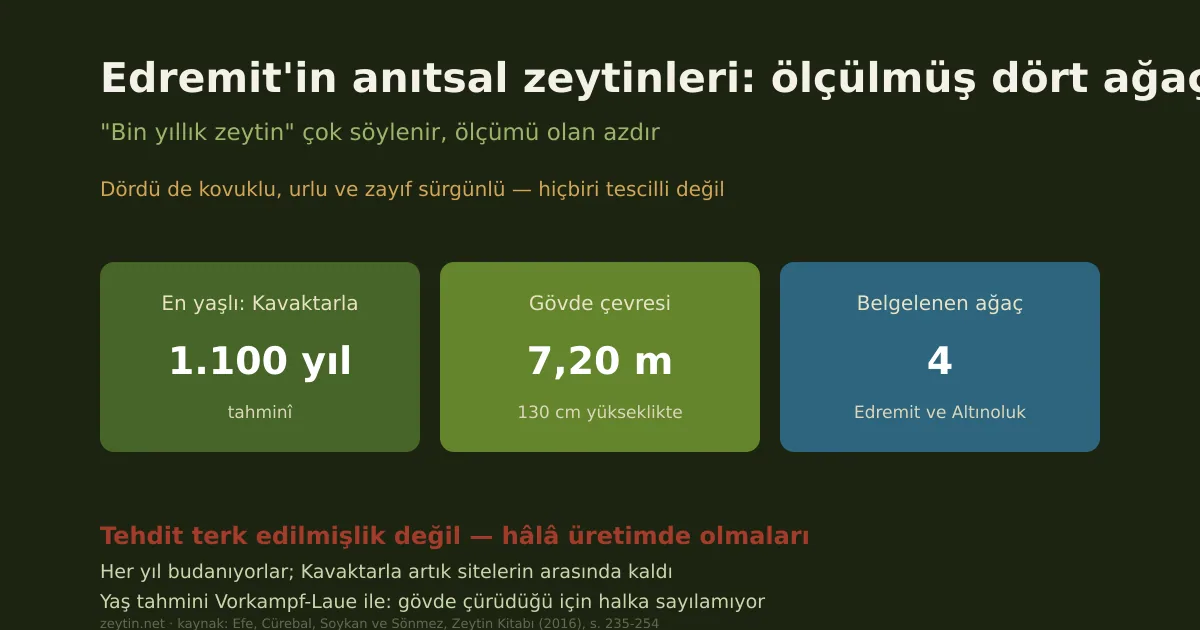
Edremit's monumental olives: four old trees, measured
At an estimated 1,100 years and a 7.20 m girth, Kavaktarla is Edremit's oldest olive. All four are hollowed and galled, none is registered, and the real threat is that they are still in production.
Article
Edremit's monumental olives: four old trees, measured
At an estimated 1,100 years and a 7.20 m girth, Kavaktarla is Edremit's oldest olive. All four are hollowed and galled, none is registered, and the real threat is that they are still in production.
 Article
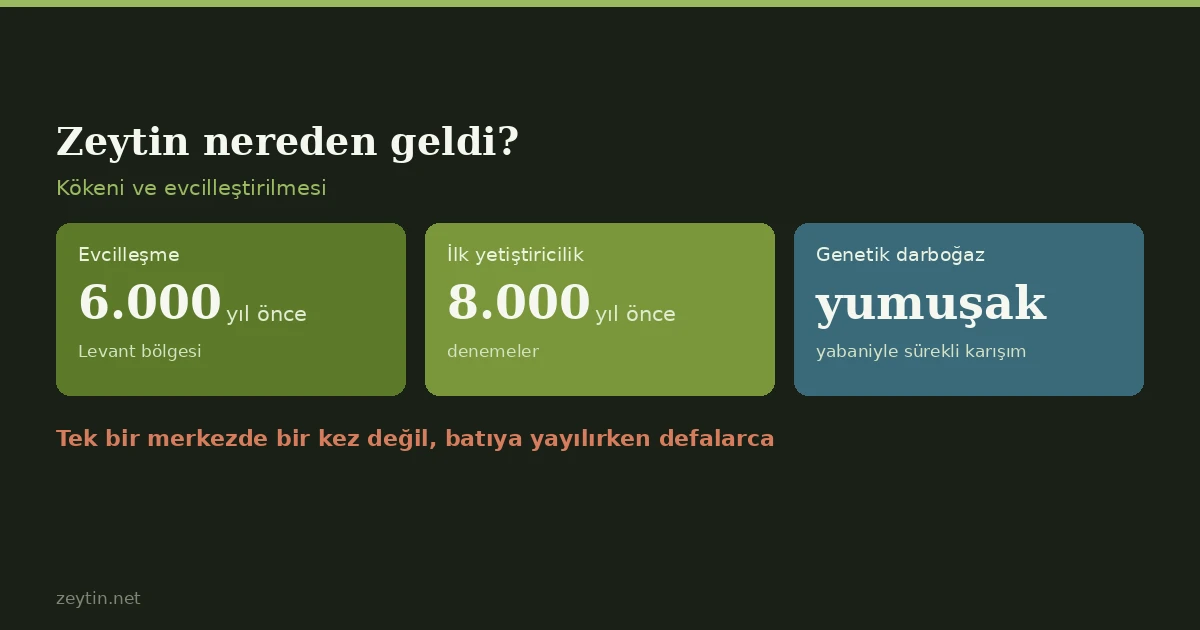
Where did olives come from? Origin and domestication
The olive was domesticated about 6,000 years ago in the Levant — but not at a single centre. Genetic work shows the cultivated olive kept mixing with the wild oleaster throughout its spread.
Article
Where did olives come from? Origin and domestication
The olive was domesticated about 6,000 years ago in the Levant — but not at a single centre. Genetic work shows the cultivated olive kept mixing with the wild oleaster throughout its spread.
 Article
History of the Olive
The olive was domesticated in the eastern Mediterranean some six thousand years ago. Traces in Anatolia, routes of spread and the birth of trade.
Article
History of the Olive
The olive was domesticated in the eastern Mediterranean some six thousand years ago. Traces in Anatolia, routes of spread and the birth of trade.
 Article
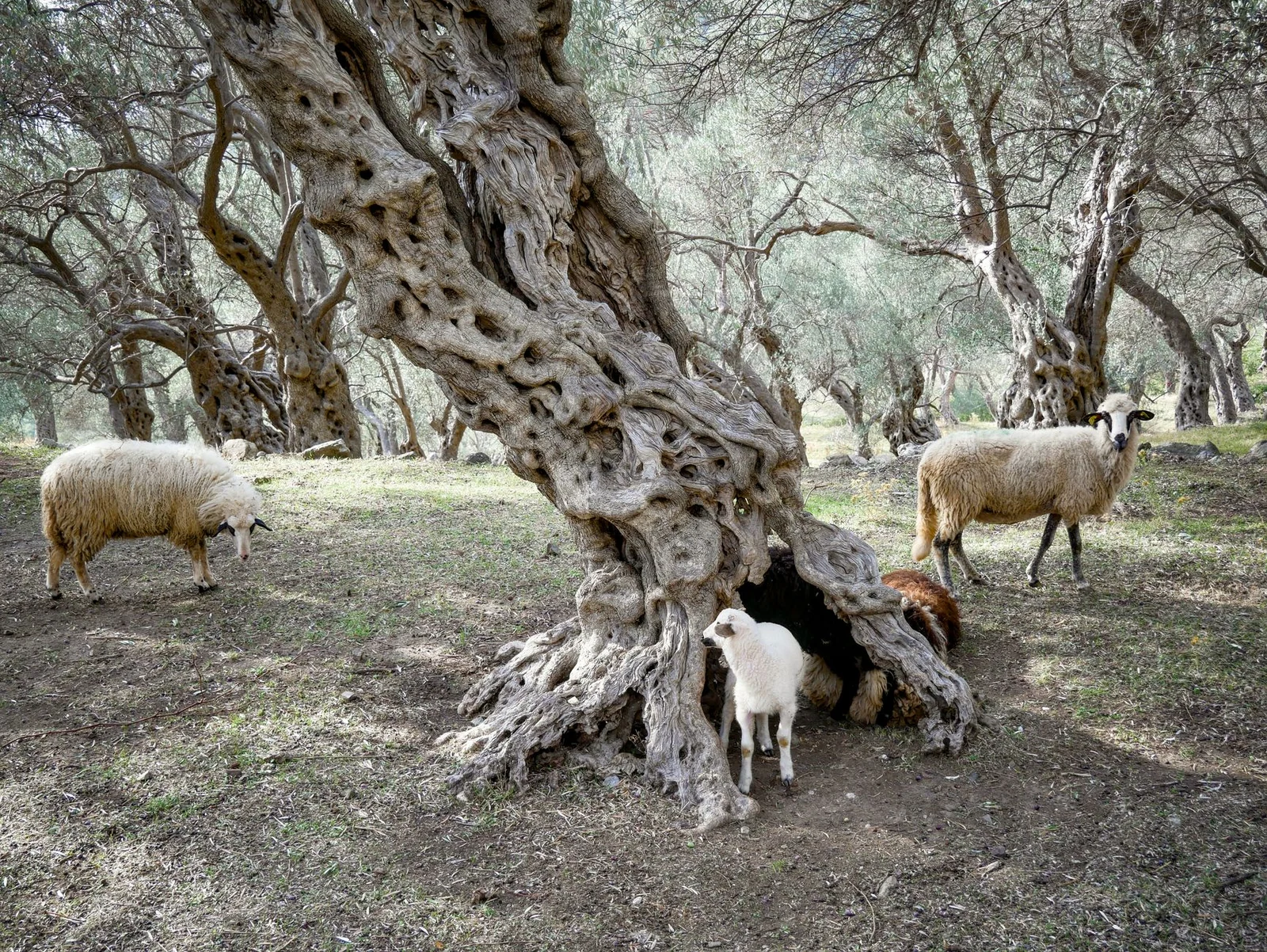
The History of the Olive in Anatolia
Where did the olive come from, and when was it first cultivated in Anatolia? From the stone workshop at Klazomenai to today's Aegean groves.
Article
The History of the Olive in Anatolia
Where did the olive come from, and when was it first cultivated in Anatolia? From the stone workshop at Klazomenai to today's Aegean groves.