Is Turkish olive oil cheap? Fourteen months against Europe
Turkish and European olive oil prices compared in one currency. How wide is the gap, and is it currency or market?
One of the most frequently repeated sentences about Turkish olive oil goes like this: we are among the world's largest producers, but our exports fall short of what we deserve. What usually follows is a discussion of branding, packaging and promotion.
All of that may well be true. But there is a more basic question that rarely gets asked: is Turkish olive oil actually cheap?
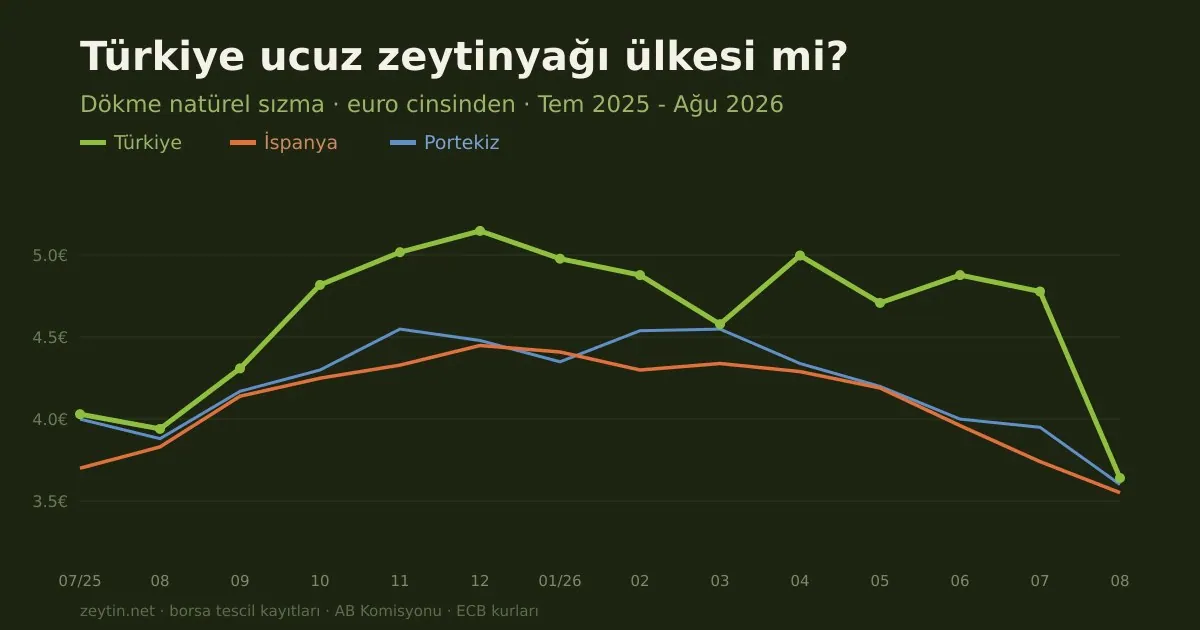
We have the data to answer it directly. On one side, the registration records of Turkish commodity exchanges; on the other, the producer prices published by the European Commission. Both are wholesale prices for bulk extra virgin olive oil. The only obstacle was currency, and the European Central Bank's daily reference rates take care of that.
The answer does not fit the familiar story.
How the comparison was made
Three sources were combined:
- Türkiye — extra virgin olive oil sales registered on the Aydın, Edremit, Nazilli and Gaziantep commodity exchanges. Monthly figures are volume-weighted averages.
- Europe — weekly producer prices from the European Commission's agri-food data portal: Spain, Italy, Portugal and Croatia, category "extra virgin olive oil (up to 0.8%)".
- Exchange rates — the European Central Bank's daily euro reference rates. Each registration was converted at the rate of the day it took place; the monthly figure is the average of those converted values.
That last point matters more than it looks. Converting a monthly average at a single end-of-month rate produces a wrong number; in periods when the currency moves quickly the error runs to several per cent. Converting each transaction at its own day's rate is more work, but it is the correct approach.
Period: July 2025 to August 2026, fourteen months. Our European series begins at that date, which is as far back as we can go.
The table
| Month | Türkiye TL/kg | Rate | Türkiye €/kg | Spain | Italy | Portugal |
|---|---|---|---|---|---|---|
| 2025-07 | 189.03 | 46.91 | 4.03 | 3.70 | 9.61 | 4.00 |
| 2025-08 | 187.80 | 47.80 | 3.94 | 3.83 | 9.59 | 3.88 |
| 2025-09 | 209.28 | 48.56 | 4.31 | 4.14 | 9.51 | 4.17 |
| 2025-10 | 235.23 | 48.63 | 4.82 | 4.25 | 9.24 | 4.30 |
| 2025-11 | 243.80 | 49.31 | 5.02 | 4.33 | 7.73 | 4.55 |
| 2025-12 | 257.94 | 50.18 | 5.15 | 4.45 | 7.04 | 4.48 |
| 2026-01 | 253.08 | 50.20 | 4.98 | 4.41 | 6.81 | 4.35 |
| 2026-02 | 251.40 | 51.88 | 4.88 | 4.30 | 6.77 | 4.54 |
| 2026-03 | 234.42 | 50.71 | 4.58 | 4.34 | 6.73 | 4.55 |
| 2026-04 | 261.95 | 52.67 | 5.00 | 4.29 | 6.68 | 4.34 |
| 2026-05 | 250.64 | 52.96 | 4.71 | 4.19 | 6.41 | 4.20 |
| 2026-06 | 259.63 | 53.72 | 4.88 | 3.96 | 6.15 | 4.00 |
| 2026-07 | 257.32 | 53.64 | 4.78 | 3.74 | 5.22 | 3.95 |
| 2026-08 | 201.38 | 55.39 | 3.64 | 3.55 | 4.88 | 3.60 |
Croatia is left out of the table; its prices run between €10 and €13 and reflect a small boutique market. The rate column is the mid-month EUR/TRY reference rate, while the euro prices are calculated from each transaction's own daily rate.
Türkiye is not the cheap option
In thirteen of the fourteen months, Türkiye's price sits above Spain's.
The gap is not trivial. In November 2025 Türkiye was at €5.02 against Spain's €4.33 — a difference of 16%. In June 2026, €4.88 against €3.96 — 23%. Bulk Turkish extra virgin olive oil is close to a quarter more expensive than the product of the world's largest producer.
Against Portugal the picture is the same: Türkiye is ahead in eleven of the fourteen months.
Italy tells a different story. At €9.61 in July 2025 it was more than double the Turkish price; by August 2026 it had fallen to €4.88. That curve is Italy's own supply crisis resolving itself, and it shows why taking Italian prices as a reference is misleading. Italy is a net importer; its price reflects what it needs, not what it produces.
Why Türkiye is missing from European tables
Türkiye is absent from almost every international source that tracks olive oil prices. The reason is simple: those tables are compiled by the European Commission from its own member states, and Türkiye is not a member.
The practical consequence is that a buyer watching the world olive oil market never sees Türkiye on screen. Spain, Italy, Greece, Portugal and Croatia are published weekly; one of the world's largest producers is missing — not because the data does not exist, but because nobody has put it in the same place.
That is where the value of this table lies. Turkish exchange registrations and European producer prices have been set side by side in the same unit and on the same calendar for the first time. You can only see how small the gap is once the two series are joined.
What this means
Before reaching for branding as an explanation for disappointing exports, there is something simpler to look at: there is no price competition to speak of.
Spain is the reference for the world's bulk olive oil trade. When a German or American buyer can source bulk extra virgin at €3.55 from Spain, there has to be a reason to pay €3.64 for the same product from Türkiye. That reason cannot be price — the price is the same, and more often higher.
The table supports two readings at once, and both are correct:
The bad news: we have no competitive edge in bulk exports. Bulk trading is by definition price-driven; if your price is above the reference country's, the volume you can move is limited to years when there is a supply gap. In 2023 Turkish oil sold as fast as it could be loaded, because Spain had nothing to sell. When supply normalises, that advantage disappears.
The good news: the domestic market is strong. That olive oil finds buyers at this price inside Türkiye means domestic demand can carry the price without import pressure. Türkiye is not only a producer but a major consumer — and a grower being paid more than a Spanish counterpart is good news for farm income.
So part of the answer to "why can't we export" is straightforward: we can sell it better at home. Bulk exports being unattractive is less a failure than a consequence of choice.
The real loss lies one stage further on. A country forced to cut prices in bulk sets its own price in bottled, branded product. Spain has done exactly this for decades: buying the world's bulk oil cheaply and selling it expensively under its own labels. What Türkiye is missing is not the chance to sell cheap bulk, but the chance to sell expensive bottles.
The Italian paradox
Italy's fourteen months are a lesson in themselves: from €9.61 to €4.88, close to a halving.
Reading that as a collapse would be wrong. Italy's high price was the price of a supply gap, not of production cost. Italy consumes more than it produces and covers the difference with imports from Spain, Greece and Tunisia. When harvests fell across the Mediterranean in 2023-2024, imports became expensive and Italy's domestic price spiked. As supply normalised, so did the price.
The conclusion for Türkiye matters: building an export plan around Italy's high prices is misleading. That price was a temporary scarcity premium, not a durable one, and it has largely closed.
Croatia running between €10 and €13 is a different phenomenon altogether. Croatian production is small, largely island-based, protected by geographical indications and sold direct to consumers. That figure is the price of a boutique product, not a bulk market price, and it cannot be compared with bulk trade. Hence its absence from the table.
Half the increase is currency
The second reading of the table is more instructive still.
In July 2025 a kilogram of extra virgin olive oil in Türkiye cost 189.03 lira. In July 2026, 257.32 lira — a 36% increase.
Between the same two months the euro price went from €4.03 to €4.78: 19%.
The difference is the exchange rate, which moved from 46.91 to 53.64 over the period. Roughly half of the 36% rise in lira has nothing to do with olive oil and everything to do with the currency.
This is not an abstract distinction for a grower. Fertiliser, diesel, crop protection and packaging are all substantially currency-linked. If your product's lira price rises 36% while your input costs rise with the exchange rate, most of the gain on paper disappears.
The August 2026 line is notable in this respect. The lira price fell from 257 to 201 while the euro price fell from 4.78 to 3.64 — a decline in both currencies. That is a genuine price fall that cannot be explained by currency, and can be read as the new season's expectations reaching the market.
What a grower should take from this
For anyone with a grove, the message fits in a sentence: your product being expensive by world standards is not bad news, but you need to know what it rests on.
What holds the price up in Türkiye is strong domestic demand and limited imports. As long as those two conditions hold, growers here will keep getting a better price than their Spanish counterparts. If either changes — imports become easier, or domestic demand weakens — the price will converge on the world level quickly.
So for a grower selling in bulk, the real risk is not the harvest but the market opening up. The only genuine hedge is a sales channel that is not tied to the bulk price: your own bottle, your own label, your own customer. This table shows why that channel is insurance rather than luxury.
Limits of the comparison
A few things to keep in mind:
Same product, different collection method. Turkish figures come from registered exchange sales, European figures from producer prices the Commission collects at representative markets. Both are bulk wholesale, but they are gathered differently.
Quality distribution is invisible. "Extra virgin" is a broad category; an oil at 0.2% acidity and one at 0.7% sit under the same heading. Part of the difference between countries may come from that distribution.
Fourteen months is short. We see one full season and the start of another. A longer series will strengthen or overturn this finding; we keep updating it weekly.
No freight or duty. These are ex-works prices. Logistics, insurance and any customs duty come on top of what a buyer actually pays — items where Türkiye's geography works in its favour in some markets.
Sources and related pages
Turkish prices are compiled from the open registration records of commodity exchanges affiliated with TOBB, European prices from the European Commission's agri-food data portal, and exchange rates from the European Central Bank's daily reference series. Current figures and charts are on our market page, where the raw data can be downloaded as CSV.
Related reading: From olive to oil: the price gap · Weekly price bulletin · The olive sector · Yield calculator
One rating per visitor; you can change yours at any time. Ratings are real reader votes — no seeded or default scores.
Related
 Article
Olive oil trade in the Ottoman Empire: Britain the buyer, the crop the price
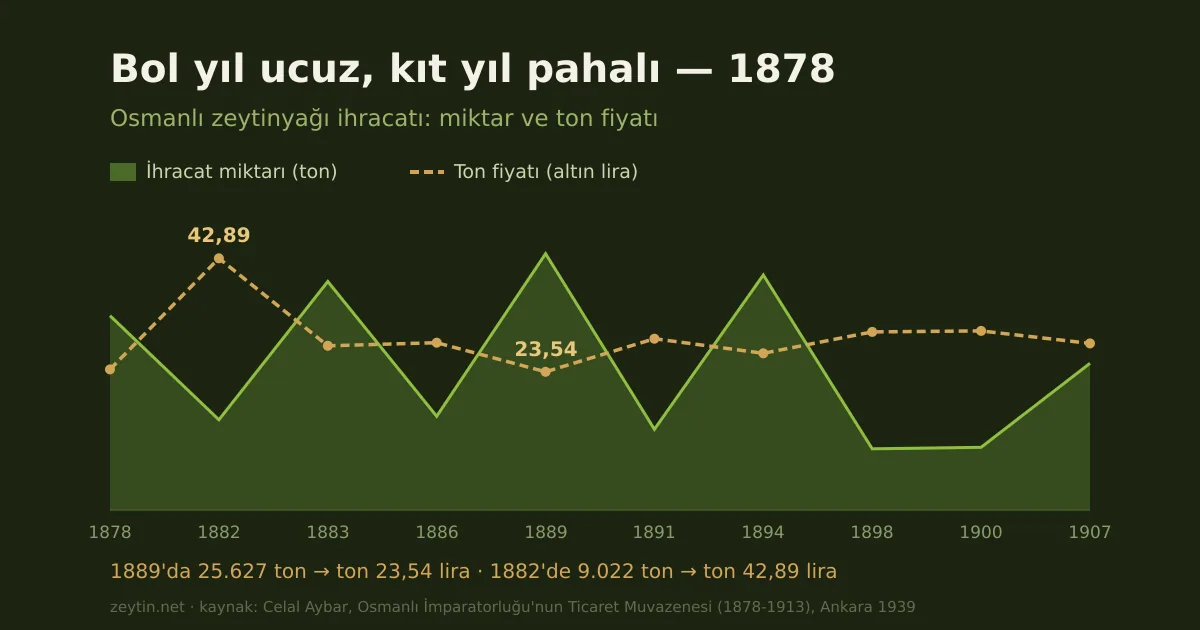
25,627 tonnes exported in 1889 at 23.54 lira a tonne; 9,022 tonnes in 1882 at 42.89. The crop-price inverse held a century ago too.
Article
Olive oil trade in the Ottoman Empire: Britain the buyer, the crop the price
25,627 tonnes exported in 1889 at 23.54 lira a tonne; 9,022 tonnes in 1882 at 42.89. The crop-price inverse held a century ago too.
 Article
From olive to oil: the price gap, 2019-2026
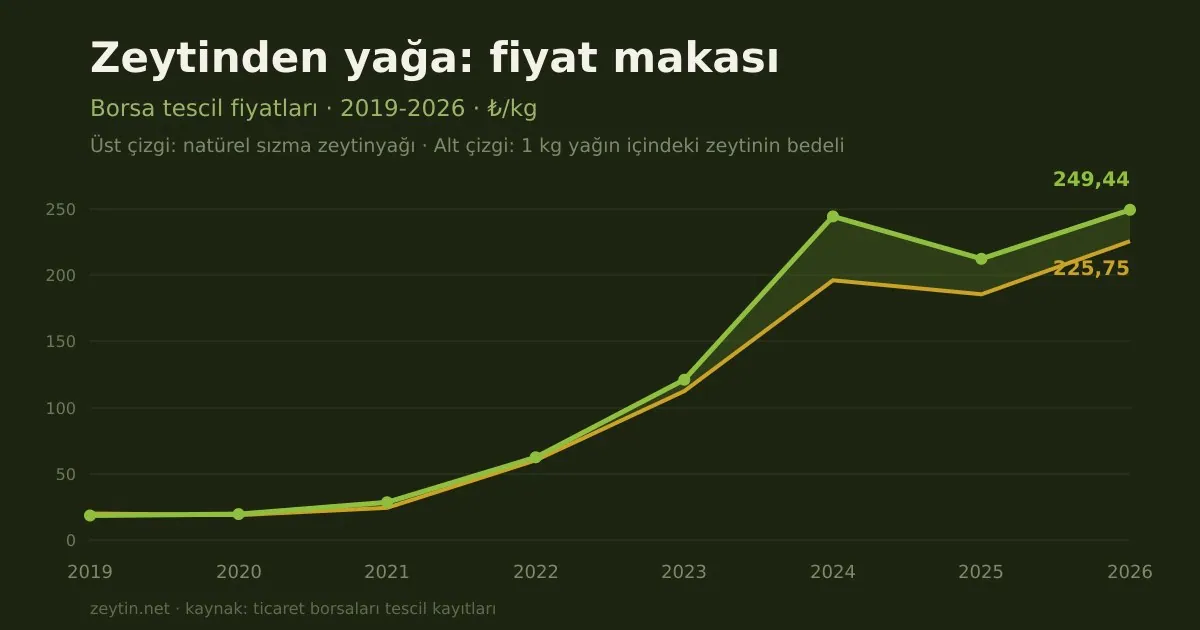
The gap between a kilo of olives and a kilo of oil, measured from exchange registrations. Why it widens, and who gains.
Article
From olive to oil: the price gap, 2019-2026
The gap between a kilo of olives and a kilo of oil, measured from exchange registrations. Why it widens, and who gains.
 Article
Did olive oil go up 13.5 times, or 1.6 times?
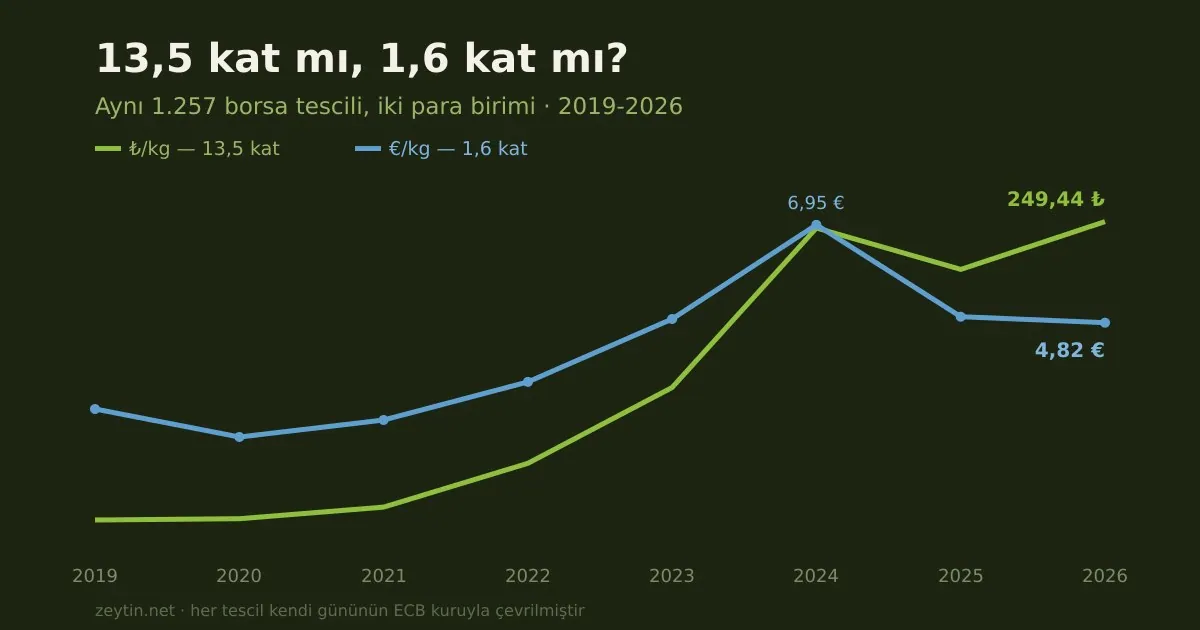
Up 13.5 times in lira, 1.6 times in euros. The same 1,257 registrations, each converted at its own day's ECB rate.
Article
Did olive oil go up 13.5 times, or 1.6 times?
Up 13.5 times in lira, 1.6 times in euros. The same 1,257 registrations, each converted at its own day's ECB rate.
 Article
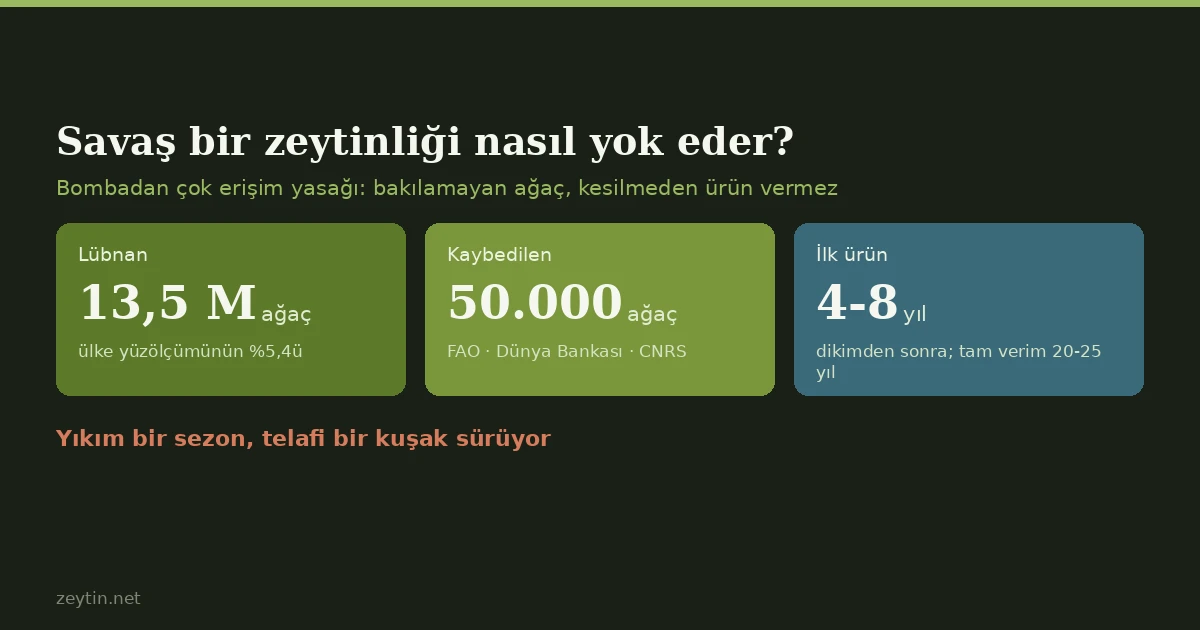
How war destroys an olive grove: denial of access does more than the bomb
An olive grove is not an annual field: first fruit takes 4-8 years, full yield 20-25. War's damage is therefore generational, not seasonal. We read the picture in Lebanon and Palestine through the tree's own biology.
Article
How war destroys an olive grove: denial of access does more than the bomb
An olive grove is not an annual field: first fruit takes 4-8 years, full yield 20-25. War's damage is therefore generational, not seasonal. We read the picture in Lebanon and Palestine through the tree's own biology.