Olive growing in Marmara: the home of the table olive
The table olive's home is not the Aegean but Marmara: 80% of the region's crop is Gemlik. The reason is climate.
Say Turkish olive growing and people think of the Aegean — rightly, since more than half the production is there. But the centre of the table olive is not the Aegean; it is Marmara.
One figure shows the difference: 80% of Marmara's production is the Gemlik variety, and Gemlik is a table olive. The Aegean's top two varieties (Memecik 45%, Ayvalık 19%) are oil varieties.
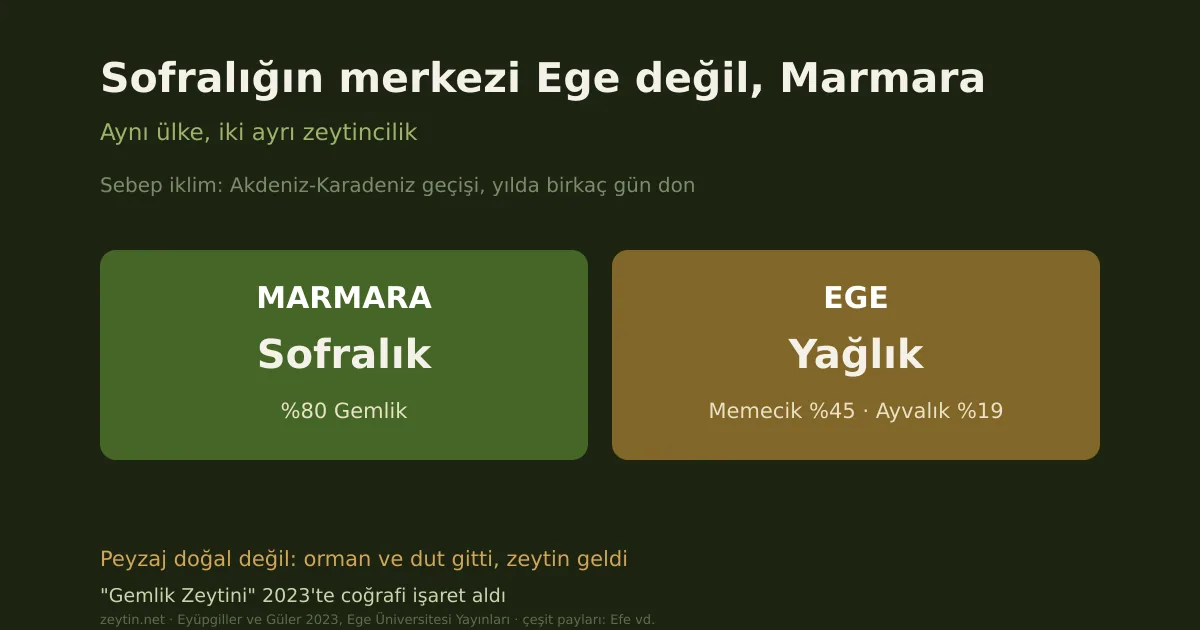
The character of each region
| Region | Emphasis | Principal varieties |
|---|---|---|
| Marmara | Table | Gemlik, Karamürsel Su, Domat, Samanlı |
| Aegean | Oil | Ayvalık, Memecik, Erkence, Tavşanyüreği, Manzanillo |
| Western Mediterranean | Oil | Tavşanyüreği, Kan Çelebi, Büyük Topak Ulak, Uslu, Gemlik |
| Eastern Mediterranean | Oil | Sarı Ulak, Büyük Topak Ulak, Halhalı, Gemlik, Ayvalık |
| Southeastern Anatolia | Oil | Nizip Yağlık, Kilis Yağlık, Halhalı |
95% of Türkiye's olive trees and 97% of its production sit in the Aegean, Mediterranean and Marmara. Olives are sparse in the southeast and on the Black Sea coast — though the southeast has nameless genotypes of its own.
Why is Marmara a table region?
The answer lies in the climate. Southern Marmara is a transition between the Mediterranean and Black Sea climates:
- Winters are not severe — the temperature drops below zero only a few days a year
- Summers are not as dry as the Mediterranean's
- Rainfall and both surface and ground water are adequate for farming
- The prevailing wind is westerly; slow in spring and autumn, faster in summer
That mildness suits table olives. Low frost risk means fruit can be left on the tree into November and December, letting black maturity complete. And because the summer drought is gentler than in the Mediterranean, the fruit stays large — and in table olives size translates straight into price.
Bursa leads southern Marmara by tree count. The province's highest production varies by year but falls in the districts of Gemlik or Mudanya.
Nor is the olive confined to the plain: in the valley running from the shores of Gemlik Bay to the town, olive trees are found even at 200-300 metres.
The landscape itself was turned into olives
A cultural landscape study of Umurbey (Gemlik, Bursa) traces how the region took its present shape:
- The natural vegetation was maquis with patches of oak and black pine forest
- Those forests were, over time, heavily converted into olive groves
- Timber processing and carpentry used to be local trades — they went with the forest
- Mulberry was widely grown for the silkworm industry common in Bursa; after olive incentives, the mulberries declined
Marmara's olive landscape is thus not natural but a product of agricultural policy. Forest and mulberry went; the olive came.
"Gemlik Zeytini" gained GI status in 2023
The region's own "Gemlik Zeytini", distinguished by its tree and fruit characteristics, received geographical indication registration in 2023. In the description given by the Yurt Ansiklopedisi: small-stoned, fleshy, flavourful and very well suited to brining.
We covered what a geographical indication actually does separately — in short, registration ties the name to a defined area and method; not every "Gemlik type" product on a shelf is registered.
The production chain in growers' own words
In the same study, the farmers of Umurbey describe traditional brined olive production themselves:
Harvest. "In Umurbey we usually begin harvesting in November; depending on the year's weather it can run into December and January."
The method has changed: "We used to spread a cloth on the ground and beat the branches with long poles; today we use better tools. With a long, fine, wide-toothed shaker we keep the olives from bruising."
That detail matters: pole harvesting is being abandoned because it both bruises the fruit and spreads olive knot.
And why they harvest late: "The Gemlik-type table olive we mostly pick reaches the consumer as the black type, so we wait longer for the fruit to ripen."
Grading. "After picking we separate them by size on a grading machine. At this stage the rotten and bruised ones have to be sorted out as well."
Brining. "We place the olives in large plastic barrels with salt. Some of the salt goes between the olives, the rest is spread to cover the top of the barrel completely. After adding the water we put a weight on top."
Those three steps also explain the cost structure of table olives: the rotten and bruised fruit sorted out at the grading stage is recorded as "reject" and makes up 73% of processing cost.
The region's historical depth
Umurbey developed in step with Gemlik. Settlements nearby go back to 5500 BC; the founding of Gemlik — ancient Kios — is placed at 1390 BC. The region came under Ottoman rule in the 14th century, and its harbour and shipyard kept it important.
There is also a period nobody mentions. According to the farmers, DDT was used for years to protect the olives from pests, from the 1950s until it was banned in the mid-1980s. Today's integrated pest management approach — measuring thresholds, protecting natural enemies, treating chemicals as a last resort — has that experience behind it.
Summary
- Marmara is the centre of the table olive; 80% of its production is Gemlik.
- The Aegean leans to oil (Memecik 45%, Ayvalık 19%); Marmara to the table.
- The reason is climate: a Mediterranean-Black Sea transition, only a few frost days, a mild summer drought.
- Bursa leads southern Marmara in tree numbers; peak production in Gemlik or Mudanya.
- Olives grow even at 200-300 m.
- The landscape is not natural: forest and mulberry went, the olive came.
- "Gemlik Zeytini" gained GI registration in 2023.
- Harvest begins in November and can run to January; the pole has given way to a wide-toothed shaker.
Sources
t; Eyüpgiller, D.S. and Güler, K. (2023). Olive Growing and Production Heritage Values in the Rural South Marmara: the Umurbey Cultural Landscape. In: Baykal, F. and Karadağ, A. (eds), Rural Industrial Heritage through Interdisciplinary Approaches, Ege University Press, pp. 449-476. ISBN 978-605-338-433-5
t; Review of the characteristics of olive varieties grown in Türkiye (Efe et al. 2011, 2012; Özkaya et al. 2004, 2009). — Regional variety distribution
Related reading: The Gemlik olive · Olive varieties · Where olives grow in Türkiye · What does a kilo of olives cost?
One rating per visitor; you can change yours at any time. Ratings are real reader votes — no seeded or default scores.
Related
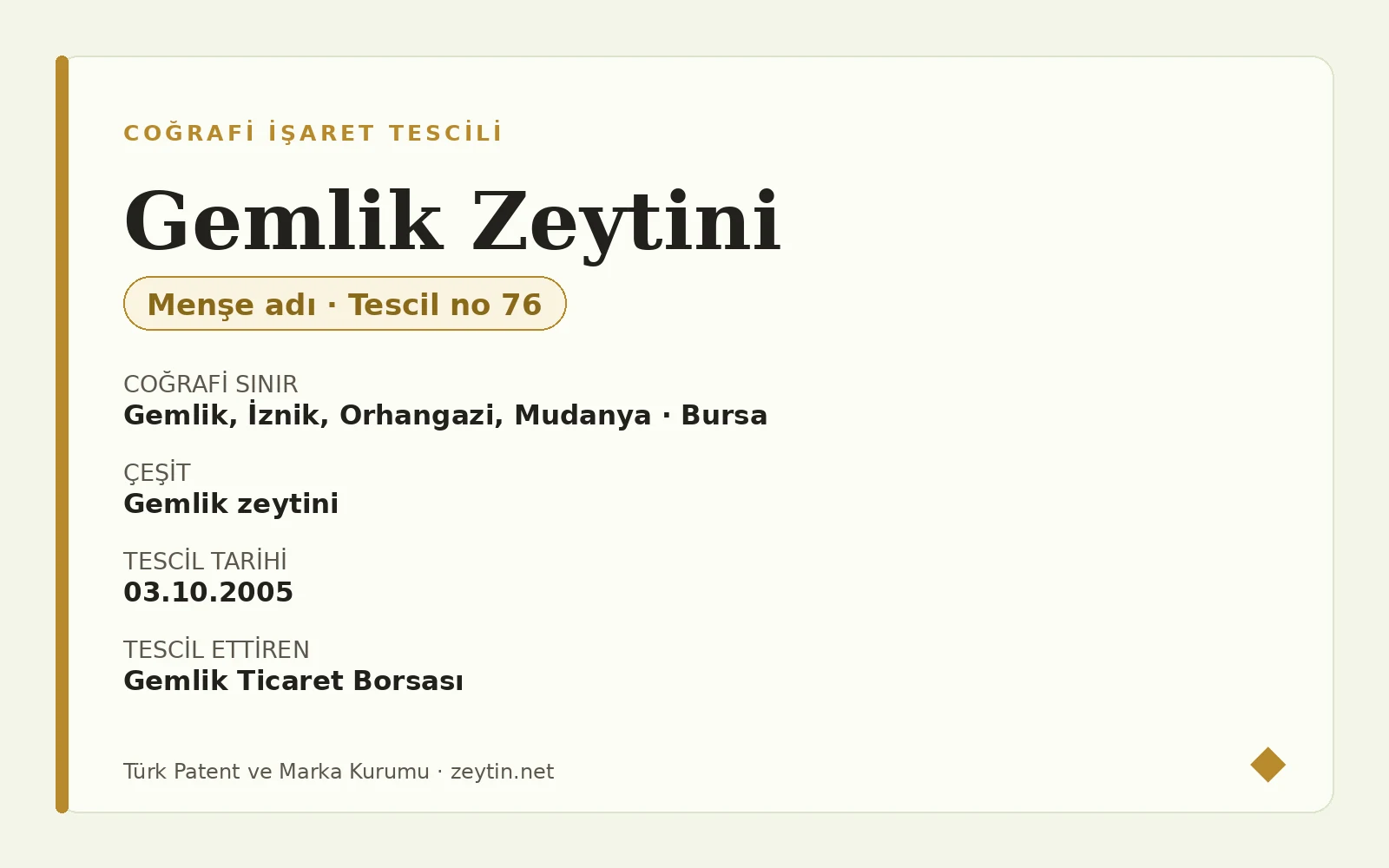 Article
The Gemlik Olive designation of origin: what the certificate says
Turkey's first registered olive (2005, no 76). The certificate defines four districts, three cultivars, four curing methods and seven size grades — all of them binding.
Article
The Gemlik Olive designation of origin: what the certificate says
Turkey's first registered olive (2005, no 76). The certificate defines four districts, three cultivars, four curing methods and seven size grades — all of them binding.
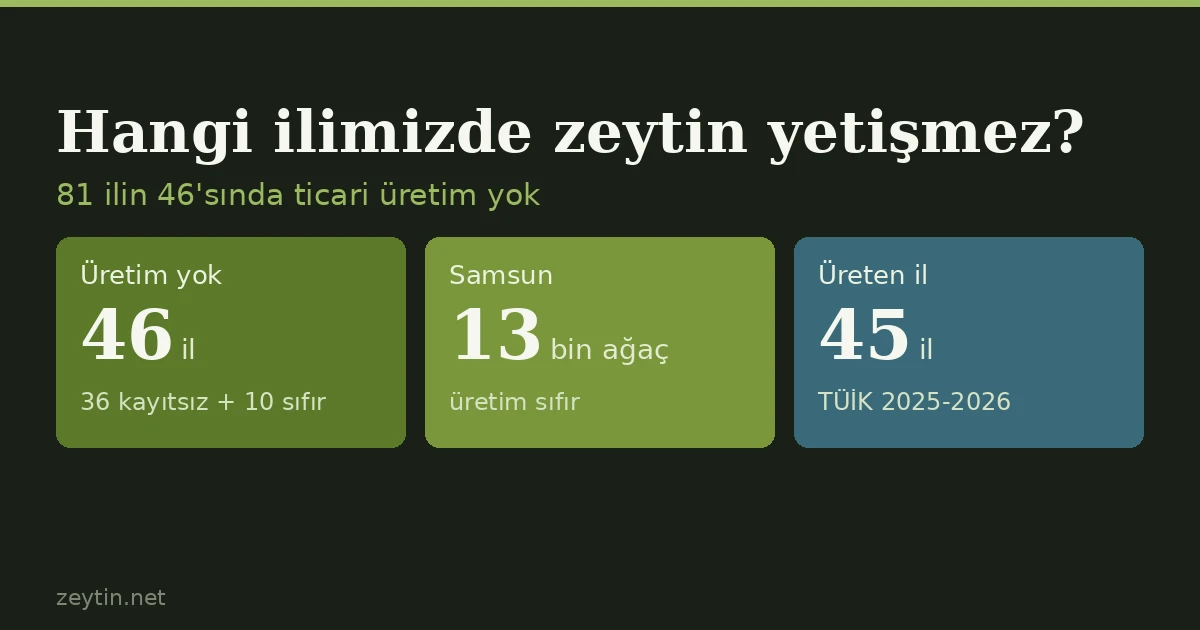 Article
Which provinces in Turkey grow no olives?
Forty-six of Turkey's 81 provinces have no commercial olive production: 36 absent from the statistics, ten reporting zero. Samsun has 13,000 trees and no crop.
Article
Which provinces in Turkey grow no olives?
Forty-six of Turkey's 81 provinces have no commercial olive production: 36 absent from the statistics, ten reporting zero. Samsun has 13,000 trees and no crop.
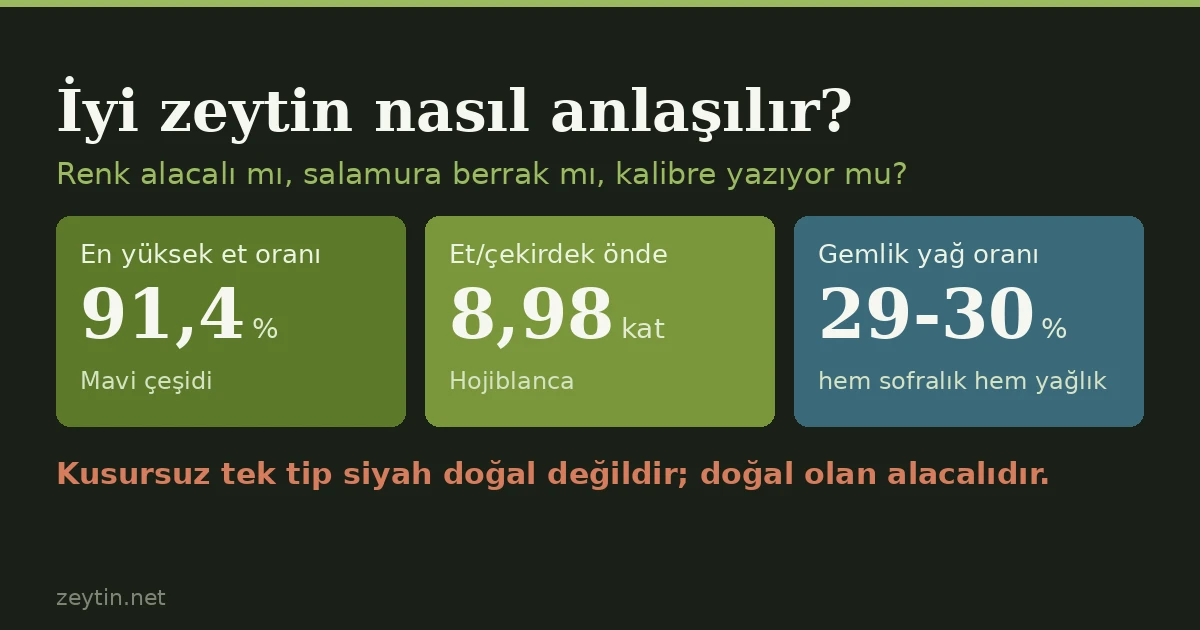 Article
How to recognise a good table olive — and what to check when buying
Is the colour mottled, the brine clear, the calibre stated? Concrete checks for buying table olives, whether Gemlik is an oil or table variety, and how to store them at home.
Article
How to recognise a good table olive — and what to check when buying
Is the colour mottled, the brine clear, the calibre stated? Concrete checks for buying table olives, whether Gemlik is an oil or table variety, and how to store them at home.
 Article
That white film on your olive brine: mould or yeast?
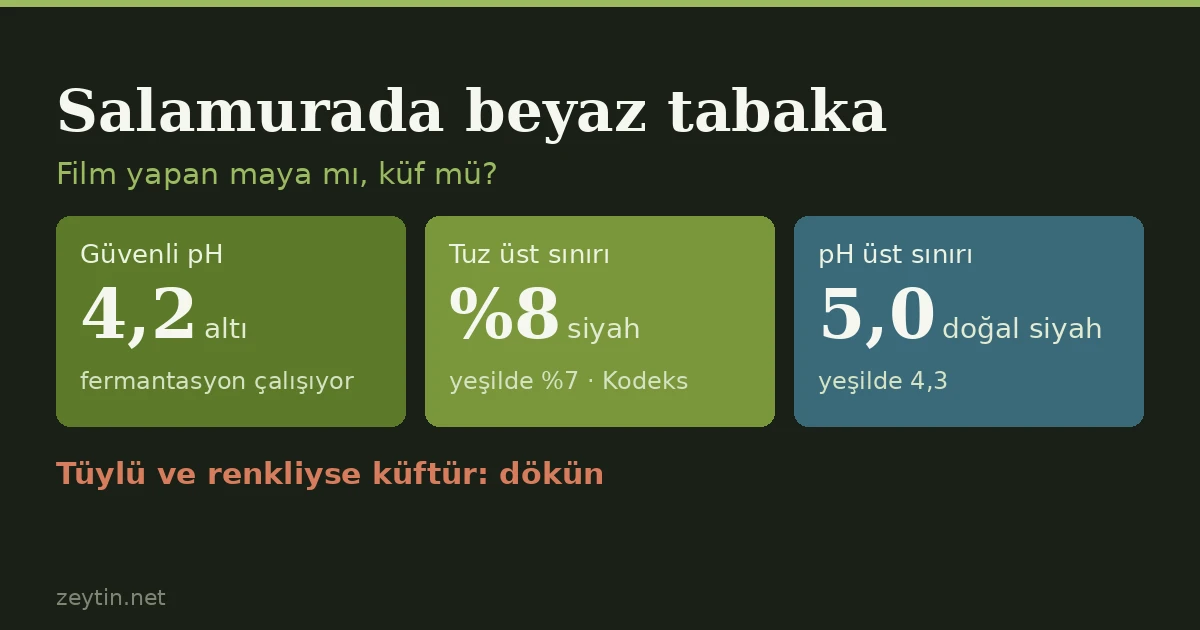
The white layer that forms on home-brined olives is usually not mould but a film-forming yeast — though that does not make it harmless. There are visible criteria for telling them apart. Together with the pH and salt ceilings the Turkish Food Codex sets for brine, here is what can be saved and what has to be thrown out.
Article
That white film on your olive brine: mould or yeast?
The white layer that forms on home-brined olives is usually not mould but a film-forming yeast — though that does not make it harmless. There are visible criteria for telling them apart. Together with the pH and salt ceilings the Turkish Food Codex sets for brine, here is what can be saved and what has to be thrown out.