Fourth in the world with 25 registrations — but what are they doing?
Türkiye is fourth in the world with 25 olive oil GIs. Yet exports fetch $3.17/kg — the product is still priced as a commodity.
Geographical indications are held up as the key to added value in olive oil. "Let's register our product, build a brand, raise the price" is a fixture of every industry meeting.
So is Türkiye not doing this?
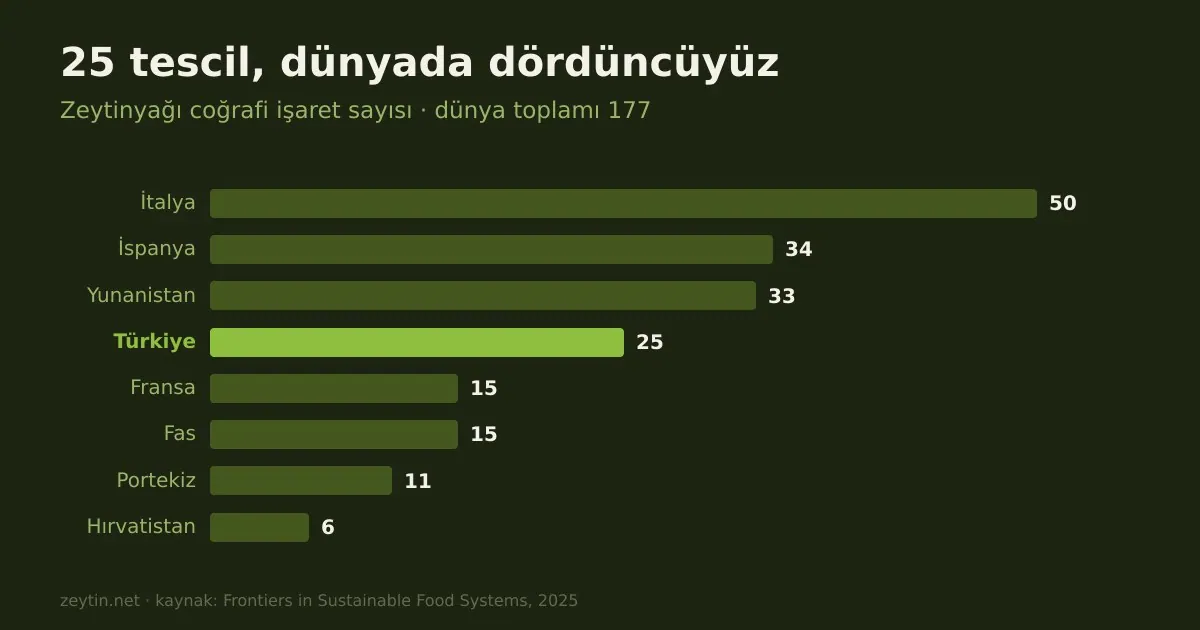
It is. More than most countries, in fact. And that is exactly where something odd begins.
Türkiye is fourth in the world
A peer-reviewed study published in 2025 gathered the world's olive oil geographical indications into a single database. The result:
| Country | Registrations |
|---|---|
| Italy | 50 |
| Spain | 34 |
| Greece | 33 |
| Türkiye | 25 |
| France | 15 |
| Morocco | 15 |
| Portugal | 11 |
| Croatia | 6 |
| Tunisia | 2 |
| Slovenia · Argentina · Chile | 1 · 1 · 1 |
| World total | 177 |
Source: A global database of olive oil geographical indications and their properties, Frontiers in Sustainable Food Systems, 2025. The counts cover olive oil GIs; table olive registrations (such as Gemlik Olives) are not included.
Türkiye holds roughly one seventh of the world's olive oil geographical indications. Without being an EU member, it sits immediately behind the Italy-Spain-Greece trio.
So "we have no registrations" is not true. The question is a different one: what are those 25 registrations doing?
A registration is not money by itself
A geographical indication is not a title deed but a promise: this product was made in this place, by this method. Whether the promise reaches the price depends on three conditions, and all three come after registration.
Enforcement. A registration asserts that production follows the specification. If nobody checks that assertion, the mark loses its meaning over time — and the producer who follows the rules is hurt most.
Recognition. A buyer has to know the mark to pay a premium for it. Toscano IGP and Kalamata PDO command premiums not because of the registration itself but because of decades of promotion and distribution behind it.
Use. How many producers actually put the registered name on how many bottles? If a registration stays on paper, the count of registrations is not a performance indicator.
Türkiye's problem is not in the number of registrations but in these three links.
How do we know?
We cannot measure it directly — and that is the most honest sentence in this article.
There is no public, regular price series showing how much more a GI-marked Turkish olive oil fetches than an unmarked equivalent. Exchange registrations record the product as "extra virgin"; the geographical indication does not enter that record. So our own data cannot see the distinction either.
What we do have are indirect indicators:
- Export unit value. Over the first half of 2026, Türkiye's olive and olive oil exports averaged $3.17 per kilogram. That is a bulk-trade level; an export mix weighted towards branded and GI-marked product would be expected to sit several times higher. Detail here.
- Bulk prices tracking the world price almost exactly. A GI product is by definition not substitutable, so it separates to some degree from the world bulk price. Türkiye's price moves almost in step with Spain's — we measured it.
Together they say this: Turkish product is still priced largely as a commodity on world markets, not as a differentiated one.
Some of Türkiye's olive geographical indications
| Product | Type | Registered | Area |
|---|---|---|---|
| Gemlik Olives | Designation of origin | 2005 | Bursa · Gemlik |
| Ayvalık Olive Oil | Designation of origin | 2007 | Balıkesir · Ayvalık |
| Milas Olive Oil | Designation of origin | 2016 | Muğla · Milas |
| North Aegean Olive Oils | Geographical indication | 2018 | İzmir and the North Aegean |
| Milas Oil Olive | Designation of origin | 2019 | Muğla · Milas |
Note the dates: the first registration is 2005, with the cluster after 2016. Türkiye's GI stock is young. Some of Italy's 50 registrations are thirty years old — and so is the recognition behind them.
The distinction between a designation of origin and a geographical indication matters. In the former, every stage of production happens in the named area; in the latter at least one stage does, while others may happen elsewhere. A designation of origin is the narrower, stronger commitment.
EU registration is a separate door
One thing should not be confused: a TÜRKPATENT registration protects a name in Türkiye, not in the European Union market.
Protection in the EU requires a separate application, and the process takes years. This is a critical distinction for exports: Ayvalık Olive Oil being registered in Türkiye does not mean the name is legally protected on a shelf in Germany.
Some Turkish products have gone through the EU process, but on the olive oil side that number is far below the count of domestic registrations. If the goal is added value in export markets, this is the door that matters.
What could be done?
This is not a policy paper, but the data points clearly at a few things.
Obtaining new registrations is not the priority. With 25 we are fourth in the world; 30 would not change the picture. The problem is not the stock but its use.
Actual use should be measured. How many producers put the registered name on how many bottles? That data is not public, and without it no assessment is possible.
Recognition in export markets. Whether a German buyer knows the name "Ayvalık" matters more than how many people know it in Türkiye.
The price difference should be visible. If we cannot measure whether GI product separates from the bulk price, we cannot know whether registration works. Adding a geographical indication field to exchange registrations would solve this on its own.
Summary
- Türkiye is fourth in the world with 25 olive oil GIs, behind Italy (50), Spain (34) and Greece (33).
- Roughly one seventh of the world's 177 registrations are Turkish.
- But a registration alone does not create a price: enforcement, recognition and actual use are required.
- An export unit value of $3.17/kg suggests the product is still priced as a commodity.
- A TÜRKPATENT registration offers no protection in the EU market; a separate application is needed.
- The priority is not new registrations but making the existing ones pay.
Related reading: Two thirds of our exports are table olives · Is Turkish olive oil cheap?
One rating per visitor; you can change yours at any time. Ratings are real reader votes — no seeded or default scores.
Related
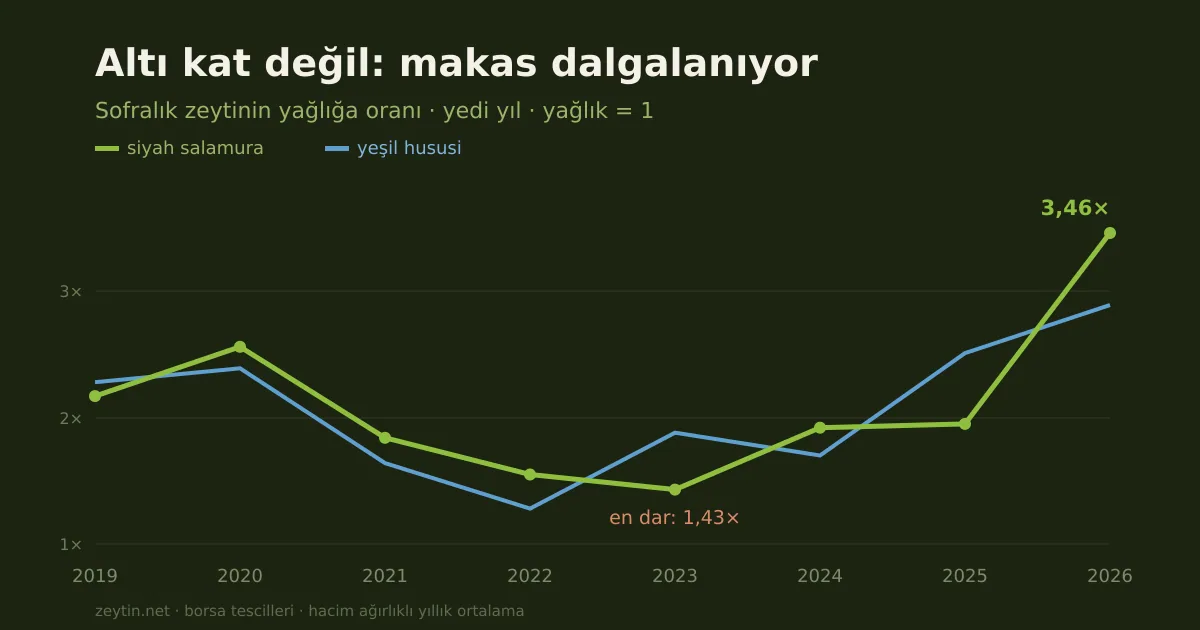 Article
Was it six times? Seven years of the table olive gap
How many times the oil price does a table olive fetch? Over seven years the ratio ranged 1.43 to 3.46, never below 1.
Article
Was it six times? Seven years of the table olive gap
How many times the oil price does a table olive fetch? Over seven years the ratio ranged 1.43 to 3.46, never below 1.
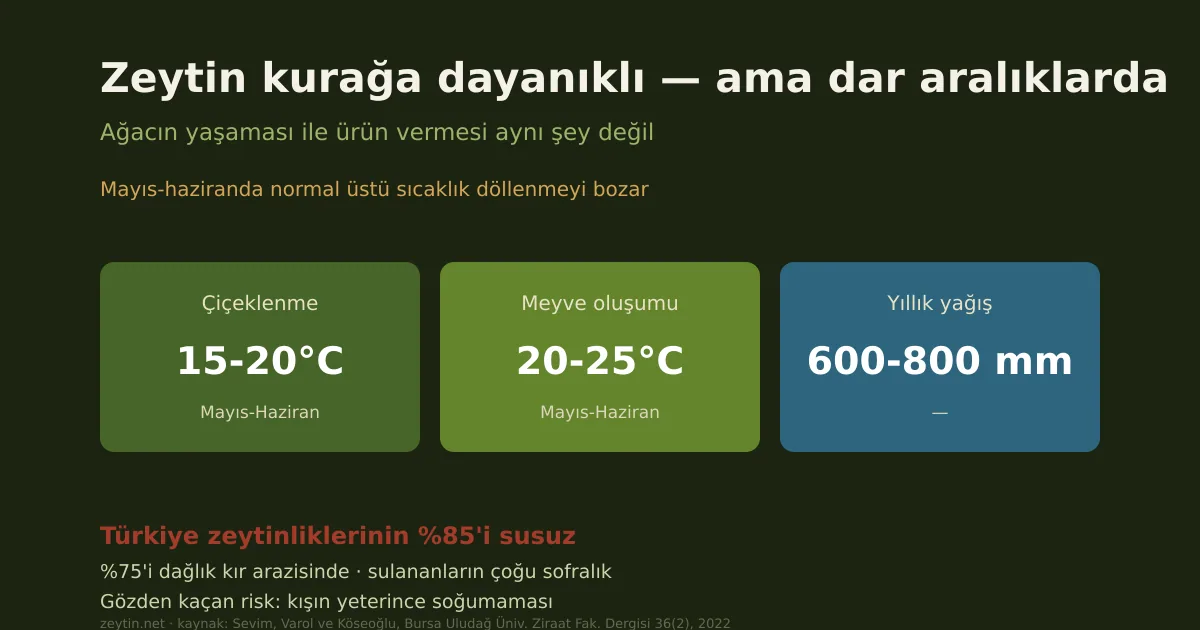 Article
Climate change and the olive: the tree survives, but will it crop?
The olive is drought-hardy but works in narrow bands. 85% of Türkiye's groves are unirrigated, 75% on mountainous land.
Article
Climate change and the olive: the tree survives, but will it crop?
The olive is drought-hardy but works in narrow bands. 85% of Türkiye's groves are unirrigated, 75% on mountainous land.
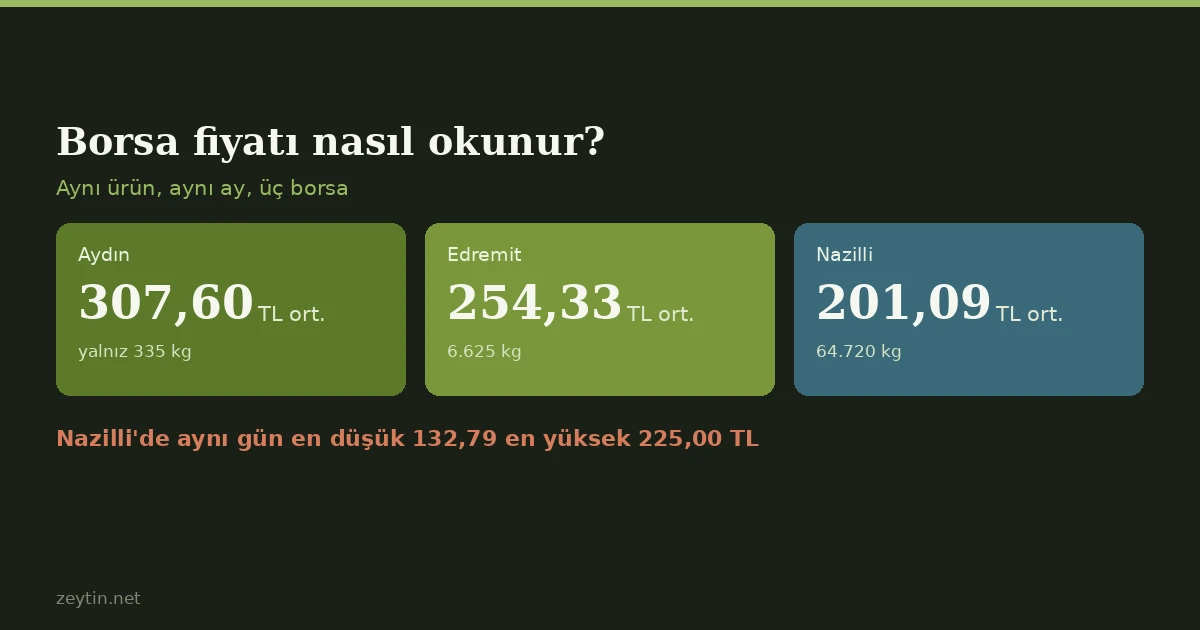 Article
How to read olive oil exchange prices
Three exchanges, three averages for the same product: 201, 254 and 308 lira. In Nazilli, trades from 132.79 to 225.00 in a single day. What an exchange price measures, and why date and volume matter more than the average.
Article
How to read olive oil exchange prices
Three exchanges, three averages for the same product: 201, 254 and 308 lira. In Nazilli, trades from 132.79 to 225.00 in a single day. What an exchange price measures, and why date and volume matter more than the average.
 Article
Two thirds of our exports are table olives: the $260 million picture
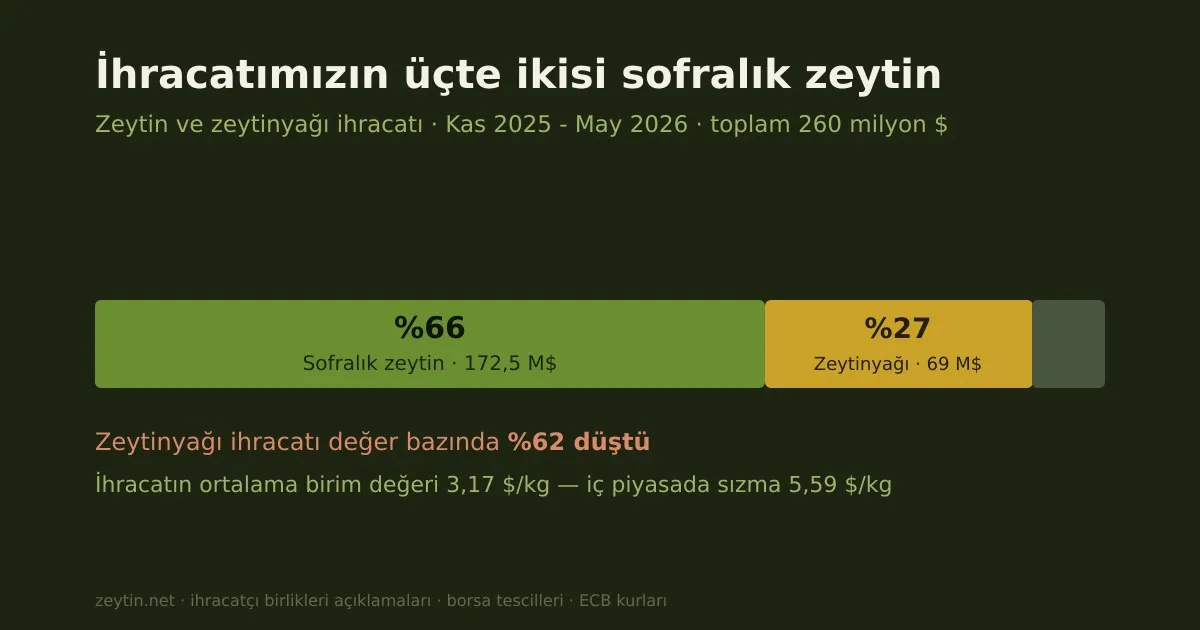
In 2025-26, 66% of exports were table olives and 27% oil. Average unit value $3.17/kg — the added value sits inside the packaging.
Article
Two thirds of our exports are table olives: the $260 million picture
In 2025-26, 66% of exports were table olives and 27% oil. Average unit value $3.17/kg — the added value sits inside the packaging.