Tree to shelf: the olive oil value chain in six stops
From fruit on the tree to bottle on the shelf: how much the price multiplies at each step, and where the added value stays.
The price of a bottle of olive oil is not set in one place. There are at least six stops between the tree and the shelf, and something is added at each one. This article traces that chain stop by stop, with our own data.
The other articles in this series measured each stop separately. Here we put them side by side, because the real question is this: where is the money made in olive oil?
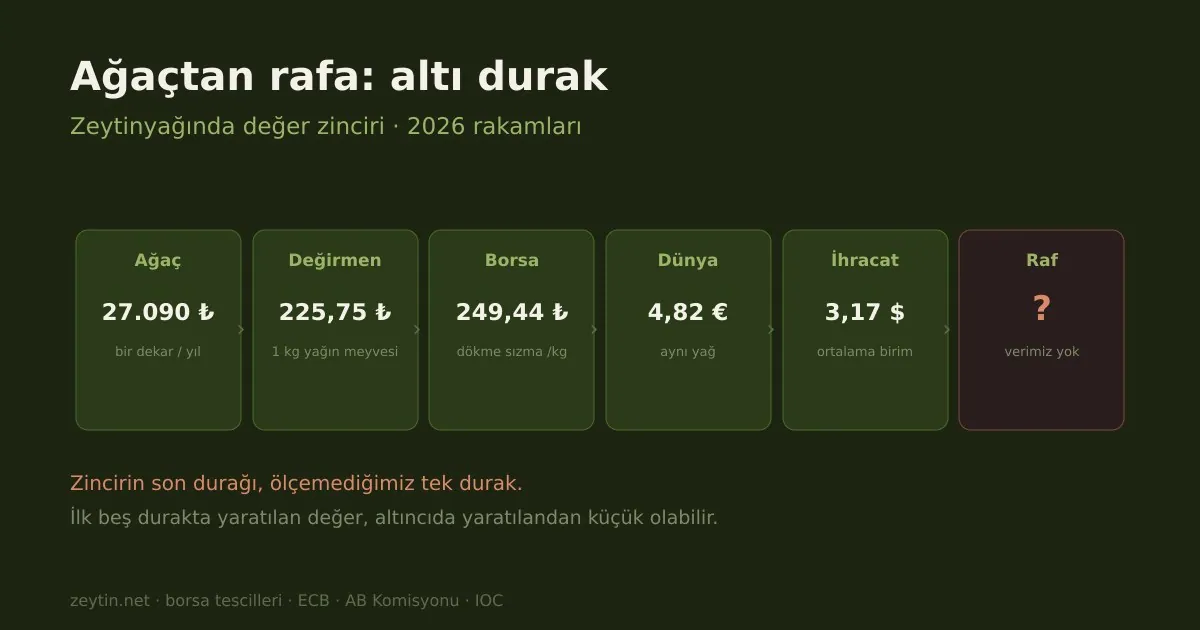
Stop 1 — The tree: what does a decare yield?
Traditional planting puts about 20 trees on a decare, and at full bearing each yields around 30 kilograms of olives. That is 600 kilograms per decare.
At the 2026 exchange average of 45.15 TL/kg for oil olives, a decare grosses 27,090 lira a year.
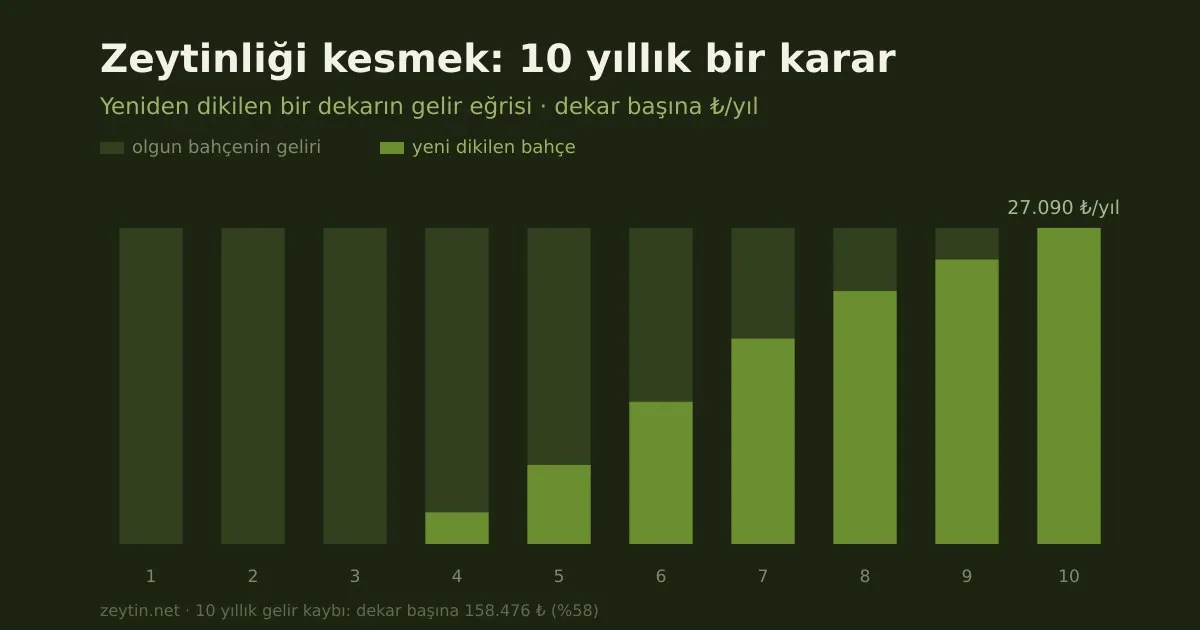
The time behind that figure matters too: a newly planted grove starts bearing in year four and reaches full yield in year ten. Replacing a cleared decare costs 158,476 lira in lost income over ten years.
Stop 2 — The mill: five kilos of olives, one kilo of oil
The share of the fruit's weight that becomes oil is the yield; at a working figure of 20%, one kilogram of oil takes five kilograms of olives.
The number that comes out of this is the foundation of the whole chain: the fruit inside one kilogram of oil is worth 225.75 lira.
When yield falls, that cost rises fast. Early harvest brings yield down to 12-16% and the raw material cost up to 282-376 lira — above the bulk selling price.
Stop 3 — The exchange: bulk extra virgin at 249.44 TL
The 2026 volume-weighted average registration price for extra virgin olive oil is 249.44 lira per kilogram.
Now combine the first two stops: 90% of the selling price is the fruit alone. Milling, storage, losses, transport, financing and profit all come out of the remaining 10%.
Across seven years that strip stayed narrow: the raw material share swung between 80% and 108%. In 2019 the fruit cost more than the oil itself.
Stop 4 — The world price: €4.82
The same oil in euros is €4.82/kg. That figure is set not by decisions taken in Türkiye but by world supply.
Spain alone produces 40% of the world's olive oil. When Spanish output halved in 2022/23, Türkiye's euro price went from €2.70 to €6.95. When Spain recovered, it fell 29%.
And an important distinction: most of the 13.5-fold rise in the lira price is currency movement. In hard currency the increase is 1.6-fold.
Stop 5 — Export: $3.17/kg
Over the first half of 2026 Türkiye exported 59,000 tonnes of olives and olive oil for $187 million: $3.17 per kilogram.
That is a little over half the domestic extra virgin price ($5.59). The reason is simple: two thirds of exports are table olives, a product with a lower price per kilogram.
On the oil side there is no price competition: in thirteen of fourteen months Türkiye's bulk price sat above Spain's.
Stop 6 — The shelf: the stop we cannot measure
The last link in the chain is the only one we have no data for.
Bulk extra virgin trades at 249.44 lira on the exchange. What does the same oil sell for on a shelf once it is bottled, labelled and branded? We cannot answer that from public, regular data — we do not collect a retail price series and we have not found a source that does.
But the rest of the chain suggests something: the value created across the first five stops may be smaller than the value created at the sixth.
That is precisely what Spain has done for decades: buy the world's bulk oil and sell it under its own labels. Italy does the same at a higher margin. Both are large producers, but their real earnings come not from production but from the last stop.
The chain in one table
| Stop | Value | Source |
|---|---|---|
| Annual gross per decare | 27,090 TL | calculation |
| Fruit inside 1 kg of oil | 225.75 TL | 20% yield |
| Bulk extra virgin, exchange | 249.44 TL | registration |
| The same oil in euros | €4.82 | ECB rate |
| Export unit value | $3.17 | exporters' associations |
| Shelf price | — | no data |
Three conclusions from the chain
First: production is the narrowest-margin link. Whoever buys olives, mills them and sells in bulk pays 90% of the selling price for raw material. It is the most exposed position in the sector.
Second: the price is not set in Türkiye. As long as the export door is open, the domestic price stays tied to the world price. Whether it rains in Andalusia shows up in an Aydın registration about a year later.
Third: the missed opportunity is not selling cheap but failing to sell dear. Turkish oil meets world standards and its price is above the world price. What is missing is the brand, distribution and recognition to carry it to the last stop. We have 25 geographical indications, but registration alone does not create a price.
What this series did
This article closes a series written on one principle: every figure carries its source in the text, and where we could not reach data we said so rather than estimating.
The price series come from exchange registrations we collect ourselves — 1,377 records since 2019. Exchange rates from the European Central Bank, European producer prices from the European Commission, world production from the International Olive Council.
The raw data can be downloaded as CSV from our market page and the calculations repeated. If you get a different result, we would like to hear about it.
The full series: The price gap · Is Turkish olive oil cheap? · Exchange volume is not the harvest · Early harvest · Two thirds are table olives · 13.5 times or 1.6? · Felling a grove · Spain's drought · 25 GIs · Yield calculator
One rating per visitor; you can change yours at any time. Ratings are real reader votes — no seeded or default scores.
Related
 Article
The table olive sector: 461 registered, 8,000 unregistered
Turkey has become the world's leading table olive producer, with a record $255.3m in 2024-25 across 117 countries. Yet only one enterprise in twenty is registered.
Article
The table olive sector: 461 registered, 8,000 unregistered
Turkey has become the world's leading table olive producer, with a record $255.3m in 2024-25 across 117 countries. Yet only one enterprise in twenty is registered.
 Article
Türkiye leaves an off year as Tunisia enters one: opposite phase in the Mediterranean
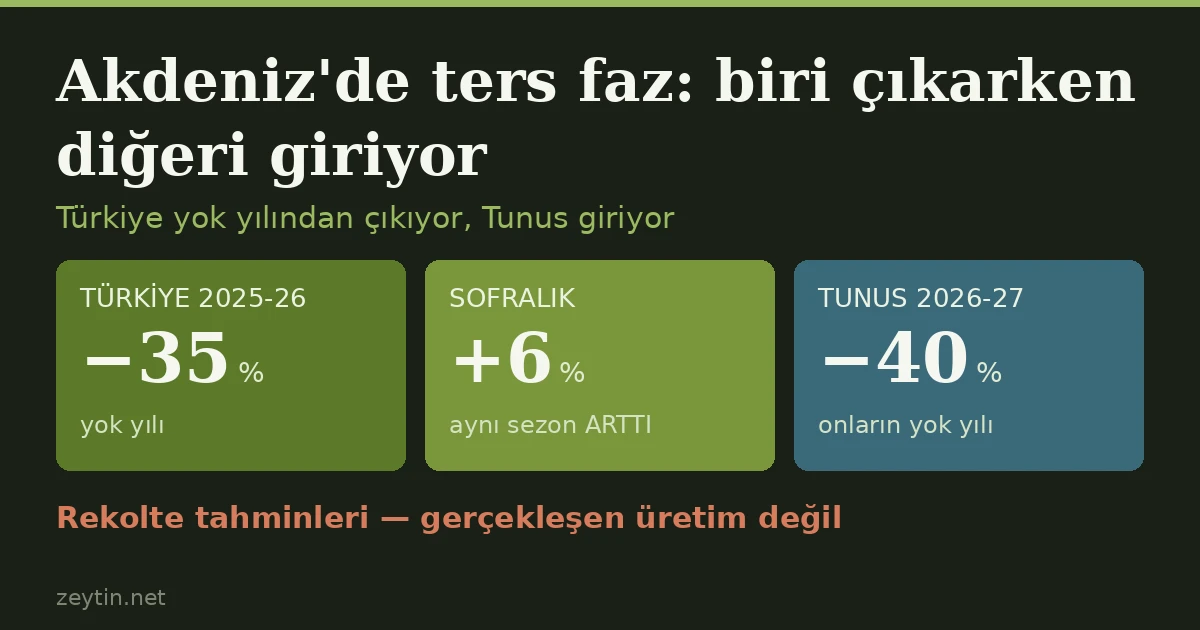
Türkiye's crop fell 35% in 2025-26, yet table olives rose and the drop was far from even: Aydın −8%, Bursa −50%. Tunisia is in the opposite phase, down 40% for 2026-27. The two countries sit in opposite halves of the cycle, and that shapes the bulk olive oil market.
Article
Türkiye leaves an off year as Tunisia enters one: opposite phase in the Mediterranean
Türkiye's crop fell 35% in 2025-26, yet table olives rose and the drop was far from even: Aydın −8%, Bursa −50%. Tunisia is in the opposite phase, down 40% for 2026-27. The two countries sit in opposite halves of the cycle, and that shapes the bulk olive oil market.
 Article
Two thirds of our exports are table olives: the $260 million picture
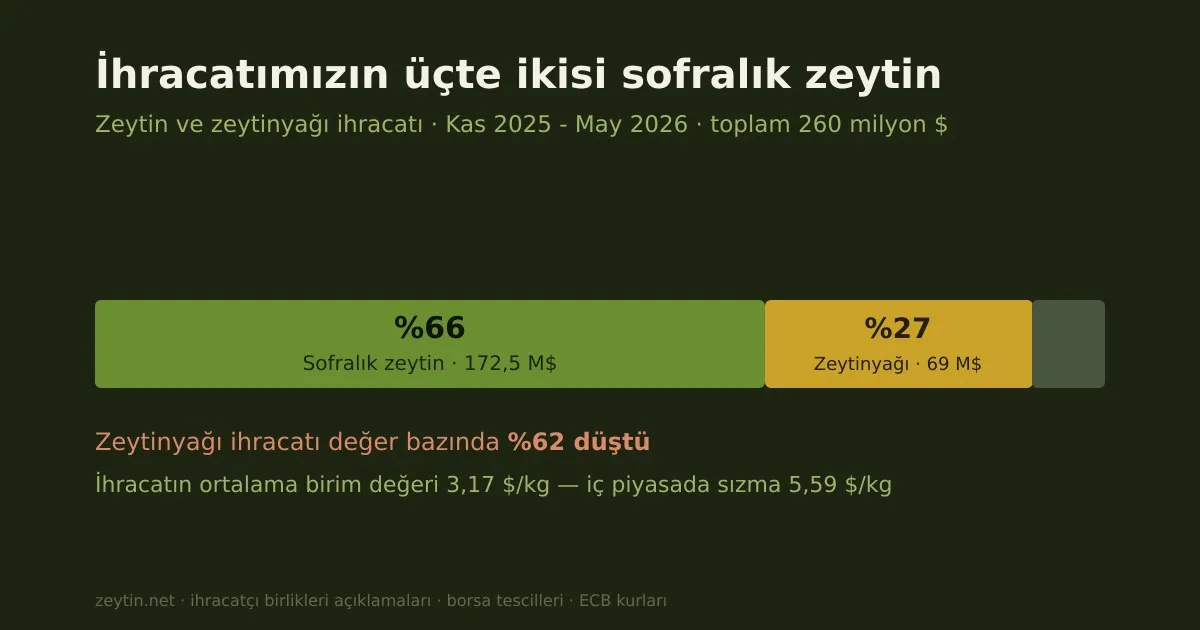
In 2025-26, 66% of exports were table olives and 27% oil. Average unit value $3.17/kg — the added value sits inside the packaging.
Article
Two thirds of our exports are table olives: the $260 million picture
In 2025-26, 66% of exports were table olives and 27% oil. Average unit value $3.17/kg — the added value sits inside the packaging.
 Article
Felling an olive grove: the arithmetic of a ten-year decision
The ten-year cost of clearing a grove for another crop: establishment, years to bearing and forgone income, per decare.
Article
Felling an olive grove: the arithmetic of a ten-year decision
The ten-year cost of clearing a grove for another crop: establishment, years to bearing and forgone income, per decare.