Saurani olive: characteristics, oil content and growing areas
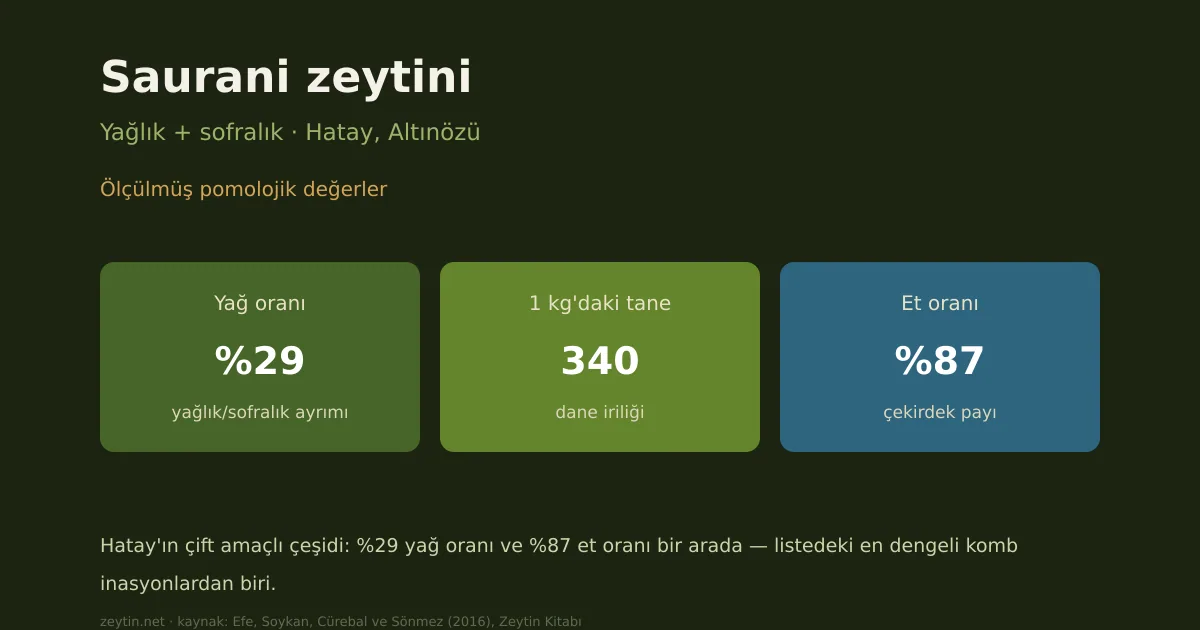
Hatay's dual-purpose variety: 29% oil with 87% flesh — one of the most balanced combinations on the list.
Saurani is Hatay's own variety, grown along the Altınözü and Kuseyr Plateau belt — ground that has produced olives without interruption since antiquity.
Saurani in numbers
| Oil content | 29% |
| Fruits per kilo | 340 |
| Flesh ratio | 87% |
| Use | Oil and table |
| Main areas | Hatay, Altınözü |
Source: Efe, Soykan, Cürebal and Sönmez (2016), Zeytin Kitabı. Fields the source leaves blank are shown as "—"; nothing has been estimated.
The cold risk
For an olive tree, the period when the temperature falls below 7 °C is dormancy. But if it drops much further, what begins is not rest but damage.
A study examining shifts in climate parameters records that temperatures falling as low as −14.6 °C in Antakya pose a risk for the cold-sensitive Saurani cultivar.
This shows why two concepts must not be confused when choosing a cultivar:
- Chilling requirement — the cool hours needed for the tree to flower. If unmet, there is no crop.
- Frost hardiness — the tissue's tolerance of sub-zero temperatures. If unmet, the tree is damaged.
Saurani's problem is the second. More: chilling requirement in olives · climate change and the olive.
⚠ Before planting a grove, look at the locality's record minimum temperatures, not its averages. An average does not kill a tree; one night's extreme does.
A flesh ratio of 87%
Saurani's flesh ratio is 87%, its stone 13%. That places it in the upper-middle among Hatay cultivars: Mavi 92%, Halhallı 90-91%, Sayfi 89%, Karamani 88%, Saurani 87%, Sarı Haşebi 85-86%.
A high flesh ratio makes the cultivar dual-purpose — it can go either to oil or to the table.
The cultivar landscape of Hatay
Cultivars originating in Hatay: Halhalı, Sarı Habeşi, Saurani, Sayfi, Karamani, Elmacık and As Topakaşı.
These local cultivars are not merely a matter of regional taste — they are a genetic reserve. Since three cultivars account for three quarters of Turkish production, a trait that may be needed later — drought tolerance, disease resistance — could be found among them.
On the region's olive oil history: the 43 olive oil workshops of Antioch.
Where it stands among measured cultivars
Its position on each axis is shown live in the comparison strip on this page, against every cultivar with a published figure. For the full ranking — and how that ranking is built — see olive variety rankings.
In short
Saurani combines 29% oil with 87% flesh — a rare pairing on this list. Being usable for both oil and the table spreads the grower's risk: whichever price is better that year, the crop can go there.
For Hatay's ancient oil tradition, see the 43 workshops of Antiokheia.
Where it stands among measured varieties
çeşit sayfası
çeşit sayfası
Zeytin Kitabı — Efe, Soykan, Cürebal, Sönmez (2016) s.37-80
Zeytin Kitabı — Efe, Soykan, Cürebal, Sönmez (2016) s.37-80
Zeytin Kitabı — Efe, Soykan, Cürebal, Sönmez (2016) s.37-80
Values are those published on each variety's own page; the comparison covers only varieties with a measured figure, so it is a comparison of what is known — not of every Turkish variety. See the full ranking and how it is built →
One rating per visitor; you can change yours at any time. Ratings are real reader votes — no seeded or default scores.
Related
 Article
The Halhalı olive: Hatay's oil cultivar
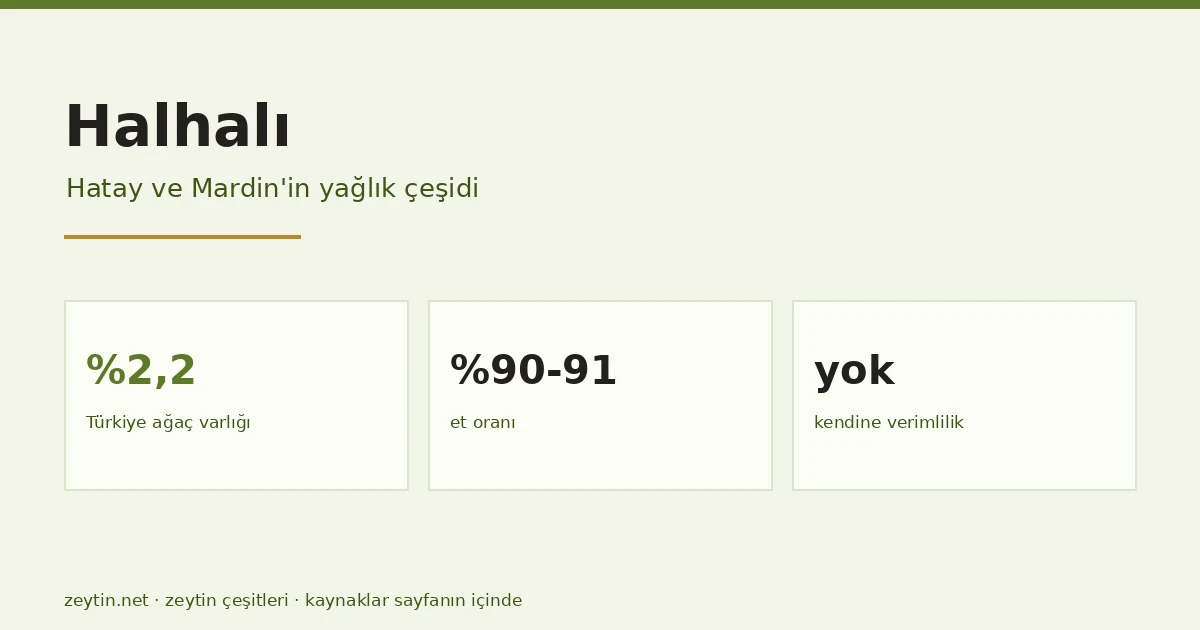
Halhalı accounts for 2.2% of Turkey's olive trees, the main oil cultivar of Hatay and Mardin. The measured self-sterility of Yuvarlak Halhalı and what it means for orchard planning.
Article
The Halhalı olive: Hatay's oil cultivar
Halhalı accounts for 2.2% of Turkey's olive trees, the main oil cultivar of Hatay and Mardin. The measured self-sterility of Yuvarlak Halhalı and what it means for orchard planning.
 Article
Olives and Olive Oil: Frequently Asked Questions
Does the fridge test work, what separates extra virgin from riviera, can you fry with olive oil? The 18 most common questions, answered briefly.
Article
Olives and Olive Oil: Frequently Asked Questions
Does the fridge test work, what separates extra virgin from riviera, can you fry with olive oil? The 18 most common questions, answered briefly.
 Article
Chilling requirement in olives: which variety grows where?
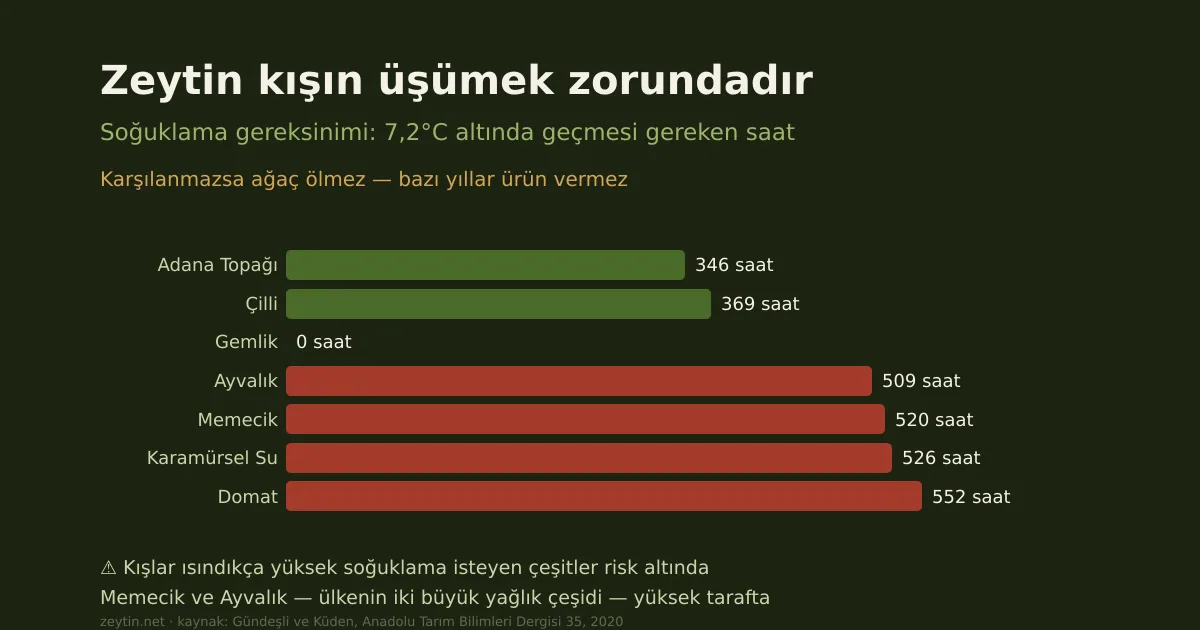
The olive must spend time below 7.2°C in winter. Adana Topağı needs 346 hours, Domat 552. Unmet, some years bring no crop.
Article
Chilling requirement in olives: which variety grows where?
The olive must spend time below 7.2°C in winter. Adana Topağı needs 346 hours, Domat 552. Unmet, some years bring no crop.
 Article
The Çilli olive: large fruit, low chilling requirement
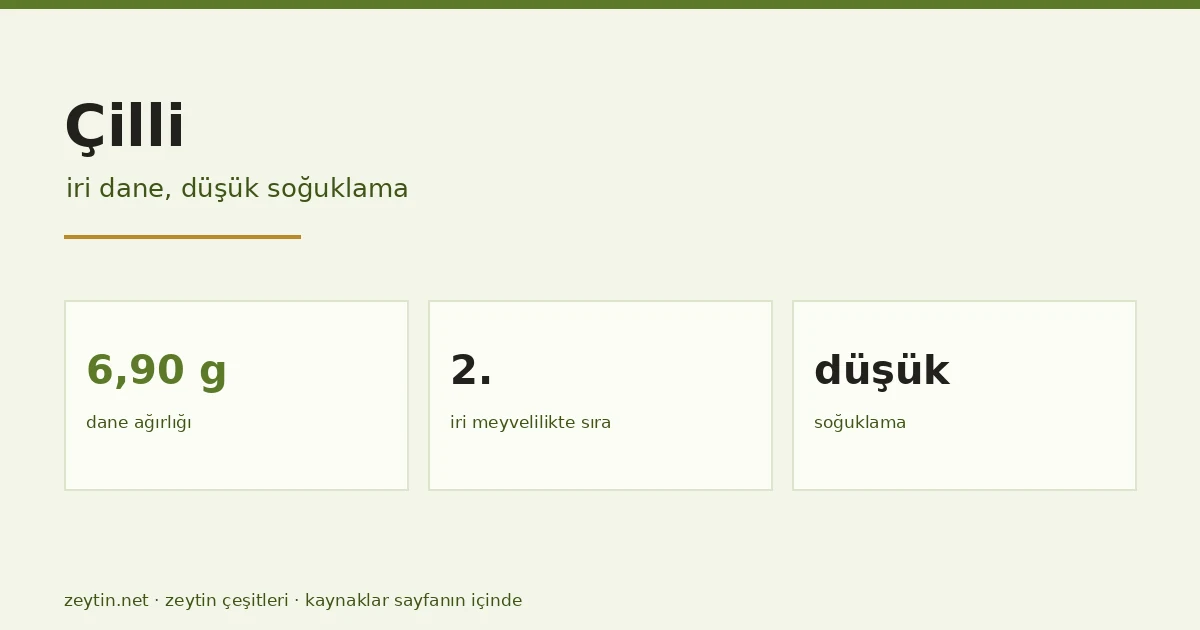
At 6.90 g it ranks among the large-fruited cultivars, and sits in the low chilling-requirement group — second only to Adana Topağı.
Article
The Çilli olive: large fruit, low chilling requirement
At 6.90 g it ranks among the large-fruited cultivars, and sits in the low chilling-requirement group — second only to Adana Topağı.