Waits at Serik olive oil mills reach 24-35 hours: mill owner asks producers to slow the harvest and says more than 8 kilos of olives are now needed for a kilo of oil
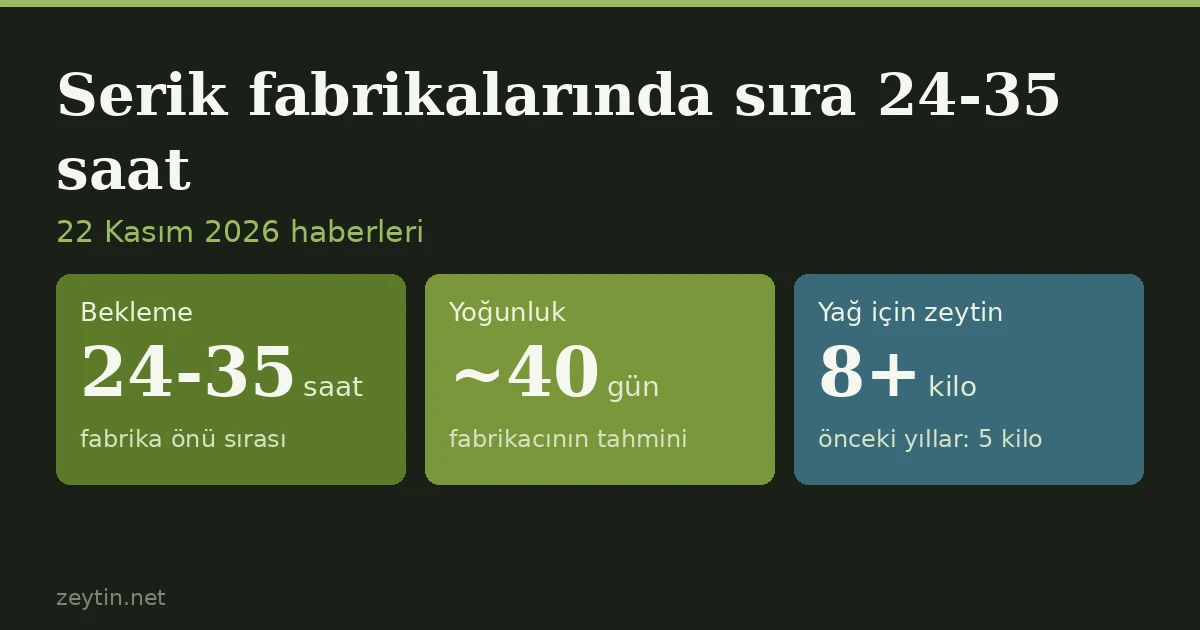
At olive oil mills in Serik, Antalya, producers are waiting 24 to 35 hours in line. Mill owner Şevket Gaffar says the rush could last about another 40 days, and that a kilo of oil now takes more than 8 kilos of olives against 5 in earlier years. The reports do not give the cause of the queue, the number of mills or the price.
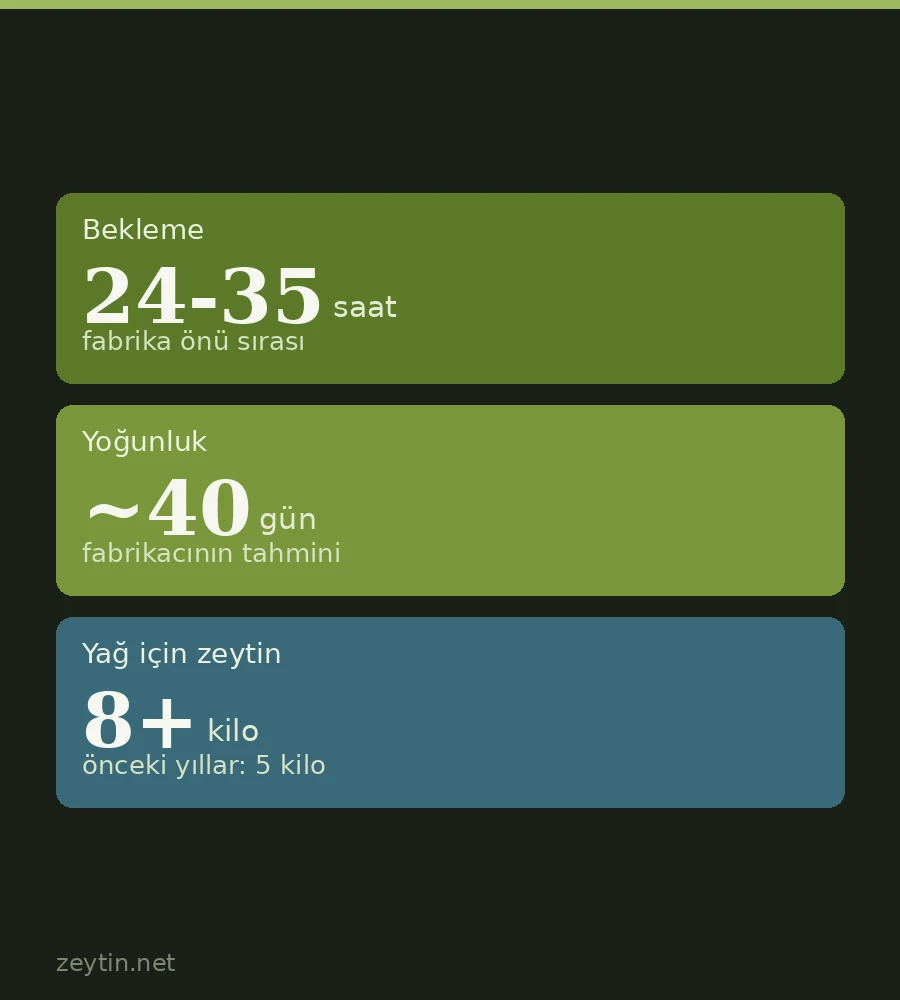
In Serik, a district of Antalya, long lines of vehicles formed in front of olive oil mills as the olive harvest picked up. According to reports dated 22 November 2026, producers are waiting 24 to 35 hours in line to have their olives pressed into oil; some reports describe the queue as "more than 30 hours", others as "reaching 35 hours". Mill owner Şevket Gaffar said the congestion could last roughly another 40 days and called on producers to slow the harvest somewhat. The second thread in the reports is as notable as the queue itself: producers say that this season the same olives are giving less oil than before.
What the reports say
| Item | What the reports say |
|---|---|
| Waiting time | 24-35 hours (more than 30 or reaching 35, depending on the report) |
| Expected duration of the rush | About 40 days (mill owner Şevket Gaffar) |
| The mill owner's working pattern | About 3 hours of sleep a day |
| Oil yield in previous years | 1 kilogram of oil from 5 kilograms of olives |
| Oil yield this season (the mill owner's statement) | 1 kilogram of oil from more than 8 kilograms of olives |
| Pressings described by one producer | 300 grams from 10 kilos of olives; the day before, 200 grams from 7 kilos (Tevfik Karatoy) |
| Vehicles in line | About 30 vehicles ahead of one producer (Mehmet Ali Durna) |
What did the mill owner say?
Şevket Gaffar said their work is very intense, that they run on about 3 hours of sleep a day, and that people are waiting 30 hours in line. His appeal is for producers to cut back the harvest a little: he said this would ease the load on the mills, the workers and the waste-handling facilities. The reports give no detail on the waste; we explain why the by-products of pressing, wastewater and pomace, are a problem of their own in our article on olive mill wastewater and pomace.
What did the producers say?
Tevfik Karatoy said the oil he got from his latest pressings was low and asked whether the cause is nature or the machinery. Mehmet Ali Durna said that low oil yield combined with low olive and oil prices means producers are losing money out of their own pockets; he described taking turns sleeping and watching the vehicles in the line. Abdullah Özen, 75, said they have to spend the night on muddy ground in the cold and asked for an automatic queue system.
Yield: putting the numbers side by side
The mill owner's statement works out as follows (our calculation): 1 kilogram of oil from 5 kilograms of olives is a yield of about 20 per cent, while 1 kilogram from 8 kilograms is 12.5 per cent. When the olives needed for the same kilogram of oil rise from 5 to 8, the amount a producer must bring goes up by 60 per cent (8 divided by 5 is 1.6).
The individual pressings described by the producer are far lower: 300 grams from 10 kilos is 3 per cent, and 200 grams from 7 kilos is about 2.9 per cent. The reports do not explain the gap. The two figures may be measuring different things, or the individual pressings may have come out very different from the season average. For that reason a single pressing should not be read as the season's yield; that is our assessment.
The Antalya figure we have reported earlier gives a different starting point: according to local press, the region averaged 7.5 kilos of olives per kilo of oil last season (about 13.3 per cent), while this season 10 to 12 kilos are needed (about 8.3 to 10 per cent). Gaffar's "5 kilos before" does not match that 7.5-kilo figure. They come from different sources and different speakers, and the reports do not reconcile them. Why yield matters where the pressing fee is charged per kilogram of oil is something we worked out in our pressing fee guide.
What waiting does to the olives
In our guide to pressing we wrote that harvested olives should ideally be pressed within 24 hours: the longer they wait, the more free fatty acids build up, and this shows in the analysis as acidity (see what to check when having olives pressed at a mill). In the Serik reports the 24 to 35 hours is the time vehicles spend in the line; they do not say how long before the olives were picked, or whether they waited in crates or on a trailer. So it is not possible to say from the reports whether this queue affects the acidity of the oil.
Why did the queue grow?
The reports do not discuss the cause; they point to the harvest picking up and to the general rush. In September, Ali Çandır, Chairman of the Antalya Commodity Exchange, said the province's crop would rise from about 55,000 tonnes last year to about 70,000 tonnes, an increase of 30 per cent (see Antalya's on-year). The queue may be this increase showing up as pressure on pressing capacity; that is our interpretation. The same picture appeared a few days ago in Manavgat, where the queue outside the Manavgat Chamber of Agriculture mill spilled onto the D-400 highway.
What the reports do not say
- The number of mills in Serik, their daily processing capacity and the pressing fee.
- A figure for the price of oil; Durna says prices are low but gives no number.
- An explanation of why the oil yield has fallen (ripeness, harvest timing, weather or machinery).
- Any reply from a chamber, municipality or provincial directorate to the request for an automatic queue system.
- A single consistent figure for how many vehicles or how many kilometres long the queue is.
What to watch
If Gaffar's 40-day estimate proves right, the rush will continue towards the beginning of January. Whether the queue shortens, whether an arrangement such as a queue system is introduced, and whether the yield complaints are also heard in other districts are the points to watch in the coming weeks of the season.
One rating per visitor; you can change yours at any time. Ratings are real reader votes — no seeded or default scores.
Related
 Article
17th Advanced Course in Olive Growing opens in Córdoba as the IOC and IFAPA move towards genetic resources cooperation
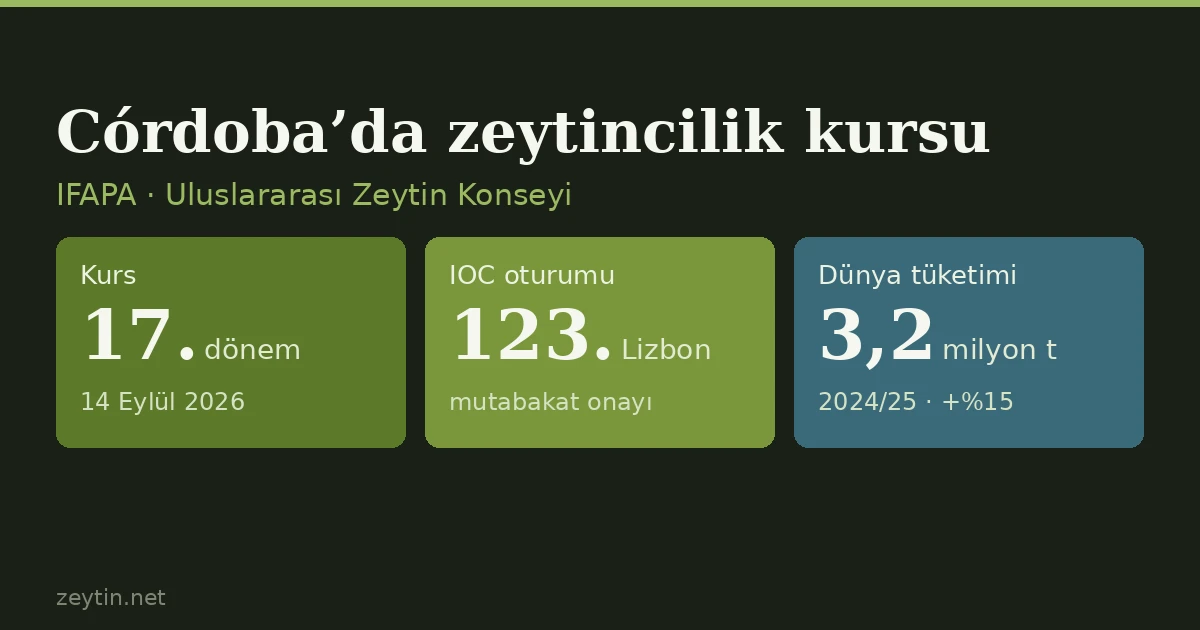
Andalusia's Institute of Agricultural and Fisheries Research and Training (IFAPA) opened its 17th Advanced Specialisation Course in Olive Growing in Córdoba on 14 September, with the International Olive Council giving the opening lecture. The Council has approved signing a memorandum of understanding with IFAPA, which hosts one of the world's key olive germplasm collections.
 Article
Tunisia sold 381,000 tonnes of olive oil in ten months: 85.5% in bulk, half of it to Spain and Italy
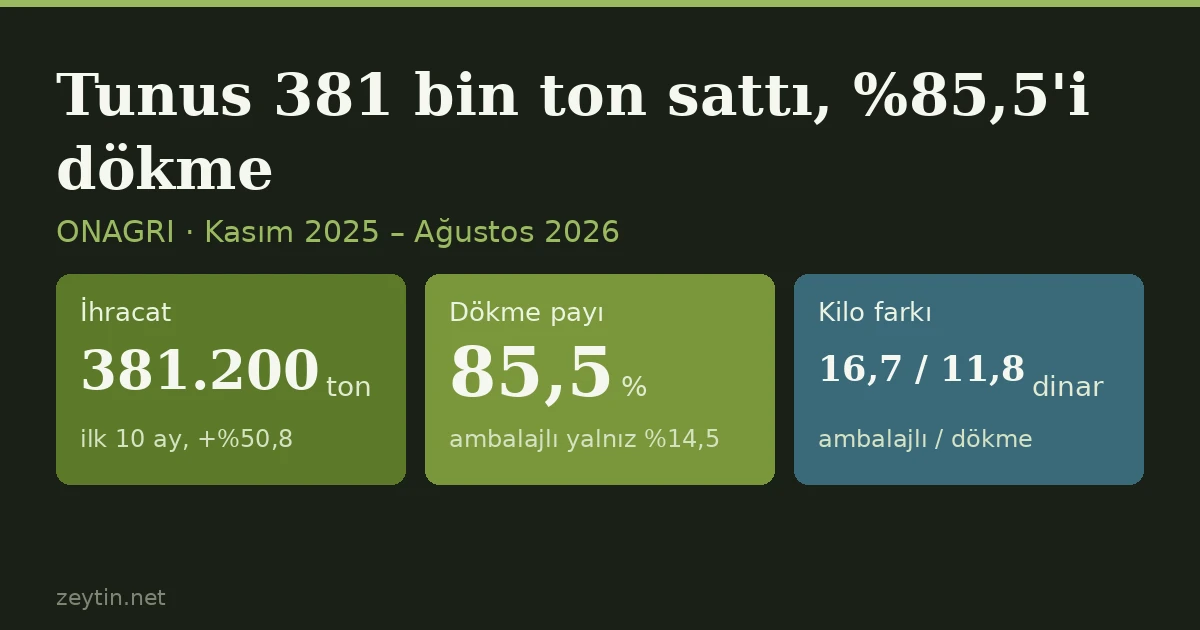
According to the National Observatory of Agriculture (ONAGRI), Tunisia exported 381,200 tonnes of olive oil in the first ten months of the 2025/26 season — volumes up 50.8% and receipts up 41.2% year on year. But 85.5% of it left the country in bulk, and more than half went to Spain and Italy. Packaged oil averaged 16.7 dinars per kilo against 11.8 for bulk. Production is set to fall 40% next season, which changes the bulk market Turkish exporters face.
 Article
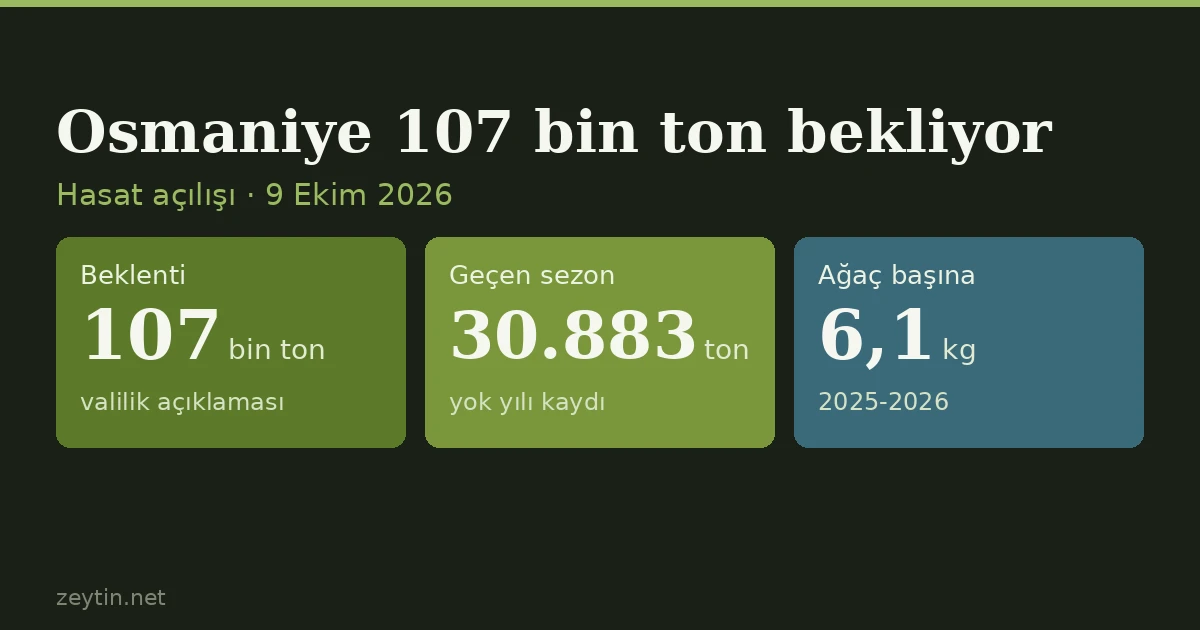
Osmaniye expects 107,000 tonnes: 3.5 times last season, in line with on-year averages
The governor's office in Osmaniye says the province's roughly 10 million olive trees are expected to yield more than 107,000 tonnes this year. That is 3.5 times last season — but 2025-2026 was an off year, and the forecast is consistent with on-year yields. Small discrepancies remain in tree counts and ranking.
 Article
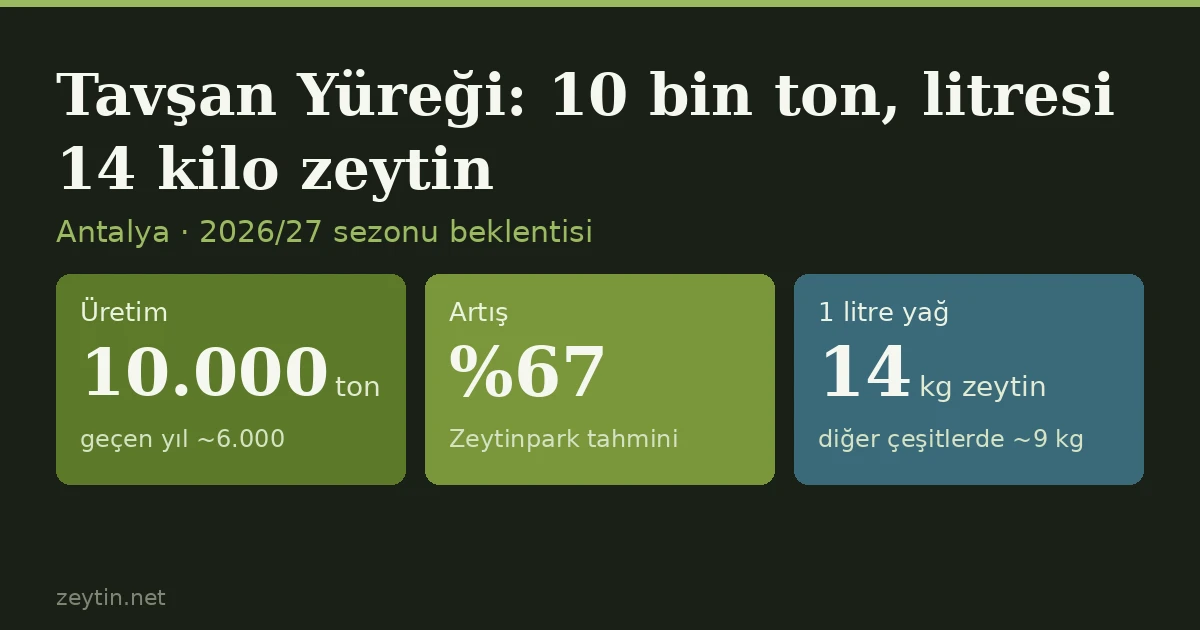
Tavşan Yüreği olive crop seen at 10,000 tonnes: output up 67%, but a litre of oil takes 14 kg of fruit
Zeytinpark general manager Bayram Çarkçıgil says output of Antalya's geographically protected Tavşan Yüreği olive will rise from 6,000 to about 10,000 tonnes. Table olives sell at 80-100 lira a kilo. Other varieties give a litre of oil from 9 kg of fruit; Tavşan Yüreği needs 14 kg, a yield of roughly 6.5 per cent.