What to check when having your olives pressed at a mill: a grower's checklist
The same olives can give a very different oil when pressed at a different mill under different conditions. From what to do before bringing olives in to two-phase versus three-phase systems, kneading temperature, yield, milling fees and the questions to ask when collecting the oil, here is what a grower having olives pressed needs to know.
Olives that have been pruned, fed, protected and finally picked with hard work over a whole year either keep or lose their value in the few hours they spend at the mill. Most olive growers in Türkiye do not own a mill; they have their olives pressed for a fee at someone else's. This article explains, step by step, what a grower should look out for when choosing a mill, delivering the olives and collecting the oil.
1. Before the olives reach the mill: time and transport
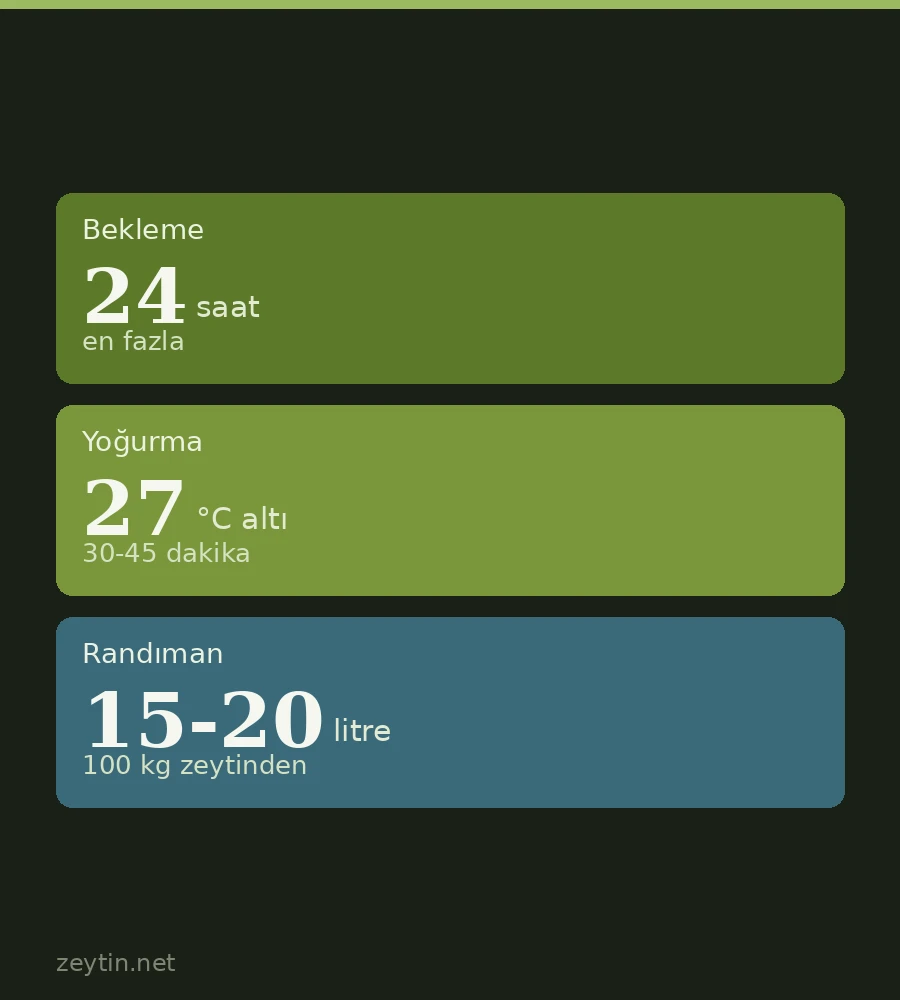
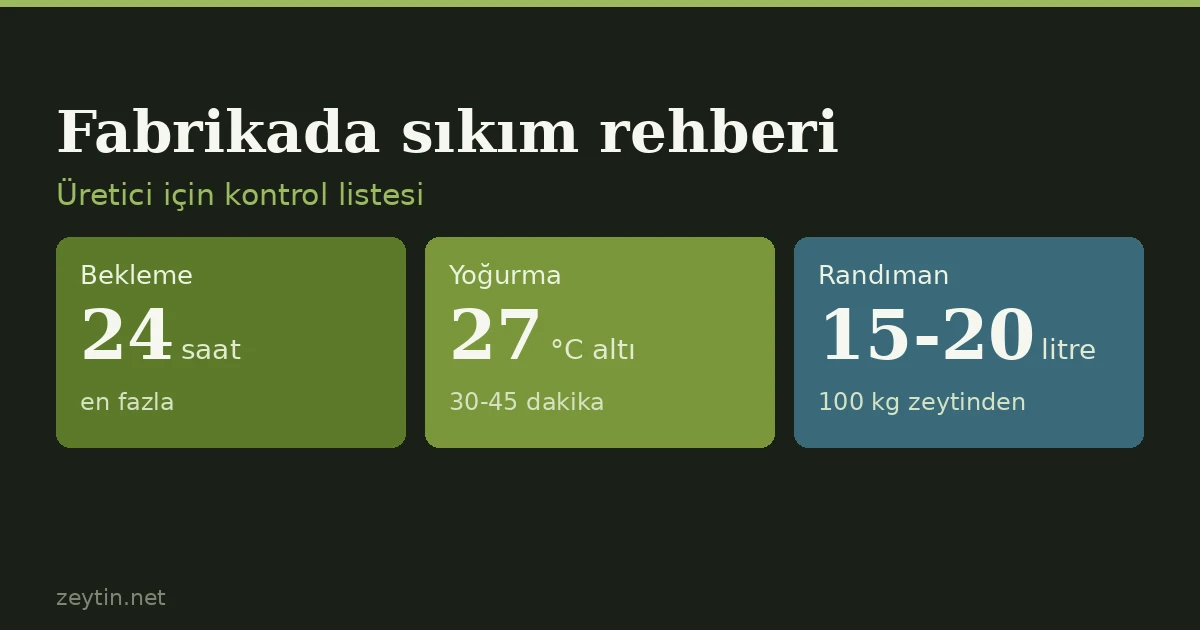
The first enemy of quality is waiting. Picked olives should ideally be pressed within 24 hours. Enzymes in the fruit keep working after it leaves the branch; the longer it waits, the more free fatty acids build up, and fermentation starts in a warming heap. The result shows up directly in the lab report as acidity. We explain what acidity means in a separate article.
That is why the milling slot should be booked before picking starts. In the busy season the queue at mills can stretch to several days; picking olives without a confirmed slot condemns them to wait in sacks.
When transporting olives:
- Use ventilated crates, not sacks. In sacks olives are crushed, get no air and heat up. Crates do not squeeze the fruit even when stacked.
- Do not leave them in the sun. Olives waiting in a trailer or field under the sun warm up quickly.
- Keep ground-picked fruit separate. Olives that fell and stayed on the ground, bruised or muddy, should not be mixed with fruit picked from the tree. One crate of poor olives can drag down the oil of the whole batch.
- Keep leaves and twigs to a minimum. Even with a leaf remover at the mill, excess leaves and soil affect the line and the taste of the oil.
2. Choosing a mill: two-phase or three-phase?
Almost all modern mills use a continuous system: olives are crushed, the paste is kneaded and a decanter (horizontal centrifuge) separates the oil from water and solids. There are two types of decanter:
| Feature | Three-phase | Two-phase |
|---|---|---|
| Water added to the paste | Yes, a significant amount | None or very little |
| Outputs | Oil + vegetation water + pomace | Oil + wet pomace |
| Vegetation water | A lot | Almost none |
| Polyphenols | Some are washed out by the added water | More remain in the oil |
Because it uses little water, the two-phase system has advantages both for the environment and for the polyphenols that give oil its bitterness and pungency. The three-phase system makes the vegetation water problem worse; we looked at that by-product's environmental impact in olive mill waste water and pomace. Traditional stone mills and press systems still exist; with them hygiene and waiting time become even more critical.
Other questions to ask when choosing a mill:
- Daily capacity and queue: will the olives I deliver be processed the same day?
- Individual batches: will my olives be processed as a separate batch, without mixing with other growers' fruit?
- Line cleaning: is the line cleaned between batches?
3. What happens on the line? Kneading temperature and time
The two settings that most determine quality at the mill are made in the malaxer, the tank where the paste is kneaded:
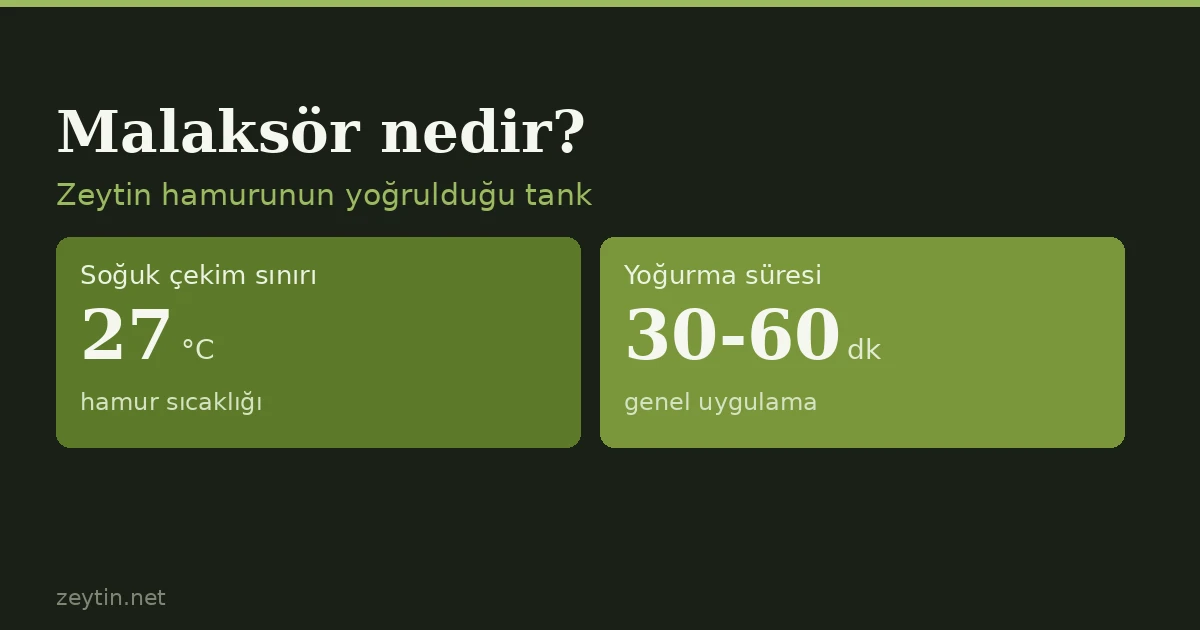
- Temperature: for the label to say "cold pressed" or "cold extracted", the paste must stay below 27 °C throughout. Higher temperatures raise oil yield but cost aroma and polyphenols.
- Time: usually 30-45 minutes. The longer it takes, the more the paste is exposed to oxygen.
A mill that wants higher yields may be tempted to raise the temperature. For the grower the rule is simple: if you are aiming for good, marketable extra virgin oil, ask "at what temperature and for how long is the paste kneaded?" You will find all the details of this stage in what is a malaxer, and how the whole line works in our guide how cold-pressed olive oil is made.
4. Yield: how many litres from how many kilos?
After pressing, the most discussed topic is yield, the amount of oil obtained from a given amount of olives. On average 100 kilos of olives give 15-20 litres of oil. The figure varies with variety, ripeness, year and rainfall: it can fall to 12% with early harvest and rise to 25% with late harvest.
Two traps to watch for when calculating:
- Litres are not kilos. Olive oil is lighter than water; a litre of olive oil weighs about 0.91-0.92 kilograms. "18 kilos of oil from 100 kilos" and "18 litres of oil from 100 kilos" are not the same result; ask whether the mill measures by weight or by volume.
- Yield is not the fruit's oil content. Oil content measured in the lab shows the total oil in the fruit; not all of it comes out at the mill, and some stays in the pomace. We explain varieties' oil contents and this difference on our page on olive varieties with the highest oil content.
The lower yield of early-harvested olives may look like a loss, but the oil's character and price are different; we discuss that balance in is early harvest expensive or valuable?
5. Milling fees: money or oil?
In toll pressing the fee is charged in one of two ways:
- In money: a set fee per kilogram of olives processed. For example, for the Topçam Madran Olive Oil Mill owned by Çine Municipality in Aydın, the municipal council set the fee in its 2025 tariff at 2.25 lira per kilogram.
- In oil: a percentage of the oil produced is left at the mill. In an earlier tariff at the same mill, that share was 7%.
Which is better depends on that year's oil price and yield. In years when oil prices are high, paying in money may make more sense; when cash is short, paying in oil may be easier. Before deciding, do a simple calculation: compare the fee in money with the market value of the oil you would leave behind. You can see milling's share of production costs in our analysis what does a kilo of olives cost to produce?
6. Collecting the oil
Protecting the quality of the oil leaving the mill is now in the grower's hands:
- Containers: food-grade stainless steel tanks or food-safe, light-proof containers. Never use old paint, detergent or fuel cans.
- Fill level: fill the container to the brim as far as possible; air left inside speeds up oxidation.
- Light and heat: store the oil in a cool, dark place.
- Sediment: freshly pressed oil is cloudy and sediment settles at the bottom. Long contact with that sediment can cause defects; the oil should be separated from it within a few weeks.
7. Getting an analysis
If you plan to sell your oil, or simply want to know whether it really is extra virgin, have it analysed at an accredited laboratory. The basic tests are free acidity, peroxide value and UV absorbance (K232, K270). Acidity reflects the history of the fruit and the pressing; peroxide and K values show the oil's oxidation status. We explain what the label categories stand for in extra virgin, virgin and riviera olive oil grades explained.
Quick checklist
- Book your milling slot before picking; have olives pressed within 24 hours.
- Use ventilated crates, not sacks; keep ground-picked fruit separate.
- Where possible, choose a mill with a two-phase system and a clean line.
- Ask whether your olives will be processed as a separate batch.
- Ask about kneading: below 27 °C, 30-45 minutes.
- Clarify whether yield is in litres or kilos.
- Compare the fee in money and in oil.
- Store oil in full, clean, light-proof containers; separate it from sediment; if you are selling, get an analysis.
One rating per visitor; you can change yours at any time. Ratings are real reader votes — no seeded or default scores.
Related
 Article
North Aegean Olive Oils: a registration stricter than the food codex
The mark of ten localities rather than one district — and unusually, it sets tighter limits than the national standard on peroxide, FAEE, waxes and K270.
Article
North Aegean Olive Oils: a registration stricter than the food codex
The mark of ten localities rather than one district — and unusually, it sets tighter limits than the national standard on peroxide, FAEE, waxes and K270.
 Article
What is a malaxer? The tank where olive paste is kneaded, and the 27 °C limit
A malaxer is the stainless steel kneading tank where crushed olive paste is slowly mixed so that oil droplets can merge. Time and temperature decide both yield and aroma, and this is also where the limit for "cold extraction" is drawn.
Article
What is a malaxer? The tank where olive paste is kneaded, and the 27 °C limit
A malaxer is the stainless steel kneading tank where crushed olive paste is slowly mixed so that oil droplets can merge. Time and temperature decide both yield and aroma, and this is also where the limit for "cold extraction" is drawn.
 Article
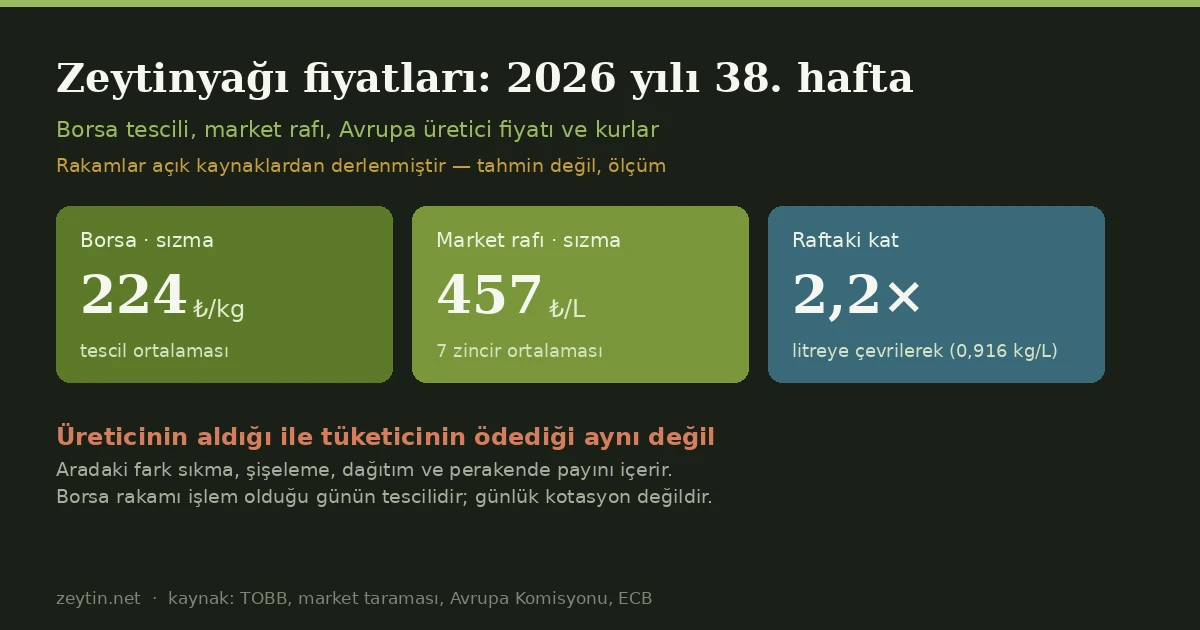
Olive Oil Prices: Week 38 of 2026
Week 38 of 2026: Turkish exchange prices, European producer prices and exchange rates side by side.
Article
Olive Oil Prices: Week 38 of 2026
Week 38 of 2026: Turkish exchange prices, European producer prices and exchange rates side by side.
 Article
How is olive oil acidity measured? Titration, the formula and taking a sample
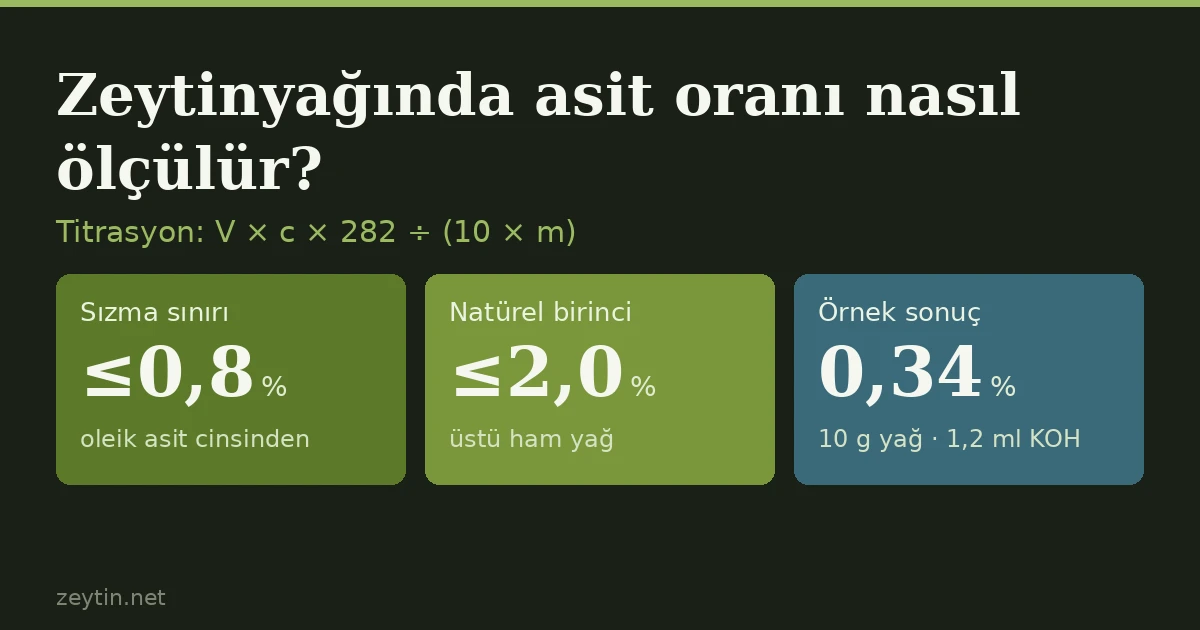
Olive oil acidity is measured in a laboratory by titration: the oil is dissolved in a solvent, free fatty acids are neutralised with potassium hydroxide, and the percentage is calculated as oleic acid from the amount used. The formula, a worked example, sampling and the limits of home test kits.
Article
How is olive oil acidity measured? Titration, the formula and taking a sample
Olive oil acidity is measured in a laboratory by titration: the oil is dissolved in a solvent, free fatty acids are neutralised with potassium hydroxide, and the percentage is calculated as oleic acid from the amount used. The formula, a worked example, sampling and the limits of home test kits.