How to read an olive oil lab report: acidity, peroxide, K232, K270 and ΔK
The rows of figures on an olive oil lab report look cryptic at first. What do free acidity, peroxide value, K232, K270, ΔK, ethyl esters and sensory analysis measure, what are the limits for extra virgin and virgin grades, and how do you interpret a report using a worked example?
When you go to a laboratory to sell your oil, send a sample to a buyer or simply answer the question "is my oil really extra virgin?", you get back a page of tables. Free acidity, peroxide, K232, K270, ΔK... a number next to each row, sometimes a limit. This article explains what each row measures, what problem it reveals and what the limits are for extra virgin and virgin grades.
The limits are set in the European Union's olive oil legislation (Regulation 2022/2104) and in the International Olive Council trade standard; the Turkish Food Codex communiqué on olive oil is based on the same methods and similar limits.
The big picture first: two kinds of analysis
The tests on an olive oil report fall into two groups:
- Quality tests show how well the oil was produced and preserved. Acidity, peroxide, K232, K270, ΔK, ethyl esters and sensory analysis belong here. They decide the split between extra virgin and virgin.
- Purity tests show whether the oil really is only olive oil and whether it has been mixed with other oils. Fatty acid profile, sterols, waxes and stigmastadienes belong here.
For growers the first group matters every year; the second comes into play mainly in trade and when adulteration is suspected.
The limits in one table
| Parameter | Extra virgin | Virgin |
|---|---|---|
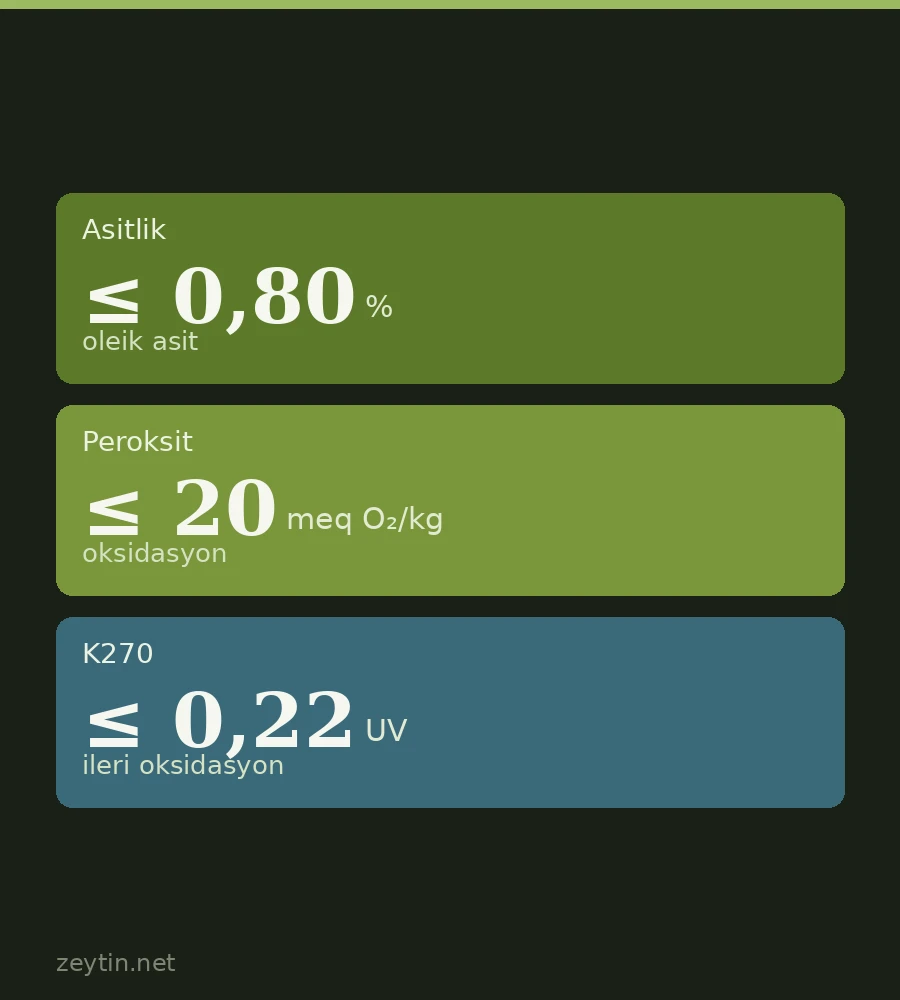
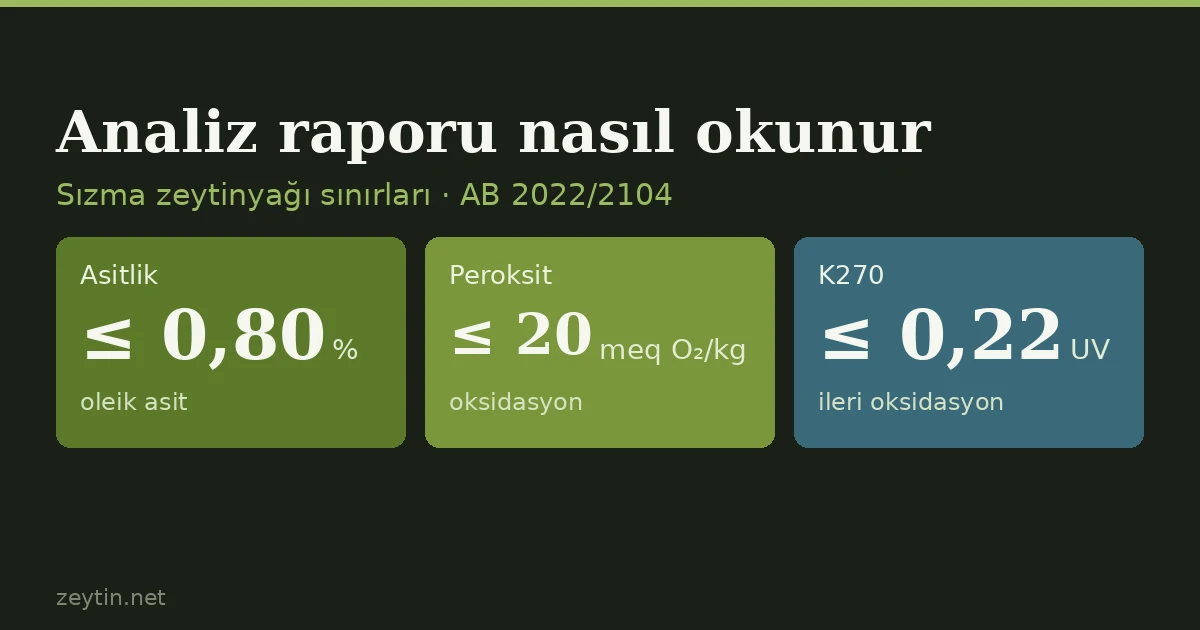
| Free acidity (% oleic acid) | ≤ 0.80 | ≤ 2.0 |
| Peroxide value (meq O₂/kg) | ≤ 20.0 | ≤ 20.0 |
| K232 | ≤ 2.50 | ≤ 2.60 |
| K268 / K270 | ≤ 0.22 | ≤ 0.25 |
| ΔK | ≤ 0.01 | ≤ 0.01 |
| Ethyl esters (mg/kg) | ≤ 35 | — |
| Sensory: median of defects (Md) | 0 | ≤ 3.5 |
| Sensory: median of fruitiness (Mf) | > 0 | > 0 |
To count as extra virgin, an oil must meet all the criteria in the table at the same time. A single parameter above its limit lowers the grade. Oil with acidity above 2.0 or a median of defects above 3.5 is classed as "lampante" and is not fit for direct consumption; it has to be refined.
Free acidity: the history of the fruit and the pressing
What it measures: the share of fatty acids that have broken away from triglycerides and become free, expressed as a percentage of oleic acid.
What it shows: what the olives went through from the branch to the mill. Fruit fly damage, fruit left lying on the ground, bruising, heating in sacks and long delays between picking and pressing all raise acidity. Acidity is largely fixed at pressing; in a well-stored oil it does not rise quickly in the bottle.
A common misconception: acidity cannot be tasted. The idea that "bitter, peppery oil has high acidity" is wrong; bitterness and pungency come from polyphenols. We explain what acidity means in detail in what does acidity mean in olive oil.
Peroxide value: the first step of oxidation
What it measures: the primary oxidation products (peroxides) formed when oil reacts with oxygen, as milliequivalents of active oxygen per kilogram.
What it shows: how much air, light and heat the oil has been exposed to. Peroxide rises in oil left in open containers, half-full tins or warm rooms. Unlike acidity, peroxide increases during storage.
Caution: peroxides are unstable; over time they break down into other compounds. A very old, spoiled oil can therefore show a lower peroxide value than expected. Peroxide should not be read alone but together with the K values.
K232 and K270: oxidation traces in ultraviolet light
What they measure: how much ultraviolet light the oil absorbs at specific wavelengths. The oil is diluted in a solvent and read in a spectrophotometer.
- K232: absorbance at 232 nanometres. It reflects conjugated dienes formed in the early stage of oxidation and moves together with peroxide.
- K270 (or K268): absorbance around 270 nanometres. It reflects secondary products of advanced oxidation (conjugated trienes, aldehydes and ketones).
What they show: high K232 and K270 mean the oil has oxidised, that is aged or been poorly protected. K270 also carries traces of refining: the bleaching step in refining leaves strong absorbance in this region. Refined oil mixed into extra virgin pushes K270 up.
ΔK: a clue to refined oil
What it measures: the shape of the absorbance curve around 270 nanometres, meaning the difference between the value at 270 and the values either side.
What it shows: refined oils are known to give a characteristic peak in this region because of compounds formed during bleaching. The limit for extra virgin and virgin oil is 0.01. Exceeding it suggests that refined oil may have been added.
Ethyl esters: the trace of poor fruit
What they measure: esters formed by fatty acids with ethyl alcohol (mg/kg).
What they show: ethyl alcohol forms in olives that have been left waiting and have started to ferment. High ethyl esters therefore indicate oil made from deteriorating, stored or poor-quality fruit. The test has another important role: catching poor oil that has been through mild "soft deodorisation" to remove defective odours and is then sold as extra virgin. Deodorisation removes the smell but leaves the ethyl esters.
Sensory analysis: the human part of the lab
However good the chemical results, an oil cannot be classed as extra virgin without passing a tasting panel. A trained panel of 8-12 people smells and tastes the oil under standard conditions, scoring defects (such as musty, winey, vegetable water, frostbitten olives, metallic, rancid) and positive attributes (fruitiness, bitterness, pungency). The result is given as the median of the panellists' scores.
- Extra virgin: median of defects 0, median of fruitiness above 0.
- Virgin: median of defects not above 3.5, fruitiness above 0 (an oil with a detected defect falls into the virgin grade even if its chemistry meets extra virgin limits).
We describe what the defects are like and how they arise on our page on olive oil tasting defects and positive attributes.
A sample report: how to read it
Suppose the laboratory sends back these results:
| Parameter | Result | Extra virgin limit | Interpretation |
|---|---|---|---|
| Free acidity | 0.42 | ≤ 0.80 | Compliant; olives pressed in good condition |
| Peroxide | 9.6 | ≤ 20.0 | Compliant; low oxidation |
| K232 | 1.95 | ≤ 2.50 | Compliant |
| K270 | 0.16 | ≤ 0.22 | Compliant |
| ΔK | 0.003 | ≤ 0.01 | No sign of refined oil |
The values are illustrative and do not come from a real measurement.
Chemically this oil is extra virgin. Two things must not be forgotten, though. First, it cannot be called extra virgin without sensory analysis. Second, an analysis shows the situation on that day. If the same oil sits through the summer in a warm, bright place in a half-full container, its peroxide and K232 values may approach the limits within a few months. We explain how to protect oil in our guide how to store olive oil.
Which result points to what?
| High value | Possible cause | Where to look |
|---|---|---|
| Acidity | Fly-damaged, ground-picked, bruised or long-stored fruit | Grove and before pressing |
| Peroxide + K232 | Air, light, heat; half-full containers; ageing | Storage |
| K270 | Advanced oxidation or refined oil added | Storage or adulteration |
| ΔK | Refined oil added | Adulteration |
| Ethyl esters | Fermented fruit, soft deodorisation | Fruit quality or processing |
Practical tips for growers
- Take the sample to the lab in a clean, dark, full-to-the-brim bottle kept cool; a half-full sample left in the heat will give a worse result than your oil deserves.
- Take the sample from a container that represents the whole batch you will sell.
- Have the analysis done at an accredited laboratory; that is what counts in trade.
- Consider having a sensory analysis done before selling as well.
You will find what the label grades tell consumers in extra virgin, virgin and riviera olive oil grades explained and how to read an olive oil label.
One rating per visitor; you can change yours at any time. Ratings are real reader votes — no seeded or default scores.
Related
 Article
Extra Virgin, Virgin, Riviera: Olive Oil Grades Explained
What do 'extra virgin', 'riviera' and 'refined' mean on the label? The difference lies in the production method and acidity.
Article
Extra Virgin, Virgin, Riviera: Olive Oil Grades Explained
What do 'extra virgin', 'riviera' and 'refined' mean on the label? The difference lies in the production method and acidity.
 Article
The Ayvalık Olive Oil designation of origin: the chemical profile in the certificate
Registered in 2007. The certificate carries tables of fatty acids, sterols and phenolics — the ranges within which an oil counts as Ayvalık Olive Oil are set out in figures.
Article
The Ayvalık Olive Oil designation of origin: the chemical profile in the certificate
Registered in 2007. The certificate carries tables of fatty acids, sterols and phenolics — the ranges within which an oil counts as Ayvalık Olive Oil are set out in figures.
 Article
Osmaniye Olive Oil: a registration with sensory thresholds above six
Registered in 2022. Fruitiness ≥6.4, bitterness ≥6.0, pungency ≥6.1 — unusually high thresholds. Milling within 48 hours of harvest is required.
Article
Osmaniye Olive Oil: a registration with sensory thresholds above six
Registered in 2022. Fruitiness ≥6.4, bitterness ≥6.0, pungency ≥6.1 — unusually high thresholds. Milling within 48 hours of harvest is required.
 Article
Olive Oil Prices: Week 39 of 2026
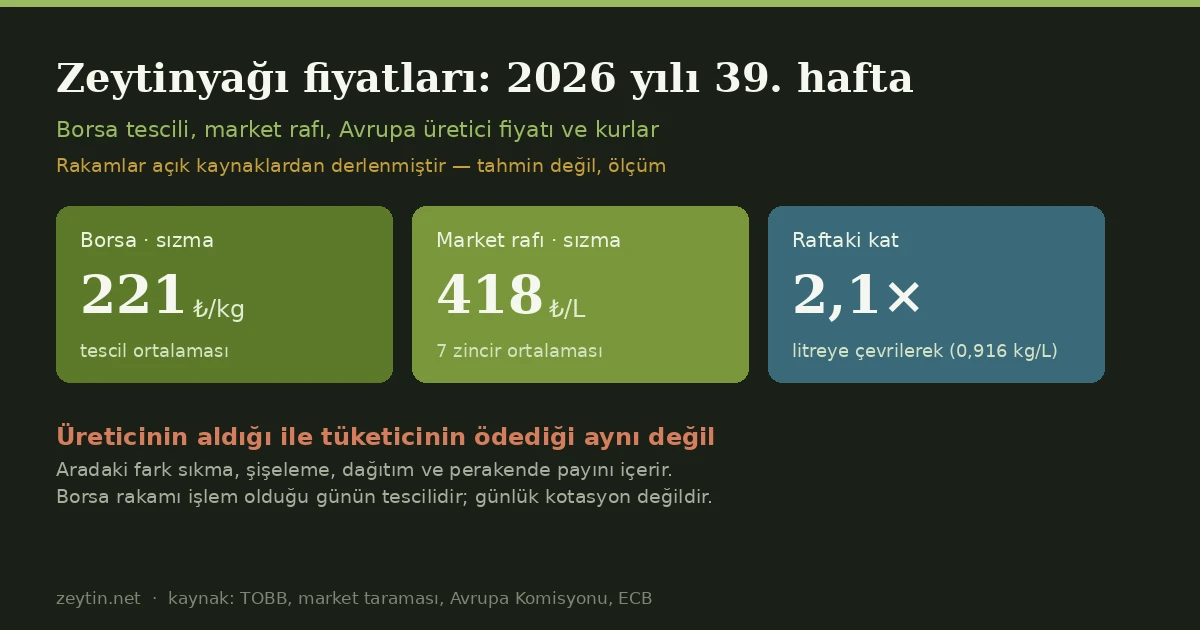
Week 39 of 2026: Turkish exchange prices, European producer prices and exchange rates side by side.
Article
Olive Oil Prices: Week 39 of 2026
Week 39 of 2026: Turkish exchange prices, European producer prices and exchange rates side by side.