Where do olives grow in Turkey? The picture in 45 provinces
The Aegean alone produces half the national crop; ten Black Sea provinces together manage 865 tonnes. In 46 provinces there is no commercial production at all.
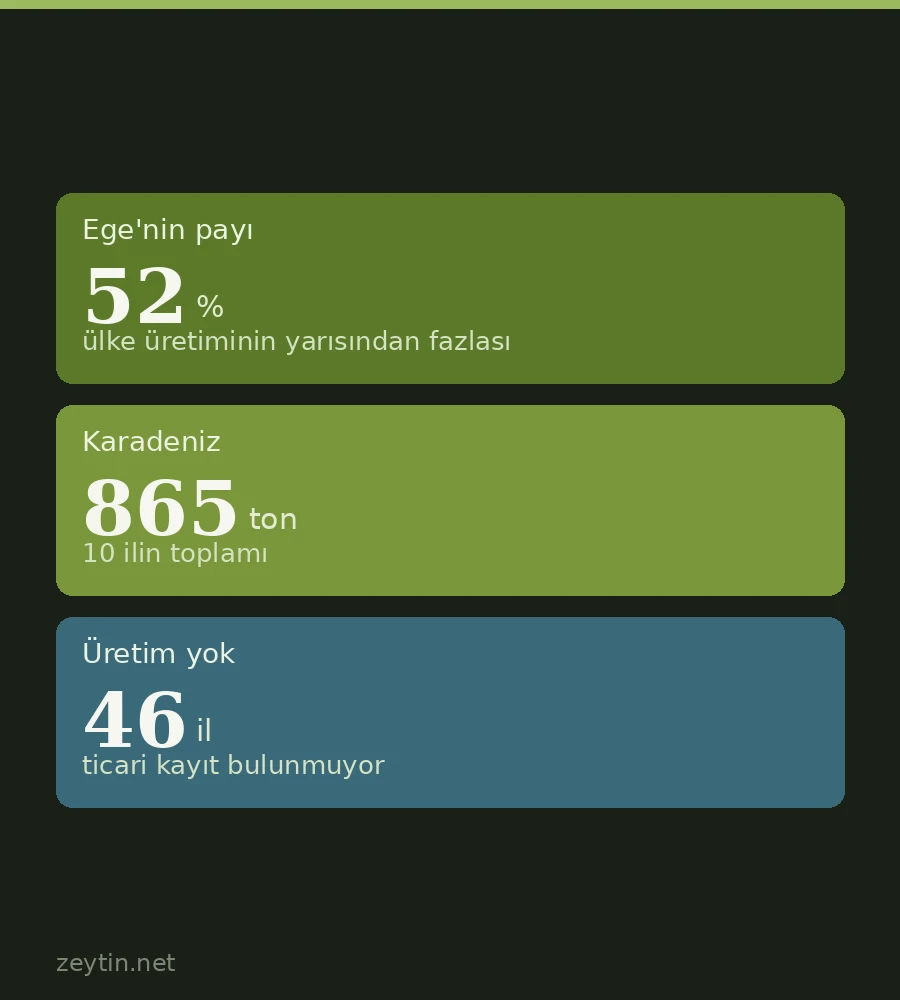
Olives are grown, with recorded production, in 45 of Turkey's 81 provinces; the remaining 36 have no commercial record at all. But "grown" and "grown at economic scale" are not the same thing: in the 2025-2026 season more than half of the national crop came from a single region, the Aegean.
Olive production by region
According to the Turkish Statistical Institute's 2025-2026 season figures, production by region is as follows:
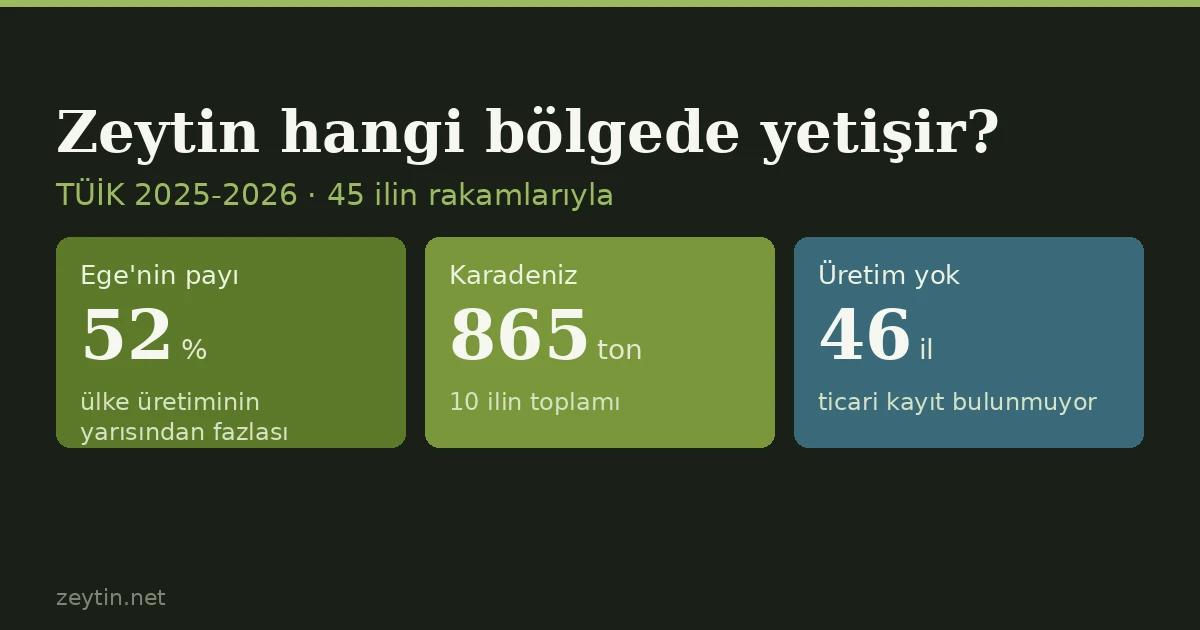
| Region | Provinces | Olives | Olive oil | Trees |
|---|---|---|---|---|
| Aegean | 6 | 1,321,855 t | 167,985 t | 86.8 million |
| Mediterranean | 9 | 567,300 t | 80,262 t | 41.4 million |
| Marmara | 9 | 396,008 t | 44,414 t | 30.2 million |
| Southeastern Anatolia | 9 | 84,058 t | 15,849 t | 17.1 million |
| Black Sea | 10 | 865 t | 53 t | 96 thousand |
| Central Anatolia | 2 | 211 t | 17 t | 46 thousand |
The Aegean alone accounts for roughly 52 per cent of national output. Add the Mediterranean and Marmara and the share reaches 96 per cent. In practice Turkish olive growing is the business of three regions; the other three together account for less than 4 per cent.
The largest producing provinces
The top three provinces are all Aegean: Aydın with 439,278 tonnes, İzmir with 376,021 and Manisa with 320,045. Mersin follows from the Mediterranean with 224,537 tonnes, then Hatay with 182,319. Marmara's largest is Balıkesir at 151,630 tonnes, ahead of Bursa (140,847) and Çanakkale (81,895).
The ranking changes for olive oil. İzmir leads with 60,988 tonnes, Aydın follows with 44,785. Hatay turns 182,000 tonnes of fruit into 34,599 tonnes of oil, while Bursa produces only 8,192 tonnes of oil from 140,000 tonnes of fruit. The reason is straightforward: Bursa's weight is in Gemlik, that is, in table olives. High fruit tonnage does not make a province an oil producer.
Yield per tree is where the real difference lies
Tree count alone is misleading. Southeastern Anatolia has 17.1 million trees but produces 84,000 tonnes; Marmara produces 396,000 tonnes from 30.2 million trees. Yield per tree makes the picture clear:
| Province | Yield |
|---|---|
| İzmir | 20.3 kg per tree |
| Aydın | 19.6 kg |
| Mersin | 19.5 kg |
| Çanakkale | 15.8 kg |
| Kilis | 5.8 kg |
| Gaziantep | 4.6 kg |
A tree on the Aegean or Mediterranean coast yields roughly four times what a tree in the southeast does. The gap is usually explained by access to irrigation, soil depth and the severity of summer drought. In the southeast there are many trees and little water.
Region also determines the variety
Each region is known for its own cultivars. The Aegean has Memecik, Domat, Erkence and Edremit (Ayvalık); Marmara has Gemlik; the Mediterranean has Sarı Ulak and Büyük Topak Ulak; the southeast has Nizip Yağlık, Kilis Yağlığı and Halhalı. This distribution is not accidental: varieties were selected over centuries for local winter cold, summer drought and harvest timing.
Moving a variety to another region rarely gives the expected result; oil content and ripening dates shift. You can see which variety grows where on our olive map of Turkey.
Why the coastal belt?
The olive's preference for the coast is not about the sea itself but about the way water moderates temperature. Because the sea warms and cools more slowly than land, winter nights on the coastal belt are milder and summer heat is steadier. That is precisely what the tree needs: dry and hot in summer, cool but frost-free in winter.
Olives also require a certain amount of winter chill. Flower buds need a period below roughly 7-10 °C to form, which is why the tree will grow in a tropical climate but set no fruit. An olive tolerates neither hard cold nor an absence of cold; it grows in the narrow band between. That is why the Mediterranean basin is the olive basin.
The same region does not produce the same amount every year
The map is fixed; production is not. Olives show alternate bearing: a heavy crop one year is followed by a light one. The twelve-season total for the six largest provinces (Aydın, İzmir, Manisa, Muğla, Bursa, Çanakkale) shows this clearly:
| Season | Total fruit |
|---|---|
| 2020-2021 | 762,050 t |
| 2021-2022 | 1,089,833 t |
| 2022-2023 | 2,106,410 t |
| 2023-2024 | 804,669 t |
| 2024-2025 | 2,213,148 t |
| 2025-2026 | 1,517,269 t |
At province level the swing is sharper still. Aydın closed 2023-2024 with 109,210 tonnes and produced 478,484 tonnes the following season, a difference of 4.4 times. This is not a climate disaster or disease but the tree's natural rhythm; irrigation, pruning and fertilisation soften the swing without removing it.
The practical consequence is that "how much does this region produce" cannot be answered from a single season. The 2025-2026 figures in this article represent a strong season; 2023-2024 was a weak one.
The marginal regions
Three regions sit at the margin, and each raises its own question:
- The Black Sea — 865 tonnes across ten provinces. Four report output, six report none. In detail: Do olive trees grow on the Black Sea coast?
- Central and Eastern Anatolia — winter cold rules out commercial production. In detail: Do olives grow in cold regions?
- The 46 provinces with no record — which they are and why: Which provinces in Turkey grow no olives?
In short
Olives in Turkey grow broadly south of a Sinop-Artvin line, in a coastal and near-coastal belt. Half the crop comes from the Aegean and 96 per cent from the Aegean-Mediterranean-Marmara triangle. On the Black Sea production is confined to microclimates; in Central and Eastern Anatolia winter cold rules it out at commercial scale. What drives the yield gap is not tree count but water and climate.
Figures are based on the Turkish Statistical Institute's provincial crop production statistics for the 2025-2026 season.
One rating per visitor; you can change yours at any time. Ratings are real reader votes — no seeded or default scores.
Related
 Article
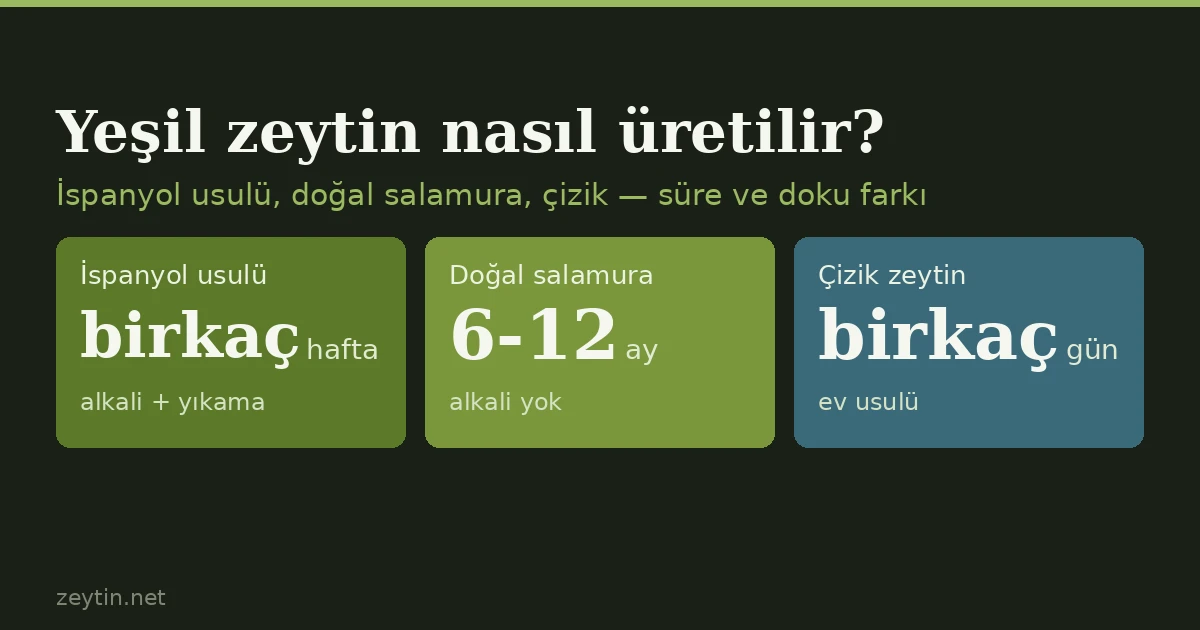
How are green table olives made? Three methods, three results
Green olives cannot be eaten off the tree; the bitterness must be removed. The difference between Spanish-style, natural brine and scored methods sets time, texture and taste.
Article
How are green table olives made? Three methods, three results
Green olives cannot be eaten off the tree; the bitterness must be removed. The difference between Spanish-style, natural brine and scored methods sets time, texture and taste.
 Article
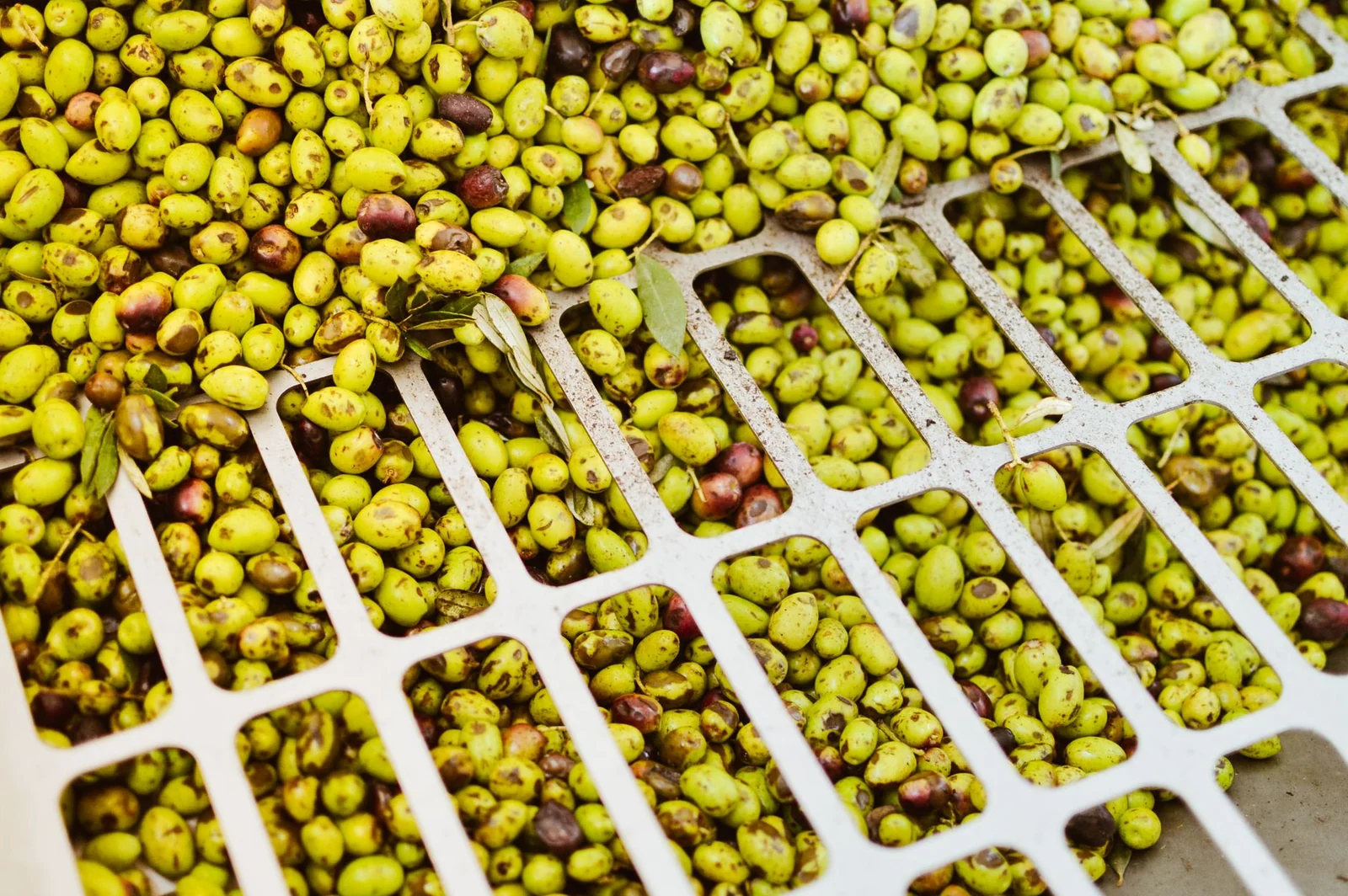
Which is Turkey's best-quality olive?
Quality criteria and measured values for Turkey's main olive varieties — fruit weight, oil content and intended use.
Article
Which is Turkey's best-quality olive?
Quality criteria and measured values for Turkey's main olive varieties — fruit weight, oil content and intended use.
 Article
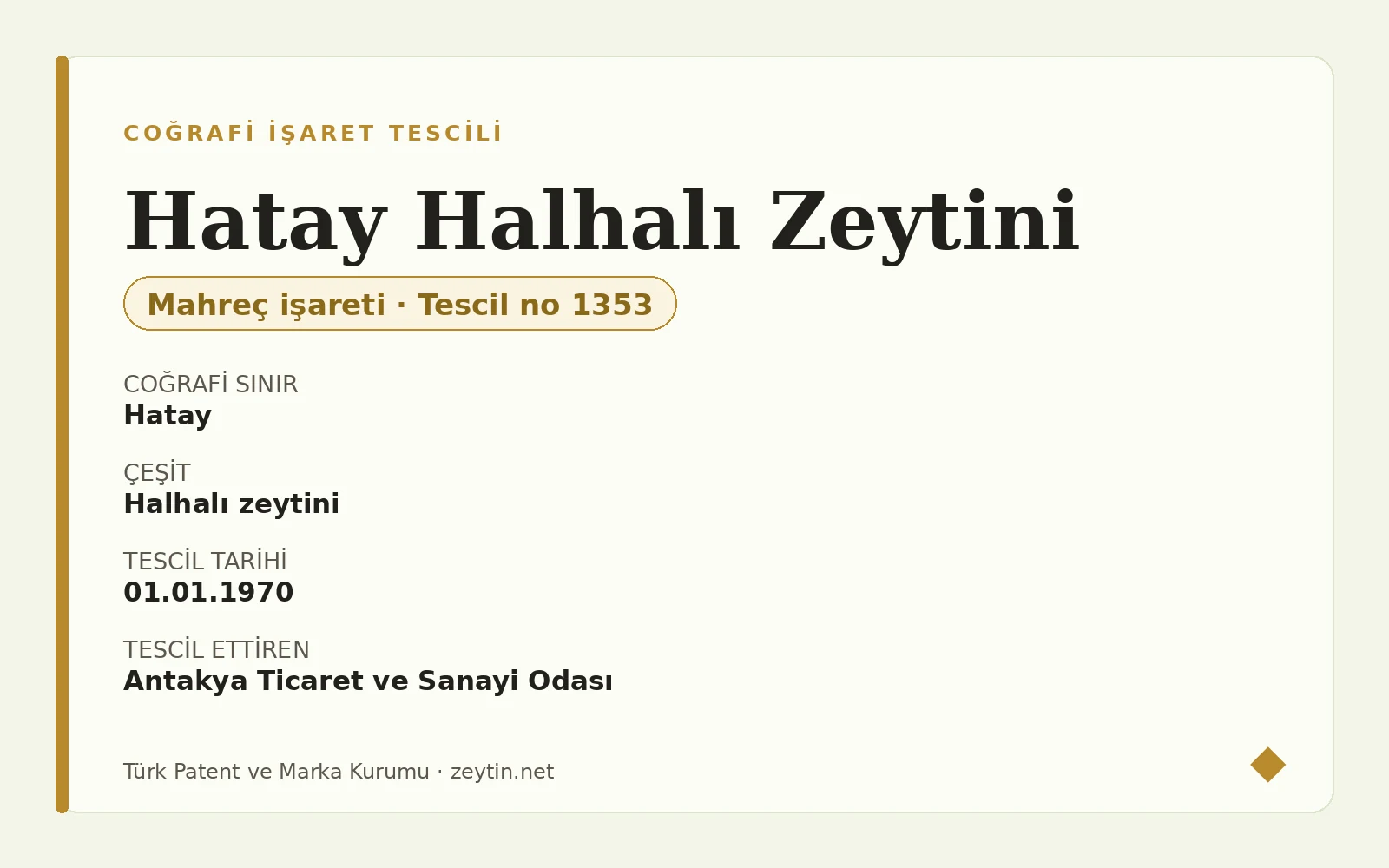
Hatay Halhalı Olive: what long sunshine hours do to phenol content
Registered in 2023. The certificate ties the high phenol content (322-525 mg/kg) directly to long sunshine hours, and defines two separate debittering methods.
Article
Hatay Halhalı Olive: what long sunshine hours do to phenol content
Registered in 2023. The certificate ties the high phenol content (322-525 mg/kg) directly to long sunshine hours, and defines two separate debittering methods.
 Article
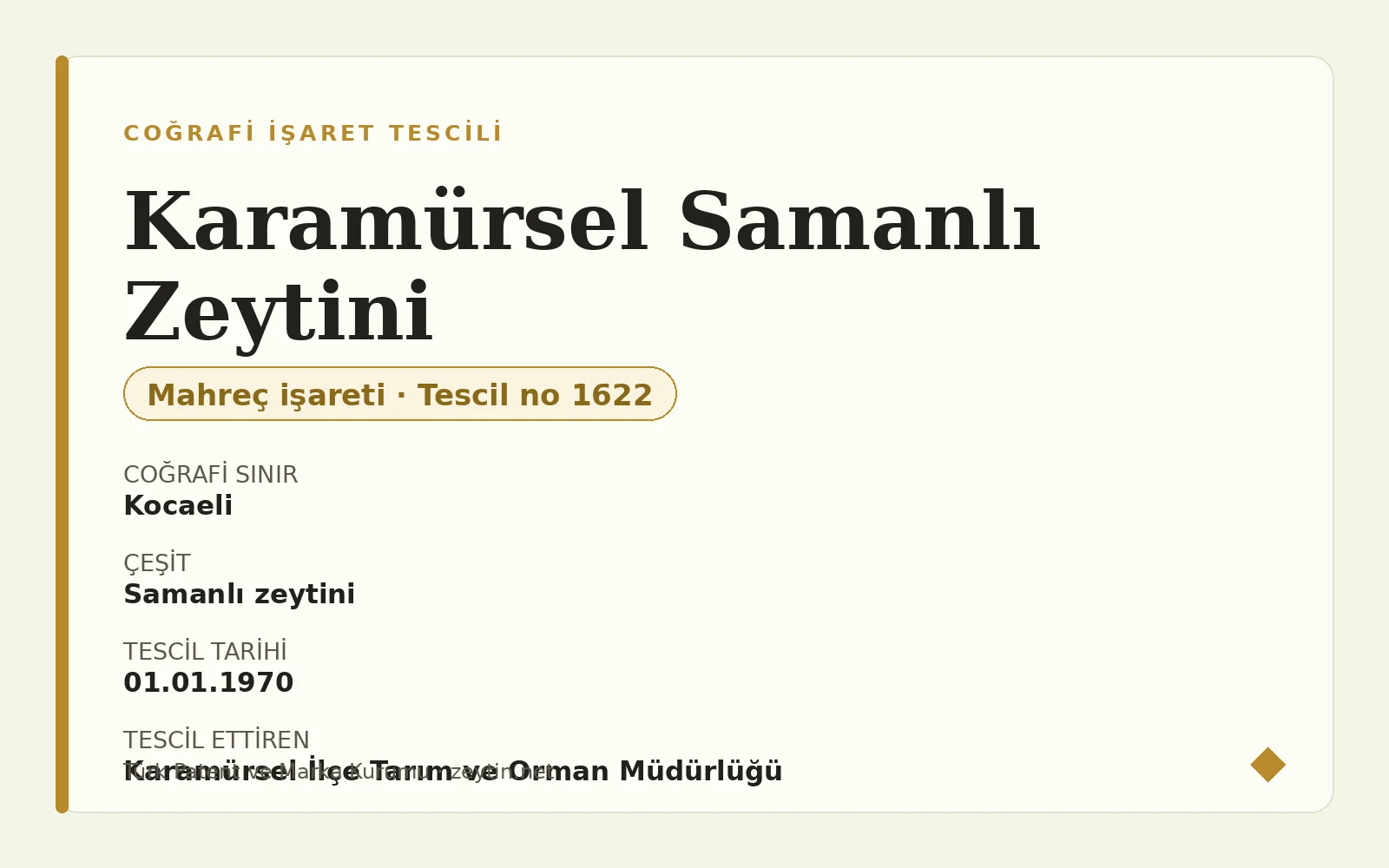
Karamürsel Samanlı Olive: low bitterness earns it the name “sweet olive”
Registered in 2024. Its oleuropein content of 6-8% is low, so it debitters quickly and is locally called the sweet olive. Its skin is 0.2-0.4 mm.
Article
Karamürsel Samanlı Olive: low bitterness earns it the name “sweet olive”
Registered in 2024. Its oleuropein content of 6-8% is low, so it debitters quickly and is locally called the sweet olive. Its skin is 0.2-0.4 mm.