Which provinces in Turkey grow no olives?
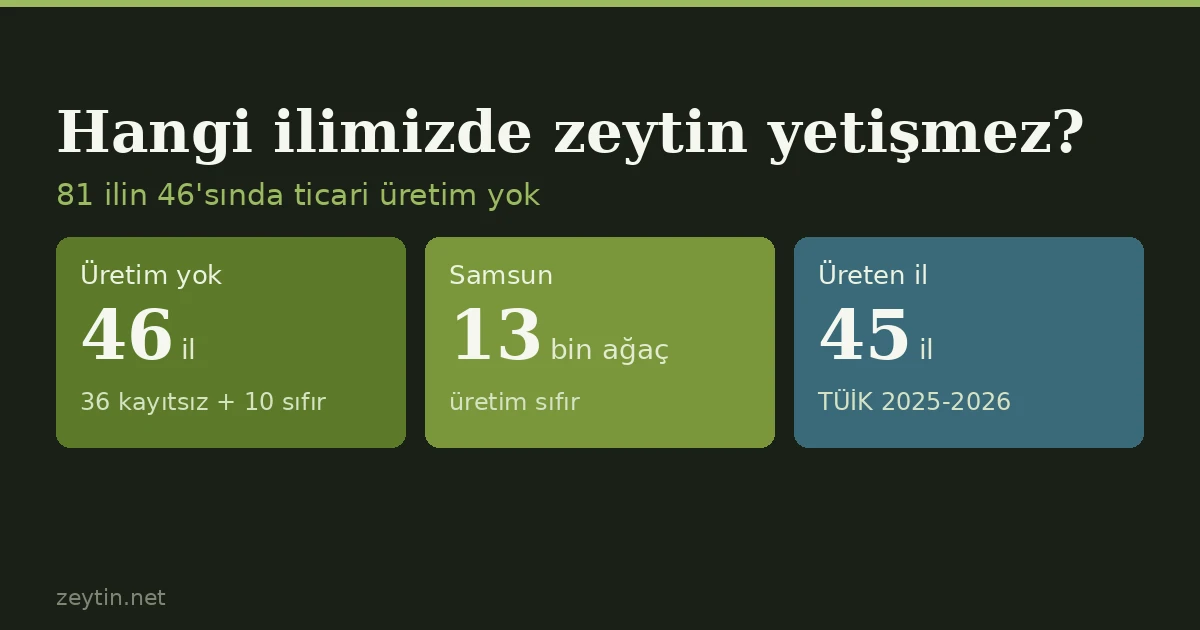
Forty-six of Turkey's 81 provinces have no commercial olive production: 36 absent from the statistics, ten reporting zero. Samsun has 13,000 trees and no crop.
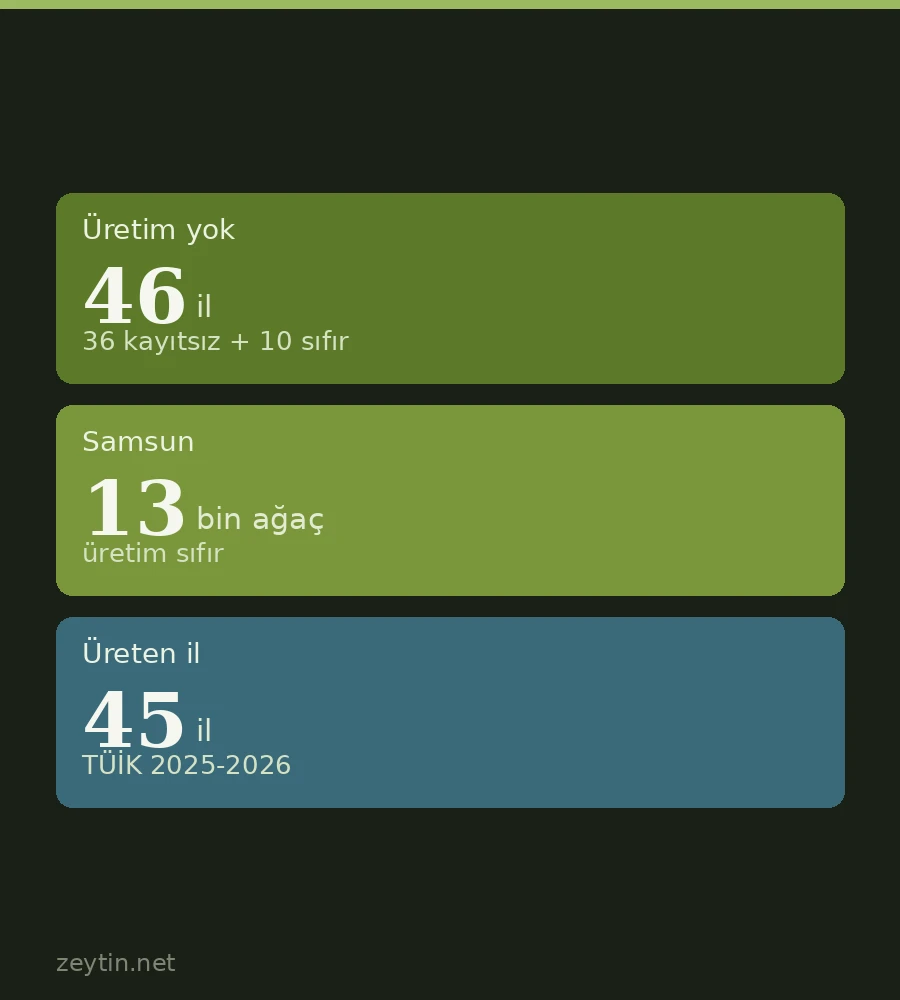
Short answer: 46 of Turkey's 81 provinces have no commercial olive production. Thirty-six do not appear in the statistics at all, and ten are listed but closed the season at zero.
The ten provinces reporting zero
These provinces appear in the 2025-2026 provincial statistics but with no production:
| Province | Region | Registered trees |
|---|---|---|
| Ankara | Central Anatolia | none |
| Bartın | Black Sea | none |
| Batman | Southeastern Anatolia | none |
| Edirne | Marmara | none |
| Ordu | Black Sea | 1,000 |
| Rize | Black Sea | none |
| Samsun | Black Sea | 13,000 |
| Siirt | Southeastern Anatolia | none |
| Tokat | Black Sea | 1,000 |
| Zonguldak | Black Sea | none |
Samsun is the striking case: 13,000 registered trees and zero production. Trees were planted and survive, but no commercially harvestable crop comes off them.
The 36 provinces absent from the statistics
Afyonkarahisar, Aksaray, Amasya, Ardahan, Ağrı, Bayburt, Bingöl, Bitlis, Bolu, Düzce, Elazığ, Erzincan, Erzurum, Giresun, Gümüşhane, Hakkari, Iğdır, Karabük, Kars, Kayseri, Konya, Kütahya, Kırklareli, Kırıkkale, Kırşehir, Malatya, Muş, Nevşehir, Niğde, Sivas, Tunceli, Van, Yozgat, Çankırı, Çorum and İstanbul.
These provinces have no groves at a scale worth recording, so they never enter the statistics. A few garden trees may exist; measured, reported production does not.
Why not? Three separate reasons
1. Winter cold — Central and Eastern Anatolia
Most of the list falls in this group. An olive tree survives brief spells around -7 °C; between -10 and -12 °C thin branches and one-year shoots die back and that season's crop is lost. Below -15 °C the trunk is damaged and the tree must regrow from the base.
In Erzurum, Kars, Ardahan, Ağrı, Van, Sivas and Yozgat winters cross that threshold every year. A single tree can be protected through one winter, but a commercial grove needs a guarantee every year. So none are planted.
2. Summer humidity — the Black Sea coast
Six of the ten zero provinces are on the Black Sea: Rize, Ordu, Samsun, Zonguldak, Bartın and Tokat. Cold is not the obstacle here; coastal winters are mild.
The problem is persistent summer humidity: olives need summer drought, constant moisture feeds fungal disease and the olive fruit fly, and rain during flowering prevents pollination. The tree lives but does not crop. In detail: Do olive trees grow on the Black Sea coast?
3. Land use and choice — İstanbul and Edirne
İstanbul is not on the list for climatic reasons. Southern Marmara is Turkey's third largest olive region and İstanbul lies in the same belt. Historic groves were given over to housing, and what remains is too small to record.
Edirne is similar: the climate is marginal but Thrace has turned to sunflower and wheat. In some provinces the accurate phrase is not "olives will not grow" but "olives are not grown".
What does "zero" mean here?
Zero does not mean there is not a single olive tree in the province. The statistics measure commercial production: fruit that is harvested, sold and recorded. Olives picked from two trees in a garden do not enter the figure.
The distinction matters, because two different questions are easily confused:
- "Will an olive tree survive here?" — In most provinces the answer is yes. A sheltered garden in Ankara, or even Eskişehir, can keep a tree alive for years.
- "Can olives be grown here?" — This means a reliable crop every year. That answer applies to a far narrower geography.
For most provinces on the list the first answer is uncertain and the second is clearly no.
If you want to plant a tree in one of these provinces
Establishing a commercial grove is one thing; putting a few trees in a garden is another. If you are considering the latter:
- Know your winter minimum. If the coldest night of the past decade went below -12 °C, the tree will eventually be cut back to the base. Between -7 and -10 °C, a sheltered position gives you a chance.
- Choose the site by microclimate. The foot of a south-facing wall, a corner out of the wind, sloping ground where cold air does not pool. Cold air collecting in a hollow sits several degrees below the plain's average.
- Wrap young trees for the first winters. Olives grow hardier with age; the critical period is the first three or four years.
- Variety differences amount to a few degrees, and those degrees decide the outcome. For measured figures see cold-hardy olive varieties.
- Set expectations for the crop. At the margin a tree bears in some years and not in others. Do not expect the regularity needed to press oil.
For the Black Sea provinces the picture differs: there the obstacle is humidity rather than cold, so wrapping achieves nothing. Only site selection reduces humidity — an inland valley, a slope open to the wind.
Where does the boundary run?
Broadly south of a Sinop-Artvin line, in the coastal and near-coastal belt. Outside it winters are too hard or summers too humid.
The exceptions are microclimates. Artvin's Çoruh Valley lies inland, sheltered by mountains and at low elevation, and delivers Turkey's highest yield per tree at 30.8 kg. A place that reads as impossible on the map can work on the valley floor.
The provinces that do produce
Regional figures for the 45 producing provinces, the largest growers and a yield comparison: Where do olives grow in Turkey?
For anyone considering a grove at the cold margin: Do olives grow in cold regions?
Figures come from the Turkish Statistical Institute's provincial crop production statistics for the 2025-2026 season.
One rating per visitor; you can change yours at any time. Ratings are real reader votes — no seeded or default scores.
Related
 Article
Olive growing in Marmara: the home of the table olive
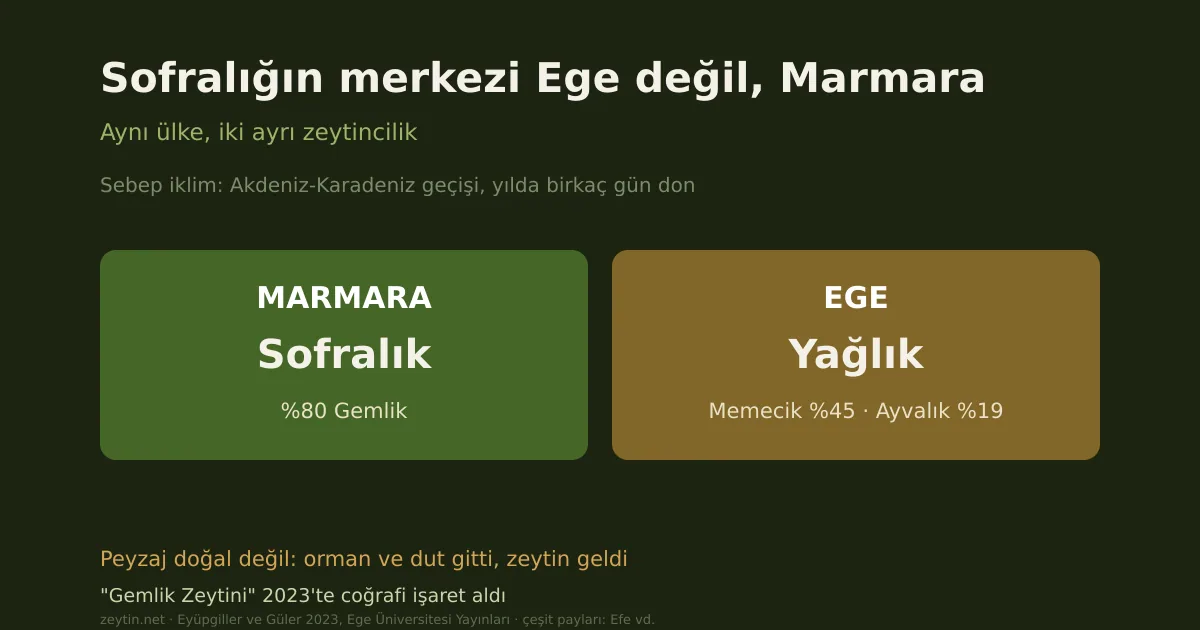
The table olive's home is not the Aegean but Marmara: 80% of the region's crop is Gemlik. The reason is climate.
 Article
Kiraz olive: characteristics, oil content and growing areas
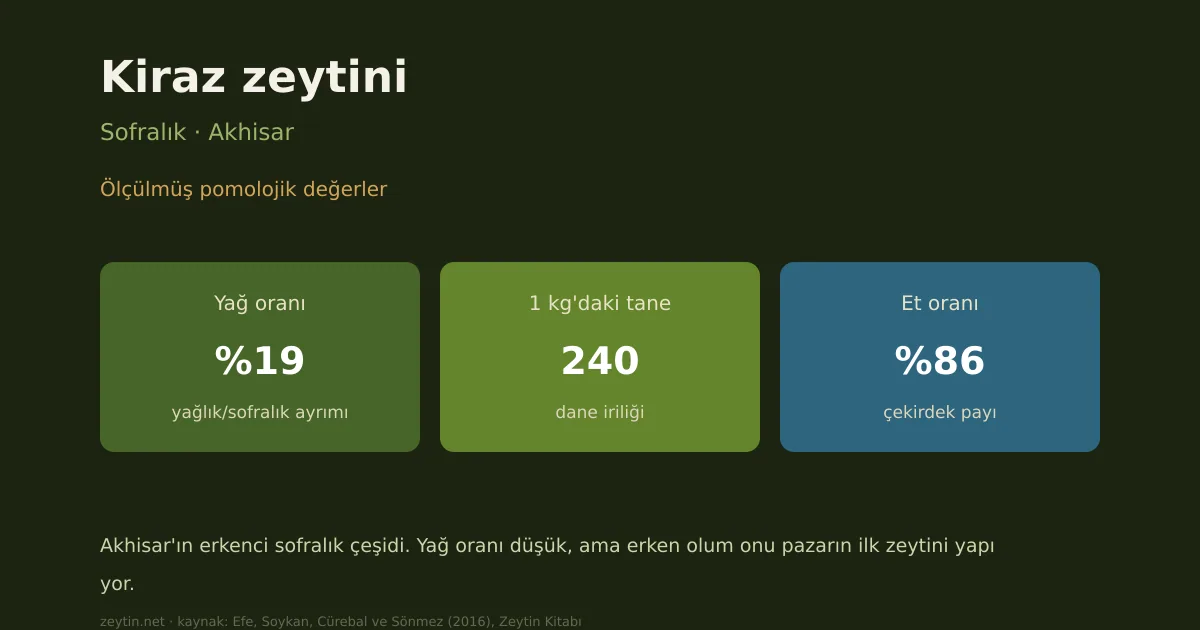
Akhisar's early table variety. Low in oil, but early maturity makes it the season's first olive to market.
 Article
Hursuki olive
Hursuki is a recorded variety of south-eastern Anatolia. No measured pomological data published.
 Article
Gaziantep Green Olive Pastry: a registration that turns a recipe into a rule
The only prepared dish among olive geographical indications. The document binds the half-moon shape, the 14-15 cm diameter, the filling gram by gram, the sheep breed, and inspection twice a year. The olives used are oil-type, not table.