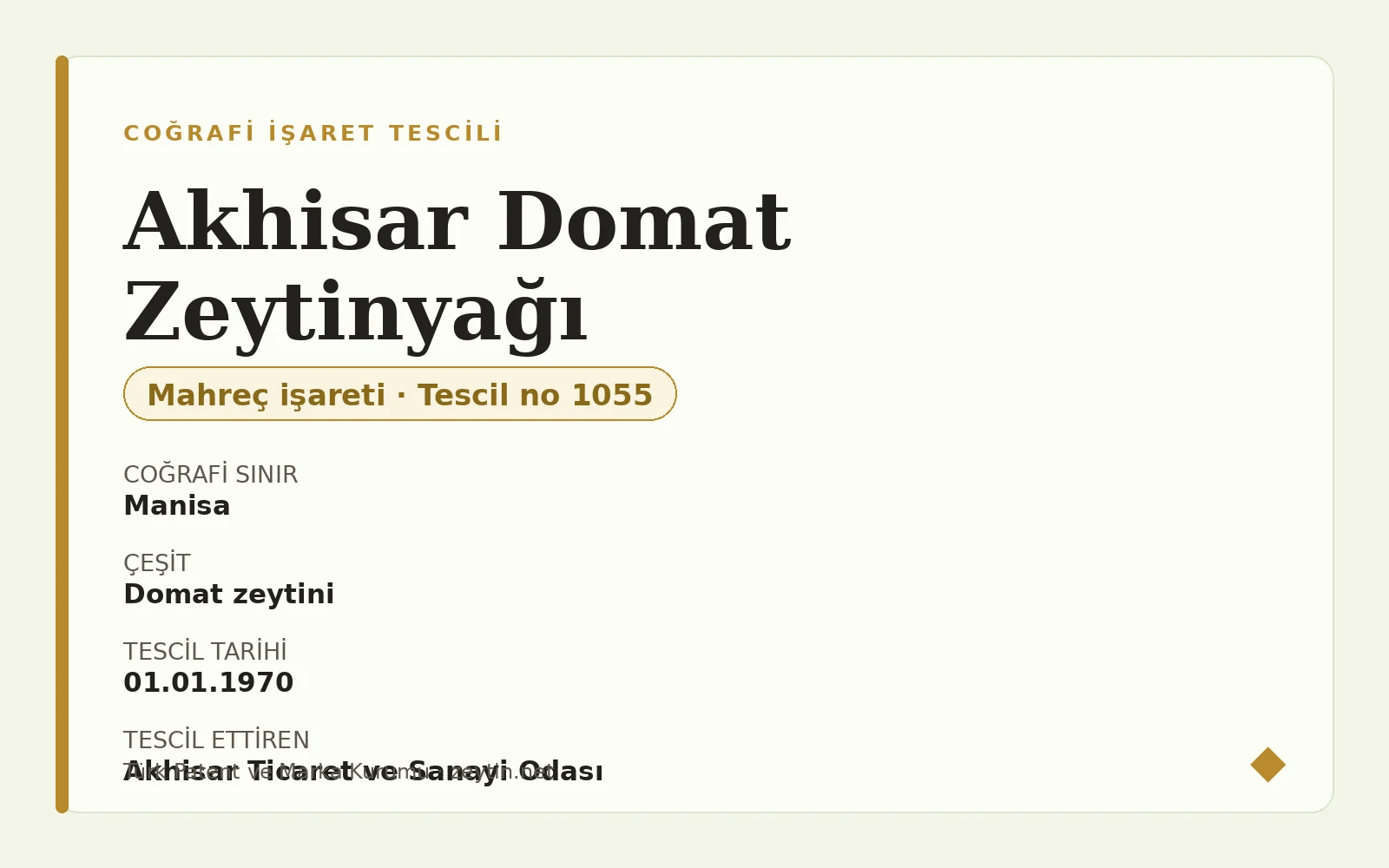
Akhisar Domat Olive Oil: stricter limits than its twin
Registered in 2017. Set against the Uslu oil registered the same day the difference is clear: peroxide ≤17 and acidity ≤0.65, both narrower.
Same chamber, same day, same boundary: the Akhisar Chamber of Commerce and Industry registered two olive oils together. But their limits are not the same.
The record
| Registration no | 1055 |
| Protection from | 10.11.2017 |
| Type | Geographical indication |
| Registered by | Akhisar Chamber of Commerce and Industry |
| Area | Akhisar, Gölmarmara, Salihli, Turgutlu, Saruhanlı and Kırkağaç in Manisa |
| Raw material | Akhisar Domat Olive (registration no 166) |
Its raw material is itself registered — both links of the chain are protected.
The difference from its twin
| Criterion | Domat (1055) | Uslu (1056) |
|---|---|---|
| Peroxide value | ≤ 17 | ≤ 20 |
| Free acidity | ≤ 0.65 | ≤ 0.8 |
The Domat oil commits to a narrower band on both criteria. Free acidity of 0.65 sits below the legal extra virgin ceiling of 0.8.
Sterol profile
| Sterol | Value |
|---|---|
| β-sitosterol | 86.20 – 87.64% |
| Delta-5-avenasterol | 5.76 – 6.12% |
| Clerosterol | 0.89 – 0.96% |
| Sitostanol | 0.59 – 0.84% |
| Delta-5,24-stigmastadienol | 0.53 – 0.74% |
| Delta-7-avenasterol | 0.37 – 0.65% |
| Campestanol | 0.11 – 0.14% |
| 24-methylene cholesterol | 0.10 – 0.12% |
| Cholesterol | ≤ 0.5 |
| Brassicasterol | ≤ 0.1 |
| Total β | ≥ 93 |
| Total sterols | ≥ 1000 mg/kg |
| Erythrodiol + uvaol | ≤ 3.0 |
The sterol profile is olive oil's identity fingerprint: adulteration with another vegetable oil shows up in this table. The erythrodiol + uvaol limit of 3.0 is also notable — the codex allows 4.5, and this narrower figure catches pomace oil blending.
The area as the document defines it
The short line in the record does not give the registration's full boundary. The document's own definition reads:
t; Manisa ili Akhisar, Gölmarmara, Salihli, Turgutlu, Saruhanlı ve Kırkağaç ilçeleri
The cultivar behind it, measured
The registration is granted to a place, but the cultivar the definition rests on has measurable values:
| Property | Value |
|---|---|
| Meyve ağırlığı | 5,30 g |
| 1 kg’daki tane sayısı | 165 |
| Et oranı | %83,76 |
| Et/çekirdek oranı | 5,25 |
| Yağ oranı | %20,57 |
| Hasat | Eylül-Kasım |
| Olgunlaşma | Ekim ortası |
| Kendine verimlilik | Kısmi — tozlayıcıları Ayvalık, Memeli, Memecik, Gemlik |
| Kullanım | Sofralık — iri danesi nedeniyle dolgulu yeşil zeytin |
| Dikim aralığı | 6×8 m · 7×7 m |
| Kuraklık ve soğuk | Her ikisine orta düzeyde dayanıklı |
| Kökeni | Akhisar (Manisa) · Ege Bölgesi |
At 20.57% the oil content sits mid-range; yield alone is not the argument here, aroma is. The cultivar is partially self-fertile; pollinators are used to secure yield. A flesh-to-stone ratio of 5.25 is the basic measure of how much of a table olive is actually eaten.
Its place in Manisa's olive production
| Item | Value |
|---|---|
| Fruit production | 623,493 t |
| — for oil | 411,412 t |
| — for the table | 212,081 t |
| Olive oil production | 64,292 t |
| Trees | 24,982 thousand |
| Yield per tree | 25.0 kg |
Oil and table production are close in this province (66% for oil); the production base is not locked to one direction.
Why a geographical indication rather than a designation of origin?
The record at the top of this page gives the type as geographical indication — the looser of the two categories: at least one stage of production must take place in the defined area, not all of them.
At first glance that may look like a shortcoming. Looking at the region's economic structure shows it is a necessity.
Çümen and Tunalıoğlu (2023) measured that structure by interviewing 35 managers of table-olive processing and exporting firms in Akhisar:
| Indicator | Value |
|---|---|
| Annual olive production in Akhisar | ≈ 200,000 t |
| Processed as table olives | 65% |
| Share of Türkiye's table olive output | 35% |
| Share of Türkiye's green (Domat) olive output | 80% |
| Raw fruit sourced from outside Akhisar | 87% |
| Sourced from Akhisar itself | 13% |
The last two rows are decisive. Akhisar accounts for 80% of Türkiye's green olive output, yet only 13% of the fruit it processes comes from its own land.
Akhisar is therefore not a growing centre but a processing centre. A designation of origin — the strict category requiring every stage in the area — could not have been obtained under that structure. A geographical indication is the only category matching the region's reality.
The distinction matters to the consumer as well: the words "Akhisar Domat Zeytinyağı" guarantee that the olives were processed in the defined area, not that they were grown there. We compared the two categories against a designation-of-origin example on the Gemlik Zeytini page.
The region's export markets appear in the same study: Germany, Iraq, Iran and Bulgaria.
Oil is the minority line in Akhisar
65% of Akhisar's output goes to the table. That fits the Domat cultivar's identity: Domat is known as a green table olive and is counted among the domestic cultivars suited to Spanish-style processing.
Akhisar Domat Zeytinyağı is therefore the registration of a line outside the region's main flow — made from fruit unsuited to table use or set aside for oil.
That may also explain why the registration keeps its quality thresholds tight: free acidity at 0.65 against the codex's 0.8, peroxide at 17 against 20. A minority product line has something to prove.
Further sources
- Çümen, K. & Tunalıoğlu, R. (2023). Examination of quality and branding in table olive processing and export. Tarım Ekonomisi Dergisi, 28(2), 213-226.
One rating per visitor; you can change yours at any time. Ratings are real reader votes — no seeded or default scores.
Related
 Article
Bayramiç Olive Oil: aroma compounds defined as percentages
Registered in 2022. The certificate defines aroma by compound rather than adjective: hexanal 36.15%, E-2-hexenal 26.14%. Iodine value 80-93.
 Article
Olive Oil Prices: Week 35 of 2026
Turkish exchange prices, European producer prices and exchange rates side by side: extra virgin at 300 TL/kg in Edremit, Spain's national average €3.52/kg.
 Article
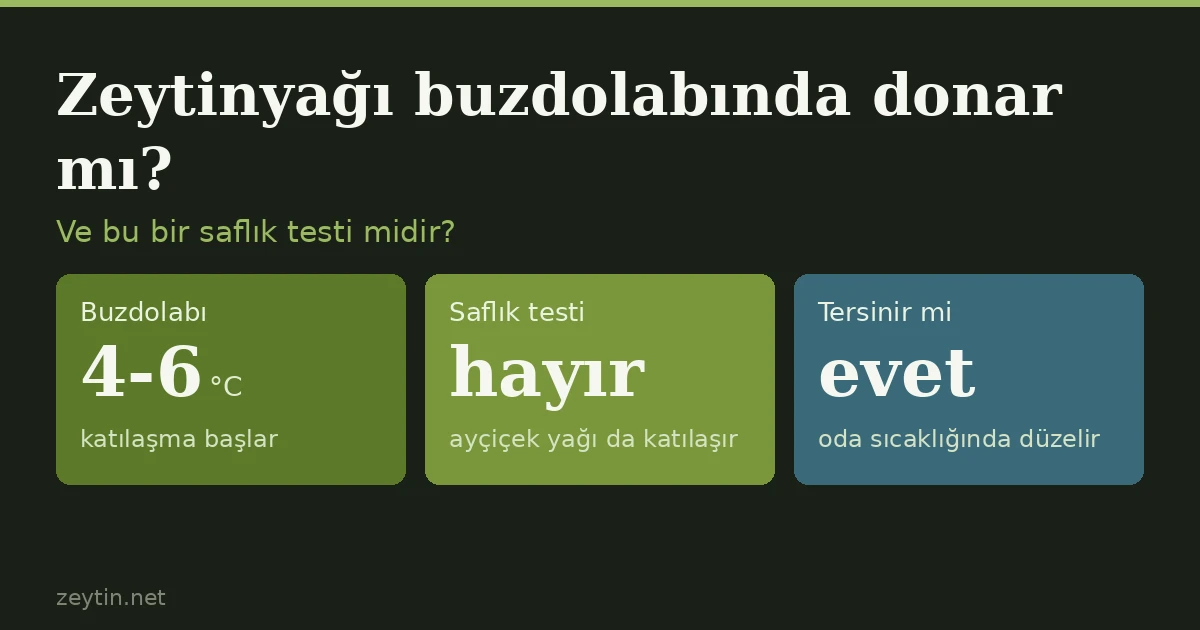
Does olive oil solidify in the fridge?
Olive oil solidifies in the fridge, but this is not a purity test: sunflower and canola oil do the same. The rate depends on variety and fatty acid composition.
 Article
Olive Oil
The difference between extra virgin, virgin, refined and riviera; what acidity means, how cold pressing works and how to store oil.