Why do small olive growers sell at harvest? What do licensed warehouses and electronic receipts offer?
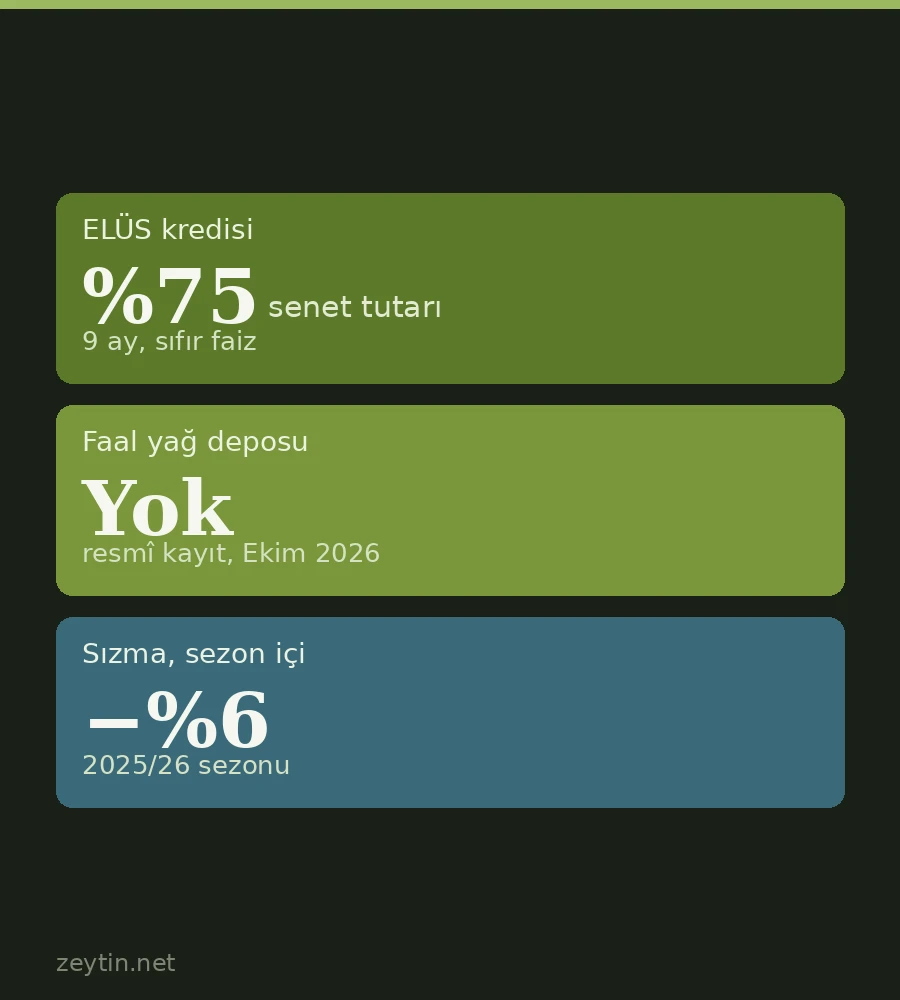
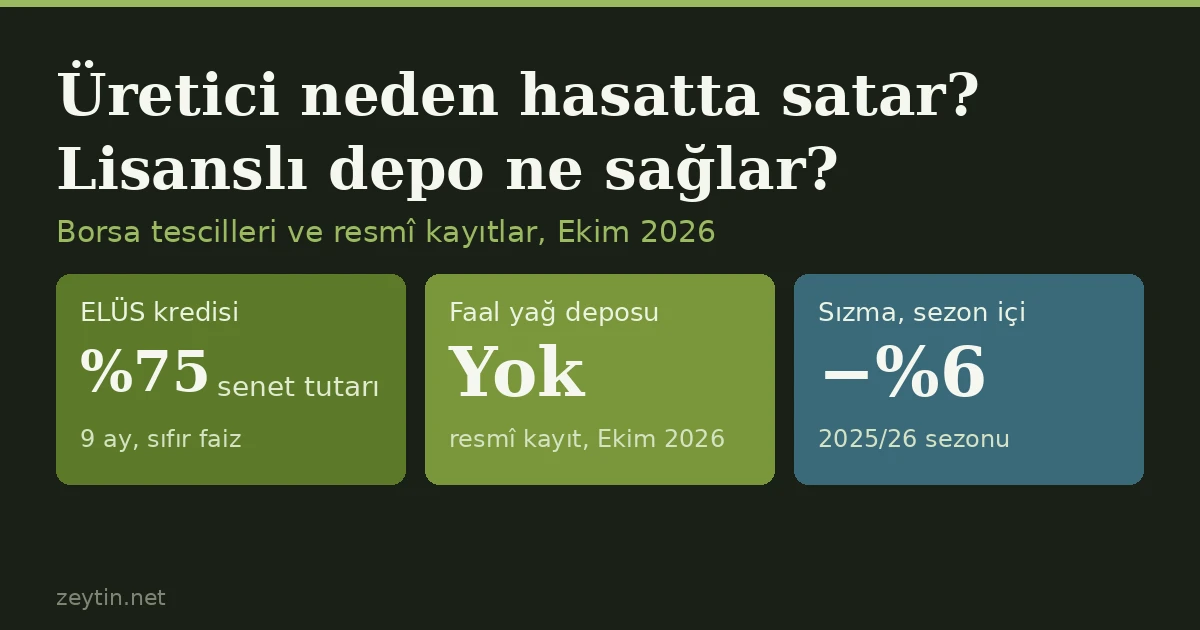
Exchange records show that prices do not bottom out at harvest every year; the real issue is the cost of waiting. Licensed warehouses and electronic receipts (ELÜS) are the legal way to raise cash without selling the oil: interest-free loans up to 75% of the receipt, storage fee support and tax exemptions. But as of October 2026, official records show no licensed olive oil warehouse with an operating permit.
When the harvest starts, a small grower has two options: sell the oil straight away, or hold it and hope for a better price. Most choose the first. This article asks two questions. Does the grower who waits actually earn more? And what do licensed warehouses and electronic warehouse receipts (ELÜS in Turkish), the official way to afford waiting, offer an olive oil producer in Türkiye today?
The short answer: waiting does not pay every season, but a grower who cannot wait never gets the choice. A licensed warehouse is the legal way to raise cash without selling the product. Olive oil is covered by the system; however, as of October 2026, the official records we could reach show no licensed olive oil warehouse with an operating permit.
Does the price really bottom out at harvest?
To measure this we used olive oil sales registered on the Aydın, Edremit, Nazilli, Gaziantep and Bandırma commodity exchanges (our price series, last record 8 October 2026). We treated each season as November to October and compared the volume-weighted average of the harvest months (November–January) with the last three months of the same season (August–October).
| Season | Crude oil, harvest | Crude oil, season end | Change | Extra virgin, harvest | Extra virgin, season end | Change |
|---|---|---|---|---|---|---|
| 2021/22 | 36.00 | 54.32 | +51% | 40.01 | 64.77 | +62% |
| 2022/23 | 66.27 | 144.71 | +118% | 82.10 | 185.08 | +125% |
| 2023/24 | 170.89 | 187.96 | +10% | 239.76 | 246.86 | +3% |
| 2024/25 | 138.27 | 165.65 | +20% | 214.88 | 217.52 | +1% |
| 2025/26 | 174.08 | 185.51 | +7% | 252.08 | 237.57 | −6% |
Harvest: November–January. Season end: August–October. Nominal prices. The 2025/26 season-end crude oil average rests on few trades.
The table does not tell a one-way story. In crude olive oil the season-end price is above the harvest months in all five seasons. But the big gaps belong to the first two seasons, when inflation accelerated and drought in Spain sent world prices soaring (see how Spain's drought set the price in Türkiye). In the last three seasons the crude oil gap was between 7% and 20%; for extra virgin it was 3%, 1% and, in the latest season, minus 6%.
These are nominal figures, and the lira lost purchasing power over the same months. Our inflation-adjusted price calculation shows that much of the nominal rise is general inflation. What is more, in 2024/25 the lowest monthly extra virgin average came not at harvest but in April and May 2025 (172.63 and 172.93 ₺/kg).
So "prices always bottom out at harvest" is not a law. A grower who waits wins in some years and loses in others. The real question is who pays the cost of waiting.
One caveat: an exchange record does not show when the grower sold, only when the oil was registered. We covered that difference in exchange volume is not the harvest.
Why can't growers wait?
Three reasons stand out.
Cash. Picking labour and milling fees are paid during the harvest, and fertiliser, crop protection and debts built up over the year are also waiting for harvest money. We reported the cost pressure voiced by the sector before the season in two pressures before the harvest.
Storage. The Ministry of Agriculture and Forestry's Olive and Olive Oil Sector Policy Document (2022–2026) states that storing olive oil in unsuitable conditions at producer level causes "very significant quality losses". Oil kept in light and heat deteriorates, and oil that drops out of the extra virgin grade can wipe out the gain from waiting on its own. Good practice is in how to store freshly pressed olive oil.
Awareness. A survey of 64 olive growers in İzmir by a team from Ege University, published in 2014, found that only 17.2% of growers knew about licensed warehousing. In the same survey, "selling at a low price after harvest to pay debts" scored 2.36 out of 5, while the top problem was low olive oil prices (4.67). The study is old and covers a single province, but the signal is clear: debt pressure was not everyone's first problem, while not knowing the system was widespread.
What are licensed warehouses and ELÜS?
The legal basis is Law No. 5300 on Licensed Warehousing of Agricultural Products, adopted on 10 February 2005. The details are in the Regulation on Licensed Warehousing of Agricultural Products, published in Official Gazette No. 28616 of 12 April 2013, and the Olive Oil Licensed Warehouse Communiqué issued the same day. Under the communiqué:
- A warehouse company needs at least 4,000 tonnes of enclosed capacity and each branch at least 500 tonnes; tank temperature must be kept between 12 and 24 °C.
- Oil is not accepted until it is weighed and analysed by an authorised grader. The receipt states the grade, free fatty acidity and origin; a separate receipt is issued for every 500 kg.
- Olive oil may be stored for at most 18 months from the month of production; refined and riviera oil for at most 12 months.
According to the Ministry of Trade, insurance of the facilities and the stored product is mandatory; in case of damage, the loss is calculated from the average price on the Turkish Mercantile Exchange (TÜRİB). The Olive Research Institute is one of the ministry's five reference authorised graders.
The receipt is issued electronically: ELÜS. The grower can sell, transfer or pledge it on TÜRİB without moving the oil. We have explained what acidity means; in a licensed warehouse that value sets the receipt's grade and therefore its price.
What does it offer on paper?
According to the support list published by TÜRİB:
- Interest-free loan: Ziraat Bank can lend up to 75% of the ELÜS value, interest-free, for a maximum of 9 months. The bank's own page also confirms the 75% ceiling.
- Storage fee support: for products including olives and olive oil, 75% of the Ministry of Trade's storage fee tariff is supported (2025–2028 period).
- Tax: income from trading products held in licensed warehouses is exempt from income and corporate tax until the end of 2028; the transactions are also exempt from stamp duty and VAT.
An example: in the last three months of the 2025/26 season, the exchange average for extra virgin oil was 237.57 ₺/kg. At that price a receipt for 1 tonne of oil is worth roughly 237,570 ₺; 75% of it is about 178,000 ₺. With that money a grower can cover harvest costs and keep the oil unsold for up to 9 months. If the price rises, the grower gets the gain; if it falls, the timing of the sale is still the grower's decision. There is no guaranteed profit, but no forced sale either.
The problem: there is no olive oil warehouse
These supports only work if a licensed warehouse accepts the oil. Official sources show the following:
- Sector Policy Document (2022–2026): no licensed warehouse company had yet received an operating permit for olive oil. For table olives, the first licensed warehouse started operating in 2015.
- According to a feasibility study by the South Marmara Development Agency (GMKA) dated August 2023, two olive oil companies held establishment permits (4,000 tonnes in Bursa, 10,000 tonnes in Akhisar); neither had a licence.
- Among the Ministry of Trade fee tariffs updated on 7 October 2026 there is a tariff for table olives (storage 176.40 ₺/tonne/month), but none for olive oil.
- On 14 August 2026 GMKA announced a consultancy contract with the Ayvalık Chamber of Commerce to prepare the licence application documents for an olive oil licensed warehouse in the North Aegean.
According to ministry statistics, as of 18 September 2026, 288 companies hold licences and total licensed capacity is 15.2 million tonnes, mostly for grain. In short, for the 2026/27 harvest, the official records we could reach show no warehouse where a grower could turn olive oil into ELÜS.
The role of cooperatives
Until a warehouse opens, the closest tool is the cooperative. Agricultural sales cooperatives collect their members' produce and sell it jointly, taking the storage and marketing burden off individual growers. We examined the prices announced by the union that does this in the Marmara region in Marmarabirlik purchase prices. A cooperative is no substitute for a licensed warehouse, but it strengthens a small grower's bargaining power.
We covered the price relationship between the fruit and the oil in from olive to oil: the price gap, and the minimum price debate in harvest forecast and the minimum price debate.
In numbers
| Item | Value | Source |
|---|---|---|
| Minimum warehouse capacity | 4,000 tonnes | Olive Oil Licensed Warehouse Communiqué (2013) |
| Quantity per receipt | 500 kg | Same communiqué |
| Maximum storage period | 18 months | Same communiqué (refined and riviera 12 months) |
| Interest-free loan against ELÜS | 75%, 9 months | TÜRİB, Ziraat Bank |
| Storage fee support | 75% of tariff | TÜRİB (2025–2028) |
| Tax exemption | until end-2028 | TÜRİB |
| Operating olive oil licensed warehouse | none found | Sector Policy Document; Ministry of Trade tariffs (October 2026) |
| Growers aware of licensed warehousing | 17.2% | İzmir survey, 2014 |
| Crude oil, harvest to season end (2025/26) | +7% | Exchange registrations |
| Extra virgin, harvest to season end (2025/26) | −6% | Exchange registrations |
In short
- Prices do not bottom out at harvest every year: in the last three seasons the nominal return to waiting was between −6% and +3% for extra virgin and between +7% and +20% for crude oil.
- The cost of waiting is cash and storage quality; licensed warehousing was designed to solve both.
- Interest-free loans against ELÜS, storage fee support and tax exemptions also cover olive oil.
- But as of October 2026, official records show no licensed olive oil warehouse with an operating permit; the North Aegean project is still preparing its licence. Until a warehouse opens, the supports stay on paper.
One rating per visitor; you can change yours at any time. Ratings are real reader votes — no seeded or default scores.
Related
 Article
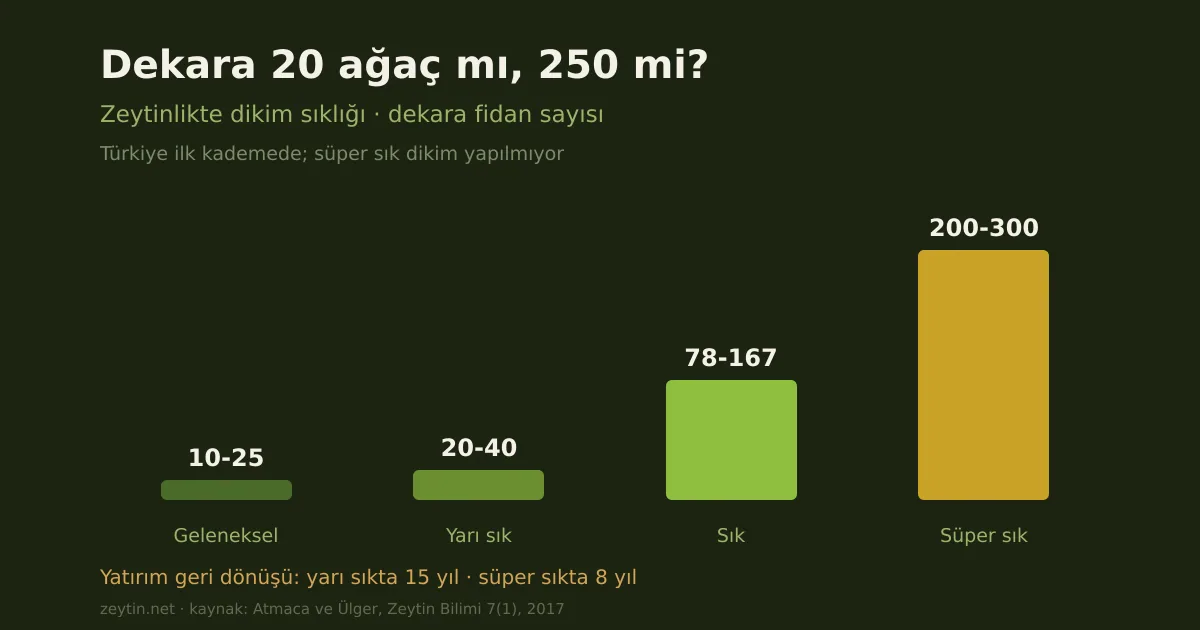
Twenty trees per decare, or 250? The density debate
15-25 trees per decare in Türkiye, 200-300 in super-intensive systems. Payback falls from 15 years to 8 — but the densest is not the most profitable.
 Article
Solar panels above the grove: energy without cutting trees?
In Spain, 5,150 solar modules were raised four metres above a working olive grove without removing a single tree. The height is set not by the trees but by a harvester that opens to 3.5 metres. A University of Córdoba model puts joint output at 789 kg of oil and 891 MWh per hectare.
 Article
How much is deducted when you sell olives? Withholding tax, the producer receipt and the social security cut
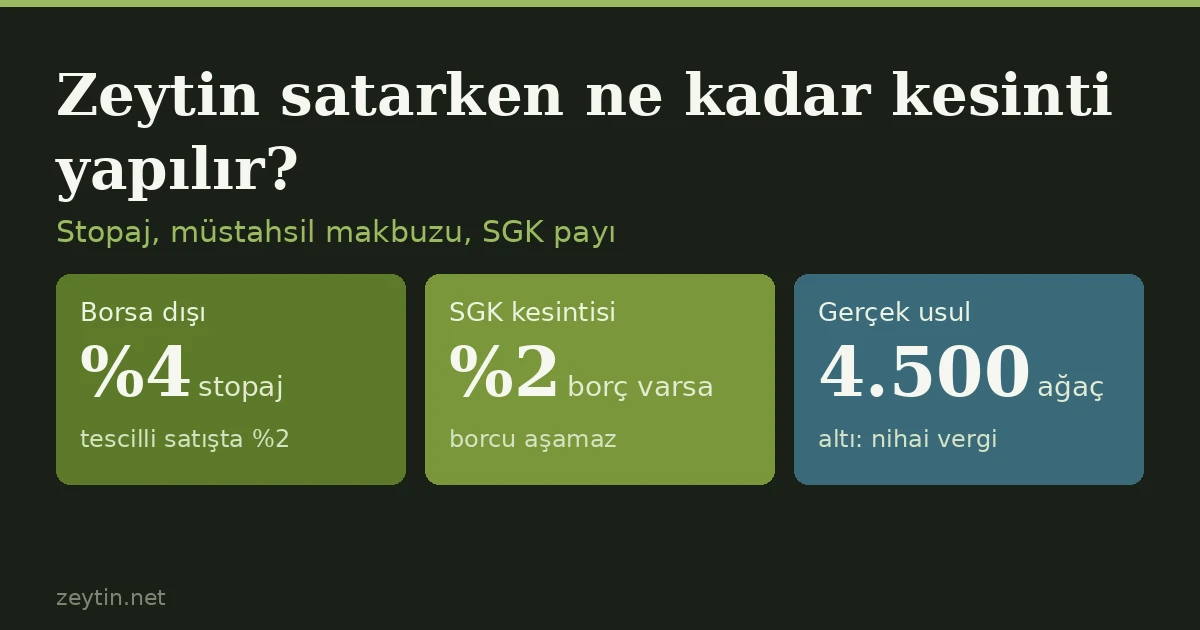
Growers selling olives to a trader or cooperative have 4% of the price withheld as income tax, or 2% if the sale is registered on a commodity exchange; below 4,500 trees this is the final tax. Farmers with premium arrears also face a 2% social security deduction. The producer receipt, exchange fees and a worked example with Akhisar prices.
 Article
What temperatures can the olive withstand?
Ideal 15–20 °C, an upper limit of 40 °C (with irrigation), a lower limit of −7 °C. Temperature thresholds, chilling requirement, and the climate risk of production narrowed to four varieties.