Crop forecast climbs as the minimum-price debate returns: what the exchange numbers say
With the 2026 harvest approaching, crop forecasts are up 40 percent in some provinces and growers want a floor price. Our exchange series shows why the dispute is really about olives, not oil.
As the olive harvest approaches, two topics dominate the conversation in Türkiye's growing regions: crop forecasts and a minimum price. At a sector meeting held in Antalya, participants said the crop could rise by 40 percent this season and reach 70,000 tonnes. Field surveys to establish the crop size are under way in Manisa, Bursa and Tekirdağ. Growers have one shared demand: announce a floor price before harvest begins.
The reasoning becomes clearer in the exchange records. Every figure below comes from realised transactions published by Türkiye's commodity exchanges — not forecasts, but trades that actually cleared.
Olive oil rose over the year
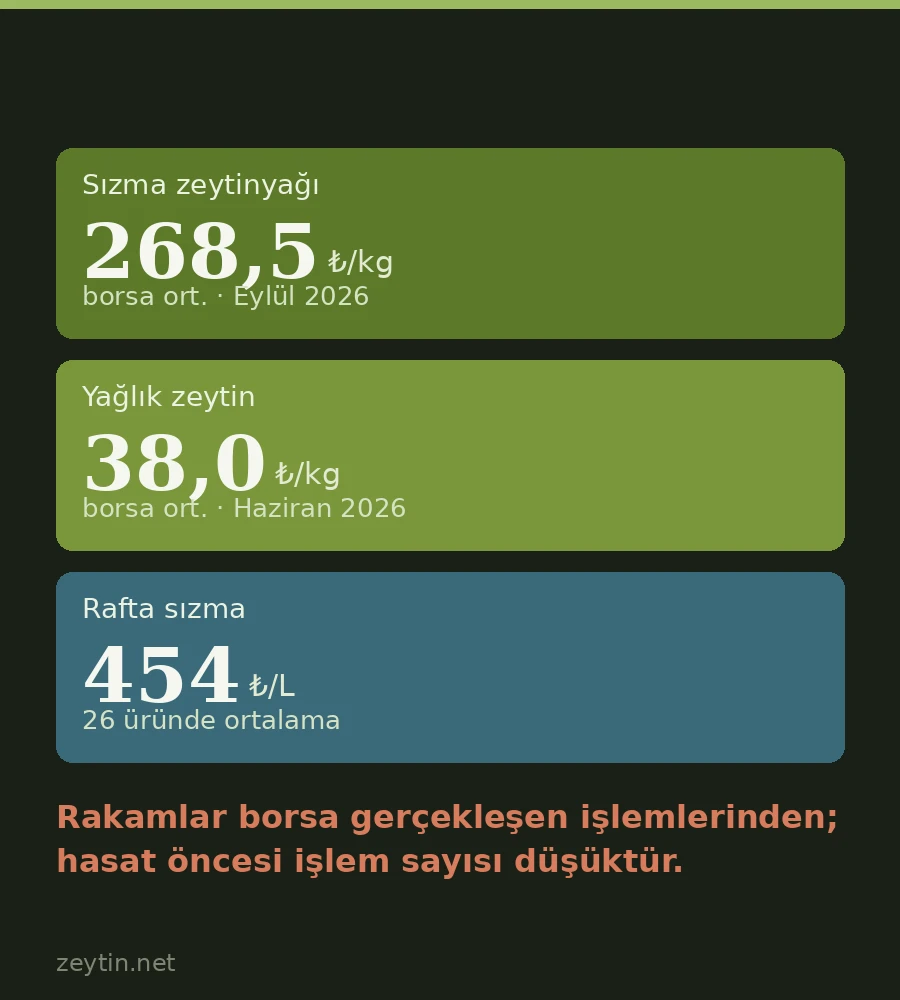
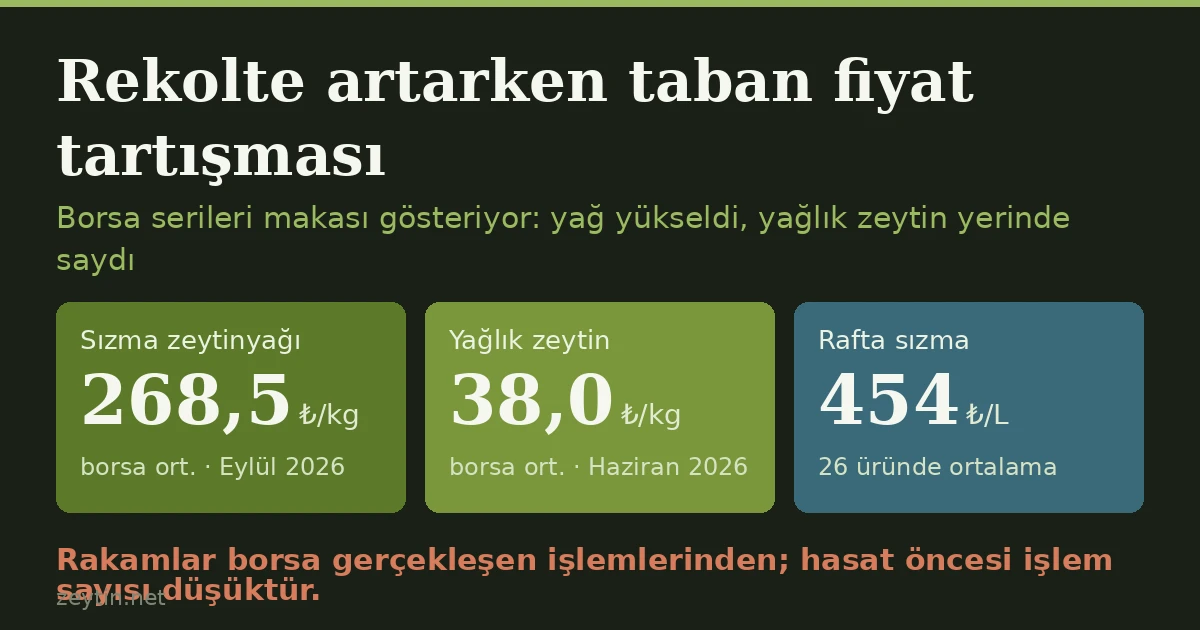
The monthly exchange average for extra virgin olive oil was 217.7 lira per kilogram in September 2025. By September 2026 it had reached 268.5 lira, an annual increase of roughly 23 percent. Crude olive oil moved more sharply: from an average of 160.6 lira in September 2025 to 238.8 lira in August 2026.
The path was not a straight line. Extra virgin peaked at 278.0 lira in May 2026, then eased to 270.2, 257.9 and 252.4 lira in the following months before returning to 268.5 lira in September. Through the summer, oil moved sideways rather than upward.
The real knot: what the grower sells
The heart of the dispute is not olive oil but olives for oil, because most orchard owners sell fruit, not oil. In the exchange series, the monthly average for oil-bound olives was 37.2 lira per kilogram in October 2025 and 38.0 lira in June 2026. Over eight months there is no meaningful change.
Read that way, the frame is clear: while olive oil gained more than 20 percent, its raw material stood still. The demand for a floor price grows out of that gap.
The spread between exchanges is not small either
In trades on 7 September, extra virgin olive oil averaged 216.71 lira in Aydın and 308.81 lira in Edremit — a difference of 92 lira per kilogram. Crude oil shows a similar spread: 183.48 lira in Aydın, 220.00 lira in Nazilli, 250.00 lira in Gaziantep.
There is no single explanation. Traded volume, acidity and the quality of the particular lot that reached the exchange that day all pull prices apart. A 165-tonne crude oil trade in Aydın cannot be read with the same weight as a 750-kilogram trade in Edremit. We have covered how to read exchange prices separately.
What is happening on the shelf
In our retail survey, extra virgin olive oil ranges from 249 to 1,186 lira per litre, averaging 454 lira across 26 products. The distance between the 268.5 lira exchange price per kilogram and the shelf average covers bottling, packaging, distribution and brand margin. That distance is the second leg of the floor-price argument: the grower sits at the bottom of the chain.
What a floor price would and would not fix
A floor price aims to stop prices falling below a set level during harvest. The demand strengthens in years when the crop is large, because rising supply pushes prices down. That is exactly this season's picture: expectations of an abundant harvest sitting alongside price anxiety.
A floor price would not, however, erase quality differences between exchanges. A low-acidity early-harvest oil does not trade at the same price as a late-harvest lot, and it should not. If a floor is set, which product group and which quality it applies to is a separate question that needs an answer.
How many trades sit behind an average?
One caveat is needed: monthly averages are not equally solid. For extra virgin oil, the July 2026 average rests on 21 trades and the August average on 8. For crude oil, the August 2026 average rests on just four trades. As the number of trades falls, a single large lot can move the average.
So the 48 percent annual jump in crude oil should not be read as "the market rose 48 percent". The better reading: little product reaches the exchange before harvest, and the lots that do arrive differ widely in quality. Once harvest begins, trade counts rise and averages settle. That is when the real picture will appear, alongside the crop survey results.
Where each product sits on the shelf
In our retail survey, the averages per litre or kilogram across five product groups are: extra virgin olive oil 454 lira, riviera olive oil 338 lira, olive paste 476 lira, green table olives 368 lira and black table olives 339 lira. The spread within a group is wide — the cheapest green table olive is 112 lira, the most expensive 1,294 lira.
For table olives, the distance between the shelf average and the exchange price is even larger than for oil. In Edremit on 3 September, special-grade green olives traded at 200 lira per kilogram and brined black olives at 150 lira. Processing, brining time and losses explain part of that gap — but not all of it.
The picture will sharpen as crop surveys are completed. We update the exchange series weekly on our market page; once harvest begins, where the price of oil-bound olives settles will be the real answer to this debate.
One rating per visitor; you can change yours at any time. Ratings are real reader votes — no seeded or default scores.
Related
 Article
Harvest opens in Mut: 300,000 tonnes expected, orchard prices start at 10 lira
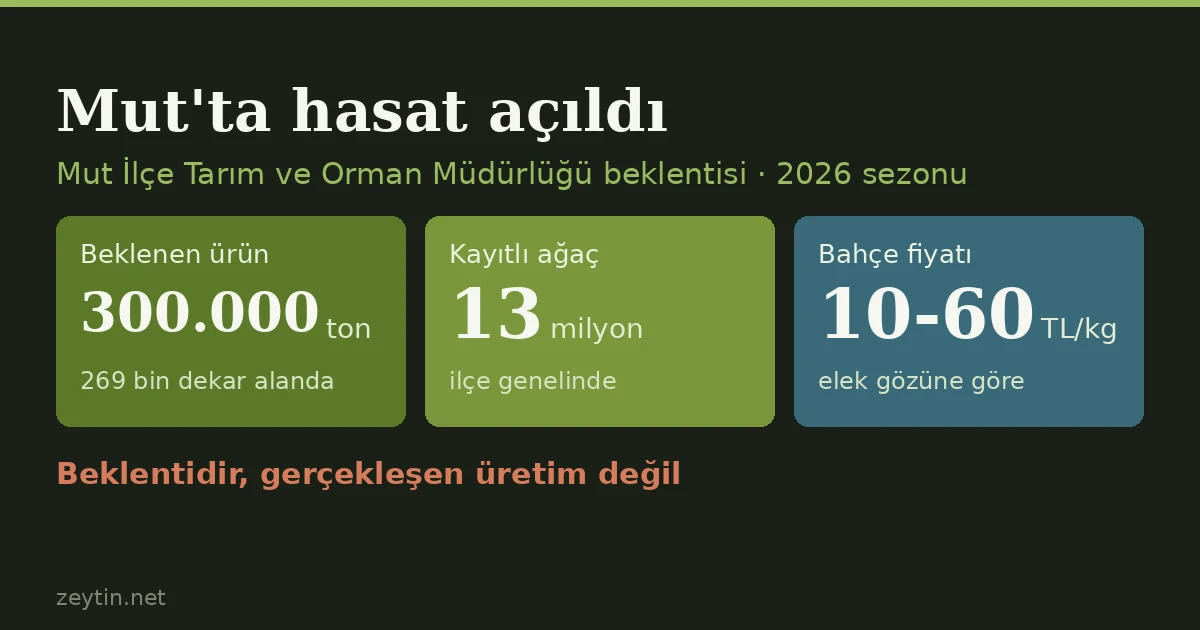
Mut's district agriculture directorate reports 300,000 tonnes expected from 269,000 decares, with orchard prices ranging from 10 to 60 lira by sieve size. Yield is high but growers are unhappy with prices. Set against our own Mersin figures the tonnage leaves an unresolved measurement gap, and we report it as such.
Article
Harvest opens in Mut: 300,000 tonnes expected, orchard prices start at 10 lira
Mut's district agriculture directorate reports 300,000 tonnes expected from 269,000 decares, with orchard prices ranging from 10 to 60 lira by sieve size. Yield is high but growers are unhappy with prices. Set against our own Mersin figures the tonnage leaves an unresolved measurement gap, and we report it as such.
 Article
"Not definitive until November": Andalusian growers push back on the crop estimate
Andalusia's agriculture ministry called its first crop estimate "high production"; cooperatives and COAG in Seville objected: recent heat will affect the crop and the estimate is not definitive until November. Türkiye is making its 2026-27 estimate in the field the same week — the same caution applies here.
Article
"Not definitive until November": Andalusian growers push back on the crop estimate
Andalusia's agriculture ministry called its first crop estimate "high production"; cooperatives and COAG in Seville objected: recent heat will affect the crop and the estimate is not definitive until November. Türkiye is making its 2026-27 estimate in the field the same week — the same caution applies here.
 Article
Artvin's Butko olive harvest begins: 700 tonnes of table olives and 80 tonnes of oil expected
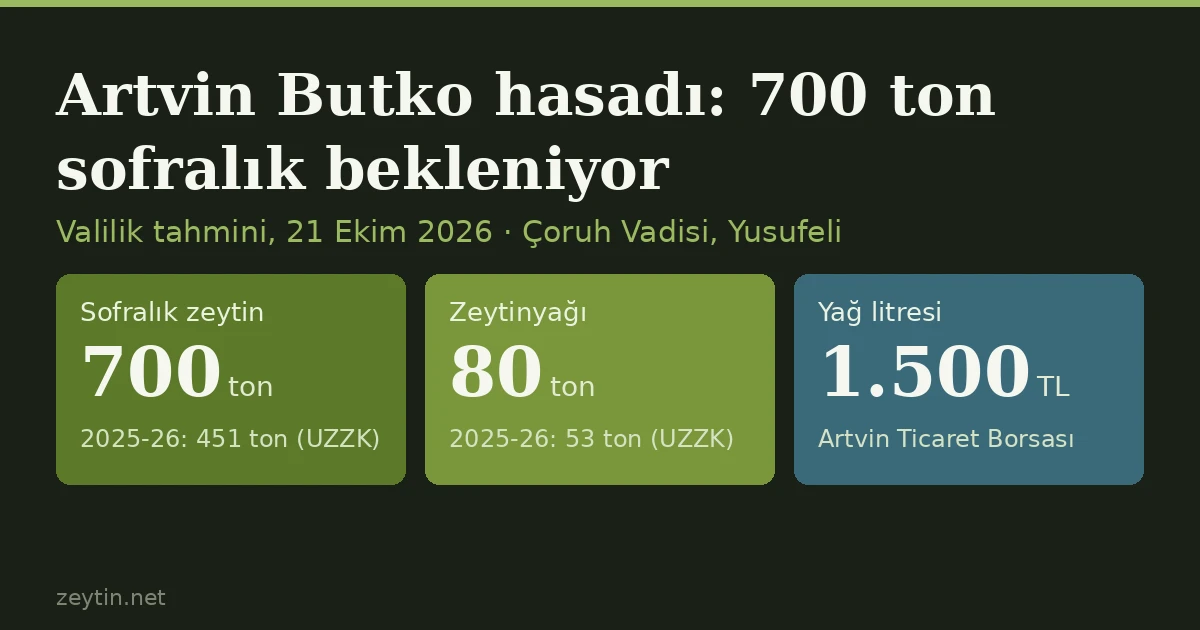
Artvin Governorate expects about 700 tonnes of table olives and 80 tonnes of olive oil from the Çoruh Valley's native Butko olive this season, 55 percent more table olives than last season's UZZK figure. The Artvin Commodity Exchange set prices at 400 lira per kilogram of olives and 1,500 lira per litre of oil; the geographical indication application is in its final stage.
Article
Artvin's Butko olive harvest begins: 700 tonnes of table olives and 80 tonnes of oil expected
Artvin Governorate expects about 700 tonnes of table olives and 80 tonnes of olive oil from the Çoruh Valley's native Butko olive this season, 55 percent more table olives than last season's UZZK figure. The Artvin Commodity Exchange set prices at 400 lira per kilogram of olives and 1,500 lira per litre of oil; the geographical indication application is in its final stage.
 Article
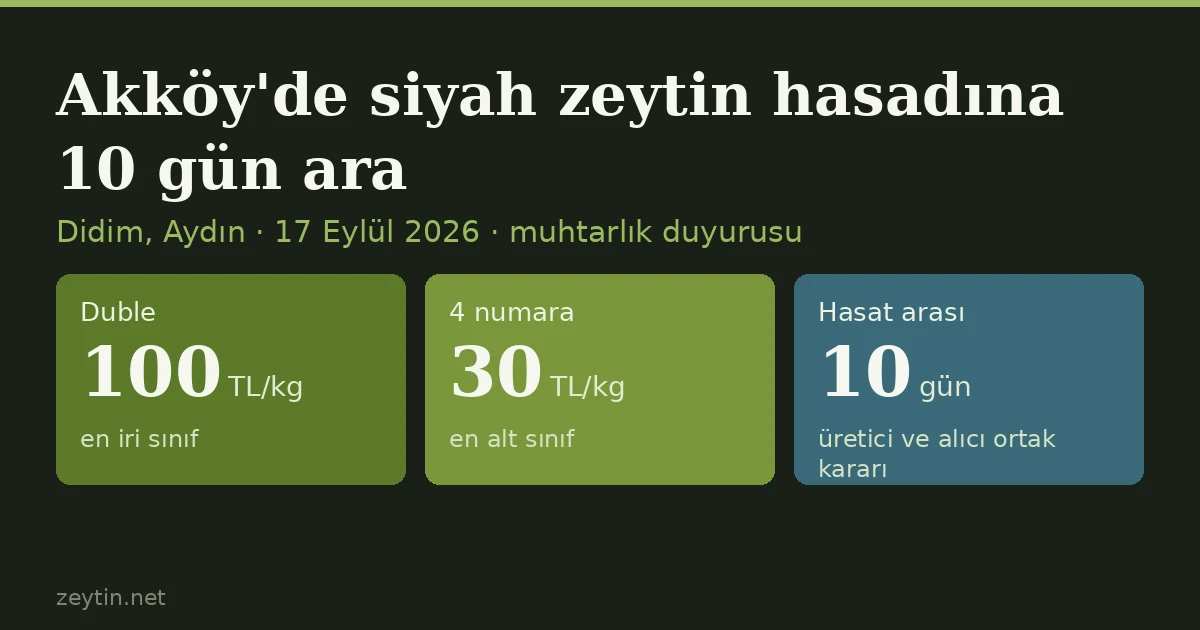
Black olive harvest paused for ten days in Akköy, Didim: a price ladder from 30 to 100 lira
In Akköy, a village in the Didim district of Aydın, growers and olive buyers have jointly agreed to suspend black olive harvesting and buying for ten days, saying announced prices do not cover costs. The price ladder published by the village headman's office runs from 100 lira a kilo for the largest grade down to 30 lira for the smallest. Growers say picking costs alone exceed the price on the lower grades.
Article
Black olive harvest paused for ten days in Akköy, Didim: a price ladder from 30 to 100 lira
In Akköy, a village in the Didim district of Aydın, growers and olive buyers have jointly agreed to suspend black olive harvesting and buying for ten days, saying announced prices do not cover costs. The price ladder published by the village headman's office runs from 100 lira a kilo for the largest grade down to 30 lira for the smallest. Growers say picking costs alone exceed the price on the lower grades.