"Not definitive until November": Andalusian growers push back on the crop estimate
Andalusia's agriculture ministry called its first crop estimate "high production"; cooperatives and COAG in Seville objected: recent heat will affect the crop and the estimate is not definitive until November. Türkiye is making its 2026-27 estimate in the field the same week — the same caution applies here.
Türkiye's 2026-27 crop estimate is being made in the field right now: commissions began work in Manisa's 17 districts on 3 September. In the same week, growers in Spain publicly pushed back against their own ministry's estimate — and the reason they gave applies here too.
What happened
On 4 September the 8th BusinessAGRO Olive Industry Roundtable met in La Puebla de Cazalla, Seville. Consolación Vera Sánchez, Andalusia's Deputy Minister of Agriculture, said initial crop estimates pointed to high production and that the regional government was optimistic about the season.
Two grower organisations in the same room disagreed:
- Cooperativas Agro-alimentarias de Sevilla and COAG Sevilla said the high temperatures of recent days would certainly affect production.
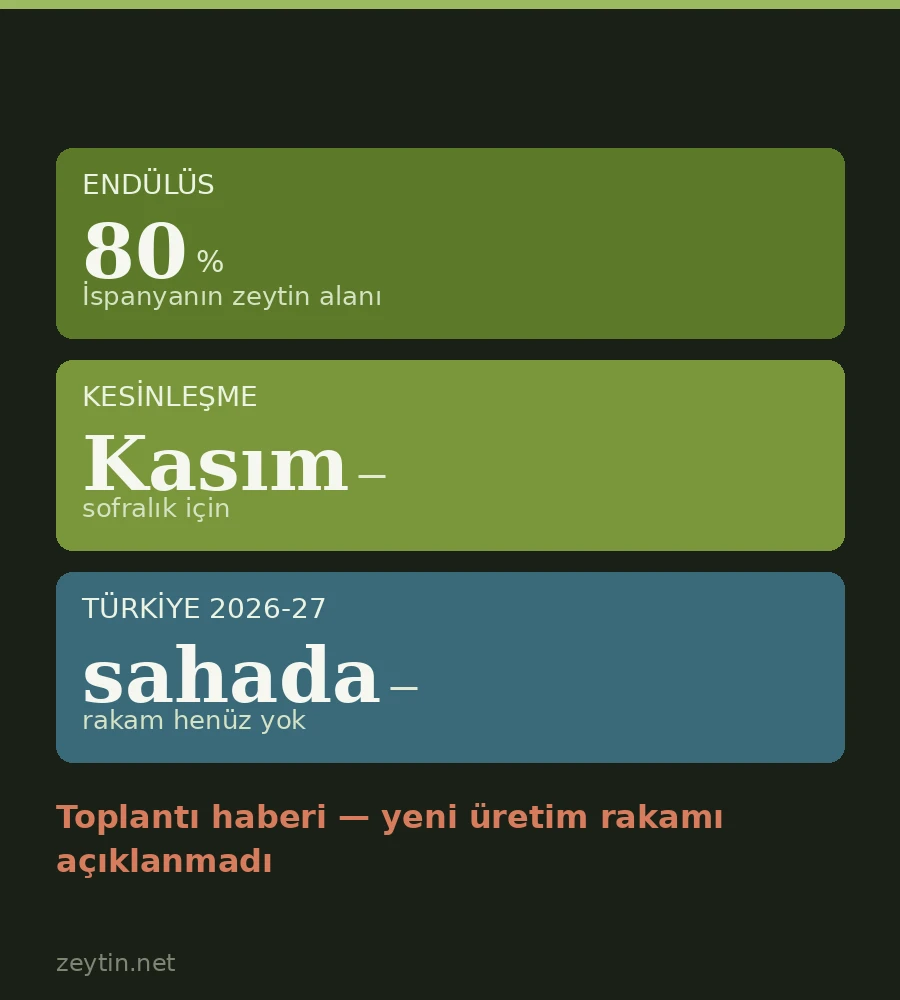
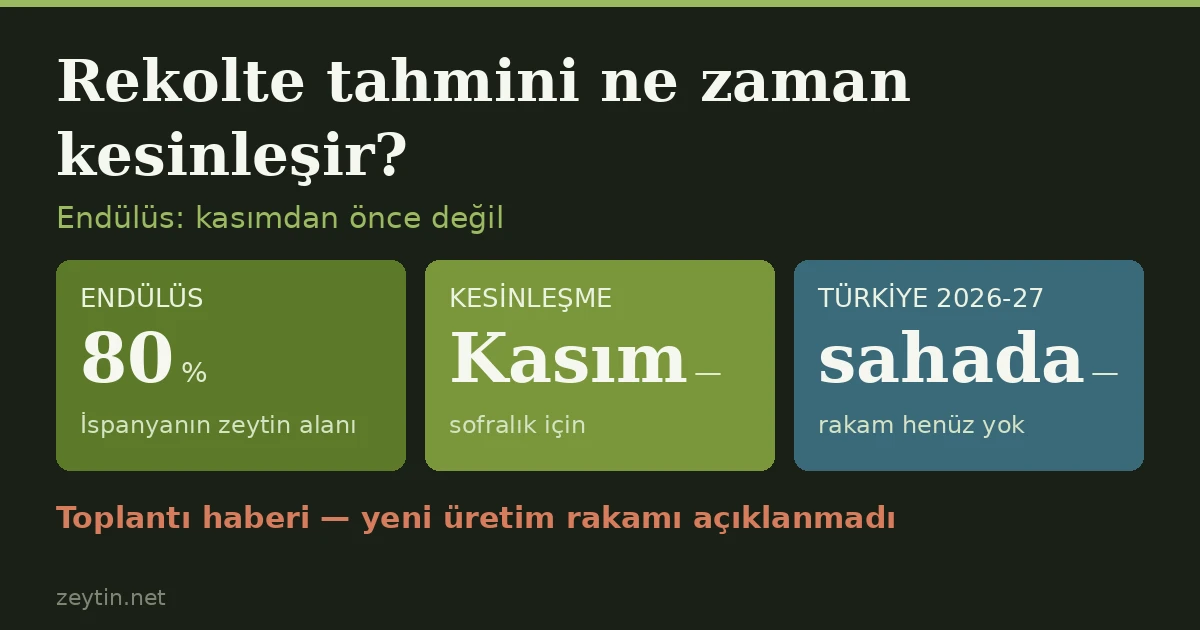
- Cooperative president Gabriel Cabello López set a precise standard: "caution is needed when considering these crop estimates, which will not be definitive — at least for table olives — until November."
- Francisco Manuel Fernández Pérez, COAG's national representative for table olives, advised growers to wait until the heatwave passes.
For scale: Andalusia holds 80% of Spain's olive-growing area, and Seville is Andalusia's table-olive centre. This is not an argument at the margins — it is at the heart of the world's largest producer.
The real question: when does an estimate become a figure?
The disagreement is not about optimism versus pessimism. It is about the calendar. A crop estimate is made before harvest, and everything that grows or shrinks the fruit between then and harvest moves the number. A heatwave is the harshest of those: it reduces fruit size, shifts oil content and damages table-grade quality.
Cabello López's "November" is not arbitrary. Table olives are picked in September and October; until the harvest is in the crates, no estimate is final. For oil olives that date is later still.
⚠ This does not make estimates useless. An estimate is a planning instrument: processors reserve capacity, exporters prepare contracts, growers hire labour. But it is not realised output, and presenting it as such misleads.
What it means for Türkiye
Every provincial and national production figure on this site is UZZK's season-based crop estimate — not TurkStat's calendar-year realised output. We give that distinction with its source on the olive page, and the note under the table says: a pre-harvest estimate, not realised output.
For 2026-27 there is no figure yet. The fieldwork in Manisa is what will produce it. When it arrives it deserves the same caution:
- The figure will rest on observations made in early September.
- Türkiye carries heat risk too; September heat in the Aegean and Marmara affects fruit development.
- The alternate-bearing rhythm suggests 2026-27 should be an on year — but as we wrote in the opposite-phase piece, that is an inference, not a published forecast.
What the Andalusian cooperative said is this site's long-standing point in Spanish: just as mistaking exchange volume for the harvest misleads, so does mistaking an early estimate for realised output.
And note where the objection comes from
The detail worth noticing is the direction of the objection. Grower organisations usually want the crop shown as small — a low crop expectation lifts prices. Here it runs the other way: the ministry says "high production" and the growers say "not so fast."
There is a commercial reading. A high crop estimate announced early pulls prices down from the start. If "there is plenty" is said before the season opens, buyers wait and growers lose bargaining power. Even if the figure is later revised down, the price expectation has already formed.
The same mechanism works here. Our piece on Andalusia's objection to North African imports showed a similar structure: both the figure and the timing of its release are instruments in the market.
Reading with care
⚠ This is a conference report; no new production figure was published. The numerical value of Andalusia's initial estimate is not given in this source.
⚠ "Not definitive until November" was said about table olives. Oil olives run on a different calendar.
⚠ The effect of the heat is a claim here, not a measurement. Its size will only be visible after harvest.
One rating per visitor; you can change yours at any time. Ratings are real reader votes — no seeded or default scores.
Related
 Article
Andalusia bans night harvesting again for 2026/27: 8,127 birds counted on 137 hectares
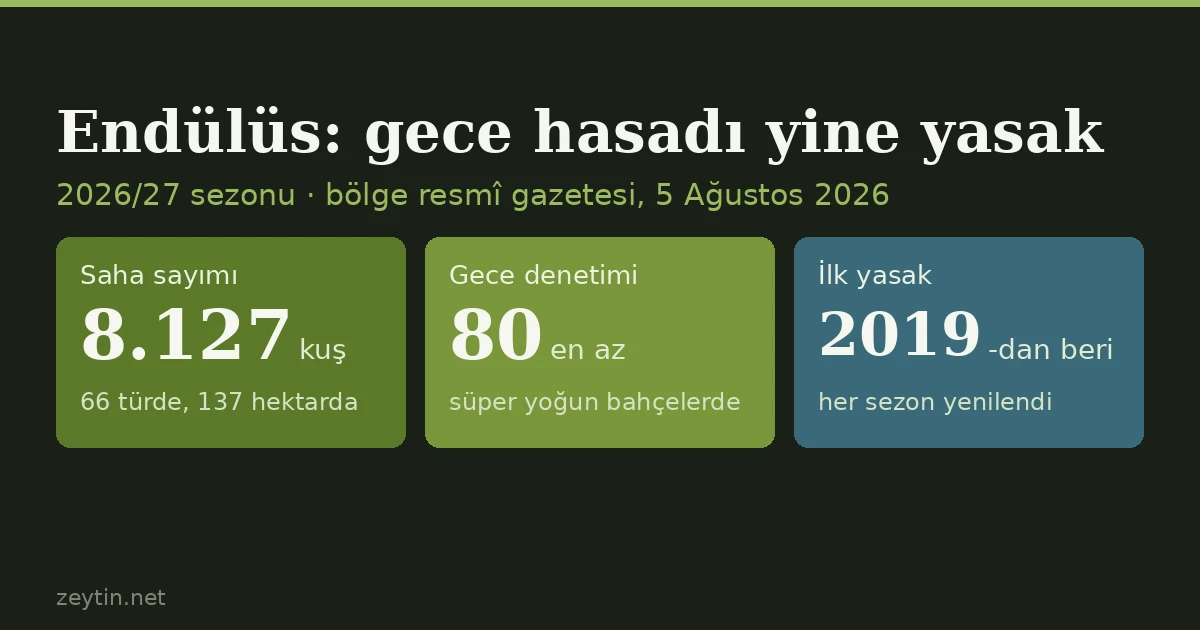
Andalusia has again suspended night-time mechanical harvesting in super-intensive hedgerow olive groves for the 2026/27 season. The resolution is dated 30 July 2026, was published in the regional official gazette on 5 August and is valid for one year. The justification is field counting: 8,127 birds from 66 species on 137 hectares. The suspension was first introduced in 2019 and has been renewed every season since.
Article
Andalusia bans night harvesting again for 2026/27: 8,127 birds counted on 137 hectares
Andalusia has again suspended night-time mechanical harvesting in super-intensive hedgerow olive groves for the 2026/27 season. The resolution is dated 30 July 2026, was published in the regional official gazette on 5 August and is valid for one year. The justification is field counting: 8,127 birds from 66 species on 137 hectares. The suspension was first introduced in 2019 and has been renewed every season since.
 Article
Antalya's crop is up 30%: of 70,000 tonnes of olives, 55,000-60,000 head for the mill
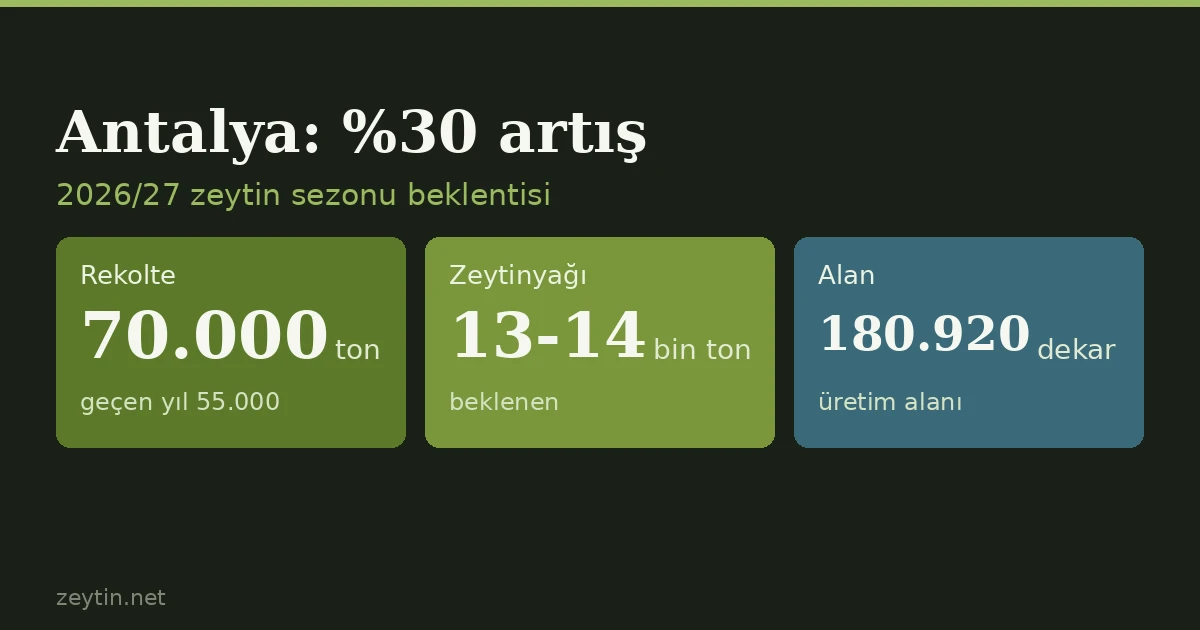
According to the Antalya Commodity Exchange, the province's olive crop is rising about 30% from some 55,000 tonnes last season to around 70,000 tonnes, with 13,000-14,000 tonnes of olive oil and 10,000-15,000 tonnes of brined fruit expected. Harvest opened on 15 September. There is movement on the registration front too: an EU application has been filed for the Tavşan Yüreği olive, and a geographical indication file is under way for the Beylik variety.
Article
Antalya's crop is up 30%: of 70,000 tonnes of olives, 55,000-60,000 head for the mill
According to the Antalya Commodity Exchange, the province's olive crop is rising about 30% from some 55,000 tonnes last season to around 70,000 tonnes, with 13,000-14,000 tonnes of olive oil and 10,000-15,000 tonnes of brined fruit expected. Harvest opened on 15 September. There is movement on the registration front too: an EU application has been filed for the Tavşan Yüreği olive, and a geographical indication file is under way for the Beylik variety.
 Article
Italy from production giant to trade hub: it exports more olive oil than it produces
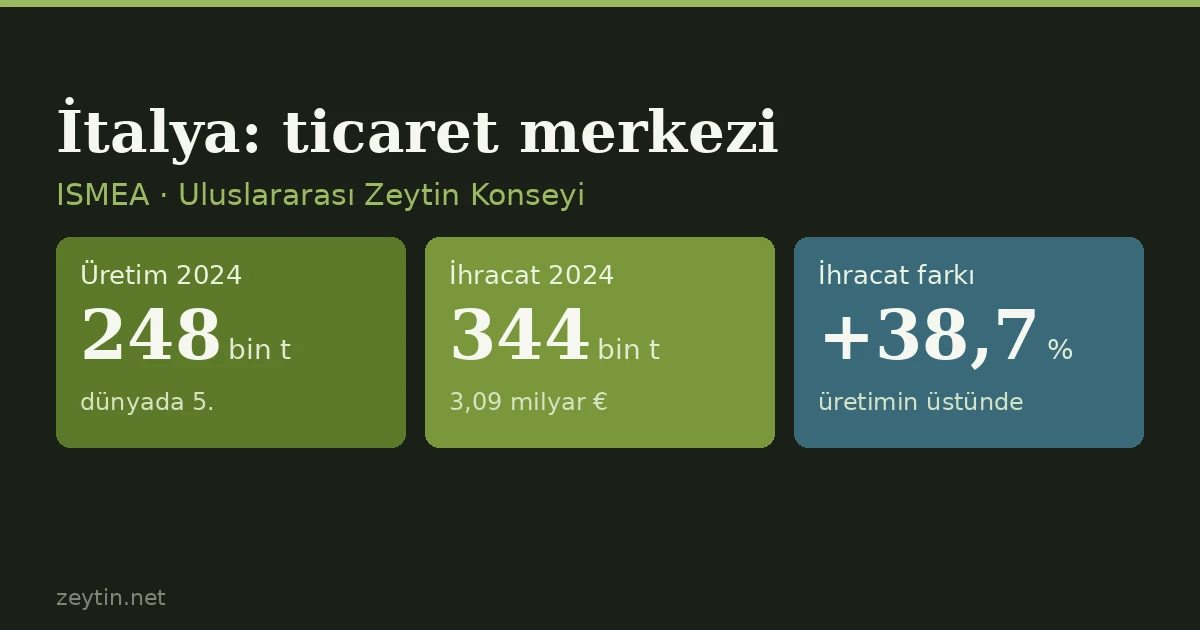
Italy produced 248,000 tonnes of olive oil in 2024 and slipped to fifth place worldwide, yet in the same year it exported 344,000 tonnes worth 3.09 billion euros. The country is now less a production giant than a trade hub that buys oil around the Mediterranean, blends it and sells it to the world.
Article
Italy from production giant to trade hub: it exports more olive oil than it produces
Italy produced 248,000 tonnes of olive oil in 2024 and slipped to fifth place worldwide, yet in the same year it exported 344,000 tonnes worth 3.09 billion euros. The country is now less a production giant than a trade hub that buys oil around the Mediterranean, blends it and sells it to the world.
 Article
Orhangazi olive oil starts on the road to geographical indication, with samples to be tested for acidity and polyphenols
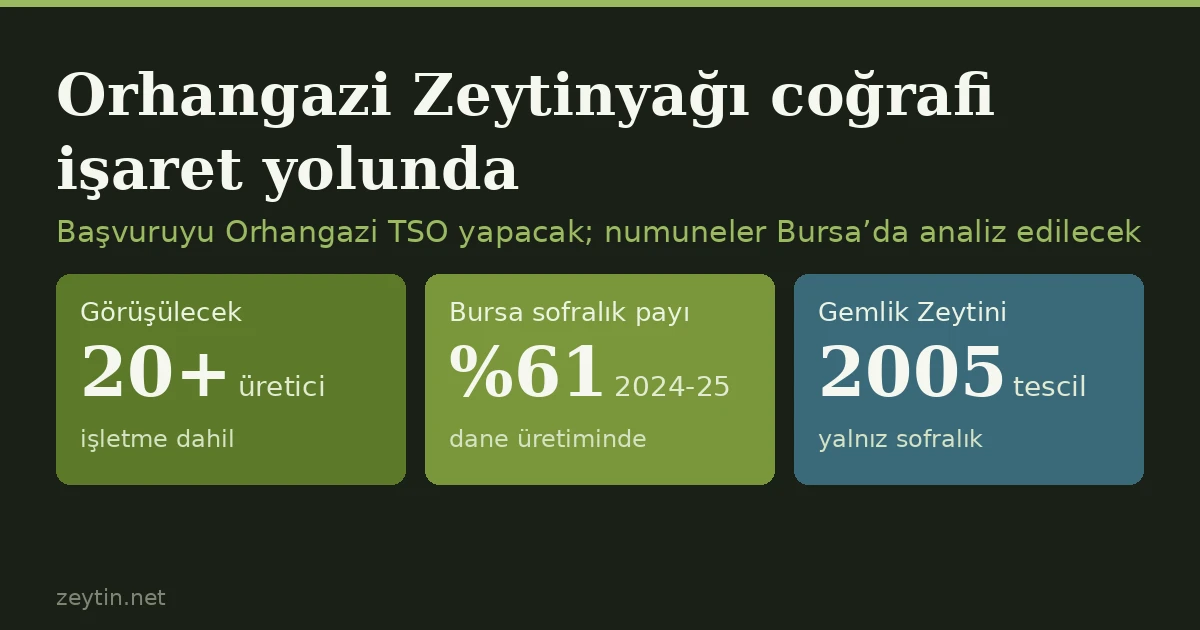
The Orhangazi Chamber of Commerce and Industry has begun preparing a geographical indication application for "Orhangazi Olive Oil". More than 20 producers will be consulted, samples tested in Bursa and the influence of the Lake İznik basin studied. The area's Gemlik Olive registration covers only table olives.
Article
Orhangazi olive oil starts on the road to geographical indication, with samples to be tested for acidity and polyphenols
The Orhangazi Chamber of Commerce and Industry has begun preparing a geographical indication application for "Orhangazi Olive Oil". More than 20 producers will be consulted, samples tested in Bursa and the influence of the Lake İznik basin studied. The area's Gemlik Olive registration covers only table olives.