Andalusia moves against North African imports: 76% of what arrives is extra virgin
Andalusia's farm sector objects that more than 76% of the olive oil imported into the region in early 2026 was extra virgin. The regional minister has requested exceptional measures under Article 195 of the EU regulation. Türkiye could meet the same door.
In our article on Algeria's record production we wrote that the surplus emerging there would most likely move as bulk oil into the bottling lines of Spain and Italy. The reaction from Andalusia confirms that expectation — with one surprise.
The incoming oil is not cheap bulk
The Andalusian farm sector's objection is not only to volume but to category: in the first months of 2026, more than 76% of the olive oil imported into the region was extra virgin.
That detail changes everything. North African imports are usually pictured as low-grade oil bound for refining, in which case they do not compete directly with local extra virgin producers — they speak to a different shelf. But more than three-quarters of what is arriving falls in the highest commercial value category, directly opposite the Spanish producer's own product.
Squeezed from both sides
The grounds for the objection are not imports alone but the cost picture they meet:
- Input costs have risen — increases in energy, fertiliser and agricultural inputs have pushed producer costs up.
- Prices at source remain low, with sharp falls.
Together these narrow producers' margins severely. Rising costs in a season when abundance is pushing prices down is the hardest combination in olive growing: more volume does not save revenue, because the unit price falls faster.
The demand: Article 195
The regional minister, Ramón Fernández-Pacheco, wrote to the Ministry of Agriculture asking for urgent measures and for intervention with the European Commission. The basis of the request is Article 195 of the EU regulation — the provision allowing exceptional measures in cases of market disturbance.
The matter has therefore moved from a producers' complaint to a request for regulatory intervention.
What it means for Türkiye
Türkiye stands in a position both similar and different.
The similarity: Turkish producers sell into the same bulk market and face the same price pressure. We covered earlier how olive oil exports fell 62% by value, in the $260 million picture. North African supply filling Europe pulls the Turkish exporter's price down too.
The difference: Türkiye is not an EU member. If the protection Andalusia seeks is granted, it will apply to "imports from non-EU countries" — and Türkiye sits in that category. A measure designed to protect the Spanish grower could meet the Turkish exporter at the same door.
On top of that sits the US 12.5% tariff. With both major markets leaning towards protection, the question of where Türkiye's expected large crop will be sold this season becomes sharper.
Read with care
⚠ Andalusia's objection is not a finding but a request. Whether the European Commission will invoke Article 195, and in what scope, is unknown. Most such requests end not in tariffs but in tighter monitoring and origin controls.
⚠ The "76% extra virgin" share refers to imports entering Andalusia; it does not mean the same ratio holds for Spain or the EU as a whole.
Scale: who produces how much?
To place the argument, production volumes help. From our own database, Türkiye's totals alongside the known sizes of the countries in this article:
| Country / region | Indicator |
|---|---|
| Türkiye — olive oil production | 475,002 t |
| Türkiye — tree stock | 171.9 million |
| Tunisia — exports (first 9 months, 2025/26) | 368,000 t |
| Algeria — production forecast | 150,000 t |
Spain is larger than all of these; by a wide margin the world's leading producer. And yet Spain is the party objecting.
The reason is not volume but category and cost. Spain produces a great deal, but at a high cost of production; what is arriving is both cheap and in the same quality class. It meets, in its own market, a supply that undercuts its own product.
What can Article 195 do?
Article 195 of the EU regulation gives the Commission power to take exceptional measures in case of market disturbance. In practice this usually takes three forms:
- Private storage aid — temporarily withdrawing surplus from the market
- Tighter import monitoring and origin controls
- More rarely, tariff or quota measures
⚠ The first two affect Turkish exporters indirectly; the third directly. Tighter origin control in fact helps the fight against adulteration and favours exporters selling documented, traceable product. The real risk lies on the tariff side.
The distinction matters, because "protectionism is coming" says little on its own; which instrument is chosen determines where Türkiye is affected.
When would it be felt?
The timetable for such requests is slow and does not align with the olive season. The regional minister's letter goes to the national ministry and from there to the Commission, which assesses market data. Even if a decision follows, implementation usually falls in the next marketing year.
The practical meaning: it does not affect this season. The large crop Türkiye expects this year will be sold under existing rules. Any effect would appear in the 2027 season at the earliest.
One thing changes immediately, though: once such a request is on the agenda, buyers start paying closer attention to origin documentation. Marketing bulk oil with incomplete paperwork becomes harder even before any decision.
One rating per visitor; you can change yours at any time. Ratings are real reader votes — no seeded or default scores.
Related
 Article
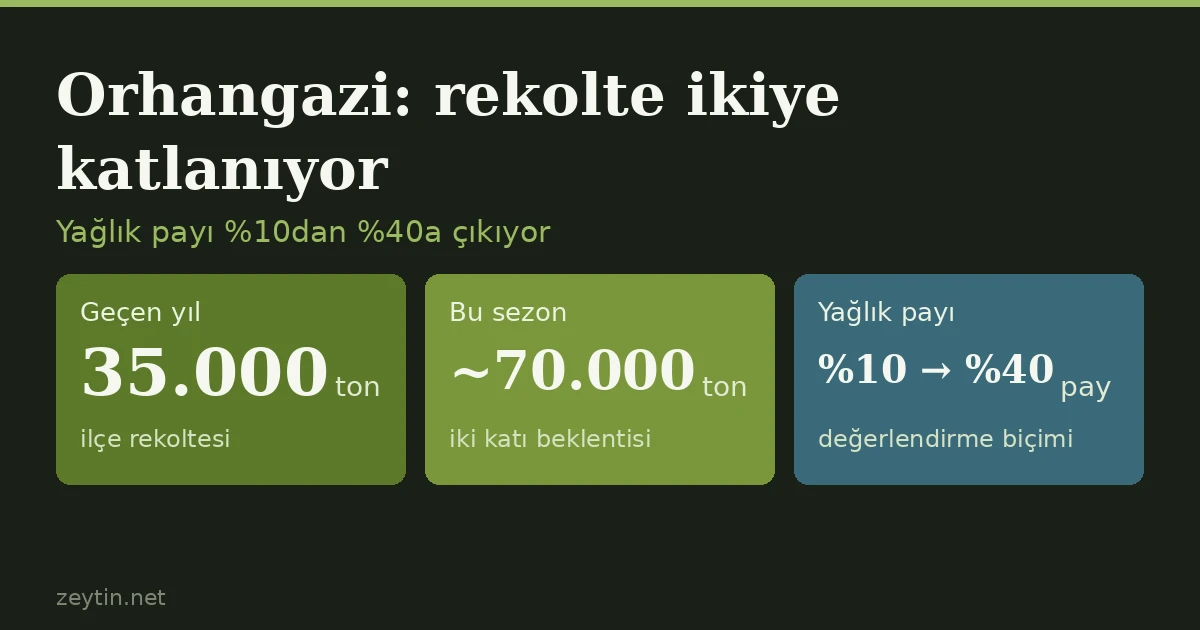
Orhangazi's crop is doubling: the oil olive share climbs from 10% to 40%
According to figures from the Orhangazi District Directorate of Agriculture and Forestry, last season's crop of roughly 35,000 tonnes could double this year. But in Türkiye's table olive heartland the real shift is in the split: the share pressed for oil is expected to rise from 10% to 40%. Mills are already in maintenance, and the grower's income now depends on fruit size.
Article
Orhangazi's crop is doubling: the oil olive share climbs from 10% to 40%
According to figures from the Orhangazi District Directorate of Agriculture and Forestry, last season's crop of roughly 35,000 tonnes could double this year. But in Türkiye's table olive heartland the real shift is in the split: the share pressed for oil is expected to rise from 10% to 40%. Mills are already in maintenance, and the grower's income now depends on fruit size.
 Article
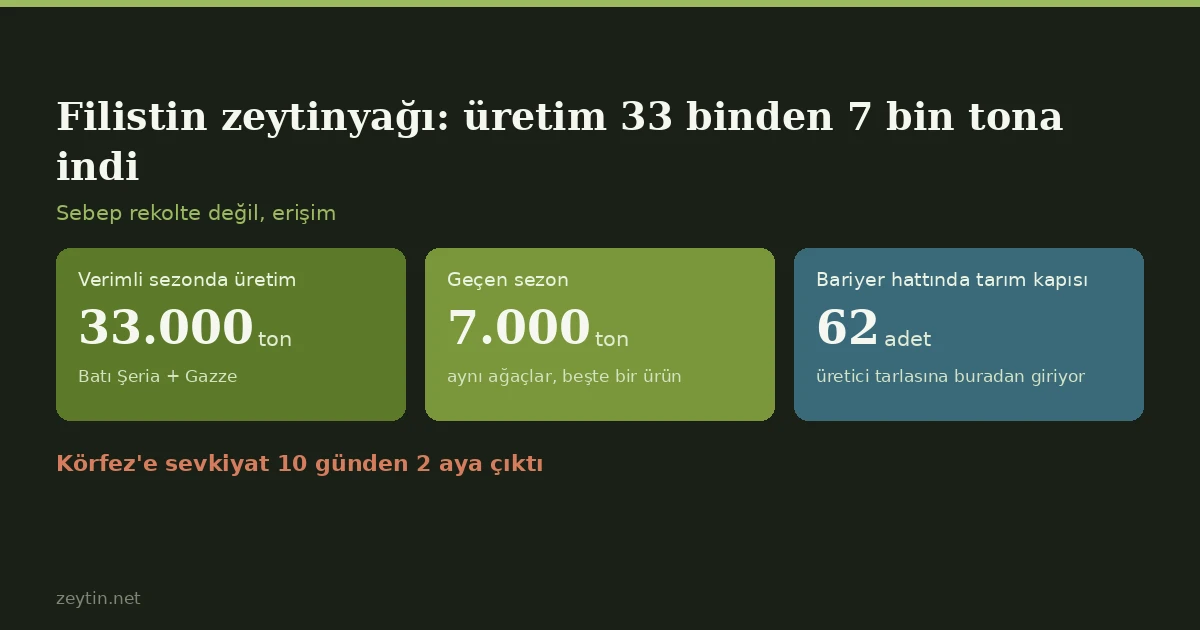
Palestinian olive oil: output down from 33,000 to 7,000 tonnes — the cause is access, not the crop
In a productive season Palestine yields 33,000 tonnes of olive oil; last season it produced 7,000. Seventy per cent of the groves sit in the northern West Bank, reached through 62 agricultural gates, and shipping times have gone from ten days to two months.
Article
Palestinian olive oil: output down from 33,000 to 7,000 tonnes — the cause is access, not the crop
In a productive season Palestine yields 33,000 tonnes of olive oil; last season it produced 7,000. Seventy per cent of the groves sit in the northern West Bank, reached through 62 agricultural gates, and shipping times have gone from ten days to two months.
 Article
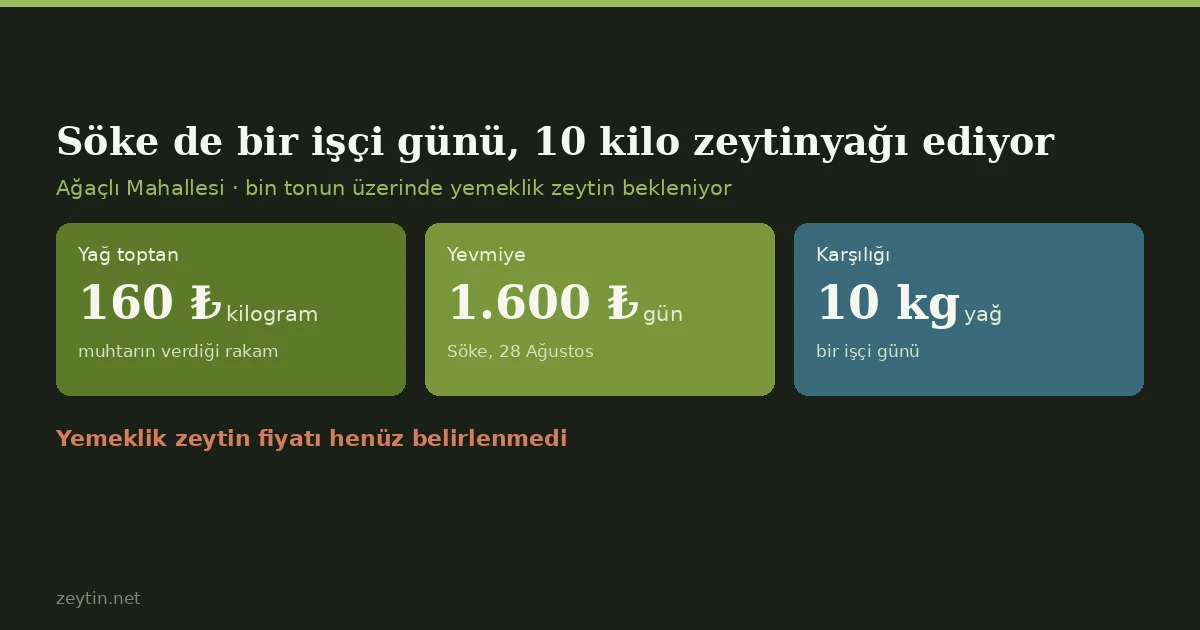
In Söke, one day's wage costs ten kilos of olive oil
Over 1,000 tonnes of table olives are expected in Söke's Ağaçlı. Two figures given by the headman sum up the season: oil at 160 lira wholesale, a day's wage at 1,600.
Article
In Söke, one day's wage costs ten kilos of olive oil
Over 1,000 tonnes of table olives are expected in Söke's Ağaçlı. Two figures given by the headman sum up the season: oil at 160 lira wholesale, a day's wage at 1,600.
 Article
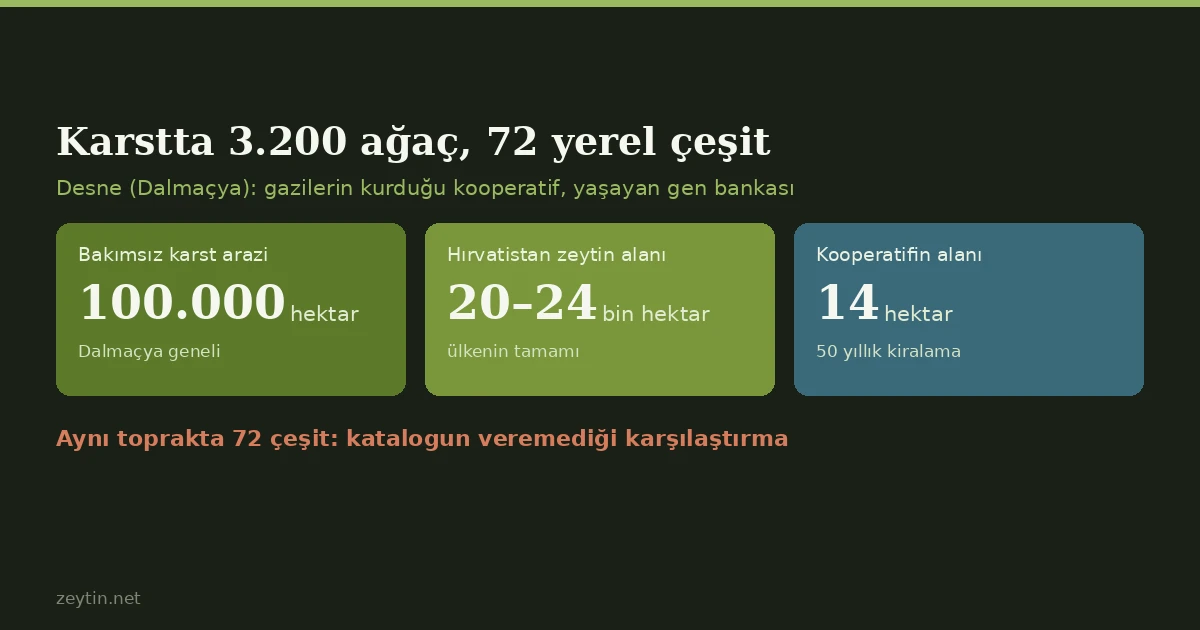
3,200 trees and 72 varieties on 14 hectares of stone: the cooperative turning Dalmatian karst into groves
Some 100,000 hectares of karst lie neglected in Dalmatia while all of Croatia has 20,000–24,000 hectares under olives. In Desne a veterans' cooperative has grown 3,200 trees of 72 native varieties on 14 hectares of rock — a grove that doubles as a natural laboratory for climate resilience.
Article
3,200 trees and 72 varieties on 14 hectares of stone: the cooperative turning Dalmatian karst into groves
Some 100,000 hectares of karst lie neglected in Dalmatia while all of Croatia has 20,000–24,000 hectares under olives. In Desne a veterans' cooperative has grown 3,200 trees of 72 native varieties on 14 hectares of rock — a grove that doubles as a natural laboratory for climate resilience.