Tunisia exported 368,000 tonnes of olive oil — but earned less per tonne
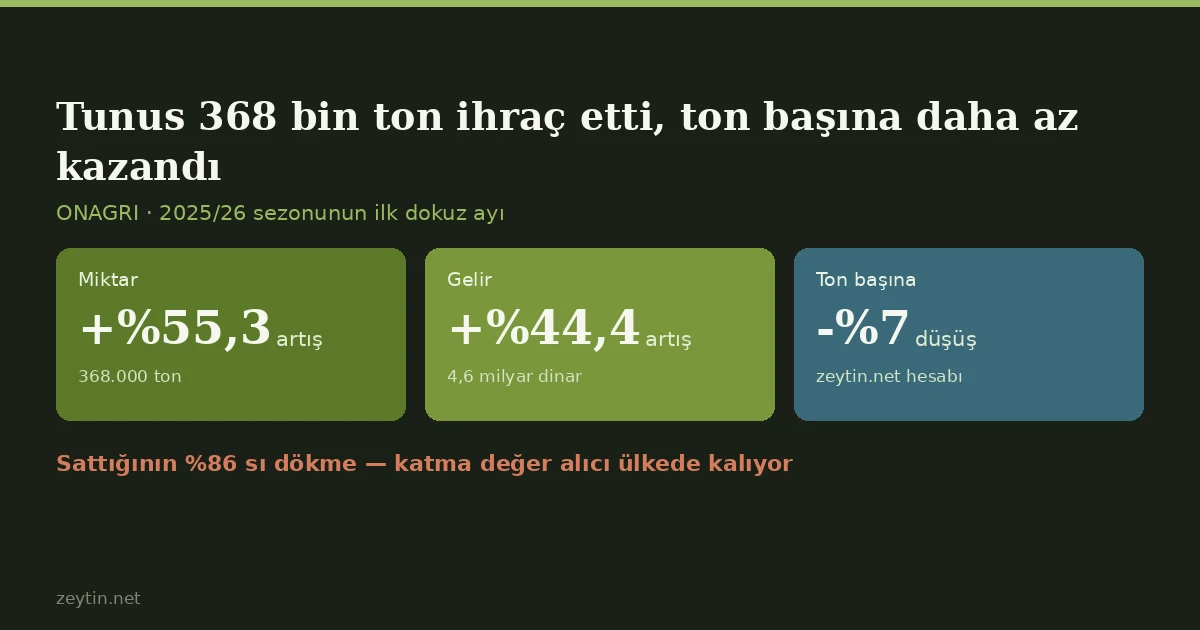
Tunisia's agriculture observatory ONAGRI reports olive oil exports up 55.3% by volume and 44.4% by value in the first nine months of 2025/26. The gap between the two means about 7% less earned per tonne.
Tunisia's National Observatory of Agriculture, ONAGRI, has published olive oil export figures for the first nine months of the 2025/26 season. They matter here because Tunisia is one of Turkey's most direct competitors in bulk olive oil.
The figures
| Indicator | 2025/26, first 9 months | Change |
|---|---|---|
| Volume exported | 368,000 t | +55.3% |
| Export revenue | TND 4.6053 bn | +44.4% |
| Bulk share (volume) | 86% | — |
| Bulk share (revenue) | 81.4% | — |
| Packaged share (volume) | 14% | — |
| Packaged share (revenue) | 18.6% | — |
| Organic olive oil | 51,200 t | ~TND 673.4 m |
ONAGRI also reports that the average export price rose 1.4% in July 2026 against the same month a year earlier.
What the coverage missed: revenue per tonne fell
Read one at a time, the figures look good: both volume and revenue are up. But they are not up at the same rate.
If volume rose 55.3% and revenue 44.4%, then revenue per tonne moved as follows:
t; 1.444 ÷ 1.553 = 0.930 → a fall of about 7%
Tunisia sold far more oil than last year and earned less on each tonne of it. This is the familiar effect of a bumper crop on price: as supply rises, unit value falls. It is the mirror image of the mechanism we described in how Spain's drought set the price in Türkiye.
The real story: bulk versus packaged
The most instructive pair of rows in the table:
- Bulk: 86% of volume, 81.4% of revenue
- Packaged: 14% of volume, 18.6% of revenue
Packaged product earns roughly 1.3 times its share of volume. The gap shows where the added value ends up: oil sold in bulk is bottled in the buying country and often re-exported under that country's brand.
This is precisely Turkey's problem too. We examined the same structure in profitability in olive oil exports: selling a lot and earning little is a question of the marketing chain, not production capacity. In from tree to shelf we traced step by step where the value is created.
Tunisia proves it with numbers: the country is having the largest harvest in its history, exports are up by more than half, and yet revenue does not rise in step — because 86% of what it sells goes out in bulk.
What it means for Turkey
Three distinct effects:
1. Price pressure. More supply in the Mediterranean pulls the world price down. Tunisia's 368,000 tonnes is large enough to affect the price Turkish exporters can get.
2. Competition. In the bulk market the rival is selling to the same buyers — bottlers in Spain and Italy, for whom the country of origin is secondary and price is primary.
3. A lesson. If even Tunisia's 14% packaged share produces 18.6% of revenue, the return on enlarging that share is a calculable thing. The same question follows from Turkey's own export mix, where two-thirds of exports are table olives.
One rating per visitor; you can change yours at any time. Ratings are real reader votes — no seeded or default scores.
Related
 Article
Spain's competition authority opposes the withdrawal rule: "very negative for competition and consumers"
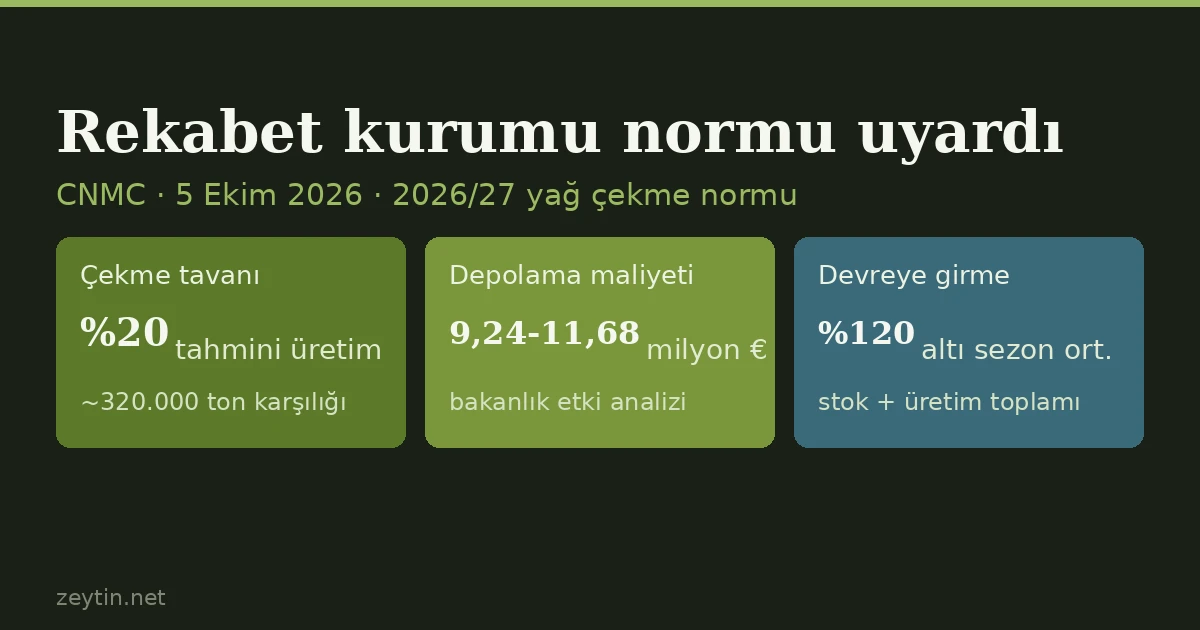
On 5 October the CNMC published its report on the draft rule that would withdraw part of Spain's olive oil from the market in the event of oversupply in 2026/27. The authority says the measure would raise prices and narrow quality and variety. The ministry's own impact assessment puts storage costs at €9.24-11.68 million. The withdrawal cap is 20 percent of estimated production — up to 320,000 tons.
Article
Spain's competition authority opposes the withdrawal rule: "very negative for competition and consumers"
On 5 October the CNMC published its report on the draft rule that would withdraw part of Spain's olive oil from the market in the event of oversupply in 2026/27. The authority says the measure would raise prices and narrow quality and variety. The ministry's own impact assessment puts storage costs at €9.24-11.68 million. The withdrawal cap is 20 percent of estimated production — up to 320,000 tons.
 Article
The world's largest bottler is for sale: a €500 million race for Deoleo
Deoleo, owner of Bertolli and Carbonell, holds 22% of global bottled olive oil sales. Italy's Coricelli leads at €500 million, Spain's Dcoop cooperative at €470 million. The Spanish government regards the company as nationally strategic. Because Deoleo is a major bulk buyer, the outcome matters to Turkish exporters too.
Article
The world's largest bottler is for sale: a €500 million race for Deoleo
Deoleo, owner of Bertolli and Carbonell, holds 22% of global bottled olive oil sales. Italy's Coricelli leads at €500 million, Spain's Dcoop cooperative at €470 million. The Spanish government regards the company as nationally strategic. Because Deoleo is a major bulk buyer, the outcome matters to Turkish exporters too.
 Article
Agriculture in the EU budget bargain: allocations kept, the four big olive oil producers still object
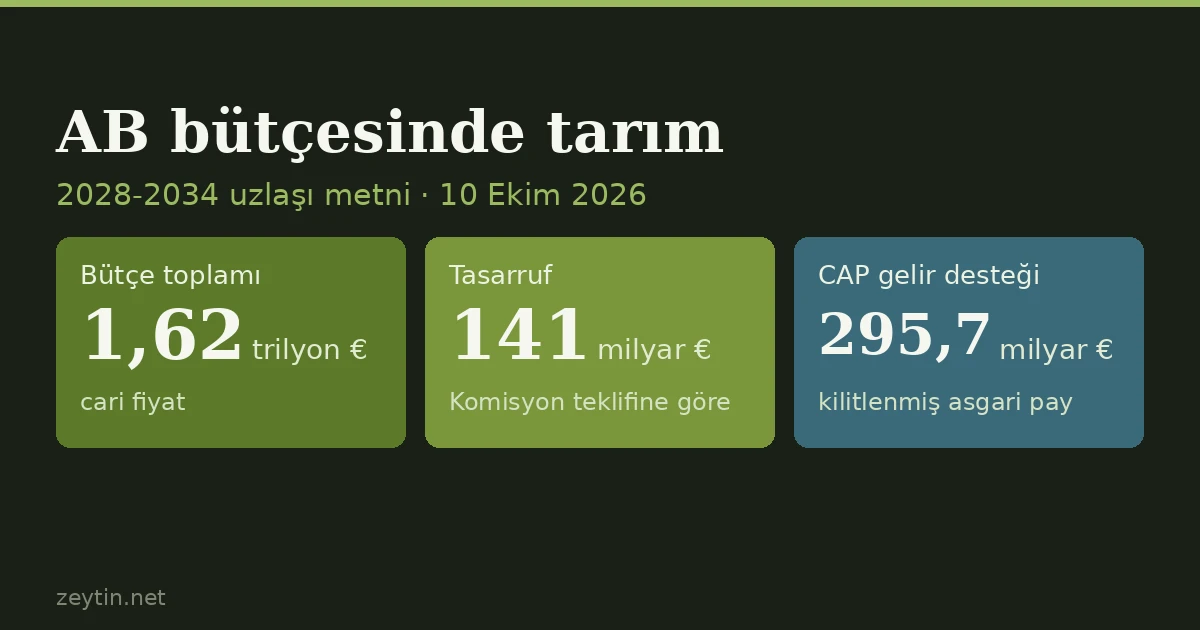
Ireland, holding the Council presidency, circulated a revised compromise text for the 2028-2034 budget on 10 October: 1.62 trillion euros in current prices, savings of 141 billion euros (8%) against the Commission proposal, with agricultural and cohesion allocations retained. The objections have not stopped, because under the Commission proposal the income support of the Common Agricultural Policy is ring-fenced at 295.7 billion euros inside a single 865 billion euro fund, against 387.8 billion euros allocated to that policy for 2021-2027. All four of the Union's big olive oil producers sit in the group of 17 states resisting the cut.
Article
Agriculture in the EU budget bargain: allocations kept, the four big olive oil producers still object
Ireland, holding the Council presidency, circulated a revised compromise text for the 2028-2034 budget on 10 October: 1.62 trillion euros in current prices, savings of 141 billion euros (8%) against the Commission proposal, with agricultural and cohesion allocations retained. The objections have not stopped, because under the Commission proposal the income support of the Common Agricultural Policy is ring-fenced at 295.7 billion euros inside a single 865 billion euro fund, against 387.8 billion euros allocated to that policy for 2021-2027. All four of the Union's big olive oil producers sit in the group of 17 states resisting the cut.
 Article
Spain decides in November: will part of a 1.6 million tonne crop be withdrawn from the market?
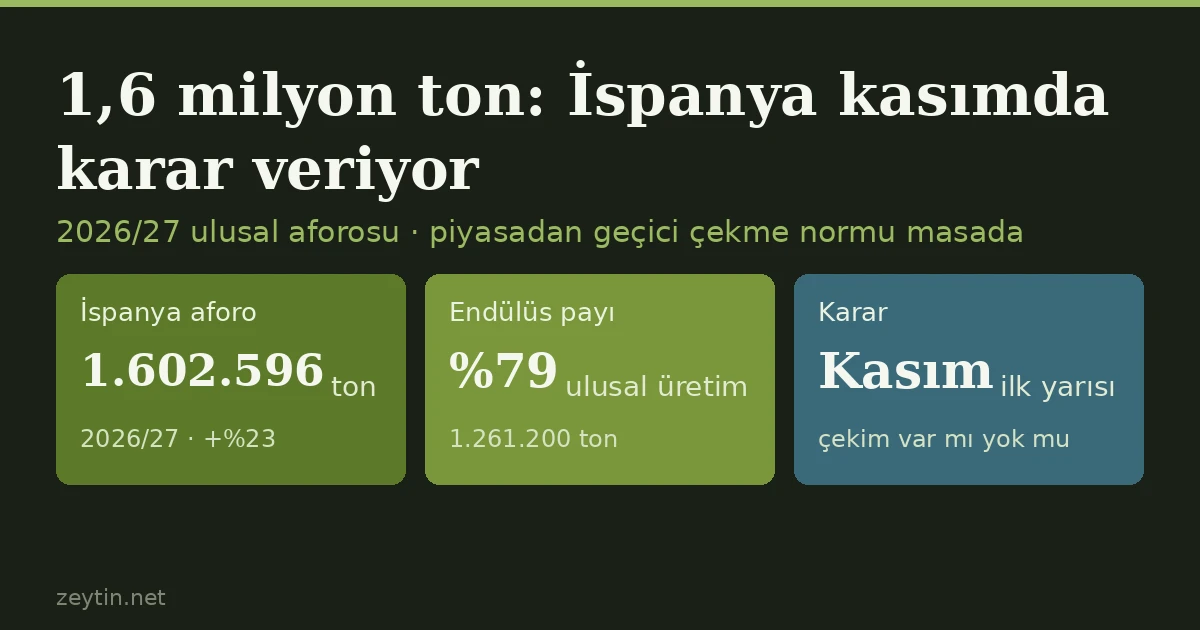
Spain's first national aforo for 2026/27 was presented in Jaén on 1 October: 1,602,596 tonnes of olive oil, 23% above last harvest. With carry-over stock, total availability approaches two million tonnes, and the Ministry of Agriculture will decide in the first half of November whether to activate a temporary withdrawal mechanism that has never been used. The ceiling on the world price Turkish exporters will face is being set here.
Article
Spain decides in November: will part of a 1.6 million tonne crop be withdrawn from the market?
Spain's first national aforo for 2026/27 was presented in Jaén on 1 October: 1,602,596 tonnes of olive oil, 23% above last harvest. With carry-over stock, total availability approaches two million tonnes, and the Ministry of Agriculture will decide in the first half of November whether to activate a temporary withdrawal mechanism that has never been used. The ceiling on the world price Turkish exporters will face is being set here.