Concordat in Akhisar: a one-year moratorium for Baktat Zeytin
A Turkish commercial court has granted a one-year definitive moratorium to Baktat Zeytin, a table-olive processor in Akhisar. We set out what the ruling means and why it matters for the sector.
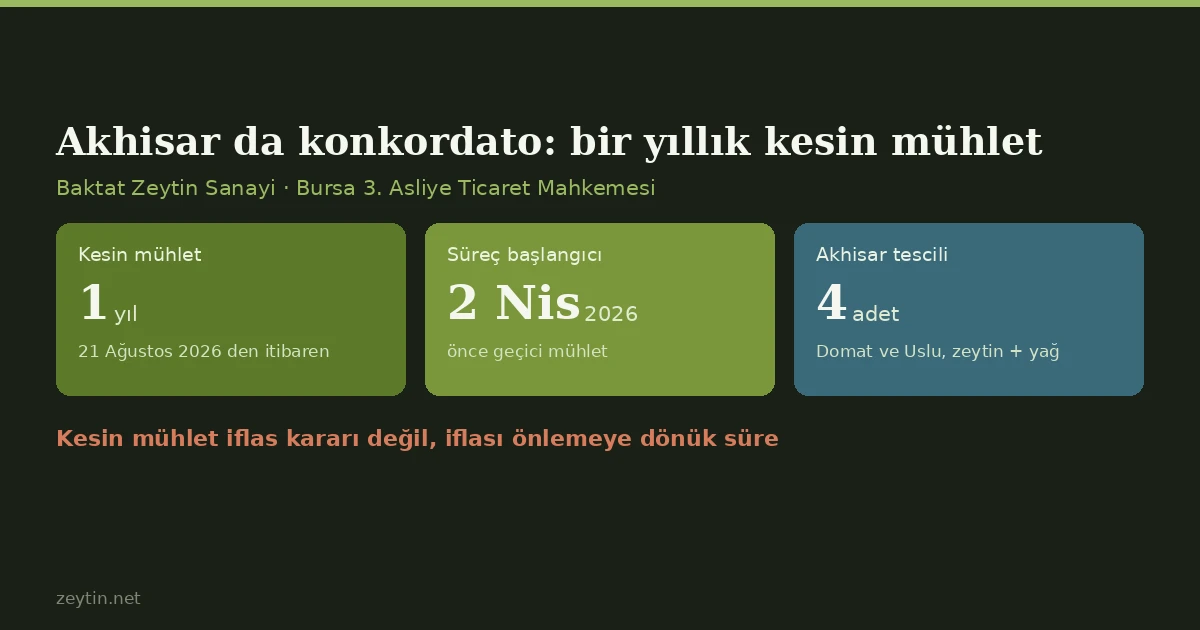
Bursa's 3rd Commercial Court of First Instance has granted a one-year definitive moratorium (kesin mühlet) to Baktat Zeytin Sanayi Ticaret A.Ş., a table-olive processor in Akhisar, Manisa. The ruling was announced on 25 August 2026 and takes effect from 21 August 2026.
This does not mean the company has closed. Below is what it does mean, and why it is worth following for the olive sector.
The timeline
| Date | Stage |
|---|---|
| 2 April 2026 | Concordat proceedings opened; the court granted a three-month provisional moratorium |
| 1 July 2026 | Provisional moratorium extended by two months; review set for 21 August |
| 21 August 2026 | Definitive moratorium takes effect (one year) |
| 25 August 2026 | Ruling announced |
The court ended the appointments of the provisional commissioners and named three people to oversee the process: the lawyer Hakan Yıldız and the certified accountants Engin Dinçeli and Birol Aslan. Their monthly fees are to be met from the company's assets. Measures imposed during the provisional period continue to apply.
What a definitive moratorium means
Concordat is a legal route allowing a company that cannot meet its debts to restructure them without going bankrupt. It has two stages:
- Provisional moratorium: short-term protection while the court examines the situation.
- Definitive moratorium: longer protection granted if the court decides the process should continue. Enforcement proceedings against the company are suspended while it keeps trading and works on restructuring.
A definitive moratorium is therefore not a bankruptcy ruling but time granted in order to avoid one. If creditors accept the concordat plan and the court ratifies it, the company continues; if not, bankruptcy may follow.
Why Akhisar
Akhisar is one of the centres of Turkey's table-olive industry. The district holds four separate geographical indication registrations: Akhisar Domat table olive, Akhisar Domat olive oil, Akhisar Uslu table olive and Akhisar Uslu olive oil.
That concentration also means the processing capacity in the district is where growers sell. In table olives the link between grower and consumer is usually a processing and packing plant of exactly this kind; we examined those links one by one in from tree to shelf.
Why it matters for the sector
Table olives are more labour-intensive than oil and involve more processing stages: brining, sizing, sorting, packing. Those stages require capital and stock-holding — the harvest happens in one season while sales are spread across the year.
That structure squeezes processors from both sides: raw material to be paid for at harvest, receivables collected over the following months. We looked at this cost structure in informality in the table olive sector and what does a kilo of olives cost to produce.
For that reason one company's concordat is not only that company's affair: who growers in the district can sell to, when they are paid, and how competition is shaped all follow from it.
What comes next
The definitive moratorium runs for a year. During it the commissioners monitor the company's finances, a concordat plan is drawn up and put to creditors. The process may be extended or end early.
Concordat rulings are published in the Turkish Trade Registry Gazette, where anyone following the case can verify them.
One rating per visitor; you can change yours at any time. Ratings are real reader votes — no seeded or default scores.
Related
 Article
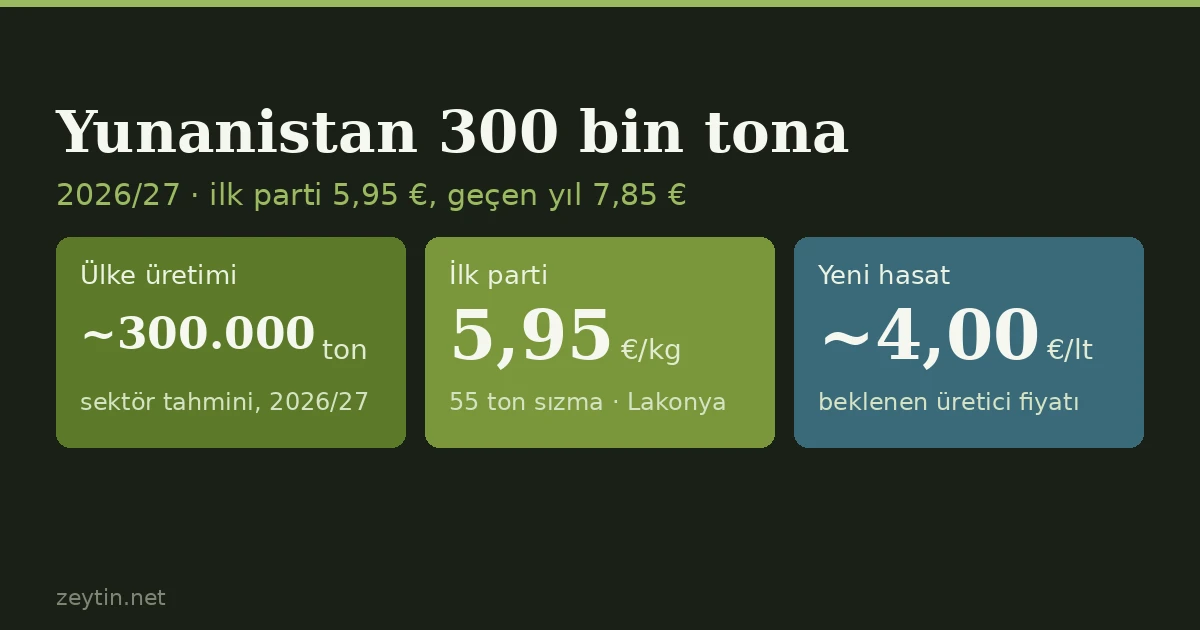
Greece heads for 300,000 tons: first lot sold at €5.95 after last year's €7.85
Greece expects its largest olive oil harvest since 2022/23 in 2026/27, with industry estimates near 300,000 tons. The season's first lot — 55 tons of extra virgin in Laconia — changed hands at €5.95 per kilo, down from €7.85 a year earlier. Carryover oil sells near €3.40 and new-crop producer prices are expected around €4. A simultaneous rebound across the three largest producers pushes down the world price Turkish exporters will meet.
Article
Greece heads for 300,000 tons: first lot sold at €5.95 after last year's €7.85
Greece expects its largest olive oil harvest since 2022/23 in 2026/27, with industry estimates near 300,000 tons. The season's first lot — 55 tons of extra virgin in Laconia — changed hands at €5.95 per kilo, down from €7.85 a year earlier. Carryover oil sells near €3.40 and new-crop producer prices are expected around €4. A simultaneous rebound across the three largest producers pushes down the world price Turkish exporters will meet.
 Article
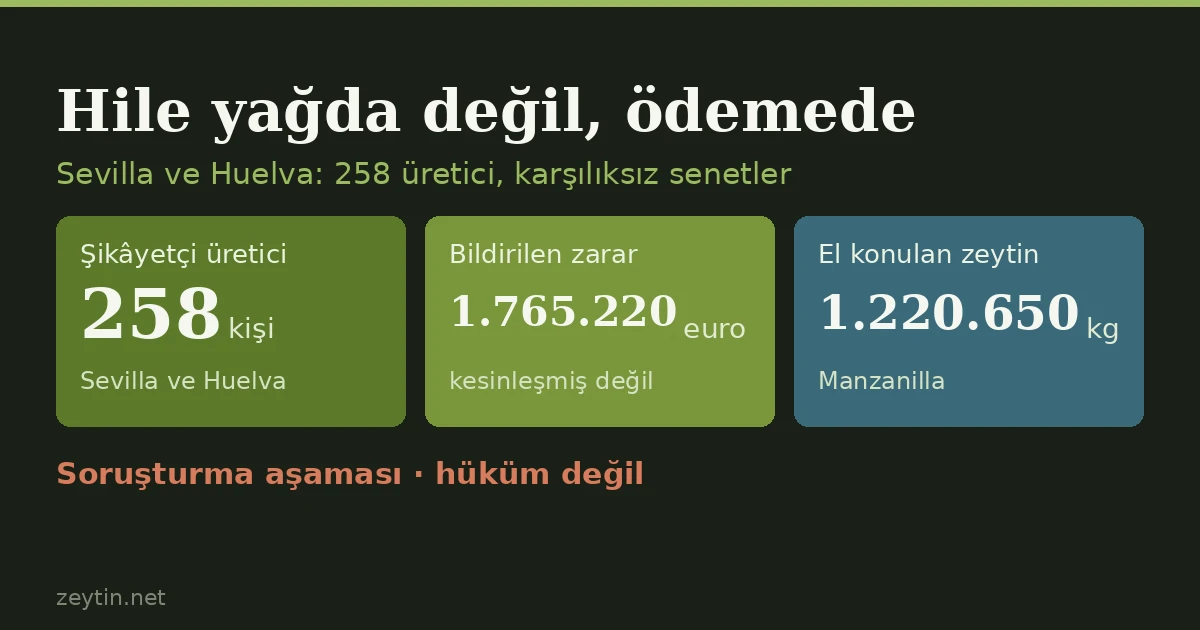
258 growers, €1.77 million: in Spain the fraud was not in the oil, it was in the payment
Spain's Guardia Civil has detained a table olive trader accused of defrauding 258 growers in Seville and Huelva of €1,765,220. The olives were real and the sales were real; the money never reached the producers. Investigators seized 1,220,650 kilos of Manzanilla olives.
Article
258 growers, €1.77 million: in Spain the fraud was not in the oil, it was in the payment
Spain's Guardia Civil has detained a table olive trader accused of defrauding 258 growers in Seville and Huelva of €1,765,220. The olives were real and the sales were real; the money never reached the producers. Investigators seized 1,220,650 kilos of Manzanilla olives.
 Article
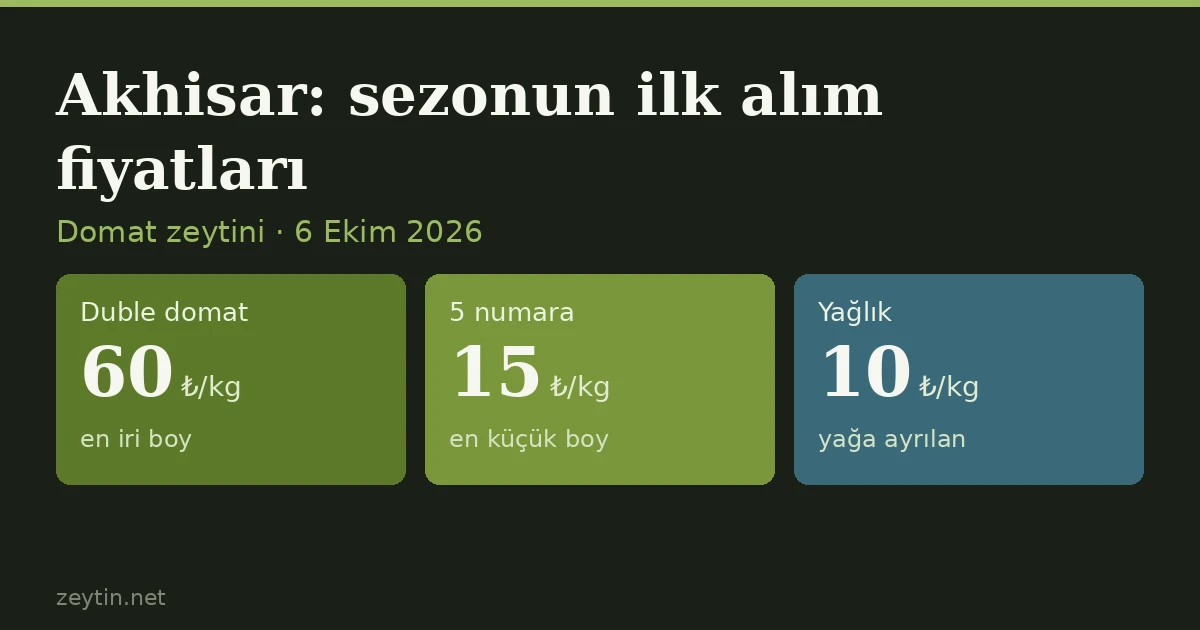
Opening prices in Akhisar: 60 lira for double Domat, 10 lira for milling olives
The season's first purchase prices for Domat olives have formed in Akhisar: 15 to 60 lira a kilo by size, and 10 lira for fruit sold for milling. The local chamber of agriculture says prices are below last year's and has called for a joint table. Farm input costs rose 27.6% over the same period.
Article
Opening prices in Akhisar: 60 lira for double Domat, 10 lira for milling olives
The season's first purchase prices for Domat olives have formed in Akhisar: 15 to 60 lira a kilo by size, and 10 lira for fruit sold for milling. The local chamber of agriculture says prices are below last year's and has called for a joint table. Farm input costs rose 27.6% over the same period.
 Article
"Not definitive until November": Andalusian growers push back on the crop estimate
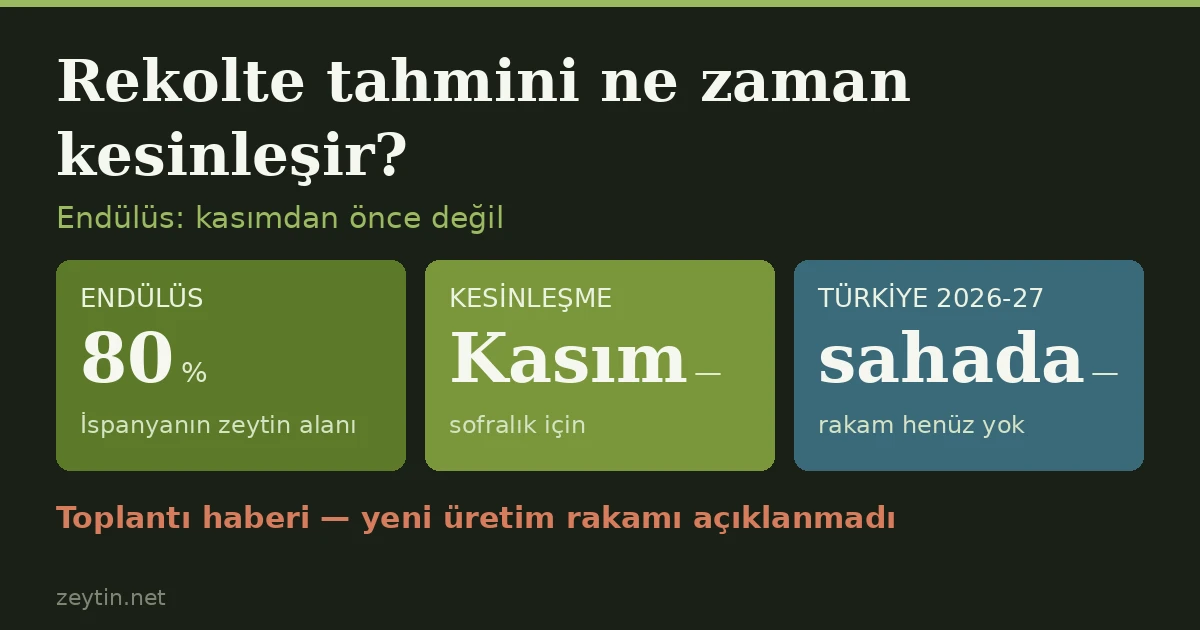
Andalusia's agriculture ministry called its first crop estimate "high production"; cooperatives and COAG in Seville objected: recent heat will affect the crop and the estimate is not definitive until November. Türkiye is making its 2026-27 estimate in the field the same week — the same caution applies here.
Article
"Not definitive until November": Andalusian growers push back on the crop estimate
Andalusia's agriculture ministry called its first crop estimate "high production"; cooperatives and COAG in Seville objected: recent heat will affect the crop and the estimate is not definitive until November. Türkiye is making its 2026-27 estimate in the field the same week — the same caution applies here.