The economics of caliber: how fruit size triples the price
160 TL at caliber 18, 55 TL at caliber 41. Fruit size is price — and the cooperative pays 16% above the exchange average.
Say "the price of olives" and people think of a single number. Yet fruit picked from the same grove on the same day fetches three times more or less depending on its size — and that difference is one of the most concrete items shaping a grower's annual income.
This article sets two prices side by side: what a cooperative pays the grower and what forms on the exchange. They measure different things, and the gap between them is instructive.
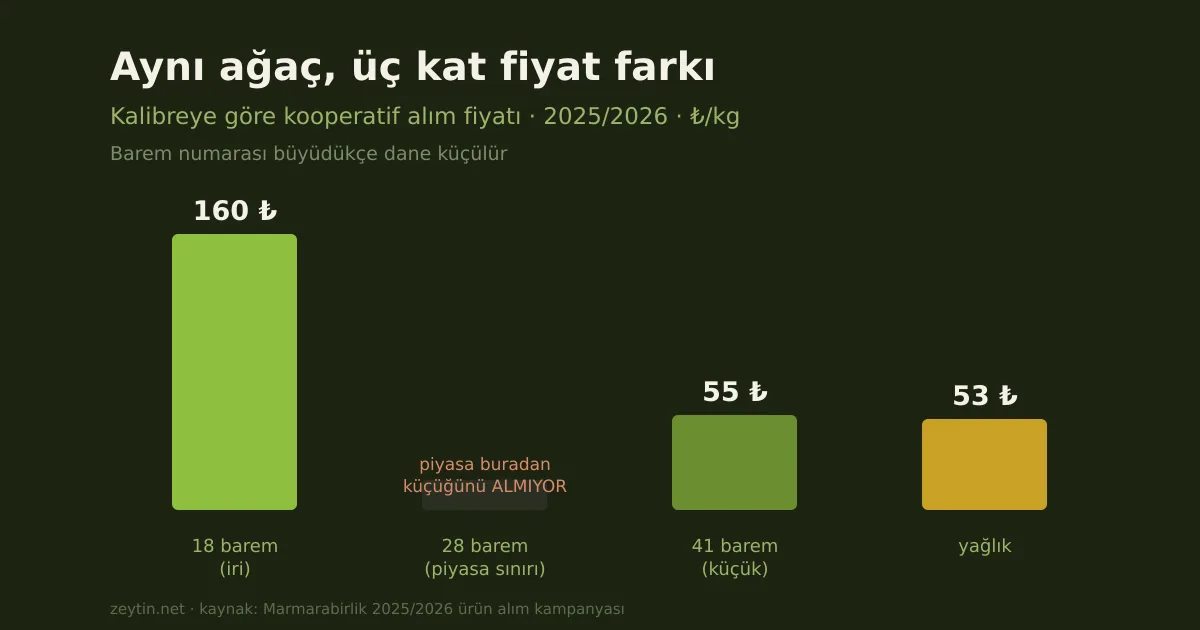
What is caliber?
In table olives, caliber (or barem in Turkish) is the count of fruits in one kilogram.
The rule runs backwards: the higher the number, the smaller the fruit. An 18-caliber olive is large, a 41-caliber olive is small — because it takes more of them to fill the same kilo.
What the table market wants is large fruit: it holds its shape on a plate, it can be stuffed, it looks fleshy. Small fruit loses its table value and generally goes to oil.
Marmarabirlik's 2025/2026 purchase prices
Marmarabirlik, Türkiye's largest olive producers' union, announces floor and ceiling purchase prices by caliber each harvest. For the 2025/2026 season:
| Caliber | Price TL/kg | Note |
|---|---|---|
| 18 (large) | 160.00 | ceiling price |
| 41 (small) | 55.00 | floor price |
| Olives for oil | 53.00 | regardless of caliber |
Source: Marmarabirlik's 2025/2026 purchase campaign announcement. The union stated it received harvest declarations of 67,000 tonnes for the season; payments are made in fifteen-day cycles, half in cash.
Three numbers, three separate things.
The caliber gap is almost threefold. Large fruit 160 lira, small fruit 55. Same tree, same harvest. The 105 lira between them comes not from quality but from size.
Oil olives are cheaper than even the smallest table grade — 53 against 55 lira. The moment fruit fails to qualify for the table it drops to the bottom of its value. That threshold is the grower's most critical one.
And the real point: the market does not buy small fruit. According to the union, no buyer takes olives above 28 caliber on the open market; Marmarabirlik buys up to 41. This is where a cooperative's reason for existing becomes visible — it buys what the market will not.
Who pays more, the cooperative or the exchange?
Now to our own data. Over the same season (November 2025 onward), oil olive registrations at the Edremit exchange:
| Source | TL/kg | What it measures |
|---|---|---|
| Marmarabirlik purchase price | 53.00 | what the cooperative pays its member |
| Exchange, 2025/26 season average | 45.78 | volume-weighted over 3,119 tonnes |
| Exchange, last registration (26.06.2026) | 38.00 | a single transaction |
Exchange figures are compiled from 17 registered transactions at the Edremit Commodity Exchange. The cooperative price is fixed and announced at the start of the season; the exchange price re-forms with every transaction.
The result may surprise: the cooperative pays 16% above the exchange average. Measured against the latest registration, the gap widens to 39%.
Reading this as "the cooperative is generous" would be wrong. The two prices are different things:
- The exchange price is where supply and demand meet at that moment; it falls in the busiest harvest weeks and rises when stock thins. The registrations in the table swing between 28.78 and 60.55 lira.
- The cooperative price is announced at the start of the season and does not change. A member knows what they will get when they deliver.
So the premium the cooperative pays is not generosity but the price of predictability — it takes the risk of volatility off the grower and puts it on the union. In the union's own words, the aim is "to protect the producer from price fluctuations in the market".
How should a grower read this?
Caliber is decided before the harvest. Fruit size depends on irrigation, pruning, feeding and thinning. The threefold gap between caliber 18 and 41 is the return on decisions made in the grove — not something that can be fixed on picking day.
Falling below the table threshold is expensive. Fruit that fails to qualify drops to 53 lira, beneath even the smallest table grade. Holding that threshold is the single highest-return intervention per kilogram.
Choosing a buyer is a risk decision. The exchange pays more in a good week and far less in a bad one. The cooperative pays more on average and pays it steadily — but on its own payment schedule. Which is right depends on the grower's cash needs and tolerance for risk.
For small fruit the cooperative may be the only buyer. If the market stops at caliber 28, fruit at 41 has nowhere else to go.
Limits of the comparison
Three things to keep in mind:
The products are not exactly the same. Marmarabirlik's caliber prices are for raw fruit destined for the table; "olives for oil" on the exchange is fruit going to the mill. On the oil line the two are directly comparable; on the caliber prices the comparison is indirect.
One union only. Marmarabirlik operates in the Marmara region and predominantly in the Gemlik variety. Tariş works in the Aegean and other structures in the southeast; their pricing policies may differ.
A thin exchange sample. Oil olive registrations come only from Edremit, and the season holds 17 transactions. The series is sound but not deep.
Payment terms are not in the price. Cash on delivery and payment at three months are different things at the same number; this table compares only the announced figure.
Summary
- Caliber is the count of fruits per kilogram; the higher the number, the smaller the fruit.
- In 2025/26 the cooperative paid 160 TL for large fruit and 55 TL for small — a threefold gap, on size alone.
- Oil olives fetched 53 TL, below even the smallest table grade; losing the table threshold is costly.
- Over the same season the exchange averaged 45.78 TL — the cooperative paid 16% more.
- That premium is not generosity but the price of predictability: the cooperative's figure held all season while the exchange swung between 28.78 and 60.55.
- The market stops at caliber 28; only the cooperative buys smaller fruit.
Related reading: The same olive, six times the price · Olive varieties · Prices exchange by exchange · Tree to shelf: the value chain
One rating per visitor; you can change yours at any time. Ratings are real reader votes — no seeded or default scores.
Related
 Article
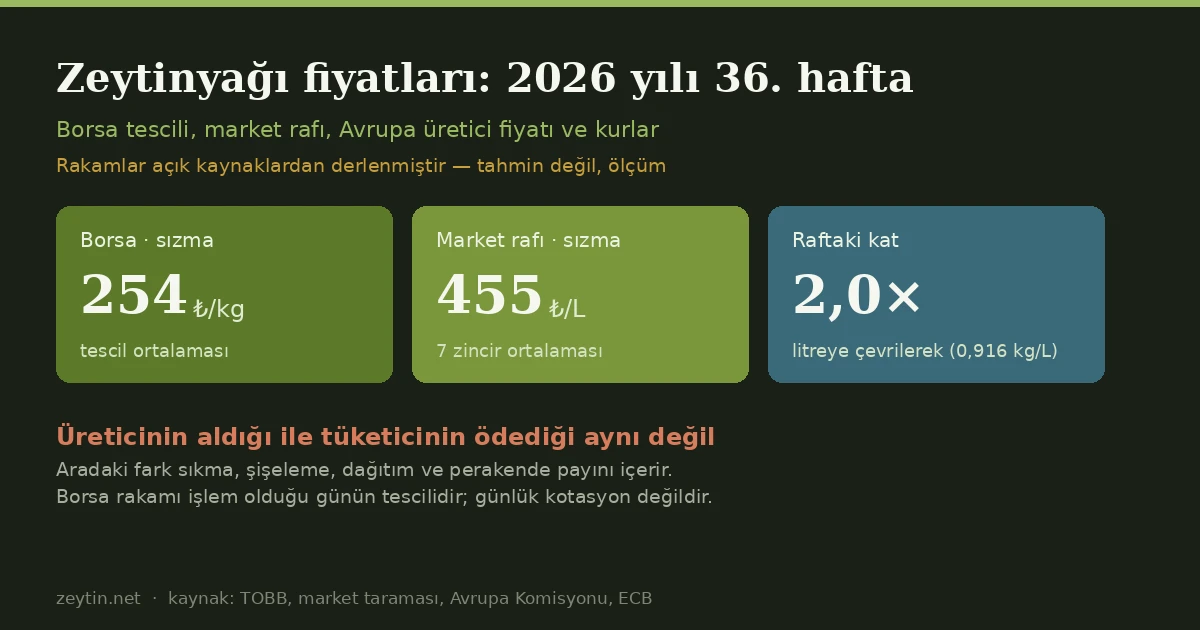
Olive Oil Prices: Week 36 of 2026
Week 36 of 2026: Turkish exchange prices, European producer prices and exchange rates side by side.
Article
Olive Oil Prices: Week 36 of 2026
Week 36 of 2026: Turkish exchange prices, European producer prices and exchange rates side by side.
 Article
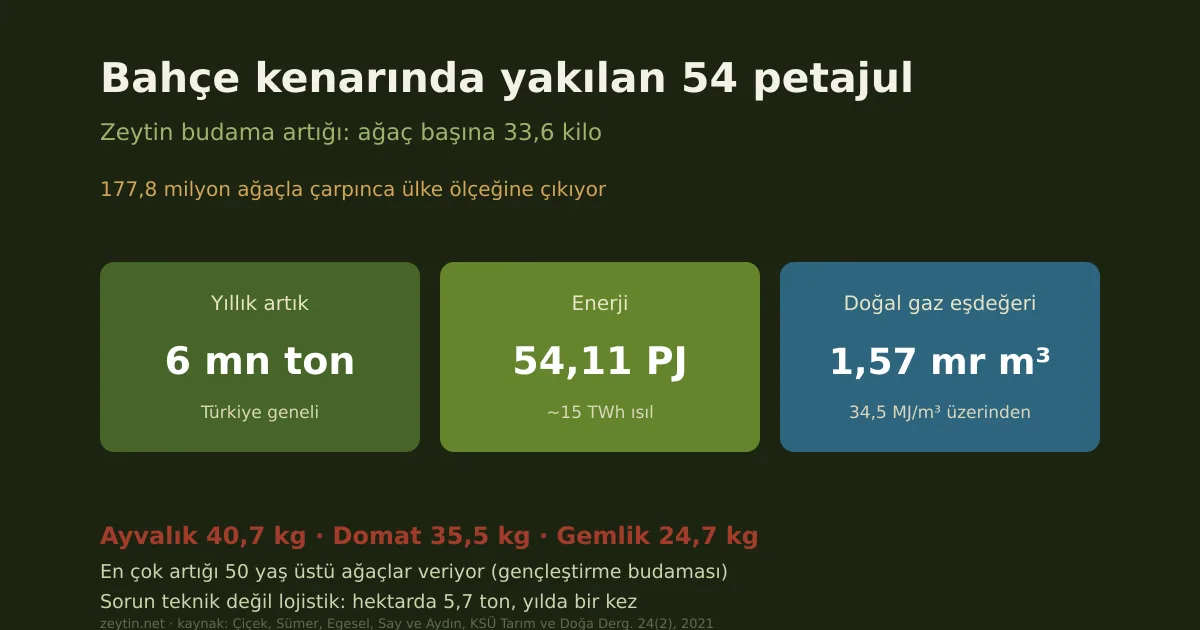
The energy burned at the field edge: olive pruning residue
One olive tree yields 33.6 kg of prunings a year. Across 177.8 million trees that is 6 million tonnes of residue and 54.11 PJ of energy — equivalent to 1.57 billion m³ of natural gas.
Article
The energy burned at the field edge: olive pruning residue
One olive tree yields 33.6 kg of prunings a year. Across 177.8 million trees that is 6 million tonnes of residue and 54.11 PJ of energy — equivalent to 1.57 billion m³ of natural gas.
 Article
Olive Oil Prices: Week 35 of 2026
Turkish exchange prices, European producer prices and exchange rates side by side: extra virgin at 300 TL/kg in Edremit, Spain's national average €3.52/kg.
Article
Olive Oil Prices: Week 35 of 2026
Turkish exchange prices, European producer prices and exchange rates side by side: extra virgin at 300 TL/kg in Edremit, Spain's national average €3.52/kg.
 Article
Vegetation water and pomace: olive oil's waste problem
Processing 1.5–2 million tonnes of olives yields 1 million tonnes of vegetation water and 1 million tonnes of pomace. Waste, or resource?
Article
Vegetation water and pomace: olive oil's waste problem
Processing 1.5–2 million tonnes of olives yields 1 million tonnes of vegetation water and 1 million tonnes of pomace. Waste, or resource?