The energy burned at the field edge: olive pruning residue
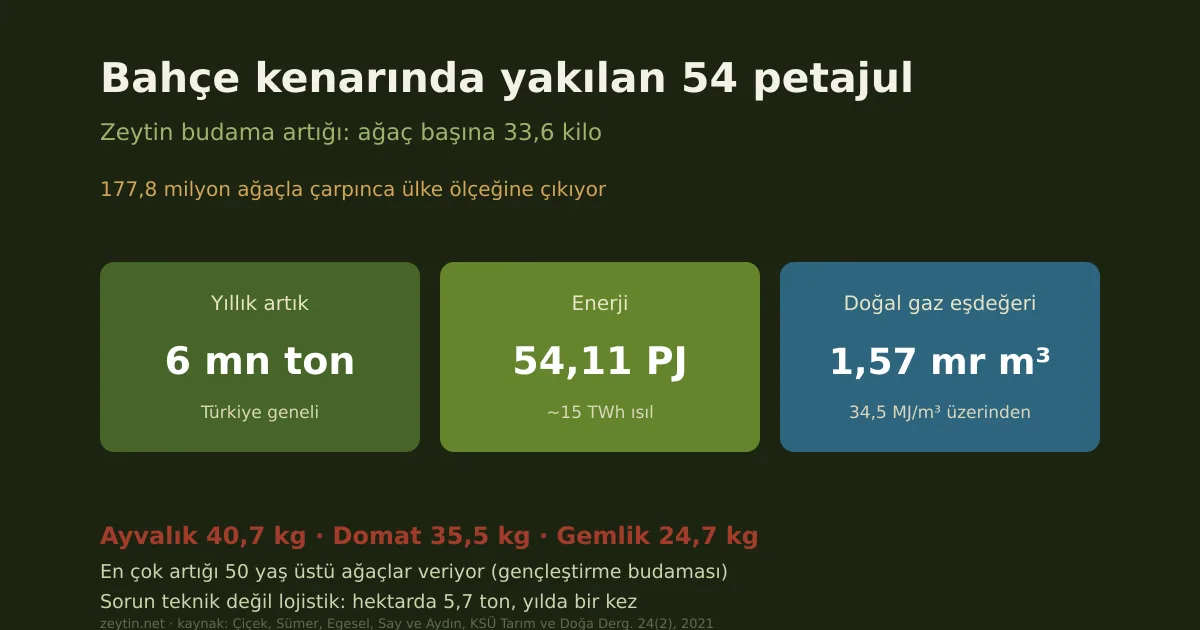
One olive tree yields 33.6 kg of prunings a year. Across 177.8 million trees that is 6 million tonnes of residue and 54.11 PJ of energy — equivalent to 1.57 billion m³ of natural gas.
The same scene plays out in every grove each winter: pruning finishes, branches pile up at the field edge, and a few weeks later they are burned. To the grower this is waste disposal. Look at the numbers and it turns out to be one of Türkiye's largest overlooked agricultural energy resources.
A joint study by Çanakkale Onsekiz Mart and Çukurova universities weighed pruning residue from 45 trees across three varieties (Ayvalık, Gemlik, Domat) and three age groups in South Marmara, putting a number on the question.
How much wood does one tree yield per year?
| Variety | 0–25 yrs | 25–50 yrs | 50+ yrs | Average | kg/ha |
|---|---|---|---|---|---|
| Ayvalık | 53.03 | 30.57 | 38.39 | 40.67 | 6,914 |
| Domat | 27.72 | 39.80 | 39.00 | 35.50 | 6,390 |
| Gemlik | 18.30 | 17.62 | 38.12 | 24.68 | 3,702 |
| Average | 33.02 | 29.34 | 38.50 | 33.62 | 5,669 |
So an average olive tree yields 33.6 kg of prunings a year, or 5.7 tonnes per hectare.
Three readings come out of the table:
1. Ayvalık produces the most, Gemlik the least — nearly a twofold gap. The reasons are canopy structure and tree density (Ayvalık 170, Gemlik 150, Domat 180 trees per hectare).
2. Old trees (50+) produce the most in all three varieties, because of the hard rejuvenation pruning they receive.
3. Young Ayvalık is surprisingly high at 53 kg. Young Ayvalık trees push vigorous shoots and their training pruning is heavy.
The figures agree with international literature: 2,500–3,000 kg/ha in Spain, 4–11 t/ha in Italy, 2,524 kg/ha in Croatia. Türkiye's 5,669 kg/ha sits mid-range.
What does that mean at national scale?
Türkiye has roughly 177.8 million olive trees. Multiplied by 33.62 kg per tree:
| Region | Trees | Total residue (t/yr) | Recoverable (50%) | Energy (PJ/yr) |
|---|---|---|---|---|
| South Marmara | 16,970,898 | 570,562 | 285,281 | 5.16 |
| Türkiye | 177,843,966 | 5,979,114 | 2,989,557 | 54.11 |
The calculation assumes a lower heating value of 18.1 MJ/kg; the range in the literature is 15.58–22 MJ/kg. The recoverable share is taken conservatively at 50%, with the remainder assumed to be chipped and returned to the soil.
Türkiye generates roughly 6 million tonnes of olive prunings a year. Even assuming only half can be collected, 3 million tonnes remain.
54.11 petajoules is an abstract number; it corresponds to:
- About 15 TWh of thermal energy
- About 1.57 billion m³ of natural gas equivalent (at 34.5 MJ/m³)
South Marmara alone accounts for 5.16 PJ, or about 1.4 TWh.
What happens to that energy today?
Largely nothing. Pruning residue meets one of three fates:
- Burned in the grove. The most common. All the energy is lost, smoke and carbon are emitted, and escaping fire is a real hazard.
- Left or chipped in place. Valuable for soil organic matter, but if left unchipped it shelters pests and pathogens. Prunings are a known reservoir for olive knot and wood-boring insects.
- Collected as firewood. Still done in rural areas, but irregular and inefficient combustion.
Ways to use it
Pruning residue is not merely something to burn:
- Pellets or briquettes. The most direct route. At 18.1 MJ/kg it competes with wood pellets (~17–19 MJ/kg).
- Mulch in the grove. Chipped in place, it returns organic matter and potassium and holds moisture under drought. Not advisable in groves with knot or wilt.
- Biorefinery feedstock. Studies exist on extracting sugars, cellulose derivatives and bioethanol from olive prunings.
- Secondary uses such as mushroom substrate and animal bedding.
Why is it still not collected?
The problem is logistical, not technical. The resource is diffuse: 5.7 tonnes per hectare, once a year, usually on hilly ground machinery cannot reach. Collection, chipping and haulage often cost more than the fuel is worth.
The realistic path is therefore not trucking residue to a central plant but using it where it falls: chipping for mulch in the grove, or village- and cooperative-scale pelletising. The total is large but spread very thinly across the map.
In short
Türkiye's olive groves produce 6 million tonnes of prunings and 54 PJ of embedded energy — 1.5 billion m³ of natural gas equivalent — every year. Most of it is burned at the field edge today. At 33.6 kg per tree nobody notices; multiplied by 177 million trees it becomes one of the country's largest diffuse biomass resources.
One rating per visitor; you can change yours at any time. Ratings are real reader votes — no seeded or default scores.
Related
 Article
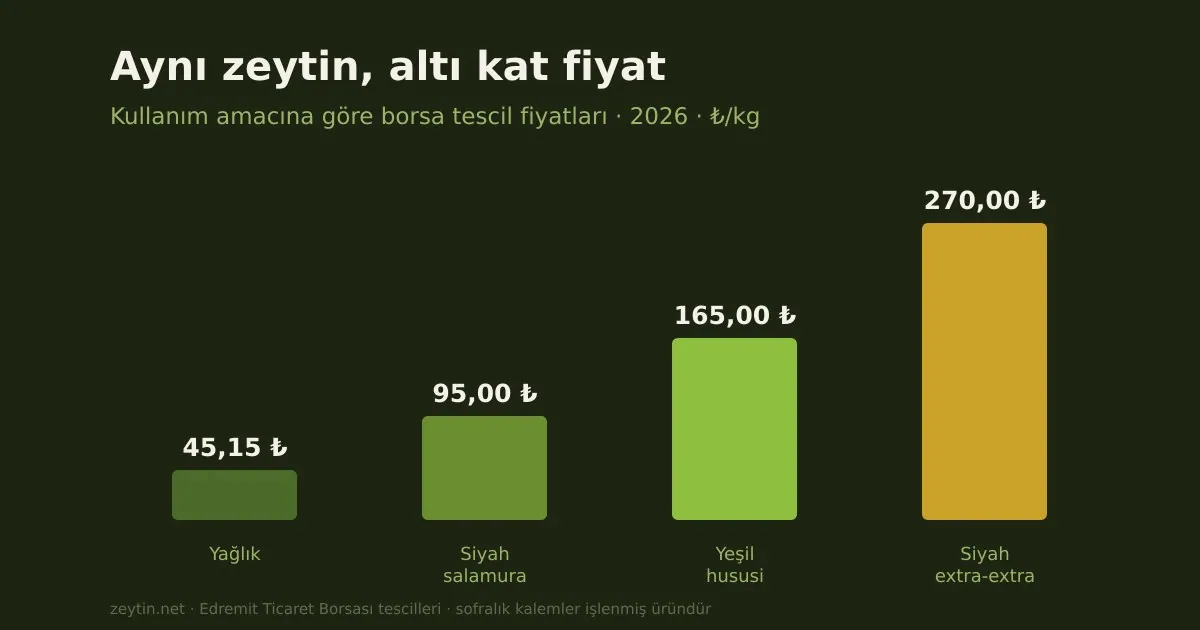
The same olive, six times the price: the quiet advantage of table olives
How much more does the same fruit fetch as a table olive than for oil? Measured over seven years of exchange data: 1.43 to 3.46 times.
Article
The same olive, six times the price: the quiet advantage of table olives
How much more does the same fruit fetch as a table olive than for oil? Measured over seven years of exchange data: 1.43 to 3.46 times.
 Article
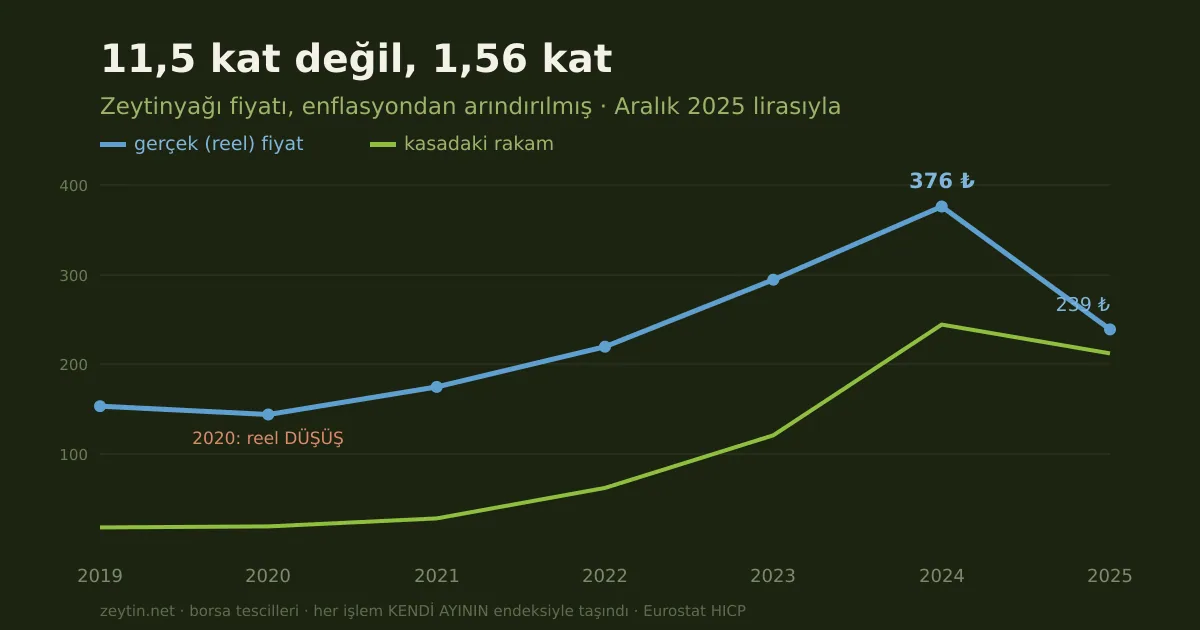
The real price of olive oil: the inflation-adjusted calculation
The lira price rose 11.5-fold, inflation 7.6-fold. The real increase is 1.56-fold — and it matches the euro-based calculation.
Article
The real price of olive oil: the inflation-adjusted calculation
The lira price rose 11.5-fold, inflation 7.6-fold. The real increase is 1.56-fold — and it matches the euro-based calculation.
 Article
The table olive sector: 461 registered, 8,000 unregistered
Turkey has become the world's leading table olive producer, with a record $255.3m in 2024-25 across 117 countries. Yet only one enterprise in twenty is registered.
Article
The table olive sector: 461 registered, 8,000 unregistered
Turkey has become the world's leading table olive producer, with a record $255.3m in 2024-25 across 117 countries. Yet only one enterprise in twenty is registered.
 Article
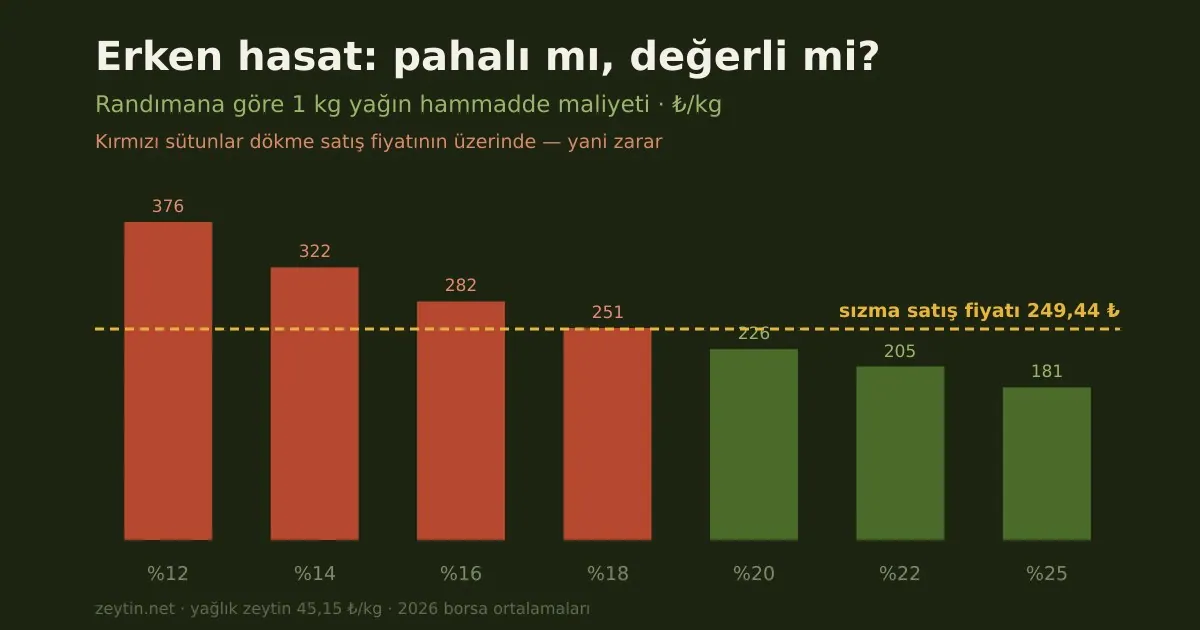
Early harvest: expensive or valuable? The arithmetic of yield
Below 18% yield the raw material costs more than the bulk price. Early-harvest oil needs a 43% premium to break even.
Article
Early harvest: expensive or valuable? The arithmetic of yield
Below 18% yield the raw material costs more than the bulk price. Early-harvest oil needs a 43% premium to break even.