How do olive growers rank their own problems?
A face-to-face survey with 64 growers in İzmir: input costs, an average holding of 45 decares, unirrigated land, and cooperative membership that rises with scale.
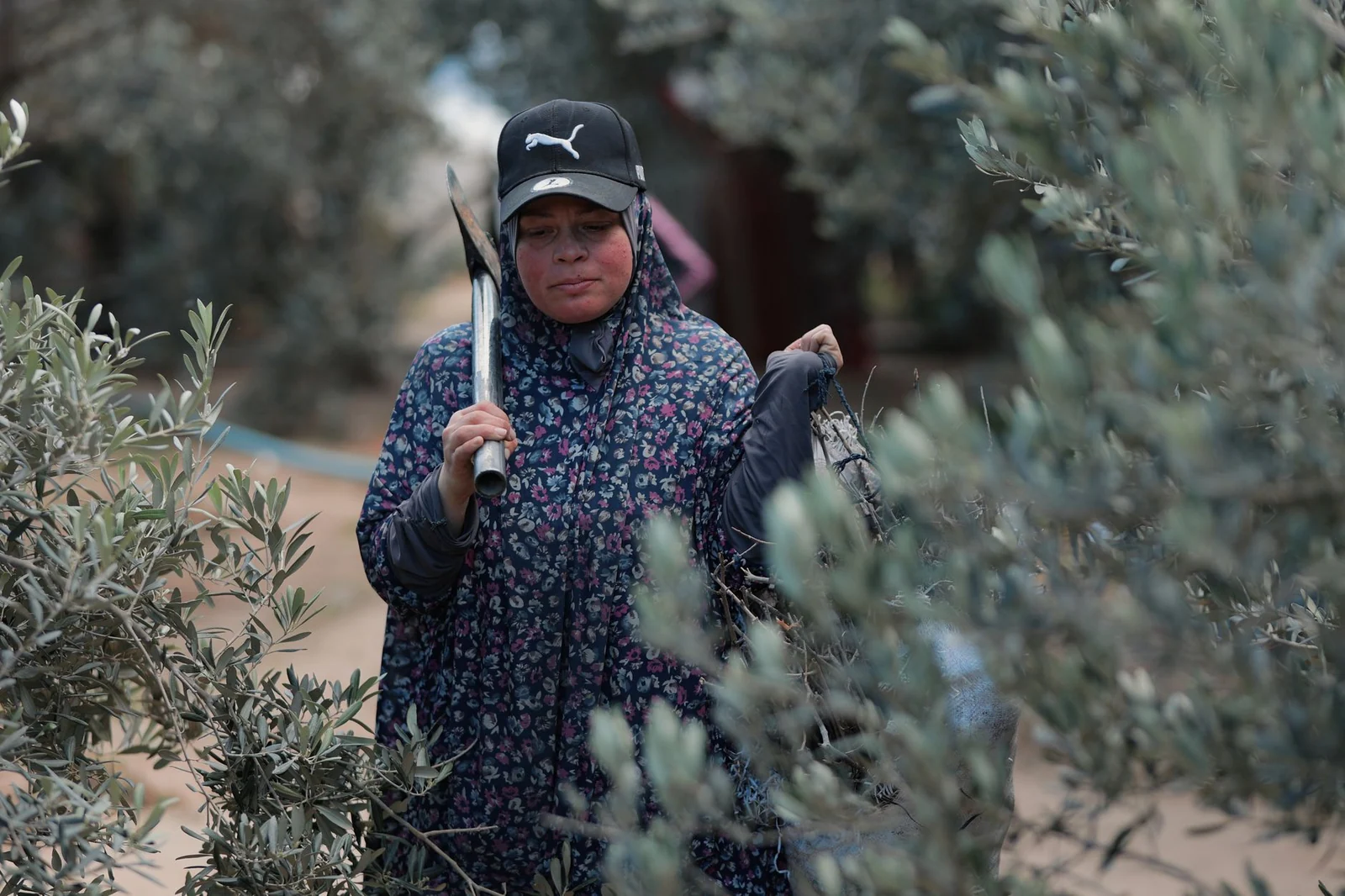
Sector problems are usually described from above: crop size, exports, price indices. But how does the grower in the field rank their own problems?
A 2014 study from the Department of Agricultural Economics at Ege University's Faculty of Agriculture asked exactly that: 64 olive growers in İzmir were interviewed face to face.
The growers' own ranking
The problems that emerged, in order:
1. High input prices
2. Insufficient demand
3. Inadequate support payments
4. Lack of training in cultivation techniques
5. Problems of organisation
What is telling about the list is that the first three concern money while the last two concern knowledge and acting together. The grower is not only saying "I earn too little"; they also name how to grow better and how to bargain collectively as problems.
How small the holdings are
The structure the study set out shows the sector's most basic constraint:
| Group | Average land |
|---|---|
| Group 1 (≤ 15 decares) | 20.2 da |
| Group 2 (16–30 decares) | 30.4 da |
| Group 3 (≥ 31 decares) | 76.5 da |
| Overall average | 45.3 da |
The average holding is 45 decares — 4.5 hectares. At that scale:
- A harvesting machine cannot be bought alone
- No storage facility can be built
- The crop is sold without bargaining power against the buyer
The consequences of small scale run through the whole sector: structural problems of Turkish olive growing.
Almost all the land is owned
The breakdown of land tenure is equally telling:
- 92.7% owned
- 6.9% sharecropped
- 0.4% rented
The olive being a perennial explains this: nobody plants on rented land a tree that will come into yield in thirty years. But it has a consequence — consolidating land is close to impossible. Parcels divided by inheritance do not recombine, and holdings carry on shrinking.
Irrigation: most of the land has none
In the surveyed holdings more land is unirrigated than irrigated: an average of 28.9 decares goes without water.
The olive tolerates drought — but tolerating is not the same as yielding. On dry land the tree lives and bears fruit, yet the yield stays markedly below that of an irrigated grove. This is one reason yields in traditional groves sit at 10–15 kg per tree.
The most striking finding: organisation rises with scale
The study's most arresting table concerns cooperative membership:
| Group | Share among members |
|---|---|
| Group 1 (≤ 15 da) | 10.3% |
| Group 2 (16–30 da) | 43.6% |
| Group 3 (≥ 31 da) | 46.2% |
The difference is statistically significant (p<0.05). Organisation is not incidental — it rises with scale.
And there lies the contradiction: the group that most needs a cooperative is the smallest holdings, because they are the ones who cannot buy machinery, cannot store and cannot bargain alone. Yet they are also the least organised.
Membership fees, distrust of cooperatives, lack of information and a sense of "I have too little crop anyway" all play a part. The outcome is the same: the grower most in need of protection stays outside the mechanism meant to provide it.
Why the grower's problem is the industry's problem
The study's starting point is worth noting: the olive oil industry draws its raw material from olive holdings. The grower's problem therefore becomes the industry's problem directly.
The chain runs like this:
- If the grower is unsupported in care and harvesting → fruit quality falls
- Fruit picked late or off the ground → acidity rises, the oil grade drops
- With no storage → the crop is sold in bulk at the post-harvest price
- The industry cannot find raw material of the quality and quantity it needs
So the industry's value added rests on a decision made in the grove. Where quality is lost: what does acidity mean in olive oil.
What the study proposes
The conclusion recommends support in four areas: care, harvesting, storage and organisation.
The first three are technical, the last structural. And the study's emphasis is this: with a marketing organisation in which producer bodies are effective, both grower incomes and productivity can be raised.
Put together with the cooperative table, that yields a clear proposal: it is hard to advance on the other three fronts without bringing small holdings into organisation. Because knowledge of husbandry, a harvesting machine and storage are all items that cannot be met individually — only collectively.
What we learn
The study shows how problems that appear as figures in sector reports actually look in the grove:
- Input costs head the list — the grower feels the margin first
- Holdings are small and land does not consolidate
- Most land is unirrigated
- Organisation is lowest exactly where it is needed most
The cost side in detail: what does a kilo of olives cost to produce · where the price is lost: from olive to oil, the price gap.
Source
- Apaydın, Y.M., Tosun, D., Demirbaş, N. — The Problems of Olive Farmers in Terms of the Development of the Olive Oil Industry in Turkey: A Case Study of İzmir Province, Ege University, Department of Agricultural Economics (2014). Face-to-face survey with 64 growers.
One rating per visitor; you can change yours at any time. Ratings are real reader votes — no seeded or default scores.
Related
 Article
Alternate bearing: one year yes, one year no
Olive oil output can swing from 40,000 to 200,000 tonnes. Why alternate bearing happens, how it breaks prices and exports, and how its amplitude can be reduced.
Article
Alternate bearing: one year yes, one year no
Olive oil output can swing from 40,000 to 200,000 tonnes. Why alternate bearing happens, how it breaks prices and exports, and how its amplitude can be reduced.
 Article
Exchange volume is not the harvest: what the 2023 record actually recorded
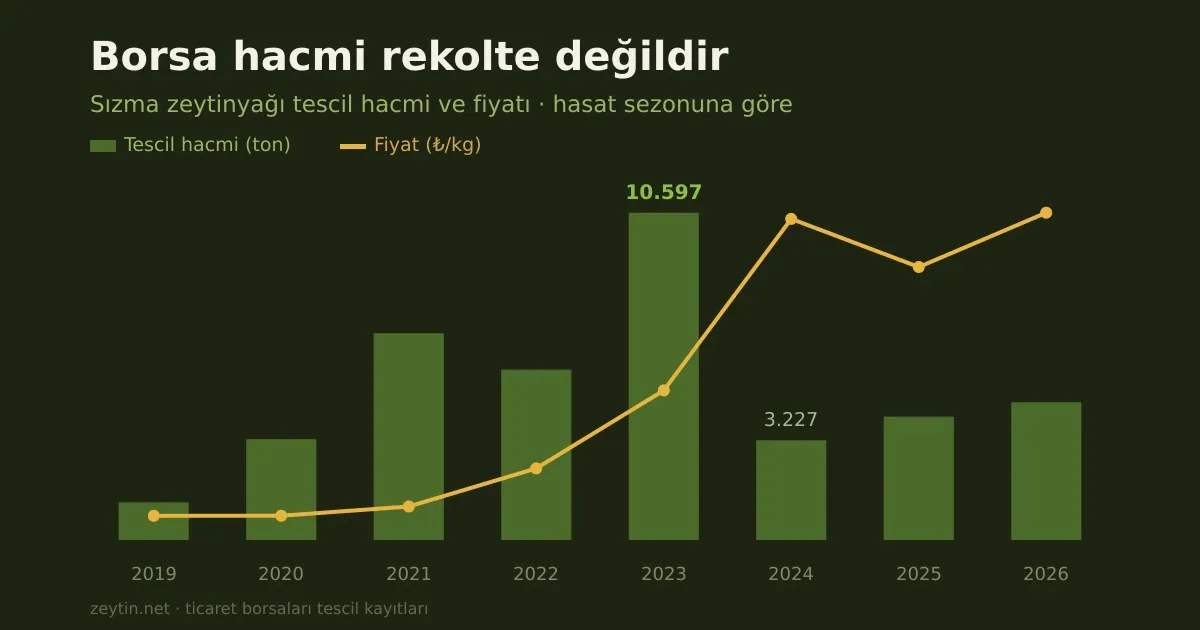
10,597 tonnes registered in 2023, down to 3,227 the next season. Harvest collapse or a change of channel? The data cannot tell them apart.
Article
Exchange volume is not the harvest: what the 2023 record actually recorded
10,597 tonnes registered in 2023, down to 3,227 the next season. Harvest collapse or a change of channel? The data cannot tell them apart.
 Article
The table olive sector: 461 registered, 8,000 unregistered
Turkey has become the world's leading table olive producer, with a record $255.3m in 2024-25 across 117 countries. Yet only one enterprise in twenty is registered.
Article
The table olive sector: 461 registered, 8,000 unregistered
Turkey has become the world's leading table olive producer, with a record $255.3m in 2024-25 across 117 countries. Yet only one enterprise in twenty is registered.
 Article
Felling an olive grove: the arithmetic of a ten-year decision
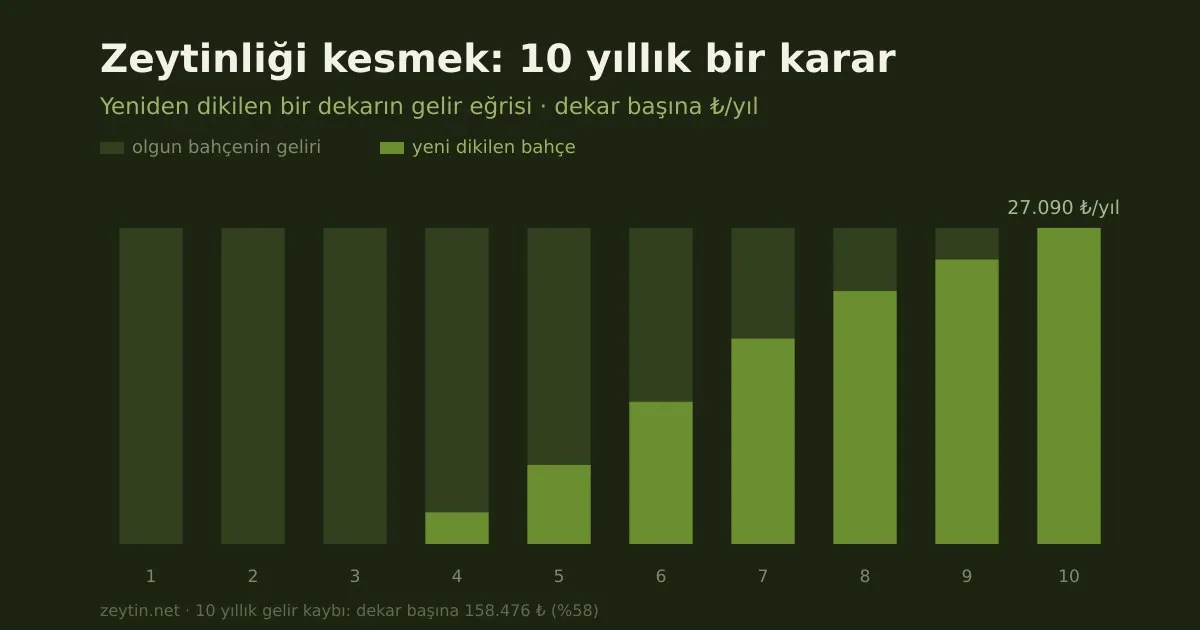
The ten-year cost of clearing a grove for another crop: establishment, years to bearing and forgone income, per decare.
Article
Felling an olive grove: the arithmetic of a ten-year decision
The ten-year cost of clearing a grove for another crop: establishment, years to bearing and forgone income, per decare.