What happens if fly-damaged olives go into the oil?
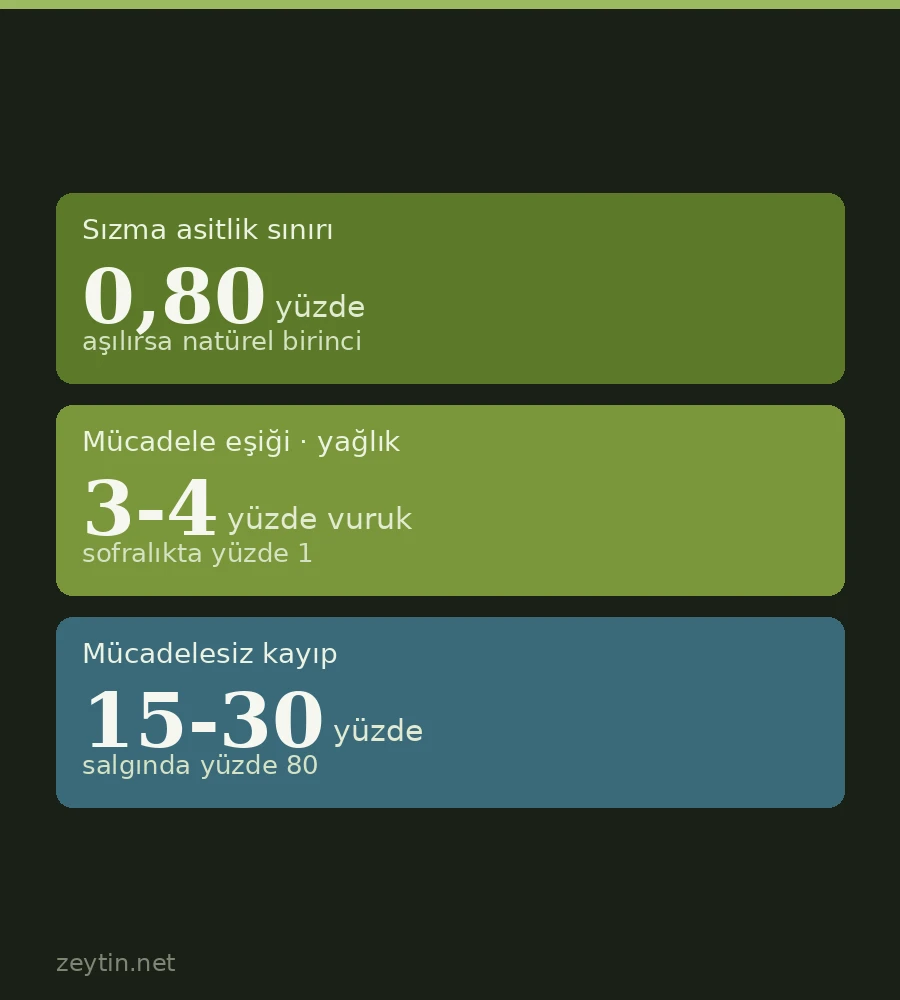
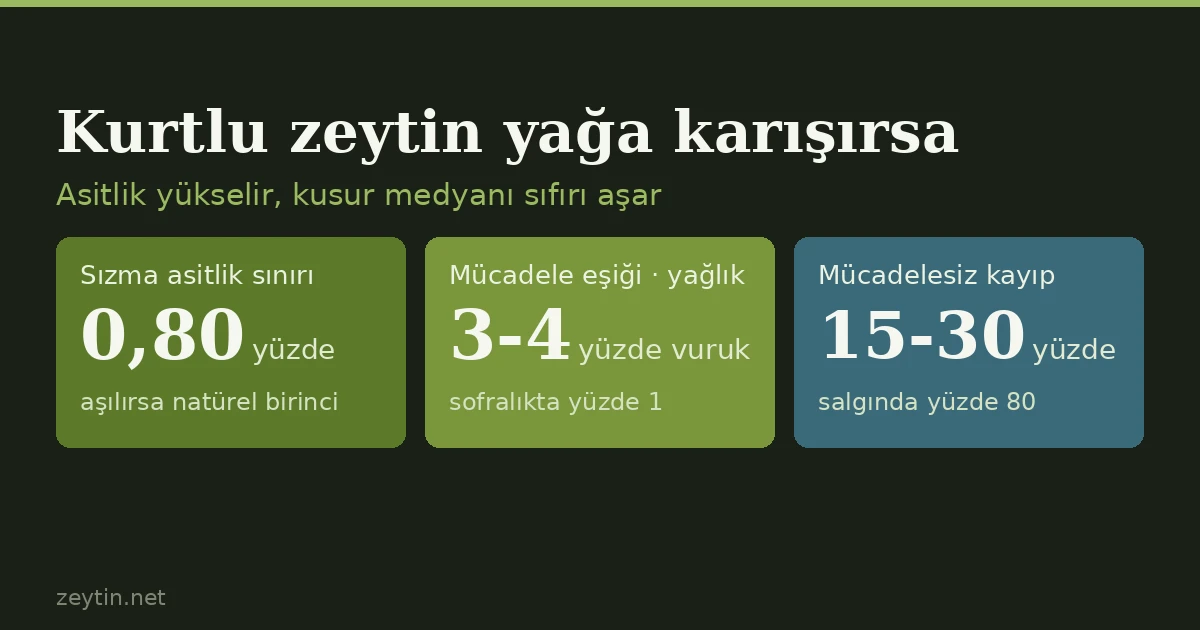
If fly-struck olives reach the mill, the oil drops a grade: free acidity and peroxide rise, phenolics fall, and sensory analysis turns up fermentative defects plus the "grubby" attribute. Turkey's official integrated pest management instruction sets the action threshold at 3-4 percent of 800-1,000 fruits for oil olives and 1 percent for brining olives. Infested fruit cannot be sorted out at the mill; the decision is made in the grove and in the timing. This article explains exactly what fly damage changes in the oil, what share is manageable, and why an infested batch should be milled separately.
It is one of the most common questions in the rush of harvest: there is fly-struck, grubby fruit in the grove and the crop is about to go to the mill. What happens if fly-damaged olives go into the oil?
The short answer: they pull the grade down. Infested fruit does not merely dull the aroma a little; it pushes the laboratory numbers and the sensory score in the same direction. But where exactly the oil falls out of the extra virgin class depends on two things: the rate of infestation, and how quickly the fruit reaches the mill.
What "grubby olives" actually means
The damage begins when the female olive fly (Bactrocera oleae) lays an egg in the fruit. The spot darkens within a day — this mark is the sting. The emerging larva tunnels through the flesh inside the drupe and, once mature, bores out through the skin.
Three distinct states exist, and they are not equivalent:
- Closed sting: an egg has been laid, tissue damage is still limited.
- Feeding larva: galleries have opened inside, part of the flesh is gone.
- Fruit with an exit hole: the drupe is now an open wound. Yeasts, bacteria and moulds enter directly.
The last state matters most. Once the exit hole opens, secondary spoilage begins, and fungal diseases such as anthracnose use the same door. Grubby fruit is therefore the gateway not of one pest but of the crowd of micro-organisms that follows it.
Three separate losses in the oil
First, weight and yield. The larva feeds on the flesh, and damaged fruit drops early, so both tonnage and extraction yield fall. Turkey's official integrated pest management instruction for olives puts the loss at 15-30 percent where no control is applied, and up to 80 percent in outbreak years.
Second, free acidity. In wounded tissue the hydrolysis of the oil accelerates: triglycerides break down and free fatty acids accumulate. Free acidity must stay at or below 0.80 percent for the extra virgin class, and in an infested batch that is the first limit to go. Peroxide value rises in the same process while phenolic content falls — that is, the compounds that give the oil its shelf life and its bitter, pungent character are depleted.
Third, sensory quality. Because infested fruit ferments, panels find winey-vinegary and musty-humid defects. On top of that, international sensory terminology has a separate attribute: "grubby", defined as the flavour of oil obtained from olives heavily attacked by the grubs of the olive fly, listed among the International Olive Council's secondary negative attributes. A trained panel distinguishes it.
| Parameter | Extra virgin limit | Expected in grubby fruit |
|---|---|---|
| Free acidity (% oleic acid) | ≤ 0.80 | rises |
| Peroxide value (meq O₂/kg) | ≤ 20.0 | rises |
| Defect median (Md) | 0 | exceeds 0 |
| Phenolic content | — | falls |
| Extraction yield | — | falls |
One line of that table is enough to drop the grade: an oil whose defect median comes out above zero falls to virgin even if its chemistry is flawless.
Above what share does it become a problem?
The official instruction calls for counting 800-1,000 fruits from July-August onwards to find the sting rate, and sets the action threshold at 1 percent for brining (table) olives and 3-4 percent for oil olives.
That threshold was written for spray decisions, but it says something else in practice: a few percent of stung fruit is manageable on the oil side, while tolerance on the table side is close to zero. The reason is simple — oil olives are crushed and the sting disappears, whereas table olives are sold whole, and calibre and blemish-free skin translate straight into price.
Even so, reading the percentage alone misleads. The same 5 percent is manageable if the stings are closed and the fruit is milled the same day; if exit holes have opened and the crop has sat in sacks for a week, that identical figure produces a far worse result.
The decisive variable is time
Infested fruit worsens as it waits, because the micro-organisms that entered through the open wound keep working inside the sack. The interval between picking and milling is therefore more critical in stung fruit than in clean fruit: same-day milling, shallow layers, shade, and ventilated crates instead of sacks.
There are two jobs in the grove as well: collecting and removing fallen and stung fruit during the damage period, and not delaying the harvest of a variety that has reached maturity. Both sit under the cultural-measures heading of the official instruction.
The mill cannot sort it out
A common expectation is that the mill will screen out infested fruit. It will not. The cleaning line separates leaves, twigs, soil and stones; a stung drupe is the same size as a sound one and of roughly the same density. Only fruit that has been thoroughly hollowed out and lightened may float in the washing tank — a partial separation at best.
The conclusion: grubby olives cannot be "cleaned" at the mill. The decision is made in the grove and at the weighbridge, and it is one thing: do not mix the batches.
Milling the infested batch separately is the cheapest fix
Tipping infested fruit into the same tank as clean fruit drags down the oil that could have been saved. Blending averages the acidity: a clean batch at 0.3 combined with an infested batch at 1.5 brings both towards the limit. Milled separately, the clean batch stays extra virgin and the infested batch finds its own price as virgin or lampante oil — and the price gap between those classes is larger than the cost of a separate milling.
At the end of the season the real figure comes from the laboratory report: read free acidity and defect median together and you can see how much of the infestation reached the oil.
How to measure the infestation at the weighbridge
Deciding about a batch takes counting, not just looking. The official method works on 800-1,000 fruits in the grove, but a quick count also serves on the way to the mill: take a hundred fruits at random from the load, look at each one and sort them into three groups — sound, closed sting, exit hole open. Cutting a suspect fruit in half settles the matter: the larval gallery shows up in cross-section as a brown tunnel.
What matters is not only the total share but the distribution of the groups. A batch that is five percent stung with closed stings causes no trouble if it is milled the same day; if most of that five percent comes from fruit with open exit holes, the batch must be treated as already fermenting and must not go into the same tank as clean fruit. The count has to be done at the weighbridge, before the load is tipped — once it is tipped, separation is no longer possible.
Summary
- Grubby fruit causes three separate losses: yield, chemical quality, sensory score.
- Free acidity must be at or below 0.80 percent and the defect median must be 0 for extra virgin; both are the first numbers to fail in an infested batch.
- Official threshold: out of 800-1,000 fruits, 1 percent for table olives and 3-4 percent for oil olives.
- Fruit with an exit hole is an open wound; spoilage accelerates the longer it waits.
- The mill does not screen infested fruit; batch separation happens in the grove.
- Blending infested fruit with clean fruit downgrades the oil that could have been saved.
One rating per visitor; you can change yours at any time. Ratings are real reader votes — no seeded or default scores.
Related
 Article
Ceyhan Olive Oil: harvest defined as “no green fruit left on the tree”
Registered in 2022. The certificate defines harvest not by calendar but by the state of the tree: when no green fruit remains and oil content peaks.
Article
Ceyhan Olive Oil: harvest defined as “no green fruit left on the tree”
Registered in 2022. The certificate defines harvest not by calendar but by the state of the tree: when no green fruit remains and oil content peaks.
 Article
Aydın Memecik Olive Oil: bitterness and pungency written into the definition
Registered in 2020. Total phenols > 100 mg/kg, peroxide ≤ 18, defect median 0. Intense fruit aroma with pronounced bitterness and pungency.
Article
Aydın Memecik Olive Oil: bitterness and pungency written into the definition
Registered in 2020. Total phenols > 100 mg/kg, peroxide ≤ 18, defect median 0. Intense fruit aroma with pronounced bitterness and pungency.
 Article
Which olive oil is the best quality?
The three measures that decide olive oil quality: grade, acidity and harvest year, plus how to read a label.
Article
Which olive oil is the best quality?
The three measures that decide olive oil quality: grade, acidity and harvest year, plus how to read a label.
 Article
Soma Olive Oil: how a cooler climate lifts yield in a lignite basin
Registered in 2023. Mean temperature 15.3 °C; the certificate ties that relative coolness to yields reaching 796 kg/da. Free acidity 0.18-0.55.
Article
Soma Olive Oil: how a cooler climate lifts yield in a lignite basin
Registered in 2023. Mean temperature 15.3 °C; the certificate ties that relative coolness to yields reaching 796 kg/da. Free acidity 0.18-0.55.