Kilis: the structure is solved, the soil is not
Kilis is the one place in south-eastern Anatolia to have finished the institutional job: a union, an integrated plant, a geographical indication. Yet 100% of 49 soil samples are iron-deficient.
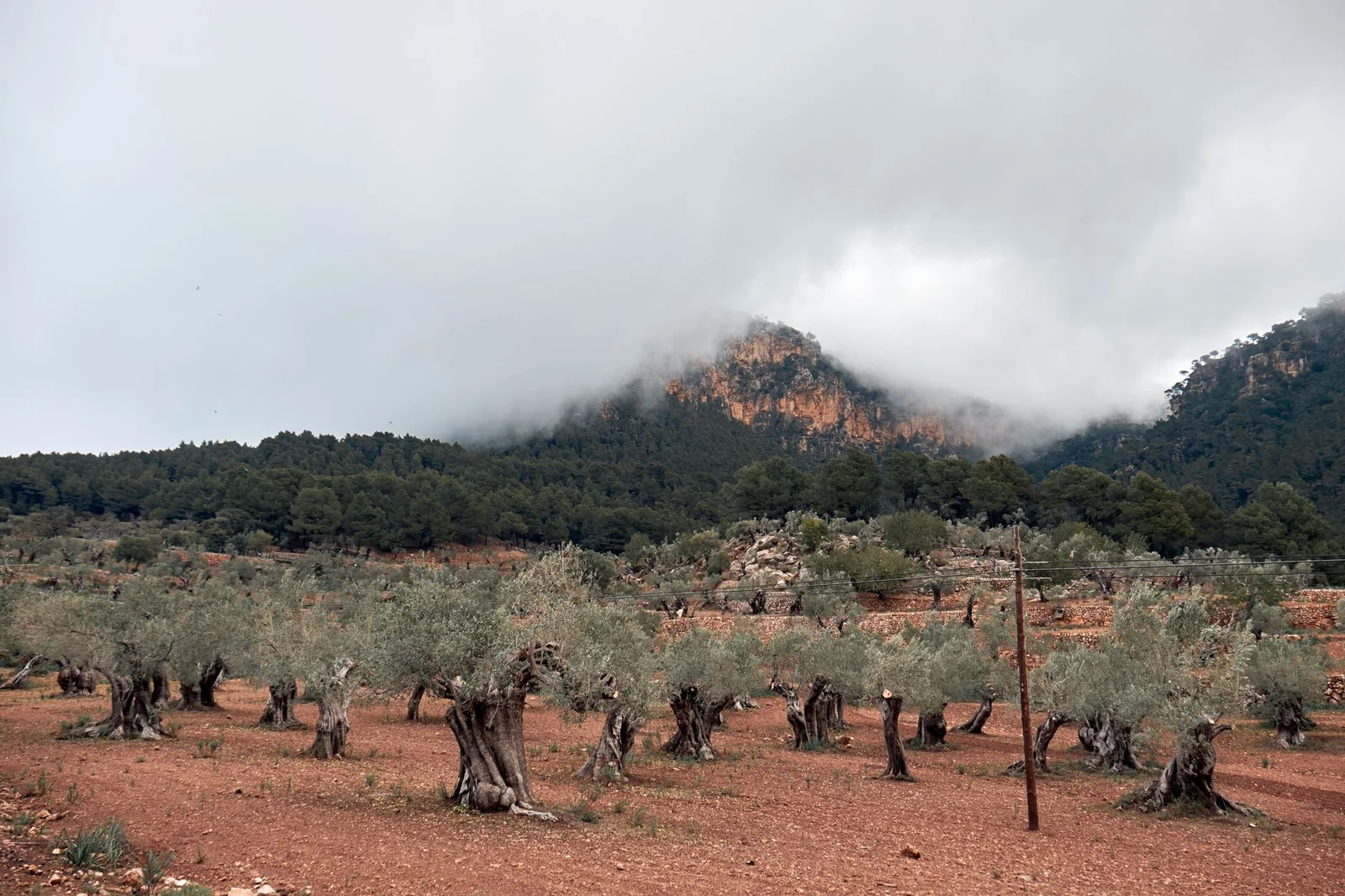
South-eastern Anatolia is regarded as the olive's homeland, yet for a long time its production stayed well below its potential. One place in the region has changed that picture: Kilis.
What Kilis did is a package often recommended in debates about agricultural development and rarely completed. Looking at Kilis today shows how far that package carries — and where it stops.
What Kilis did
Olive production in Kilis now covers 310,704 decares: more than 3.5 million bearing trees and an annual crop of roughly 22,383 tonnes.
But the real difference is not in the figures — it is in the structure that was built:
| Step | What it does |
|---|---|
| GAP Organic Farming Clustering Programme | supports growers as a cluster rather than individually |
| Kilis Province Organic Olive Producers Union | scale in negotiation, shared certification cost |
| Integrated olive oil production facility | the crop has somewhere to go — no forced bulk selling |
| Geographical indication for Kilis olive oil | a basis for branding in international markets |
Those four items are almost exactly the list recommended for Mardin and Şırnak. The difference is that in Kilis they were carried out.
The processing facility matters especially: it is hard to encourage cultivation in a region without one, because the crop has nowhere to go. We saw the same vicious circle in Mut, where the packaging industry is missing — olive oil is produced there, but its bottle travels 500 km.
And what does the soil say
The institutional work looks solved. But analysis of 49 soil samples taken from Kilis olive groves shows the job is not finished.
Basic properties
| Property | Minimum | Maximum | Mean |
|---|---|---|---|
| pH | 7.13 | 7.89 | 7.57 |
| Salinity (EC, dS/m) | 0.007 | 0.06 | 0.02 |
| Lime (CaCO₃, %) | 7.56 | 47.26 | 27.3 |
| Organic matter (%) | 0.30 | 2.58 | 1.31 |
The good news first:
No salinity problem. 100% of the samples fall in the salt-free class (below 2 dS/m). A risk common in arid regions is absent here.
pH is suitable. 72.9% of the soils are slightly alkaline, 27.1% neutral. The olive grows across a wide band, from moderately acid (5.6) to moderately alkaline (8.5) — Kilis sits comfortably within it.
Lime is not limiting. 60.4% of the soils fall in the "very high lime" class, which looks bad at first. But lime only restricts olive canopy development once it reaches 58-68%. The highest value in Kilis is 47.26% — below that threshold. The ideal range is given as 9-19%, but exceeding it is normal in olive groves.
This is where the problem starts
| Element | Status | Share of samples |
|---|---|---|
| Iron (Fe) | deficient | 100% |
| sufficient | — | |
| Phosphorus (P) | very low | 6.2% |
| low | 52.1% | |
| sufficient or above | 41.7% | |
| Zinc (Zn) | very low | 28.6% |
| low | 65.3% | |
| sufficient | 6.1% | |
| Organic matter | very low (<1%) | 33.3% |
| low (1-2%) | 56.3% | |
| medium (2-3%) | 10.4% | |
| Boron (B) | low | 34.7% |
| sufficient | 65.3% | |
| Magnesium (Mg) | insufficient | 27.1% |
| sufficient or above | 72.9% | |
| Copper (Cu) | sufficient | 100% |
| Manganese (Mn) | sufficient / high | 100% |
| Potassium (K) | sufficient or above | 75.5% |
| Calcium (Ca) | high / very high | 99% |
Three findings stand out:
1. Total iron deficiency. 100% of samples fall in the deficient class for iron (below 2.5 mg/kg). Not a single sample came back sufficient. That is the expected picture in limey, high-pH soils: the iron is present but not in a form the plant can take up.
2. Widespread zinc shortage. 93.9% of samples are "very low" or "low"; only 6.1% are sufficient.
3. Organic matter is very low. Ideal olive growth is reported to need around 3% organic matter in the topsoil, with 1% as the minimum. The Kilis mean is 1.31%, and 89.6% of samples fall below 2%. No sample reaches the "good" or "high" class.
Phosphorus tells a similar story: 87.5% of soils are insufficient for olive growing — the ideal range is 20-50 mg/kg, and only four samples fall in that band.
The potassium trap
The potassium table looks healthy: 75.5% of soils are sufficient or above. But the study adds an important warning:
t; A high or sufficient level of potassium in the soil does not mean the plant's potassium content will also be sufficient.
The reason: 90-98% of soil potassium is locked in minerals such as feldspar and mica, and very little of that is available to the plant. Plants take up potassium dissolved in soil water — so without enough water, no amount of soil potassium reaches the tree.
This is why reading a soil analysis on its own can mislead in an arid region. The same applies to calcium: it is abundant (high in 99% of samples), but under dry conditions calcium moves through the soil by mass flow, so access problems can still arise.
Why this picture forms
The reason is simple and stated plainly in the study: olive growing is generally carried out without fertilisation, and olives tend to be grown on limey, sloping land.
The olive, in other words, is treated as a tree that needs no care. And it is genuinely tough — it does not die, it goes on bearing. But what it bears is only as much as the soil allows.
Nor is this picture unique to Kilis. Comparable studies found:
- In Altınözü, Hatay: magnesium deficiency in 73.33% of olive groves, and manganese, zinc and boron deficiency in 46.66%
- Elsewhere: nutritional problems in iron, copper and manganese
The takeaway: two separate jobs
The Kilis case shows that olive growing involves two distinct jobs.
The first is structural: organisation, a processing plant, registration, markets. Kilis has largely completed this — an uncommon achievement in Turkey.
The second is agronomic: soil analysis, fertilisation, organic matter management. And that job appears not to have started.
Without the second, the first hits a ceiling. However well a product is certified, unionised and processed in its own facility, its quantity and quality will in the end be whatever a soil with 100% iron deficiency allows.
The good news: this second job is far cheaper and faster than the first. Testing soil, adding organic matter and supplying a missing element are not investments on the scale of building a processing plant.
Related: nutrient deficiencies in olive · Kilis yağlık olive · south-eastern Anatolia's nameless olives · structural problems of Turkish olive growing
Sources
- Şimşek, T., Kalkancı, N., Köse Türkmen, S., Büyük, G. & Aslan, N. (2023) — Evaluation of soil quality for olive groves in Kilis Province, Mustafa Kemal University Journal of Agricultural Sciences 28(1): 211-221
- GAP Regional Development Administration — Kilis olive and olive oil data
- Leake (2001) · Ferreira Llamas (1984) — ideal soil values for olive
- Gálvez et al. (2004) — lime content and canopy development
- Keleş Uzel & Çimrin (2020) — regional micronutrient deficiencies
- Fernández-Escobar et al. (2015) — calcium nutrition in olive
- Sumner & Miller (1996) · Olsen & Sommers (1982) — threshold values
One rating per visitor; you can change yours at any time. Ratings are real reader votes — no seeded or default scores.
Related
 Article
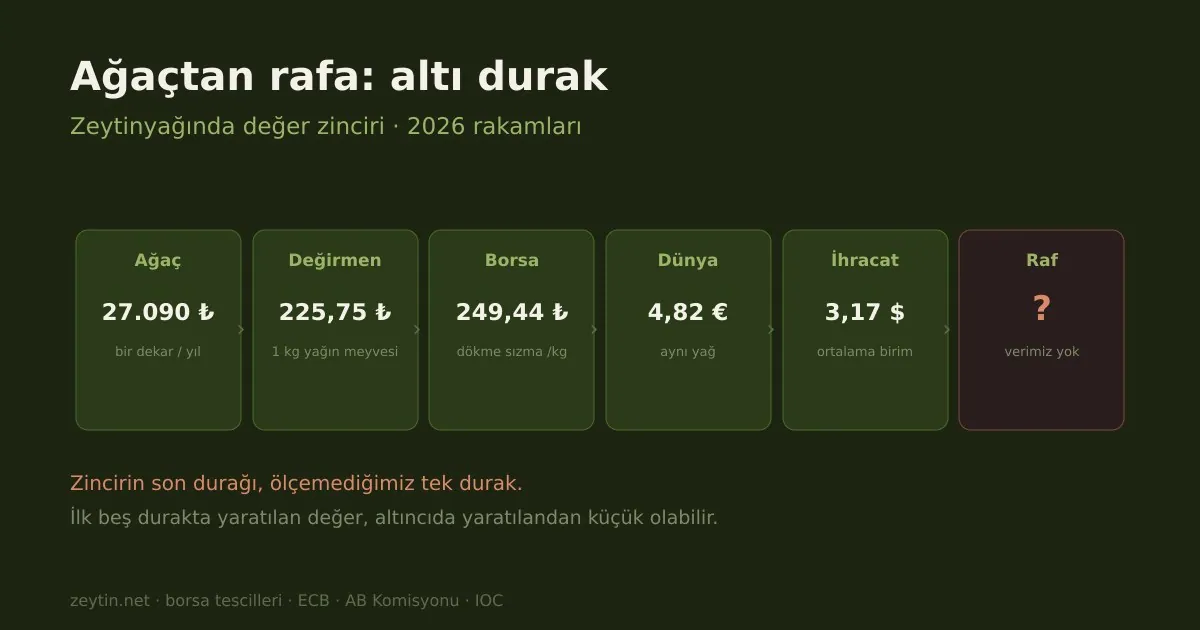
Tree to shelf: the olive oil value chain in six stops
From fruit on the tree to bottle on the shelf: how much the price multiplies at each step, and where the added value stays.
Article
Tree to shelf: the olive oil value chain in six stops
From fruit on the tree to bottle on the shelf: how much the price multiplies at each step, and where the added value stays.
 Article
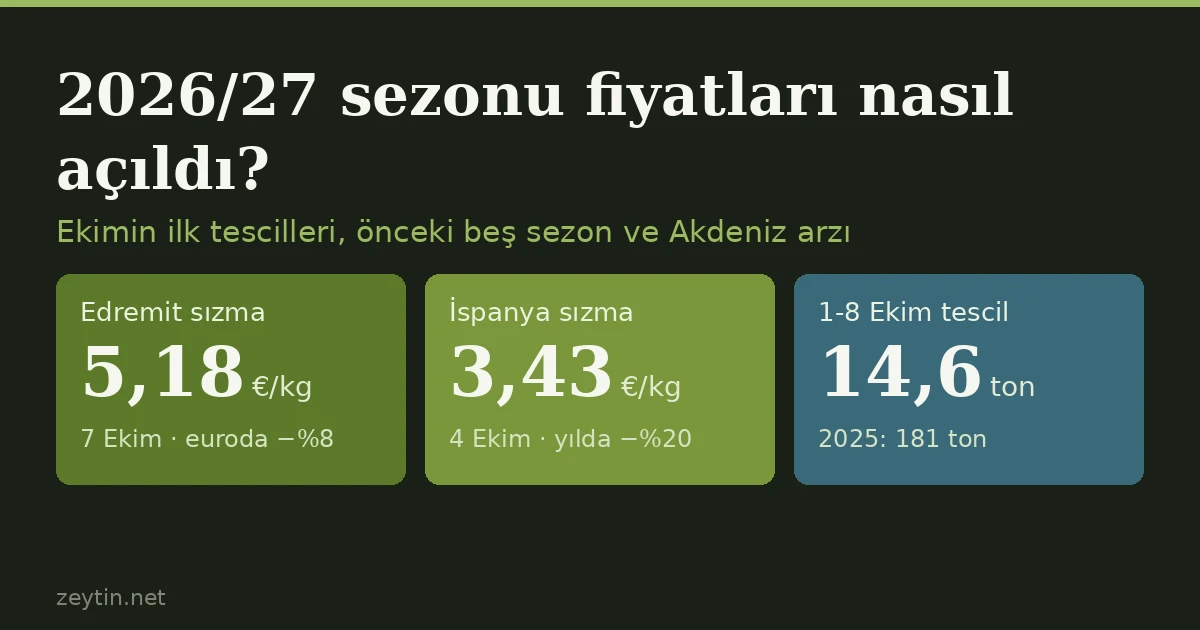
How did olive oil prices open the 2026/27 season?
The first exchange registrations of October 2026 compared with the same weeks of the previous five seasons, in lira and euros: Edremit extra virgin is up 4% in lira and down 8% in euros; Spanish producer prices fell 20% in a year. The opening is thin, and Spain is the only major producer with an official supply figure.
Article
How did olive oil prices open the 2026/27 season?
The first exchange registrations of October 2026 compared with the same weeks of the previous five seasons, in lira and euros: Edremit extra virgin is up 4% in lira and down 8% in euros; Spanish producer prices fell 20% in a year. The opening is thin, and Spain is the only major producer with an official supply figure.
 Article
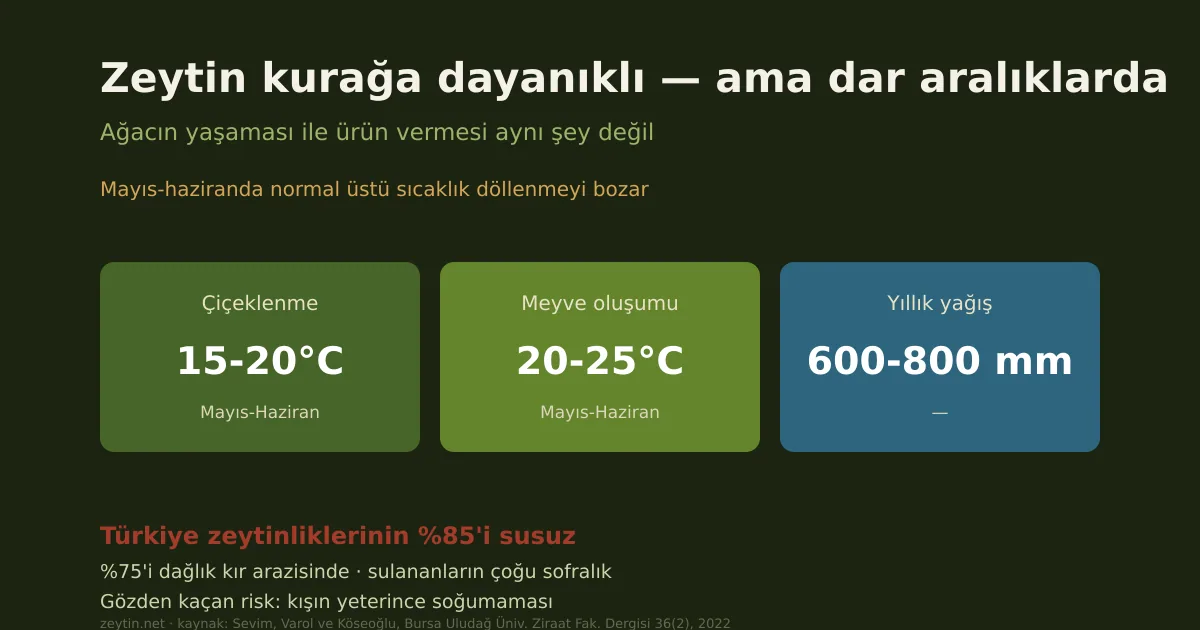
Climate change and the olive: the tree survives, but will it crop?
The olive is drought-hardy but works in narrow bands. 85% of Türkiye's groves are unirrigated, 75% on mountainous land.
Article
Climate change and the olive: the tree survives, but will it crop?
The olive is drought-hardy but works in narrow bands. 85% of Türkiye's groves are unirrigated, 75% on mountainous land.
 Article
Oleotourism: a grove's second income
What is olive oil tourism, how does it work elsewhere, and why has it not developed in Türkiye? Oleotourism, from the literature.
Article
Oleotourism: a grove's second income
What is olive oil tourism, how does it work elsewhere, and why has it not developed in Türkiye? Oleotourism, from the literature.