Does olive oil have a use-by date? Best-before dates, shelf life and oil past its date
Olive oil carries a best-before date, not a use-by date. Under the Turkish ministry's shelf-life guideline, oil past that date may be consumed, sold or donated if it was stored properly and its appearance, smell and taste are normal. Shelf life is set by the operator rather than by legislation — and even the format of the date reveals how long it is.
The date printed on a bottle of olive oil is not what most shoppers take it to be. Under the Turkish Food Codex, olive oil carries a "best before" date (TETT), not a "use by" date (STT). The difference is not a matter of wording: it determines what happens to oil past its date, who is responsible for what, and how the label should be read.
Use by, versus best before
The shelf-life guideline published by the Directorate General of Food and Control at Turkey's Ministry of Agriculture and Forestry defines the two terms separately.
A use-by date (STT) is the final date for consuming foods that spoil easily in microbiological terms and may therefore pose a risk to human health within a short time. Pasteurised milk, cheese, yoghurt, butter and meat products belong in this group. The guideline is blunt: food past its use-by date must not be consumed, even if there is no change in its sensory qualities. Such food is also treated as "unsafe food" under Article 21 of Law No. 5996.
A best-before date (TETT) indicates the period over which a food, kept under the conditions stated on its label, retains its characteristic properties. It rests on quality criteria — freshness, taste, aroma. When the guideline lists foods that do not spoil easily at room temperature, it places vegetable oils directly in this group. Olive oil belongs here.
That resolves into a practical rule: the date on olive oil is not a safety threshold but a quality commitment.
Does olive oil past its date go in the bin?
The guideline is explicit. Food past its best-before date may be consumed, offered for sale and donated, provided it has been kept under appropriate storage conditions, its packaging integrity is intact, and its appearance, smell and taste are normal.
So olive oil is not automatically "spoiled" because a date has passed. Nor does that mean the date can be ignored: the condition list has three items and all three must hold. Olive oil does not spoil microbiologically — oil is not a medium in which bacteria grow. It degrades through oxidation, and it announces that in smell and taste: musty, rancid, a glue-like or stale-walnut note. The names of those defects, and how to recognise them, are set out in our article on tasting olive oil.
The format of the date tells you the shelf life
The least-known but most useful rule in the guideline concerns how the date is written.
| Shelf life determined | What suffices on the label |
|---|---|
| Under 3 months | day and month |
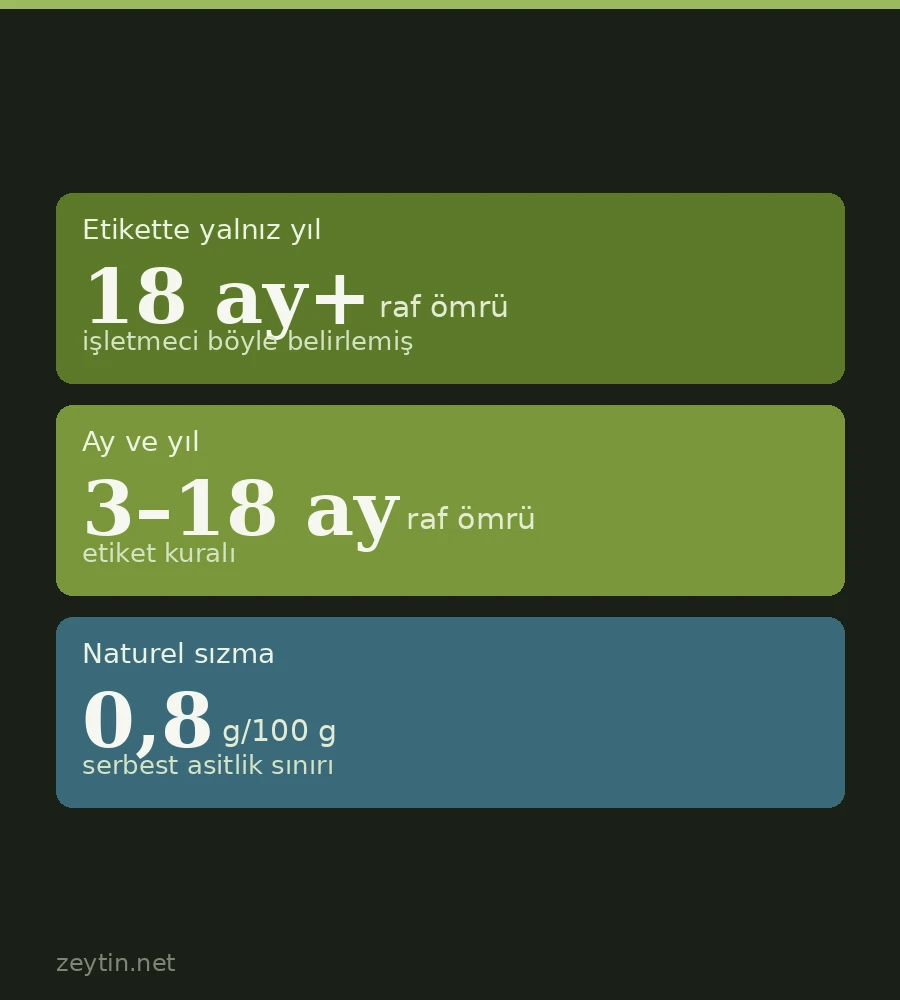
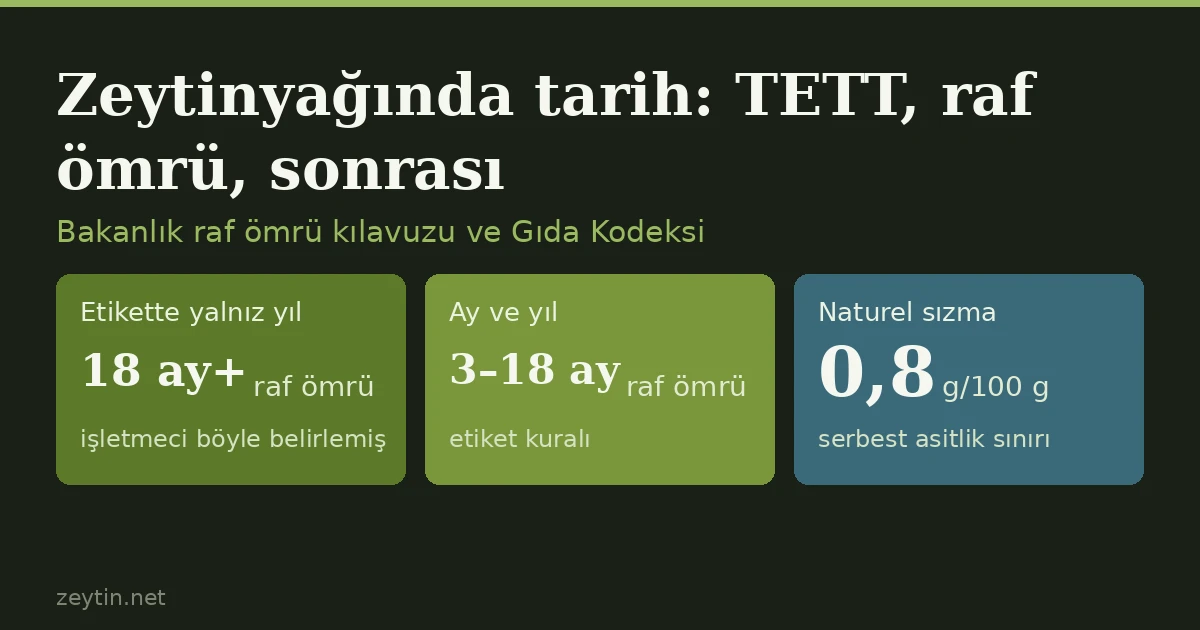
| 3 to 18 months | month and year |
| Over 18 months | year |
The table can be read backwards, and that is where it becomes useful. If a bottle of olive oil shows only a year, the producer has set its shelf life at more than 18 months. If it shows a month and a year, the shelf life falls in the 3–18 month band. The format of the date therefore tells you, indirectly, how long the producer is prepared to vouch for the oil.
The date must appear so that it is easily visible, clearly legible, contrasting with the background colour and indelible. Where particular conditions must be observed to keep the product, those conditions are stated next to the date.
Who sets the shelf life?
The answer surprises most people: the food business operator. Under the guideline, determining a food's shelf life and stating it on the label is the operator's responsibility under the Turkish Food Codex Regulation on Food Labelling and Consumer Information, and the operator is expected to follow a risk-based approach in doing so.
The legislation sets no fixed number of months for olive oil. Two bottles can therefore sit side by side on the same shelf, one with an 18-month shelf life and one with 24 months, both fully compliant. The difference comes from the operator's own assessment of its packaging, its storage conditions and the initial quality of the oil.
The conclusion matters: comparing two dates is not comparing two oils. A longer date does not mean better oil; it means the producer has committed to a longer period.
A better marker than the date: the harvest date
The single most informative piece of information on olive oil is not the best-before date but the harvest date. Oil begins to age from the moment it is bottled, and three things set the pace: light, heat and oxygen. Of two bottles carrying the same best-before date, one may have been pressed last month and the other fourteen months ago.
Olive oil carries its own defence against oxidation: polyphenols. These compounds give the oil both its bitter, peppery character and its keeping quality; an oil high in polyphenols stays alive longer. We looked at what these compounds do in oleocanthal and polyphenols.
Laboratory values do not respond to time in the same way either. Free acidity arises largely from harvest and milling conditions and does not shift quickly on the shelf. The peroxide value, by contrast, is a direct record of storage — it rises with exposure to light and heat. The Codex gives a free acidity limit of 0.8 g/100 g for extra virgin olive oil and 2.0 g/100 g for virgin olive oil; we explained what those figures mean in acidity and how to read a lab report.
After the bottle is opened
Here the guideline offers a recommendation rather than an obligation: stating on the label how the product should be kept after opening, and within what period it should be consumed, would be useful. A phrase such as "consume within X months of opening" is therefore not mandatory on every label.
Once a bottle is open, contact with oxygen becomes continuous and ageing accelerates. In practice: the clear cruet standing next to the hob is where olive oil ages fastest. We covered how to store freshly pressed olive oil separately.
The rest of the chain is responsible too
Shelf life is not the producer's business alone. The Olive Oil and Pomace Oil Communiqué regulates transport and storage conditions by reference to the Turkish Food Codex Regulation. The Ministry's guideline puts it plainly: it is important that distributors and retail businesses comply with the producer's instructions on storage and transport conditions such as temperature, light, humidity and stacking.
That is a checkpoint for the buyer as well. For a bottle standing in sunlight in a window display, next to a heater, or under retail lighting for hours, the date on the label may no longer describe the state of the product. The date is correct and the conditions are not — and it is the conditions that determine the quality of the oil.
In short
- Olive oil carries a best-before date, not a use-by date; the date is a quality commitment, not a safety threshold.
- Oil past its best-before date may be consumed, sold or donated if it was stored properly, the packaging is intact and appearance, smell and taste are normal.
- Shelf life is set by the operator, not by legislation; a longer date does not mean better oil.
- The format of the date (year / month-year / day-month) reveals which band the shelf life falls into.
- The harvest date is more informative than the best-before date; ageing is driven by light, heat and oxygen.
Sources
- Republic of Turkey, Ministry of Agriculture and Forestry, Directorate General of Food and Control, "Guideline on Determining and Stating Shelf-Life Information on Food Labels": definitions of use-by and best-before dates, operator responsibilities, date formats.
- Turkish Food Codex Olive Oil and Pomace Oil Communiqué (2017/26): labelling (art. 14), transport and storage (art. 16), free acidity values for extra virgin and virgin olive oil.
- Law No. 5996 on Veterinary Services, Plant Health, Food and Feed, art. 21.
One rating per visitor; you can change yours at any time. Ratings are real reader votes — no seeded or default scores.
Related
 Article
Nizip Olive Oil: a registration that sets a floor for its raw material
Registered in 2011. The certificate sets conditions on the fruit, not just the oil: 15-17 mm wide, 19-20 mm long, at least 25% oil. Fruit outside that cannot be used.
Article
Nizip Olive Oil: a registration that sets a floor for its raw material
Registered in 2011. The certificate sets conditions on the fruit, not just the oil: 15-17 mm wide, 19-20 mm long, at least 25% oil. Fruit outside that cannot be used.
 Article
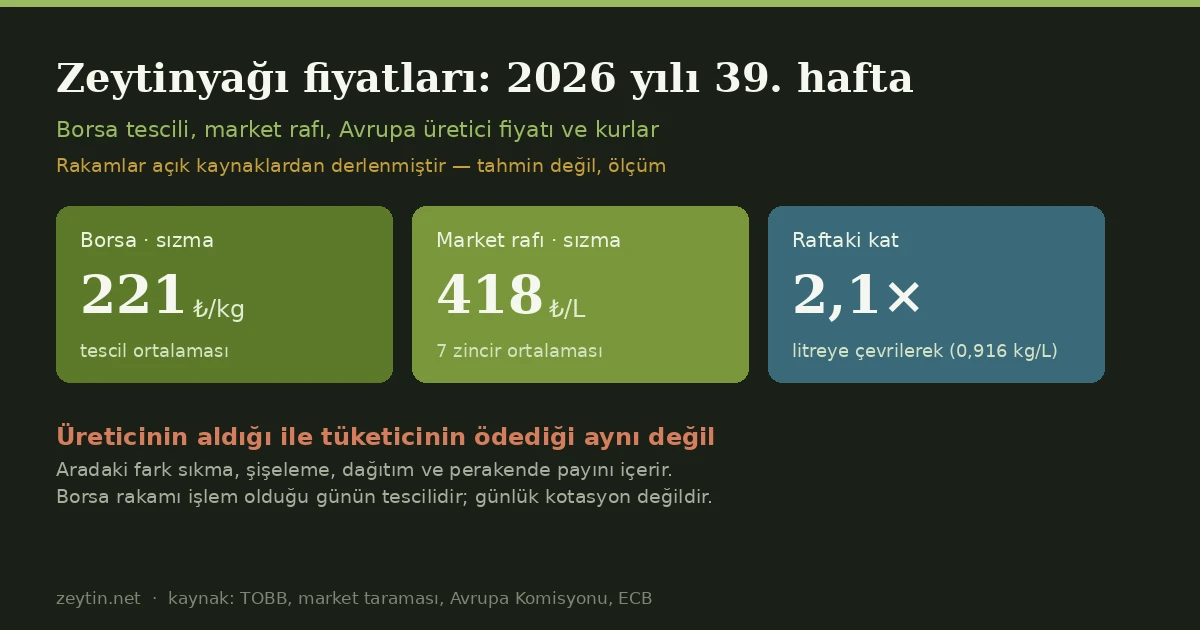
Olive Oil Prices: Week 39 of 2026
Week 39 of 2026: Turkish exchange prices, European producer prices and exchange rates side by side.
Article
Olive Oil Prices: Week 39 of 2026
Week 39 of 2026: Turkish exchange prices, European producer prices and exchange rates side by side.
 Article
Edremit Olive Oil: thirteen separate fruity perceptions listed
Registered in 2017. The certificate lists thirteen fruity perceptions, from green almond to banana skin. At least one must be present at low or medium intensity.
Article
Edremit Olive Oil: thirteen separate fruity perceptions listed
Registered in 2017. The certificate lists thirteen fruity perceptions, from green almond to banana skin. At least one must be present at low or medium intensity.
 Article
Güney Ege Olive Oils: a designation of origin across three provinces
Registration no 79, published in the Official Gazette in 2004, covers more than thirty-three districts across İzmir, Aydın and Muğla. The reasoning is not administrative but varietal: the region holds almost all of Türkiye's Memecik trees.
Article
Güney Ege Olive Oils: a designation of origin across three provinces
Registration no 79, published in the Official Gazette in 2004, covers more than thirty-three districts across İzmir, Aydın and Muğla. The reasoning is not administrative but varietal: the region holds almost all of Türkiye's Memecik trees.