The Ayvalık Olive Oil designation of origin: the chemical profile in the certificate
Registered in 2007. The certificate carries tables of fatty acids, sterols and phenolics — the ranges within which an oil counts as Ayvalık Olive Oil are set out in figures.
Geographical indication certificates are usually full of phrases like "characteristic of the region". Ayvalık Olive Oil's is not — it contains three tables setting out, in figures, the chemical ranges within which an oil may carry the name.
The record
| Registration no | 88 |
| Registration date | 11.06.2007 |
| Application | C2004/003 · 18.03.2004 |
| Type | Designation of origin |
| Registered by | Ayvalık Chamber of Commerce |
| Geographical area | The Ayvalık district of Balıkesir |
The product definition is a single sentence: extra virgin olive oil obtained from Ayvalık cultivar olives grown in the Ayvalık district and picked at early or ripe harvest.
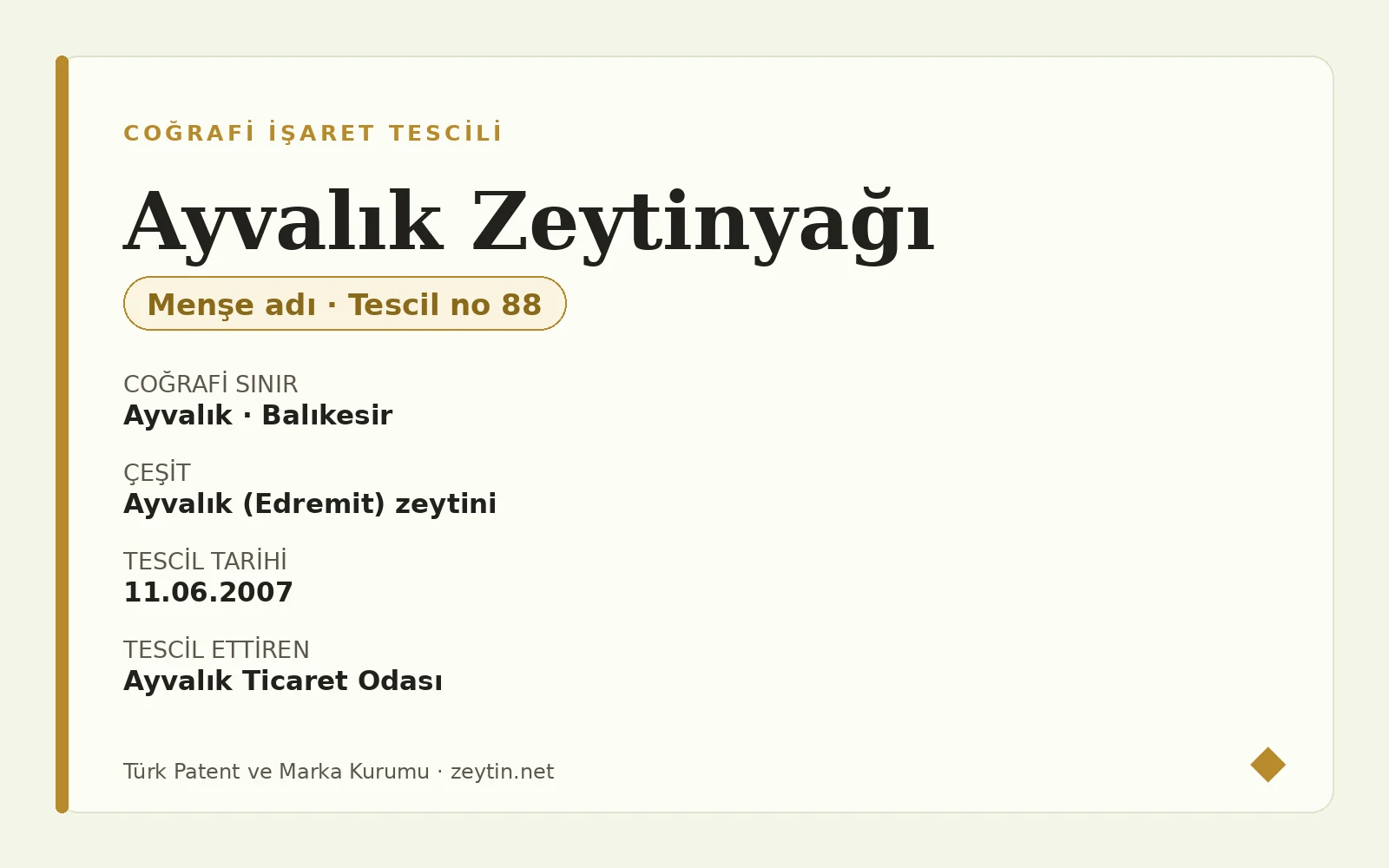
Three constraints sit in that sentence: place, cultivar and grade. All three bind.
Quality limits
| Criterion | Limit |
|---|---|
| Free acidity (% oleic) | ≤ 0.8 |
| Peroxide value (meq O₂/kg) | ≤ 18 |
| K232 | ≤ 2.5 |
| K270 | ≤ 0.22 |
| Delta E | ≤ 0.01 |
Acidity of ≤0.8% is already the legal ceiling for extra virgin; the certificate does not go below it but holds the peroxide value at 18. We explained what acidity means separately.
Fatty acid and sterol profile
This is the distinctive part of the certificate — whether an oil is Ayvalık can be tested in a laboratory against these ranges:
| Fatty acid | Range (%) |
|---|---|
| Oleic acid | 70.42 – 72.42 |
| Palmitic acid | 13.21 – 14.35 |
| Linoleic acid | 10.27 – 11.00 |
| Stearic acid | 2.79 – 2.81 |
| Palmitoleic acid | 0.471 – 0.61 |
| Linolenic acid | 0.69 – 0.73 |
On the sterol side, total β-sitosterol runs 95.9-96.41% and total sitosterol 2,446.6-2,638.4 mg/kg.
Phenolic compounds
| Compound | Range (%) |
|---|---|
| Hydroxytyrosol | 10.23 – 13.28 |
| Tyrosol | 5.52 – 9.13 |
| Luteolin | 1.13 – 2.16 |
| Apigenin | 0.82 – 0.90 |
| p-coumaric acid | 0.60 – 0.62 |
| Ferulic acid | 0.22 – 0.31 |
Hydroxytyrosol and tyrosol carry the oil's bitterness and pungency along with its oxidative stability. We looked at what this family does in oleocanthal and polyphenols.
The sensory definition
The certificate also describes the taste, and the terms are not arbitrary: the fruity aromas are fresh grass, artichoke, green almond, green tomato, green apple, green plum. The most general are green grass and artichoke.
Bitterness and pungency are usually mild to moderate, and can be intense in early-harvest oils. We weighed up whether early harvest is expensive or valuable elsewhere.
There is also a threshold: each of the three positive attributes (fruitiness, bitterness, pungency) must have a median ≥1 and their sum ≥5, with no negative attribute present.
Where the distinctiveness comes from
The certificate explains the geography through three elements:
The mountains. The Madra range acts as a natural windbreak against the prevailing northerlies that olive growing does not want. Together with the Kaz mountains it shapes the air currents.
*The imbat. The humid wind off the northern Aegean mixes with oxygen from the rich vegetation on the mountains and settles over the trees as a mist. According to the certificate this is the mechanism that protects the region's olives from drought even in the driest years*.
The soil. Sandy, loamy, calcareous Mediterranean soil, generally neutral in pH.
The raw material is defined too: the fruit is cylindrical and medium-sized, with 85% flesh and 25% oil.
The production method
The olives are harvested without touching the ground, carried in crates and reach the mill the same day. Extraction may be traditional (water press or steel press) or by continuous system.
The "same day" provision may look minor, but holding olives is the principal cause of rising acidity.
The rule on use
The name appears on the packaging together with a designation-of-origin emblem and a hologram, each carrying its own serial number. Where it cannot be applied to packaging, the logo is used on sealed tanks.
The serialised hologram is the traceability leg of the registration.
In short
The name Ayvalık Olive Oil belongs to extra virgin oil from one district, one cultivar, pressed the same day, and meeting fourteen separate chemical criteria. The certificate does not say "regional" — it says measurable.
The criteria the document binds
The registration does not only protect a name; it defines the product numerically:
| Criterion | Value in the document |
|---|---|
| Peroxide value | 18 meq O₂/kg (max) |
| Harvest-to-pressing window | max 1 saat |
Limiting the time from harvest to pressing binds the operation rather than the outcome: free fatty acidity rises while the fruit waits.
Inspection. Members: Ayvalık Ticaret Odası.
The production steps in the document
The registration describes production step by step. The document's own sequence:
1. Geleneksel Yöntem — Sulu baskı ve çelik baskı olarak iki farklı şekilde yapılır.
2. Kontinü Sistem — Bir dizi makine ile kapalı bir sistemden oluşur.
3. Depolama — Üretilen zeytinyağı, kalitesinin en iyi şekilde koruması ve muhafaza edilmesi amacı ile paslanmaz çelikten imal edilmiş, kapalı tanklarda, ısıya maruz kalmayacak bir ortamda depolanmalıdır.
4. Ambalajlama — Ayvalık Ticaret Odası Duyusal Analiz Laboratuvarı tarafından yapılan analizleri uygun bulunan ürünlerin, filtreli veya filtrelenmeden cam ve teneke ambalajlarda istenilen ölçüde dolumu yapılır.
That this sequence is binding is what separates a geographical indication from a trade mark: a mark says who produced something, a geographical indication also sets down how it must be produced.
The cultivar behind it, measured
The registration is granted to a place, but the cultivar the definition rests on has measurable values:
| Property | Value |
|---|---|
| Meyve ağırlığı | 4,98 g |
| Et oranı | %85 |
| Yağ oranı | %23-26 |
| Hasat | Ekim-Kasım |
| Kendine verimlilik | yok |
| Periyodisite | az |
| Soğuğa dayanım | yüksek |
| Kullanım | yağlık · çizik · siyah sofralık |
| Meyve boyu | 23,09 mm |
| Meyve eni | 18,85 mm |
| Meyve iriliği | orta-iri |
At 23-26% the oil content sits mid-range; yield alone is not the argument here, aroma is. The cultivar is not self-fertile — a pollinator is required in the grove. The planting the registration describes is therefore never single-cultivar in practice. Alternate bearing is low: the year-to-year swing in yield is smaller than is usual in olives.
Its place in Balıkesir's olive production
| Item | Value |
|---|---|
| Fruit production | 314,189 t |
| — for oil | 268,283 t |
| — for the table | 45,905 t |
| Olive oil production | 47,618 t |
| Trees | 11,345 thousand |
| Yield per tree | 27.7 kg |
85% of the province's fruit goes to oil. An oil-based registration matches how the province actually produces.
One rating per visitor; you can change yours at any time. Ratings are real reader votes — no seeded or default scores.
Related
 Article
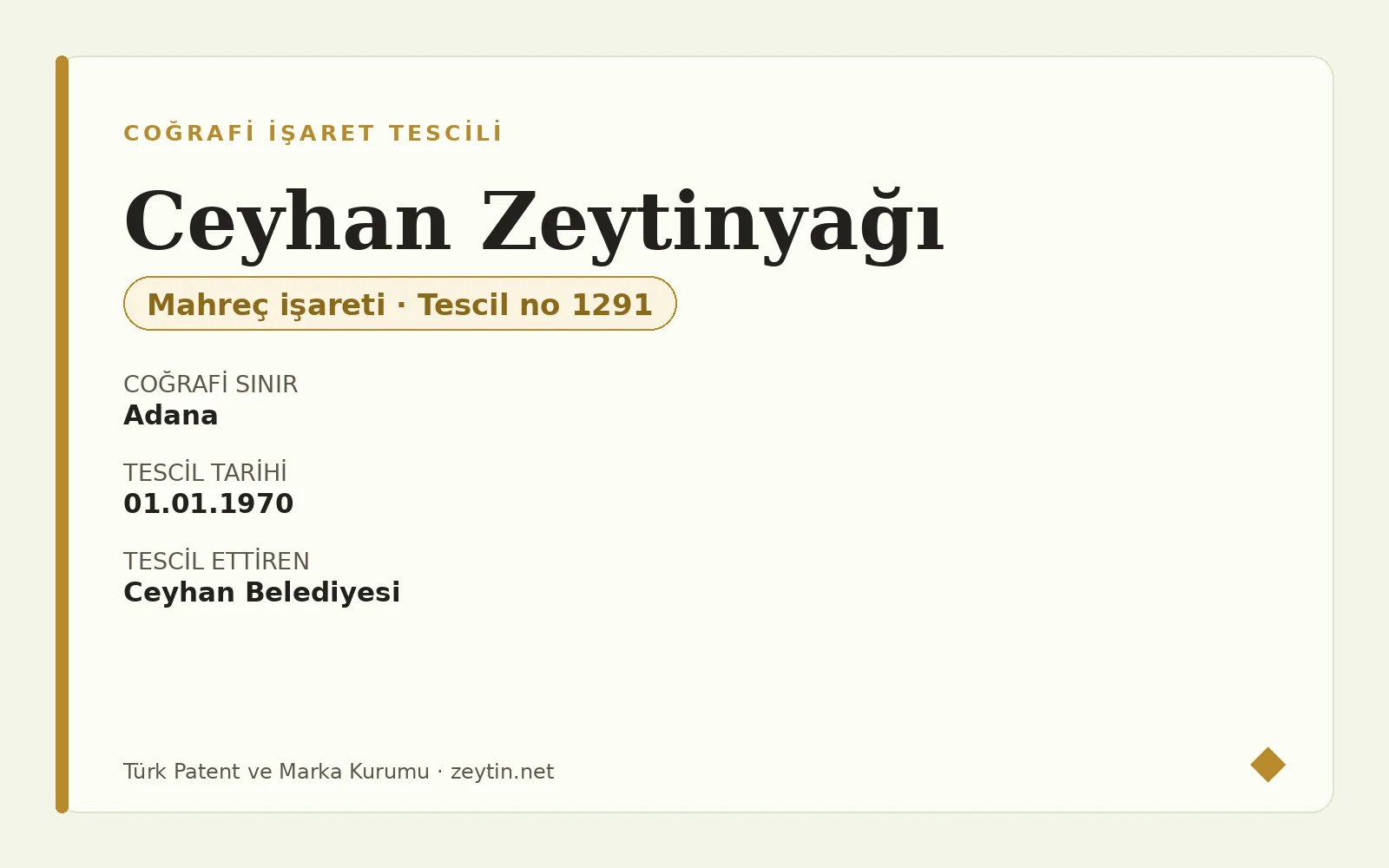
Ceyhan Olive Oil: harvest defined as “no green fruit left on the tree”
Registered in 2022. The certificate defines harvest not by calendar but by the state of the tree: when no green fruit remains and oil content peaks.
Article
Ceyhan Olive Oil: harvest defined as “no green fruit left on the tree”
Registered in 2022. The certificate defines harvest not by calendar but by the state of the tree: when no green fruit remains and oil content peaks.
 Article
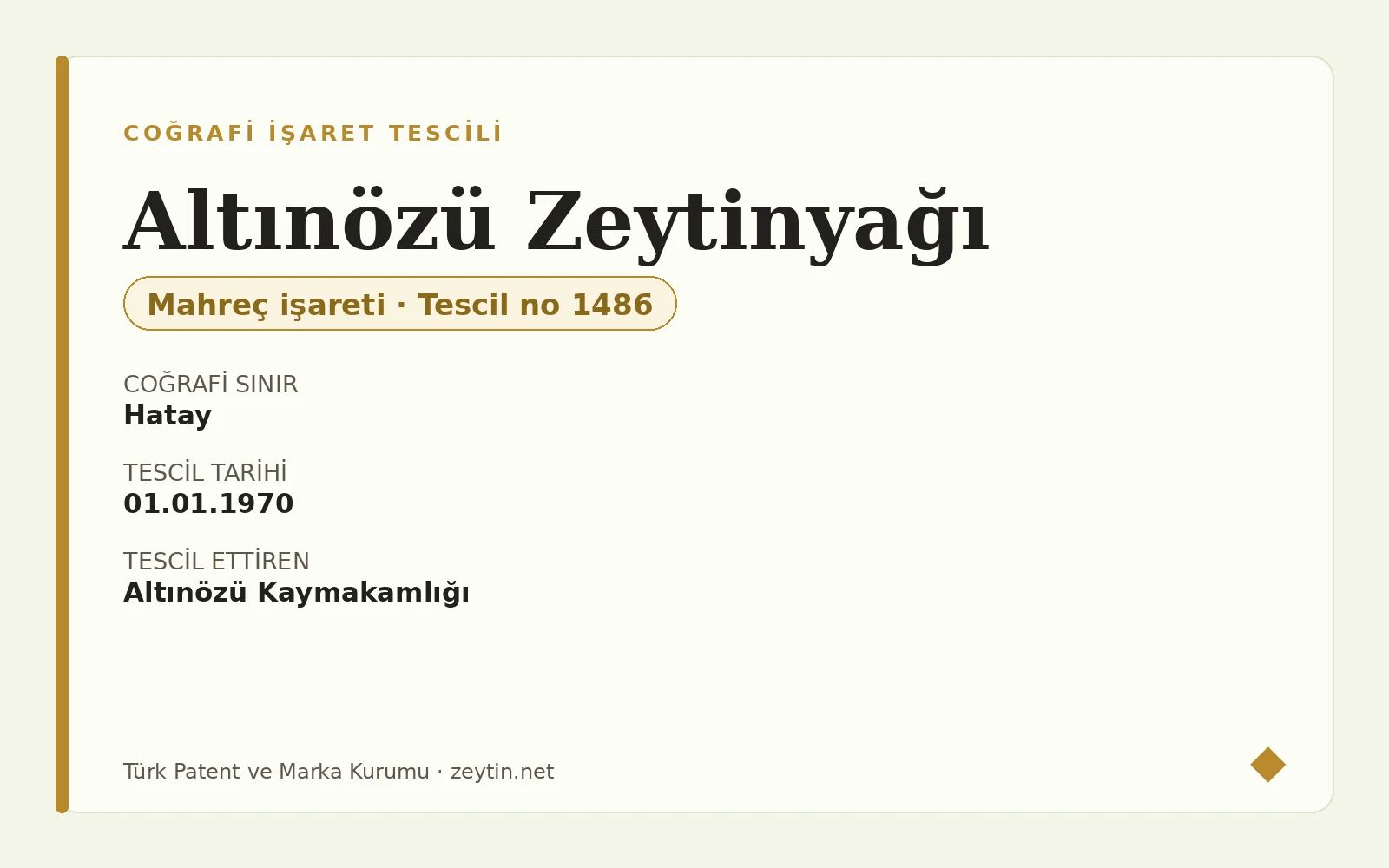
Altınözü Olive Oil: one oil from four cultivars
Registered in 2019. Halhalı, Saurani, Sarı Haşebi and Karamani are processed together. Alpha-tocopherol spans a wide 51.6-387.4 mg/kg.
Article
Altınözü Olive Oil: one oil from four cultivars
Registered in 2019. Halhalı, Saurani, Sarı Haşebi and Karamani are processed together. Alpha-tocopherol spans a wide 51.6-387.4 mg/kg.
 Article
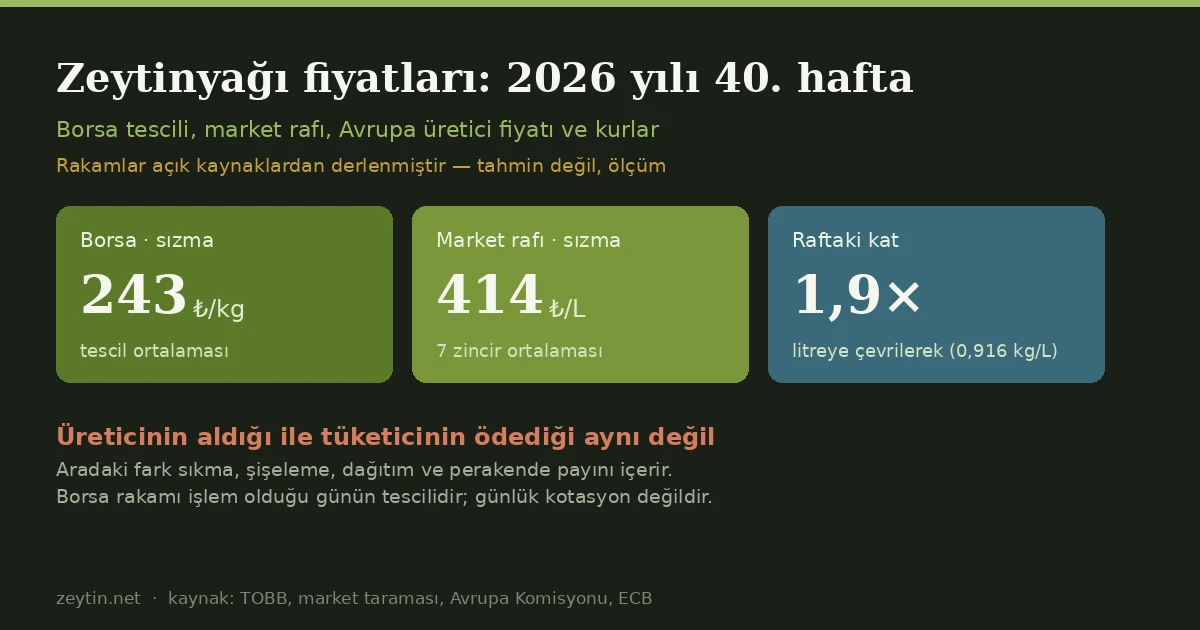
Olive Oil Prices: Week 40 of 2026
Week 40 of 2026: Turkish exchange prices, European producer prices and exchange rates side by side.
Article
Olive Oil Prices: Week 40 of 2026
Week 40 of 2026: Turkish exchange prices, European producer prices and exchange rates side by side.
 Article
Olive Oil Prices: Week 37 of 2026
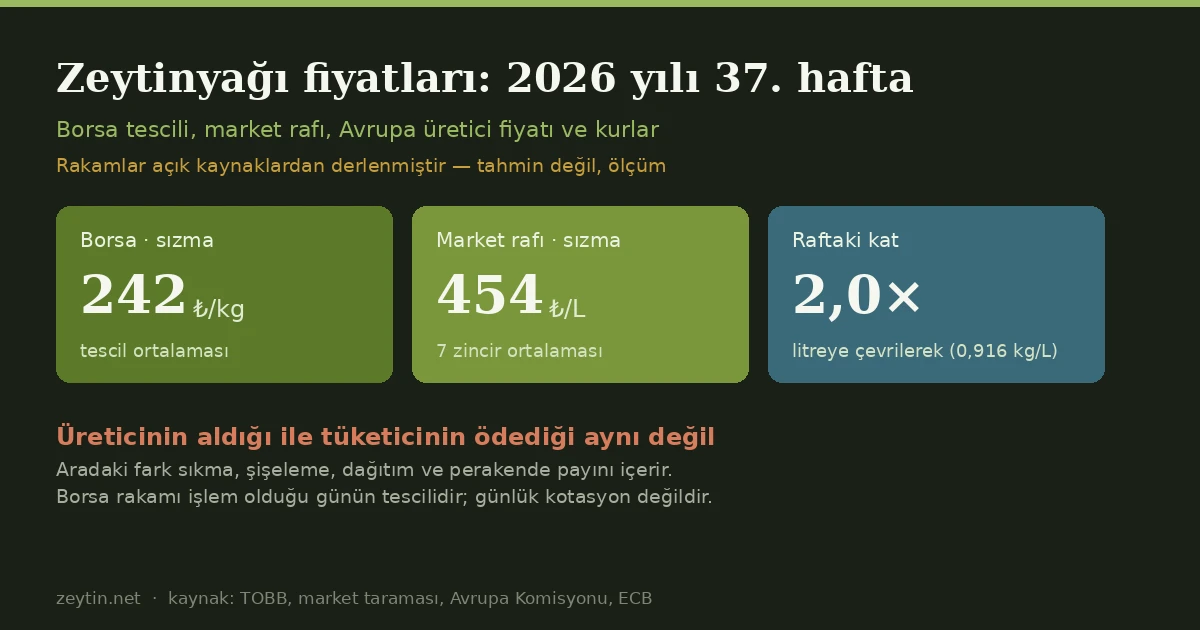
Week 37 of 2026: Turkish exchange prices, European producer prices and exchange rates side by side.
Article
Olive Oil Prices: Week 37 of 2026
Week 37 of 2026: Turkish exchange prices, European producer prices and exchange rates side by side.