Ödemiş Çekişte Olive Oil: a separate harvest window called “çakır”
Registered in 2020. The certificate names two harvest windows: early (green, November-December) and “çakır” (green turning pink, mid-December to mid-January).
Olive harvest is usually divided into “early” and “ripe”. In Ödemiş there is a third name: çakır harvest — and the certificate writes it into the definition.
The record
| Registration no | 579 |
| Registration date | 26.10.2020 |
| Application | C2019/061 · 22.05.2019 |
| Type | Designation of origin |
| Registered by | Ödemiş Chamber of Commerce |
| Area | The Ödemiş, Tire, Kiraz and Beydağ districts of İzmir |
| Cultivar | Çekişte |
Two harvest windows
| Window | Fruit colour | Timing |
|---|---|---|
| Early harvest | green | November – December |
| Çakır harvest | green turning pink | mid-December – mid-January |
“Çakır” describes locally the mottled state of the fruit during its colour change. Naming this intermediate window separately is local knowledge written into a document.

The oil may be produced from early and/or çakır harvested fruit — the registration covers both.
The cold-press requirement
The certificate also binds the method: once the olives are milled to paste, processing takes place below 27 °C — cold pressing.
The temperature threshold is not trivial: above 27 °C yield rises but aroma compounds and phenolics are lost. We discussed the trade-off in how olive oil is made.
Two registrations for one cultivar
The Çekişte cultivar underpins two registrations: Ödemiş Çekişte Olive Oil here as an oil, and Milas Çekişke Olive (no 1109) as a table olive in Muğla. One cultivar, two provinces, two products.
The criteria the document binds
The registration does not only protect a name; it defines the product numerically:
| Criterion | Value in the document |
|---|---|
| Free acidity (as oleic acid) | max %0.8 |
| Peroxide value | 15 meq O₂/kg (max) |
| Total phenolic content | 170 mg/kg min |
| Processing temperature | max 26 °C |
The free acidity limit of 0.8% is the codex ceiling for extra virgin olive oil. Here the registration restates the codex; what distinguishes the product is the other criteria below. Capping processing at 26 °C is what cold extraction means in practice: above that threshold yield rises but aroma compounds and phenolics are lost. That the document sets a floor for total phenolic content is notable — most registrations never define phenol levels, although bitterness, pungency and shelf-life behaviour largely depend on them.
Inspection. The inspection body convenes with at least once a year. Members: Ödemiş Ticaret Odası. Results are reported under Industrial Property Law no. 6769 and submitted to the Turkish Patent and Trademark Office.
The area as the document defines it
The short line in the record does not give the registration's full boundary. The document's own definition reads:
t; İzmir ilinin Ödemiş, Tire, Kiraz, Beydağ, Bayındır ilçeleri ile Aydın ilinin Nazilli, Sultanhisar ve Yenipazar ilçeleri
The production steps in the document
The registration describes production step by step. The document's own sequence:
1. Birinci Aşama — Ödemiş Çekişte Zeytinyağının üretiminde kullanılacak Çekişte çeşidi zeytinler; İnsani Tüketim Amaçlı Sular Hakkında Yönetmelik hükümlerine uygun sular ile yıkanarak, yabancı maddelerden ayrılır ve temizlenmesi sağlanır.
2. İkinci Aşama — Temizlenen zeytinler gıda ile temasa uygun ekipmanlarda/makinelerde soğuk sıkım tekniği ile en fazla 26˚C sıcaklıktaki su verilerek kırılır.
3. Üçüncü Aşama — Kırıcıda parçalanan zeytinler; dışında su dolaşan paslanmaz çelik teknelerin içinde hamur haline getirilir.
4. Dördüncü Aşama — Zeytin hamuru santrifüj edilerek zeytinyağı, su ve pirina (gıda işletmesinde iki fazlı üretim tekniği kullanılıyor ise sulu pirina) ayrılır.
5. Altıncı Aşama — Elde edilen zeytinyağı tüketime hemen arz edilmeyecek ise gıda ile temasa uygun paslanmaz çelik tanklarda, doğrudan güneş ışığı almayacak şekilde 20˚C altındaki sıcaklıklarda, kokulardan ari depolama koşullarında muhafaza edilir.
6. Yedinci Aşama — Elde edilen zeytinyağının tüketiciye arzında tercihen cam ambalajlar olmak üzere Türk Gıda Kodeksine uygun ambalaj malzemeleri kullanılır.
That this sequence is binding is what separates a geographical indication from a trade mark: a mark says who produced something, a geographical indication also sets down how it must be produced.
The cultivar behind it, measured
The registration is granted to a place, but the cultivar the definition rests on has measurable values:
| Property | Value |
|---|---|
| 1 kg’daki tane sayısı | 185 |
| Et oranı | %85 |
| Yağ oranı | %27 |
| Ana kullanım | yağlık |
| Meyve boyu | 29 mm |
| Meyve eni | 20 mm |
| Türkiye ağaç varlığındaki payı | %1,5 |
| Yöre | Ege |
Its place in İzmir's olive production
| Item | Value |
|---|---|
| Fruit production | 485,275 t |
| — for oil | 440,096 t |
| — for the table | 45,179 t |
| Olive oil production | 70,767 t |
| Trees | 18,177 thousand |
| Yield per tree | 26.7 kg |
91% of the province's fruit goes to oil. An oil-based registration matches how the province actually produces.
One rating per visitor; you can change yours at any time. Ratings are real reader votes — no seeded or default scores.
Related
 Article
Ceyhan Olive Oil: harvest defined as “no green fruit left on the tree”
Registered in 2022. The certificate defines harvest not by calendar but by the state of the tree: when no green fruit remains and oil content peaks.
 Article
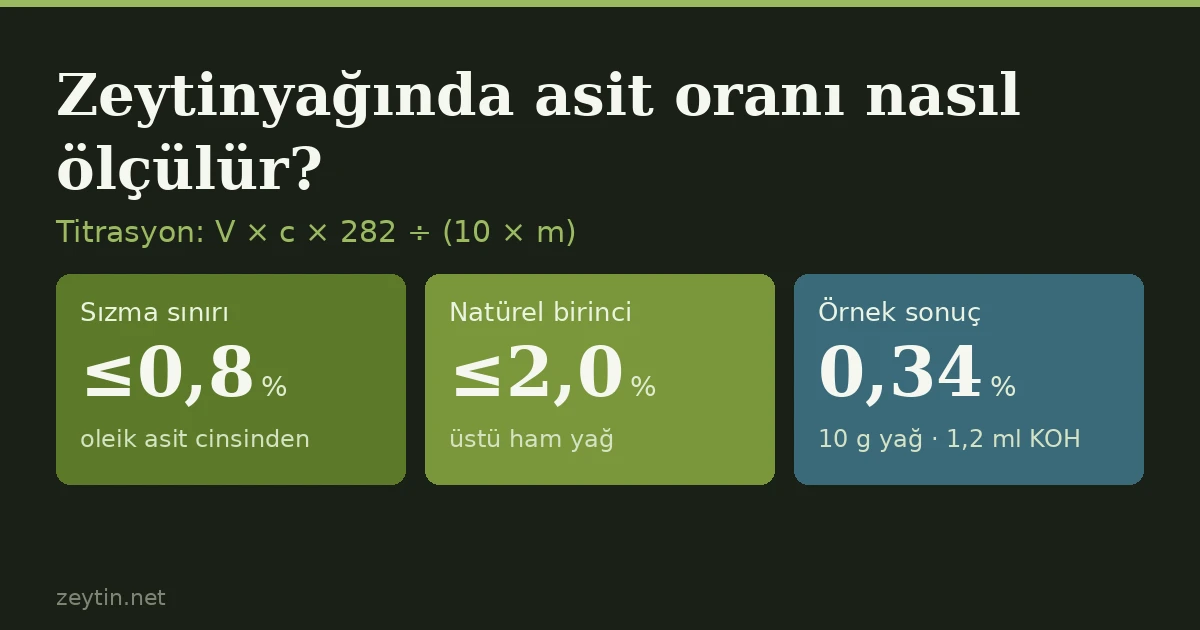
How is olive oil acidity measured? Titration, the formula and taking a sample
Olive oil acidity is measured in a laboratory by titration: the oil is dissolved in a solvent, free fatty acids are neutralised with potassium hydroxide, and the percentage is calculated as oleic acid from the amount used. The formula, a worked example, sampling and the limits of home test kits.
 Article
Olive Oil
The difference between extra virgin, virgin, refined and riviera; what acidity means, how cold pressing works and how to store oil.
 Article
How Cold-Pressed Olive Oil Is Made
From tree to bottle: washing, crushing, malaxation and separation. Why the temperature must stay below 27°C.