How is olive oil acidity measured? Titration, the formula and taking a sample
Olive oil acidity is measured in a laboratory by titration: the oil is dissolved in a solvent, free fatty acids are neutralised with potassium hydroxide, and the percentage is calculated as oleic acid from the amount used. The formula, a worked example, sampling and the limits of home test kits.
We explained what acidity means in olive oil, its limits and why it rises in what does acidity mean in olive oil. This page focuses on the other half of the question: how is that percentage actually found? The answer is a simple chemistry test, but what makes the result reliable is less the test itself than how the sample was taken.
What is being measured?
Olive oil consists mostly of triglycerides. When fruit is damaged, left waiting or warms up, these molecules break down and release free fatty acids. "Acidity" or "free acidity" expresses the amount of those free acids in the oil as a percentage of oleic acid. Oleic acid is used because it is the most abundant fatty acid in olive oil.
The laboratory method: titration
The official method is the classic titration defined in the International Olive Council standard and in European Union analysis rules. Turkish regulations are based on the same method. The steps are roughly as follows:
1. A set amount of oil is weighed on a precision balance according to the expected acidity. For low-acidity extra virgin oil, a larger sample is used.
2. The oil is dissolved in a previously neutralised solvent mixture of ethanol and diethyl ether.
3. A few drops of phenolphthalein indicator are added.
4. A potassium hydroxide solution of known concentration is added drop by drop from a burette. The base neutralises the free fatty acids.
5. The titration ends when the mixture turns pale pink and the colour persists for at least ten seconds. The volume used is read off.
The formula and a worked example
Acidity is calculated with this formula:
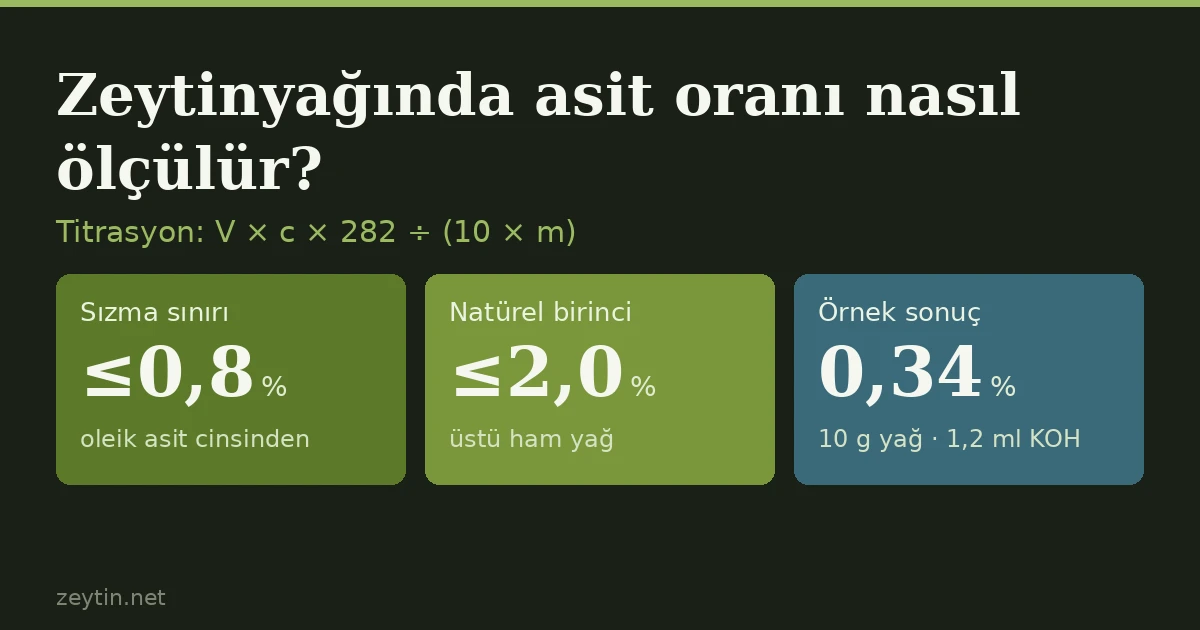
Acidity (%) = V × c × 282 ÷ (10 × m)
- V: volume of potassium hydroxide solution used (ml)
- c: concentration of the solution (mol/l)
- 282: molar mass of oleic acid (g/mol)
- m: mass of oil weighed (g)
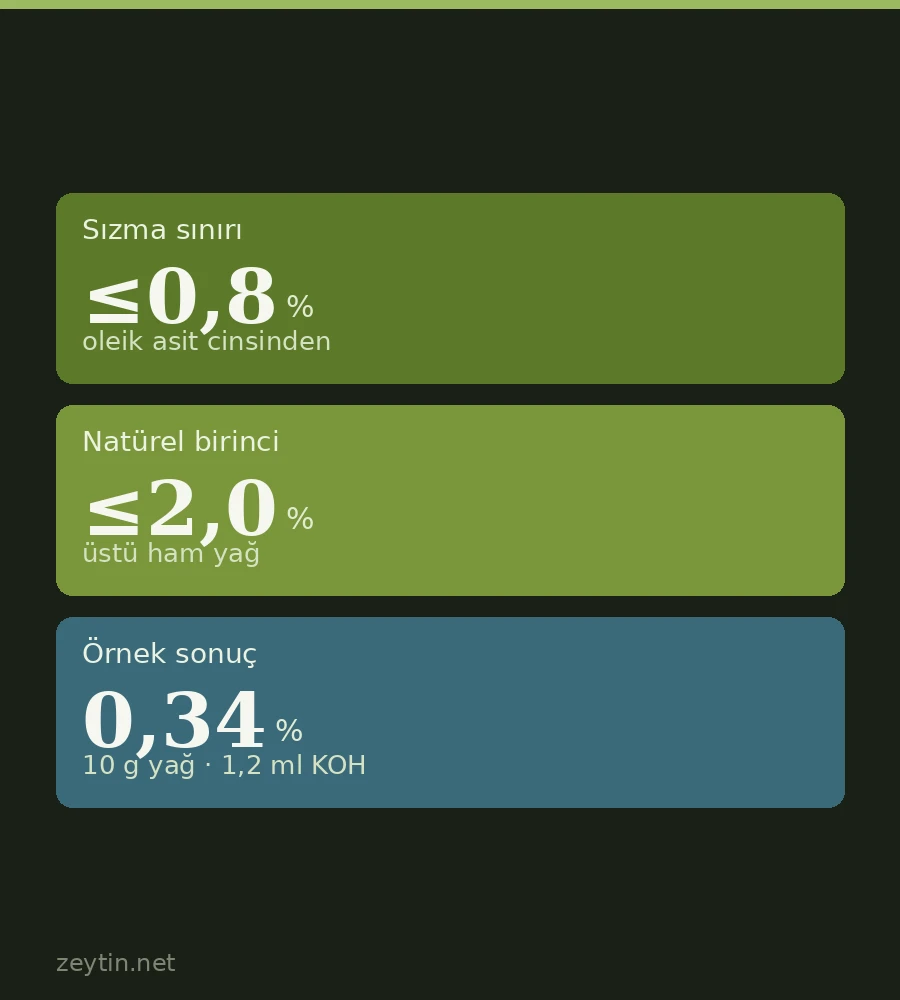
Example: 10 grams of oil are weighed and 1.2 ml of a 0.1 mol/l solution is used.
1.2 × 0.1 × 282 ÷ (10 × 10) = 0.34%
In terms of acidity, this oil is comfortably below the extra virgin limit.
What is the result compared with?
| Grade | Free acidity |
|---|---|
| Extra virgin olive oil | ≤ 0.8% |
| Virgin olive oil | ≤ 2.0% |
| Lampante olive oil | > 2.0% |
Acidity alone does not decide the grade. The same analysis package usually also measures the peroxide value (at most 20 mEq O₂ per kilogram for extra virgin) and ultraviolet absorbance values. For the extra virgin grade, a sensory panel must also find no defects and perceive fruitiness.
Sampling: the step that really decides the result
However careful the laboratory is, a badly taken sample gives a wrong result.
- Make it representative. Take oil that has been mixed, not from the bottom or the surface of a tank. Each tank is a separate sample.
- Use a dark, clean container. Prefer dark glass or a food-grade container, and never a bottle that previously held other oil.
- Fill it to the top. Leave no air gap; oxygen raises the peroxide value.
- Keep it cool and dark in transit. Leaving a sample in a car for days spoils peroxide and ultraviolet values in particular.
- Label it. Write the date, tank, lot and variety.
A small amount is enough for acidity alone; if you want a full quality analysis and sensory assessment, ask the laboratory in advance whether a larger sample is needed.
Where can it be tested?
Accredited private food laboratories, laboratories at some commodity exchanges, relevant university departments and government food control laboratories carry out this analysis. For results used in sales or exports, it matters that the laboratory is accredited for this specific test. The price of oil traded on commodity exchanges is also largely set by its acidity result.
If the result is high
Once an oil's acidity is above the limit, it cannot be brought down afterwards. Blending, filtering or settling do not remove free fatty acids. The only process that genuinely lowers acidity is neutralisation, which is a step in refining, so the oil can no longer be sold as extra virgin or virgin. A high result is therefore more useful for next season than for that oil. The most common causes are fruit left in sacks for days after picking, fallen olives mixed with those picked from the tree, and olive fly damage. Shortening the time between harvest and milling is often the cheapest improvement.
Can it be measured at home?
There are quick test kits that work with strips or small dropper bottles, and some mills use portable devices. These can give a rough idea and are useful for sorting batches at the mill. They do not replace the official method, however, and cannot be used as evidence in trade or on a label.
Tasting is no use at all. Acidity is not felt as a burning sensation; the peppery feeling in the throat comes from polyphenols and is often a sign of good, low-acidity oil.
Reading notes
The steps here are meant to explain the method, not to replace a laboratory protocol. The solvents involved are flammable and hazardous and should not be handled without proper facilities.
One rating per visitor; you can change yours at any time. Ratings are real reader votes — no seeded or default scores.
Related
 Article
Akhisar Uslu Olive Oil: oil from a black table cultivar
Registered in 2017. Uslu is principally a table cultivar; the certificate protects its oil separately. β-sitosterol sits in a very narrow 87.36-87.39% band.
Article
Akhisar Uslu Olive Oil: oil from a black table cultivar
Registered in 2017. Uslu is principally a table cultivar; the certificate protects its oil separately. β-sitosterol sits in a very narrow 87.36-87.39% band.
 Article
Edincik Su Olive Oil: ripening slowed by the sea
Registered in 2024. The certificate attributes aroma intensity to one cause: near the Erdek gulf the olives develop slowly and ripen late.
Article
Edincik Su Olive Oil: ripening slowed by the sea
Registered in 2024. The certificate attributes aroma intensity to one cause: near the Erdek gulf the olives develop slowly and ripen late.
 Article
Olive Oil Prices: Week 38 of 2026
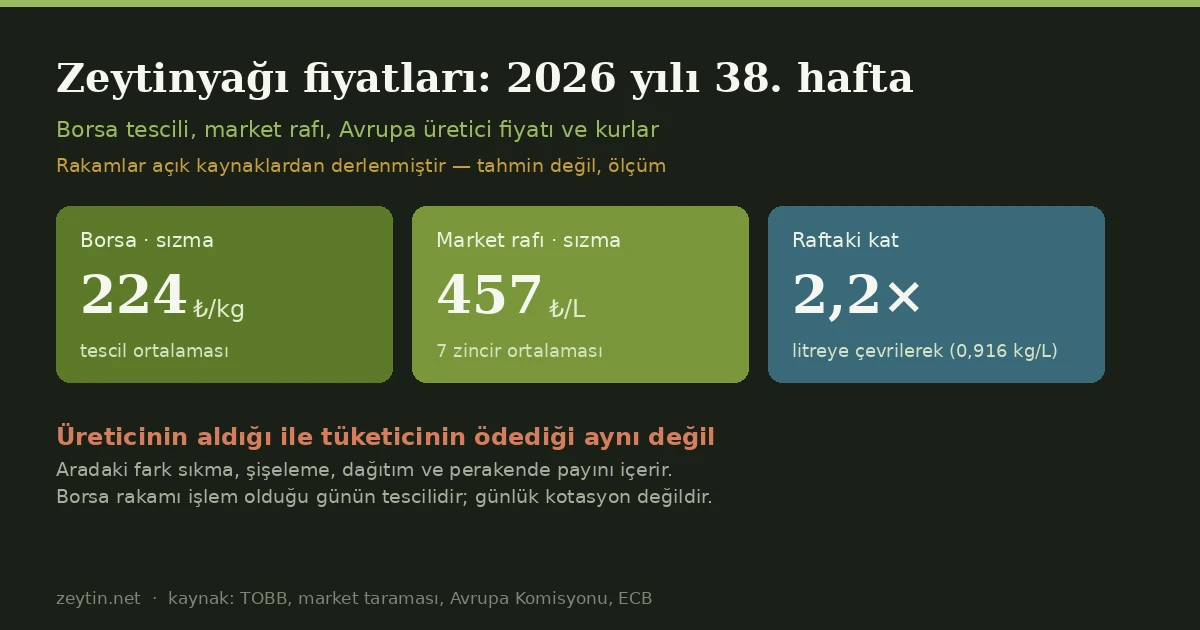
Week 38 of 2026: Turkish exchange prices, European producer prices and exchange rates side by side.
Article
Olive Oil Prices: Week 38 of 2026
Week 38 of 2026: Turkish exchange prices, European producer prices and exchange rates side by side.
 Article
Olive Oil Fraud and Adulteration: How It Is Done and How It Is Caught
Seed oil blending, refined oil sold as extra virgin, soft deodorisation… The economics of fraud, the laboratory methods, and the home tests that do not work.
Article
Olive Oil Fraud and Adulteration: How It Is Done and How It Is Caught
Seed oil blending, refined oil sold as extra virgin, soft deodorisation… The economics of fraud, the laboratory methods, and the home tests that do not work.