Can you bake with olive oil instead of butter, and how much do you use?
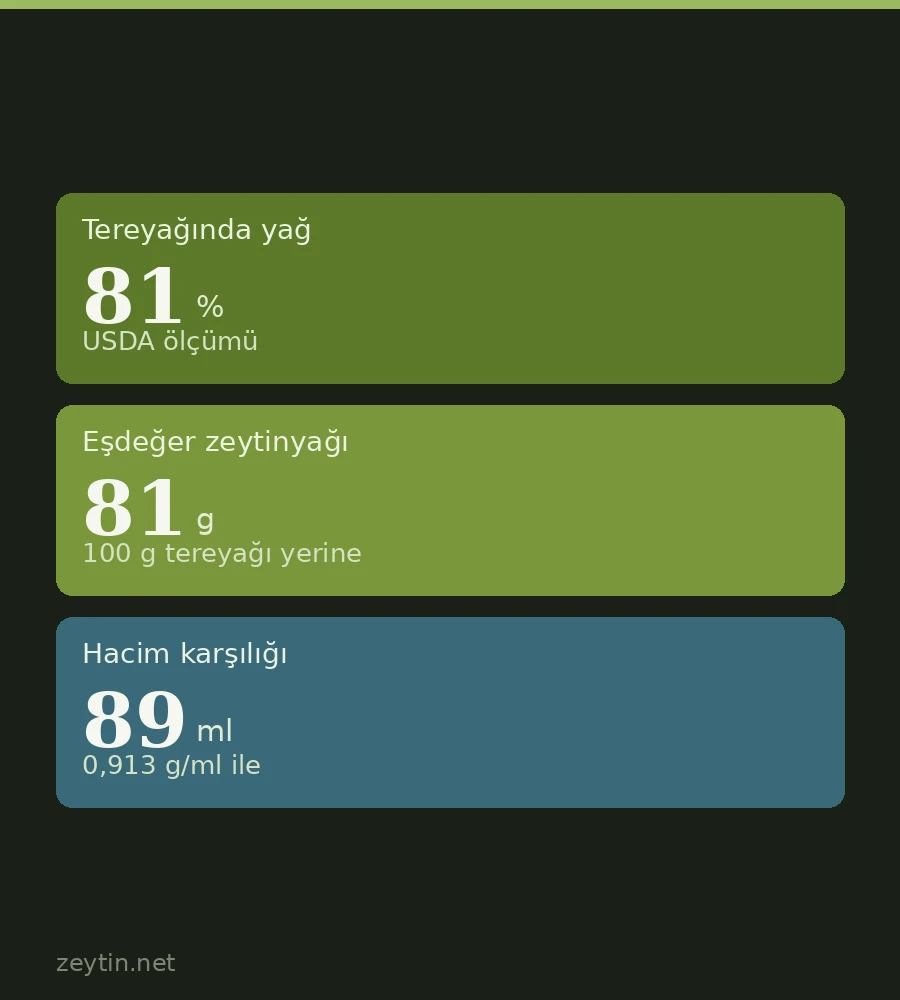
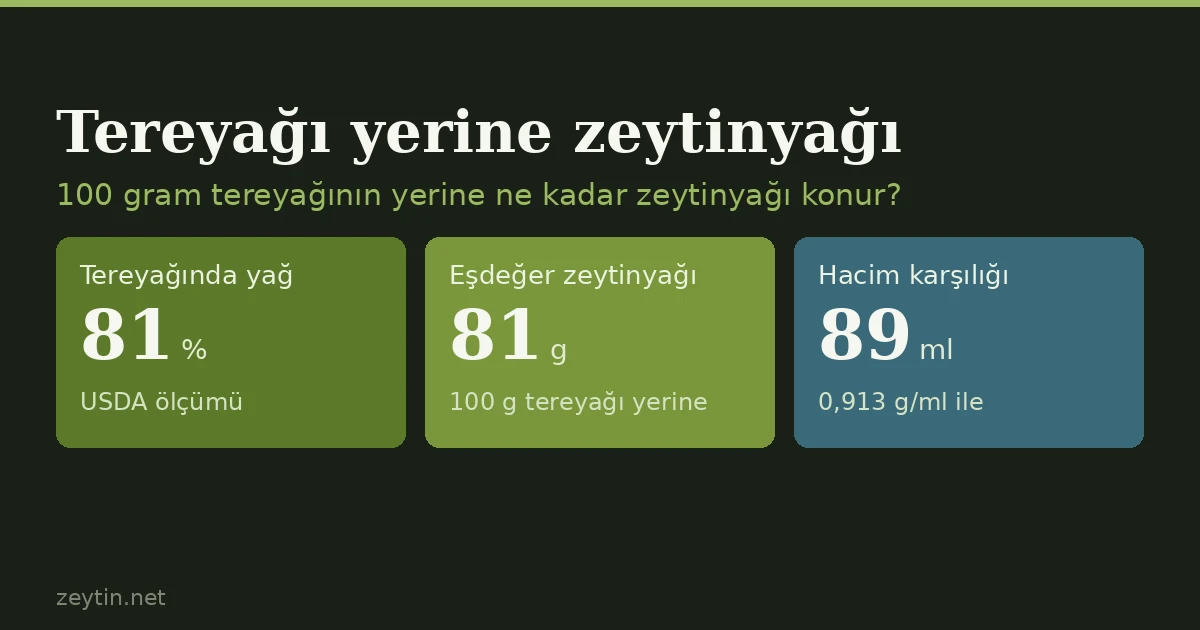
Cakes, muffins and yeasted buns can be made with olive oil. Butter is about 81% fat and 16% water, so the fat in 100 g of butter is matched by 81 g, or 89 ml, of olive oil. The common three-quarters rule sits slightly below; puff pastry and buttercream need solid fat.
Yes, you can bake cakes, muffins, savoury loaf cakes and yeasted buns with olive oil, and when a recipe calls for melted butter the swap is usually straightforward. Short answer: replace 100 grams of butter with 75-81 grams of olive oil, which is roughly 82-89 millilitres. Laminated pastry, croissants and whipped buttercream are different: they depend on the structure of a solid fat, and olive oil will not give the same result.
A fifth of butter is not fat
According to the US Department of Agriculture's FoodData Central database, 100 grams of unsalted butter contain 81.1 grams of fat, 16.2 grams of water and 0.85 grams of protein. The same database lists olive oil as 100 grams of fat with no water.
In Turkey the minimum is set by regulation. The Turkish Food Codex Communiqué on Butter and Clarified Butter (No. 2025/9), published in the Official Gazette on 4 April 2025, requires unsalted butter to contain at least 82% milk fat by weight and salted or flavoured butter at least 80%, with no more than 16% water and no more than 2% non-fat milk solids in either case.
So when a recipe says "100 grams of butter", the dough receives 80-82 grams of fat and the rest is mostly water.
How much olive oil: weight and volume
To deliver the same amount of fat, multiply the butter weight by about 0.81. Converting to volume means allowing for the fact that olive oil is lighter than water: the Codex Alimentarius standard for olive oils (CXS 33-1981) sets its relative density at 0.910-0.916 at 20 °C. We explain the kilo-to-litre gap in detail in how many litres is a kilo of olive oil; the table below uses the midpoint, 0.913.
| Butter in the recipe | Fat it contains | Olive oil (grams) | Olive oil (ml) |
|---|---|---|---|
| 1 tablespoon (14.2 g) | 11.5 g | 11.5 g | 12.6 ml |
| 100 g | 81.1 g | 81 g | 89 ml |
| 250 g | 202.8 g | 203 g | 222 ml |
Fat content is the USDA measurement (81.1%); volume is calculated at a density of 0.913 g/ml. The tablespoon weight is the USDA's US measure; in the same source a tablespoon of olive oil weighs 13.5 grams, so the fat in one tablespoon of butter is matched by about 0.85 tablespoon of olive oil.
The roughly 16 grams of water that 100 grams of butter bring do not come with olive oil, so the total liquid in the dough drops by that much.
Where the "three-quarters" rule comes from
One well-known source of the "use three-quarters as much olive oil as butter" guideline is the conversion chart of the North American Olive Oil Association (NAOOA): ¾ cup of olive oil for 1 cup of butter, and 2¼ teaspoons for 1 tablespoon. The association is an industry body, and the chart does not explain the ratio.
The arithmetic roughly supports the rule without matching it exactly. Applied by weight, 100 grams of butter become 75 grams of olive oil, or 92% of the fat the butter carried. Applied to US volume measures the gap widens: the USDA gives 227 grams for a cup of butter and 216 grams for a cup of olive oil, so ¾ cup of olive oil (162 g) supplies about 88% of the 184 grams of fat in a cup of butter. "Three-quarters" is a rounded starting point a little below equivalence, not a law.
There is a counter-example too. In a 2022 study by Giuffrè and colleagues at the Mediterranea University of Reggio Calabria, the fat in cantuccini biscuits, originally half butter and half margarine, was switched to 70% extra virgin olive oil, and total fat in the recipe had to rise from 7% to 11% to keep the biscuits' characteristics.
Where the swap works
The deciding question is what the butter is doing in the recipe. The NAOOA itself says the swap works best in recipes that call for softened or melted butter, and that sometimes there is no substitute for butter. Melted butter poured into a batter already behaves like a liquid oil; cakes, muffins and savoury olive cake belong in this group.
In yeasted doughs fat plays a different role. A 2020 review by Pușcaș and colleagues at the University of Agricultural Sciences and Veterinary Medicine of Cluj-Napoca notes that yeast-raised products are usually low in fat, yet fat lubricates the gluten and is indispensable for a soft texture. A registered example of liquid oil doing that job is the Seville torta described below: a yeasted dough kneaded with 27.7% extra virgin olive oil by weight.
Biscuits are mixed. In a 2015 study by Giarnetti and colleagues at the University of Bari Aldo Moro, replacing half the butter in shortbread with a gel made from extra virgin olive oil and inulin left the crumb structure and fracture properties close to the control, and consumers accepted the cookies well; replacing all of the butter lowered sensory quality. The experiment used an oil-based gel, not plain oil. Pușcaș and colleagues also note that biscuit and cookie doughs need plastic, mouldable solid fats to hold their shape. In practice, swapping part of the butter is safer than swapping all of it.
Where it does not work
Laminated doughs such as puff pastry and croissants hold butter as thin sheets between layers. According to the Pușcaș review, these products need a fat of suitable plasticity and high firmness that can spread between the dough layers through repeated sheeting and folding. Olive oil, liquid at room temperature, cannot form those sheets.
Recipes that begin by beating butter with sugar until fluffy, and buttercream, fall in the same category. As a 2021 study by Bascuas and colleagues at the Polytechnic University of Valencia points out, solid fat stabilises air bubbles by forming a film at the interface between air and dough. Whipped liquid oil does not build that structure.
Oven temperature and smoke point
The oven setting is not the temperature the fat inside the batter experiences. In a 2010 study by Wilderjans and colleagues at KU Leuven, the top and bottom zones of a cake heated faster than the centre because heat transfer was easier there; the surface takes most of the heat. We cover the smoke point and heat stability of extra virgin olive oil in is olive oil suitable for frying.
The oil itself also matters. In a 2013 study by Caponio and colleagues at the University of Bari Aldo Moro, taralli made with three different single-variety extra virgin oils showed different lipid degradation during storage; those made with Coratina oil, higher in phenols and carotenoids, showed significantly less oxidative degradation.
Which olive oil
The NAOOA suggests regular or light-tasting olive oil for a milder flavour and a fruitier extra virgin oil for more complexity. Oil from ripe fruit is softer and less bitter, while early harvest oil is known for bitterness and pungency, which will show in a sweet bake. The differences between grades are explained in extra virgin, virgin and riviera.
Mediterranean doughs made with olive oil
Spain's best-known example is Tortas de Aceite de Castilleja de la Cuesta, named after a town in the Aljarafe area of Seville. Commission Implementing Regulation (EU) No 515/2013 of 5 June 2013 entered it in the EU register of traditional specialities guaranteed (TSG), a scheme separate from geographical indications that protects a recipe and method rather than an origin. According to the specification published by Spain's Ministry of Agriculture, the dough is 66.8% flour and 27.7% (±2%) extra virgin olive oil; the tortas are shaped by hand, about 13 centimetres across and a few millimetres thick. The specification records that they began as family sweets made for Easter and spread widely from the early twentieth century.
Italy is mixed: Tuscan cantuccini carry an EU geographical indication, and, as Giuffrè and colleagues report, the specification requires more than 1.5% cow's butter. In Anatolia, a 2018 study by Durlu-Özkaya and colleagues describes olive oil as widely used in Turkish cooking, from savoury pastries to desserts, and as having partly taken the place of butter in Anatolian cuisine.
Shelf life
The NAOOA says baked goods made with olive oil stay moist longer; that is an industry body's statement. Peer-reviewed findings depend on the product: in the one-year storage study by Giuffrè and colleagues, the olive oil cantuccini performed better on water activity, relative humidity and hardness; sensory quality declined slightly, as expected, yet stayed acceptable. We did not find a comparison of similar length for cakes.
Summary
Butter is about 81% fat and 16% water. The fat in 100 grams of butter is matched by 81 grams (89 ml) of olive oil; the familiar "three-quarters" rule sits a little below that. Cakes, muffins, savoury loaf cakes and yeasted doughs that use melted butter suit olive oil; in biscuits a partial swap is safer; laminated pastry and whipped buttercream need a solid fat.
One rating per visitor; you can change yours at any time. Ratings are real reader votes — no seeded or default scores.
Related
 Article
How to Store Olive Oil
Light, heat, air and time — the four enemies of olive oil. Why the bottle next to your stove is in the worst possible place.
 Article
What is lampante olive oil, and why can't it be eaten as it is?
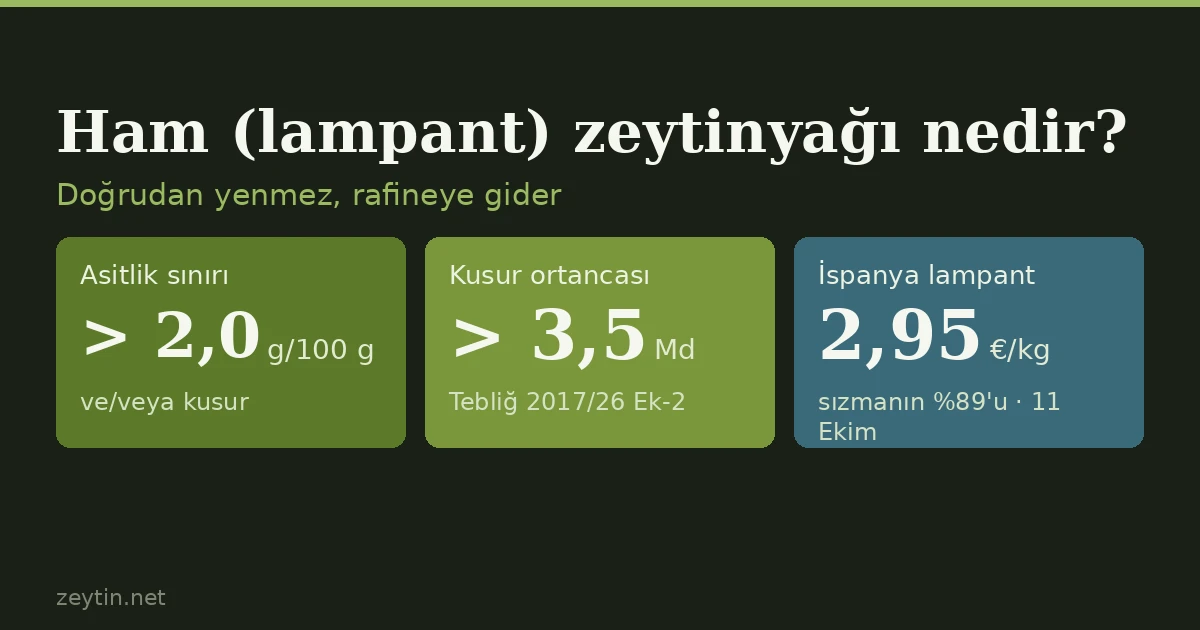
Crude olive oil — lampante, internationally — is oil obtained from olives by mechanical means alone but not considered fit for direct consumption, because its acidity exceeds 2.0 or the tasting panel's median of defects is above 3.5. At the refinery it becomes refined olive oil, and blended with virgin oil it becomes riviera. In the European Commission series for the week of 11 October, Spanish lampante stood at 2.95 €/kg, 89% of the extra virgin price; in Italy at 2.77 €, 63%.
 Article
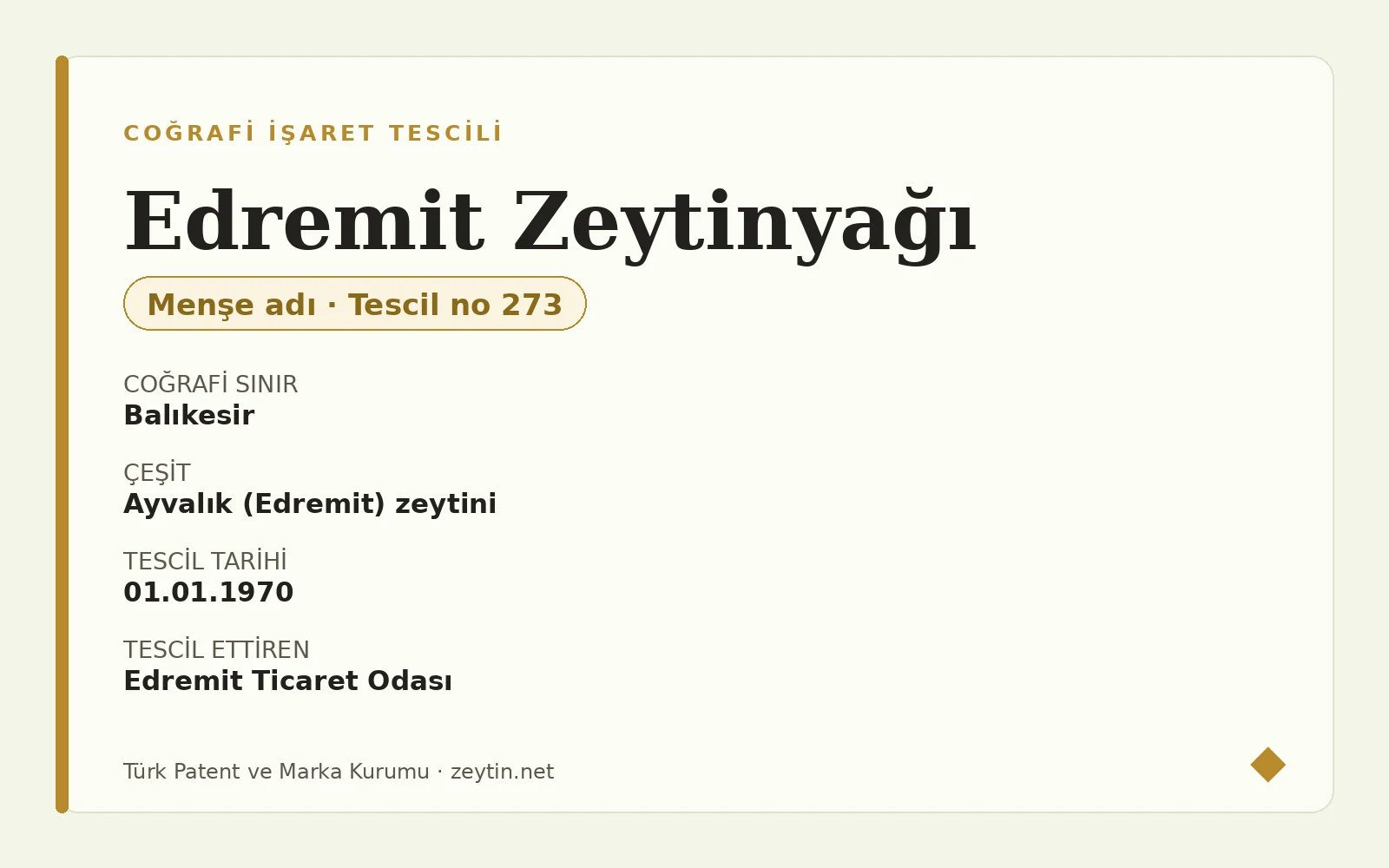
Edremit Olive Oil: thirteen separate fruity perceptions listed
Registered in 2017. The certificate lists thirteen fruity perceptions, from green almond to banana skin. At least one must be present at low or medium intensity.
 Article
North Aegean Olive Oils: a registration stricter than the food codex
The mark of ten localities rather than one district — and unusually, it sets tighter limits than the national standard on peroxide, FAEE, waxes and K270.