Olive Oil Prices: Week 44 of 2026
Week 44 of 2026: Turkish exchange prices, European producer prices and exchange rates side by side.
This bulletin brings together current prices from four open sources: trades registered at Turkish commodity exchanges (TOBB), retail prices on Turkish supermarket shelves, weekly producer prices in Europe (European Commission) and exchange rates (European Central Bank). The figures below are those available when the bulletin was prepared.
Turkey: registered exchange prices
| Product | Exchange | Average TL/kg | Trade date |
|---|---|---|---|
| Extra virgin olive oil | Aydın | 220,00 | 22.09.2026 |
| Extra virgin olive oil | Edremit | 270,00 | 22.10.2026 |
| Extra virgin olive oil | Nazilli | 200,46 | 08.10.2026 |
| Crude olive oil | Aydın | 169,92 | 22.09.2026 |
| Crude olive oil | Edremit | 158,40 | 30.07.2026 |
| Crude olive oil | Gaziantep | 189,75 | 20.10.2026 |
| Crude olive oil | Nazilli | 200,00 | 21.10.2026 |
| Olive oil (cooking) | Edremit | 225,00 | 22.10.2026 |
| Black olives, extra-extra | Edremit | 270,00 | 19.06.2026 |
| Green olives, special | Aydın | 70,00 | 14.05.2026 |
| Green olives, special | Edremit | 142,86 | 12.10.2026 |
| Olives for oil | Edremit | 31,31 | 12.10.2026 |
| Black olives, brined | Aydın | 97,84 | 06.04.2026 |
| Black olives, brined | Edremit | 213,33 | 20.10.2026 |
⚠ These are not daily quotations but prices registered on the day that product actually traded; dates differ because the olive is seasonal.
Turkey: supermarket shelf
| Product | Unit | Lowest | Average | Highest | Chains |
|---|---|---|---|---|---|
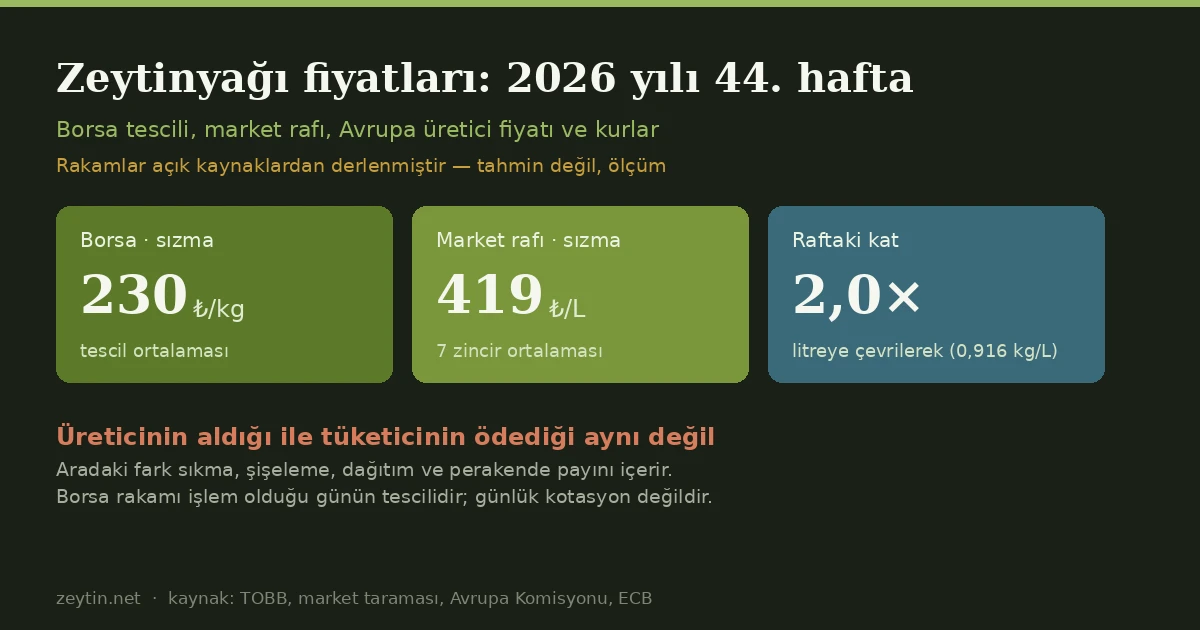
| Black table olives | ₺/kg | 99,50 | 363,25 | 686,25 | 6 |
| Extra virgin olive oil | ₺/L | 249,00 | 418,62 | 879,90 | 6 |
| Green table olives | ₺/kg | 140,00 | 340,02 | 935,00 | 6 |
| Riviera olive oil (refined blend) | ₺/L | 199,00 | 346,76 | 879,60 | 5 |
| Olive paste | ₺/kg | 225,00 | 494,46 | 1073,16 | 3 |
Prices are stripped of package size and shown per unit: oils by the litre, table olives and paste by the kilogram. Surveyed on 25.10.2026. The exchange price is what the producer receives; this is what the shopper pays, and the gap covers milling, bottling, distribution and retail margin.
Europe: weekly producer prices (extra virgin)
| Country | €/kg | Weekly change | Week ending |
|---|---|---|---|
| Spain | 3,26 | ▼ %1,7 | 18.10.2026 |
| Italy | 4,75 | ▲ %8,7 | 18.10.2026 |
| Portugal | 3,52 | ▲ %1,7 | 18.10.2026 |
| Croatia | 11,81 | ▼ %2,7 | 27.09.2026 |
Exchange rates (23.10.2026)
- 1 EUR = 55,6715 TRY
- 1 EUR = 1,1193 USD
- 1 USD = 49,7378 TRY (cross rate)
A note on comparison
The Turkish and European figures are not directly comparable: the European data is a weekly average producer price, the Turkish data the price of individual registered trades. Anyone comparing them must also account for the exchange rate and the difference in dates.
For current tables see the market page.
One rating per visitor; you can change yours at any time. Ratings are real reader votes — no seeded or default scores.
Related
 Article
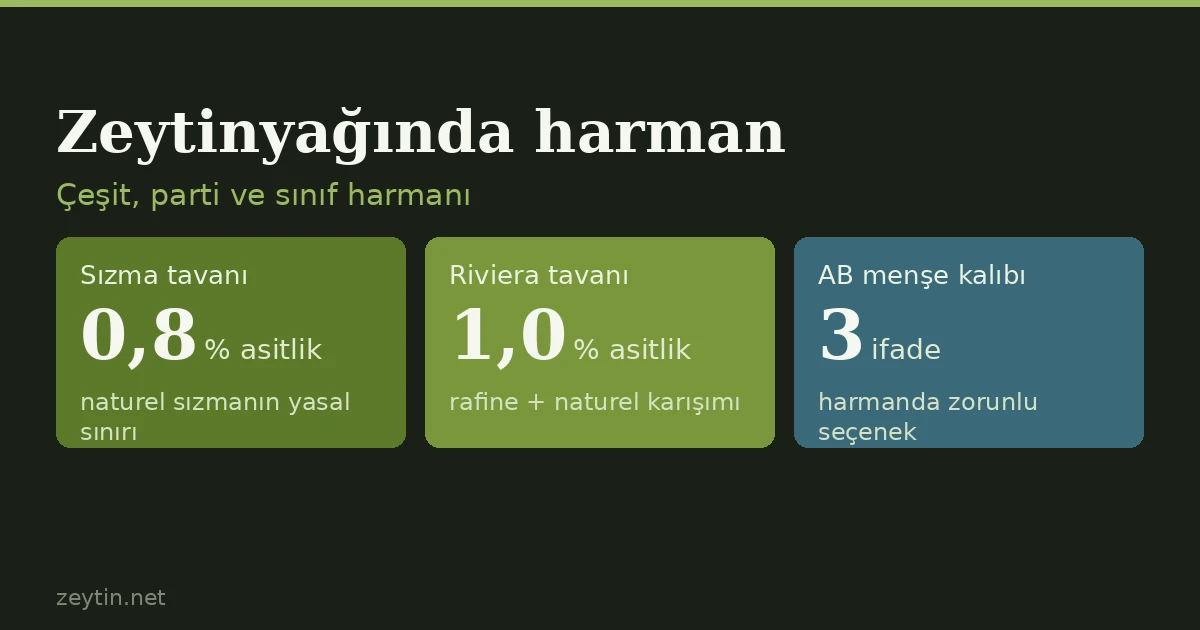
What is a blend in olive oil, and how does it differ from a single-variety oil?
A blend is the combination of several olive oils of the same grade: by variety, grove, lot or year. It is legal and on its own says nothing about quality. Mixing olive oil with other vegetable oils is not blending but adulteration; the Turkish Food Codex prohibits it outright, while the EU permits it if the label says so. Why blends are made, what a single variety gives you, and what the label does and does not tell you.
 Article
Tarsus Sarıulak Olive Oil: milling required immediately after harvest
Registered in 2020. The certificate ties product quality to one condition: the olives must be milled as soon as they are picked. Peroxide averages 8.23.
 Article
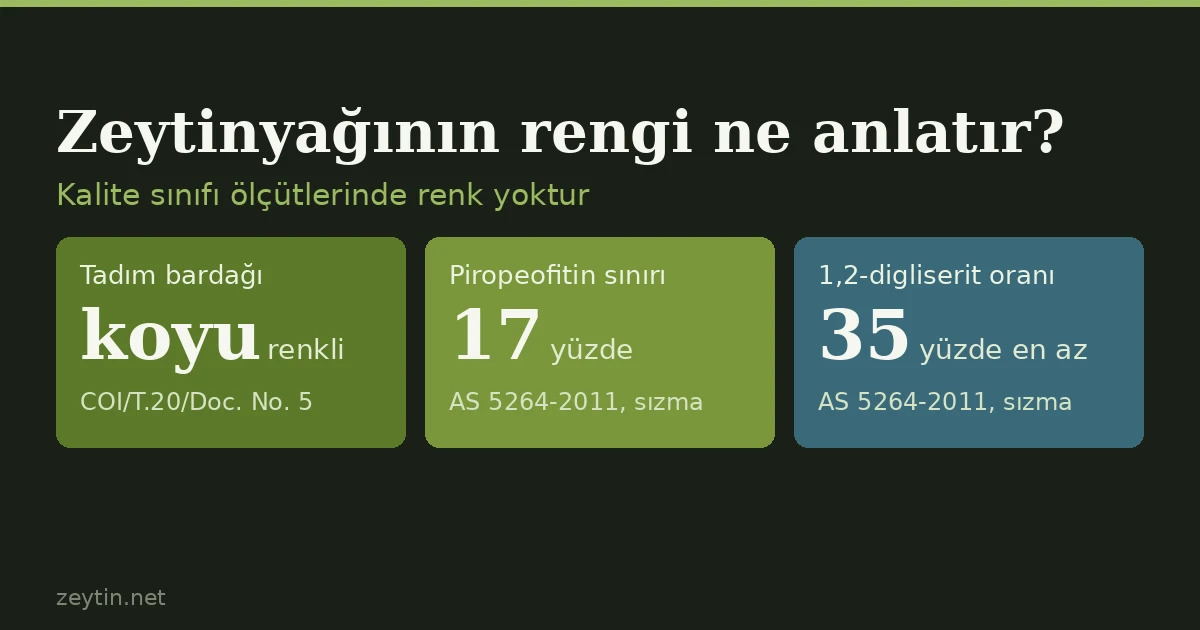
What does the colour of olive oil mean?
Dark green olive oil is widely assumed to be better, yet colour is not a criterion in any quality grade. The International Olive Council's official tasting glass must be dark enough that the colour of its contents cannot be seen — precisely so that the taster is not influenced by it. The chlorophylls and carotenoids that make the colour vary with cultivar, ripeness, leaf ratio and settling. Pigments do carry information in the laboratory as markers of freshness and heat treatment, but they cannot be read by looking at the bottle.
 Article
Edincik Su Olive Oil: ripening slowed by the sea
Registered in 2024. The certificate attributes aroma intensity to one cause: near the Erdek gulf the olives develop slowly and ripen late.