The Halhalı olive: Hatay's oil cultivar
Halhalı accounts for 2.2% of Turkey's olive trees, the main oil cultivar of Hatay and Mardin. The measured self-sterility of Yuvarlak Halhalı and what it means for orchard planning.
Halhalı is the main oil variety of the Hatay and Mardin area. At 2.2% of Turkey's tree stock it ranks sixth — one of the backbone varieties of southeastern and eastern Mediterranean olive growing.
Its best-measured trait bears directly on how a grove is planted: Yuvarlak Halhalı is self-incompatible.
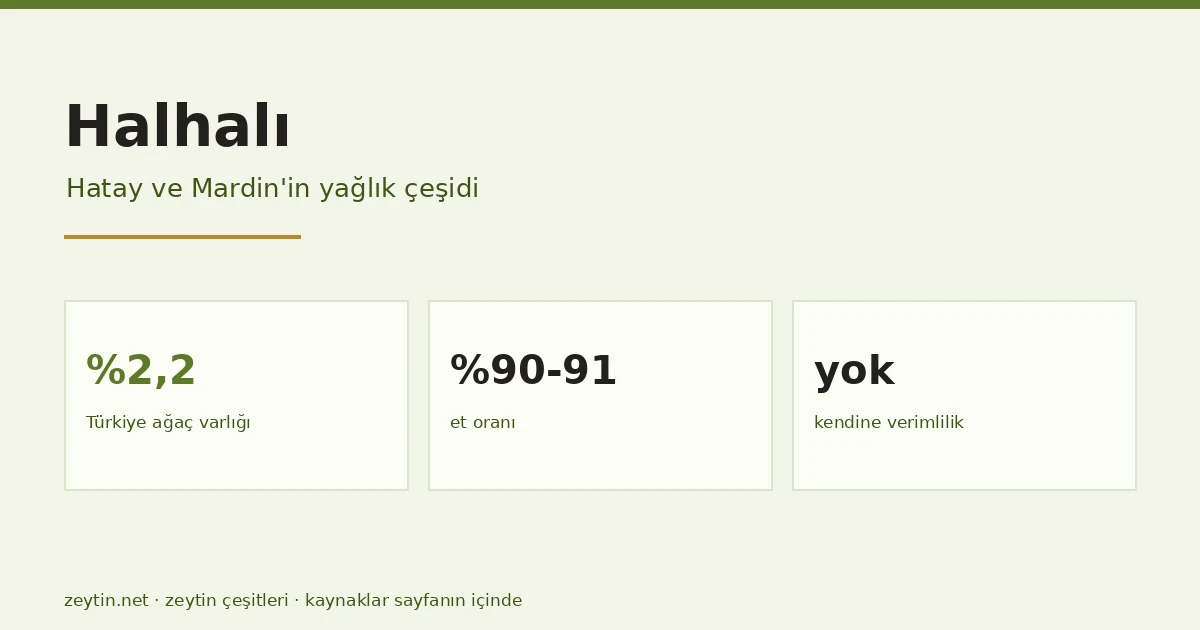
Halhalı in numbers
| Property | Value | Note |
|---|---|---|
| Share of Turkey's tree stock | 2.2% | sixth place |
| Self-fertility | none | Yuvarlak Halhalı, measured in the GAP trial |
| Main use | oil | |
| Region | Hatay · Mardin · southeast | also common around Derik |
What self-incompatibility means
In a selfing and open-pollination trial on five varieties in the GAP region, the varieties fell into three groups, and Yuvarlak Halhalı was alone in the self-incompatible group:
| Variety | Result |
|---|---|
| Yuvarlak Halhalı | self-incompatible |
| Nizip Yağlık, Delice | self-fertile |
| Domat, Gemlik | partly self-fertile |
For a self-incompatible variety a pollinator is not a preference but a requirement: a grove planted with one variety will flower and set no fruit. Part of the grove has to be given over to a compatible second variety.
The same study notes that this is genetic, tied to incompatibility (S) genes. It doesn't change with care, fertiliser or climate — it is a fixed property of the variety. The decision taken when buying saplings holds for the life of the grove.
Its place in the southeast
Halhalı is named alongside the region's other oil varieties: Kilis Yağlık (3%), Nizip Yağlık (2%), Sarı Haşebi (0.7%), Saurani (0.6%).
Together these make up the second centre of gravity of Turkish olive growing outside the Aegean. The region also holds many unnamed local genotypes; studies in Mardin and Şırnak show this: the unnamed olives of southeastern Turkey.
Halhalı is also among the varieties used in tissue-culture propagation work — appearing in in vitro micropropagation trials alongside Gulleki, Nizip Halhallı, Gemlik, Hursuki and Arbequina.
A confusion of names
The variety appears in sources in three forms: Halhalı, Yuvarlak Halhalı and Nizip Halhallı. These may not be exactly the same variety; "Halhalı" is used rather like a family name in the region, with types separating by district.
The measured self-incompatibility data belongs specifically to the Yuvarlak Halhalı type. When planting a grove, ask the nursery which type the sapling is — the pollinator decision depends on it.
In short
Halhalı is the main oil variety of the Hatay–Mardin line, at 2.2% of Turkey's tree stock. The one critical property to know when planning a grove is that it is self-incompatible: a pollinator is mandatory, and since this is genetic it cannot be compensated for later.
Registered names built on this variety
The registration covers the product of a defined area — not this variety wherever it is grown.
- Derik Halhalı Zeytinyağı designation of origin · reg. no 1249
- Hatay Halhalı Zeytini geographical indication · reg. no 1353
Where it stands among measured varieties
Zeytin Kitabı — Efe, Soykan, Cürebal, Sönmez (2016), Kitabevi Yay. s.37-80
Zeytin Kitabı — Efe, Soykan, Cürebal, Sönmez (2016), Kitabevi Yay. s.37-80
Zeytin Kitabı — Efe, Soykan, Cürebal, Sönmez (2016), Kitabevi Yay. s.37-80
Zeytin Kitabı — Efe, Soykan, Cürebal, Sönmez (2016), Kitabevi Yay. s.37-80
Türkpatent Coğrafi İşaret Tescil Belgesi — Hatay Halhalı Zeytini
Values are those published on each variety's own page; the comparison covers only varieties with a measured figure, so it is a comparison of what is known — not of every Turkish variety. See the full ranking and how it is built →
One rating per visitor; you can change yours at any time. Ratings are real reader votes — no seeded or default scores.
Related
 Article
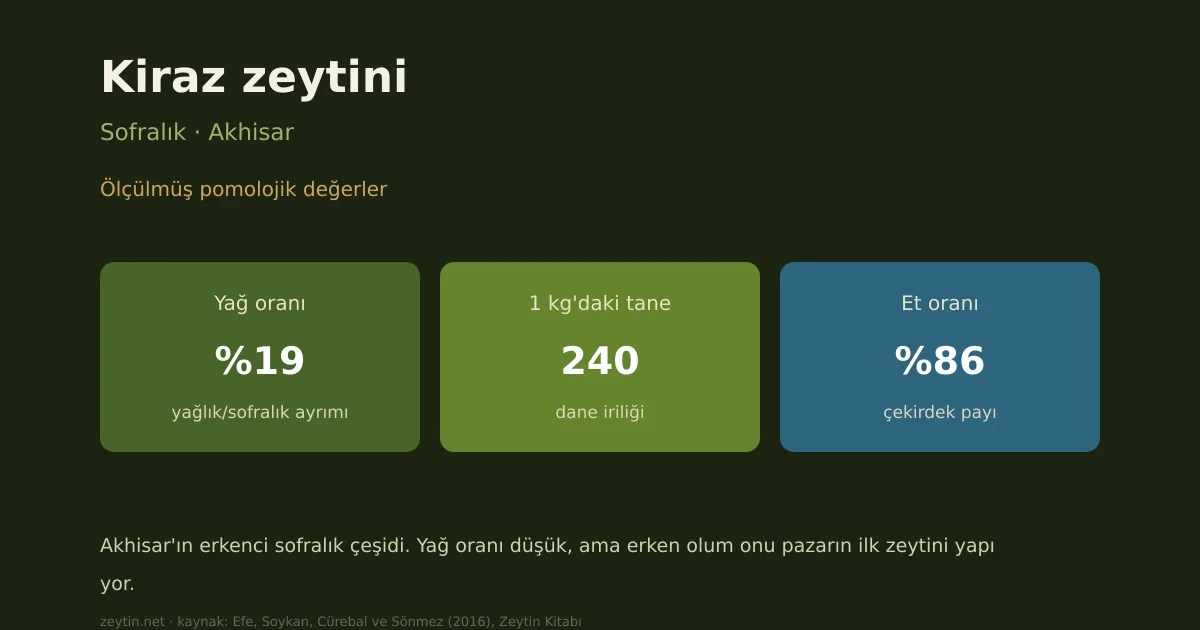
Kiraz olive: characteristics, oil content and growing areas
Akhisar's early table variety. Low in oil, but early maturity makes it the season's first olive to market.
Article
Kiraz olive: characteristics, oil content and growing areas
Akhisar's early table variety. Low in oil, but early maturity makes it the season's first olive to market.
 Article
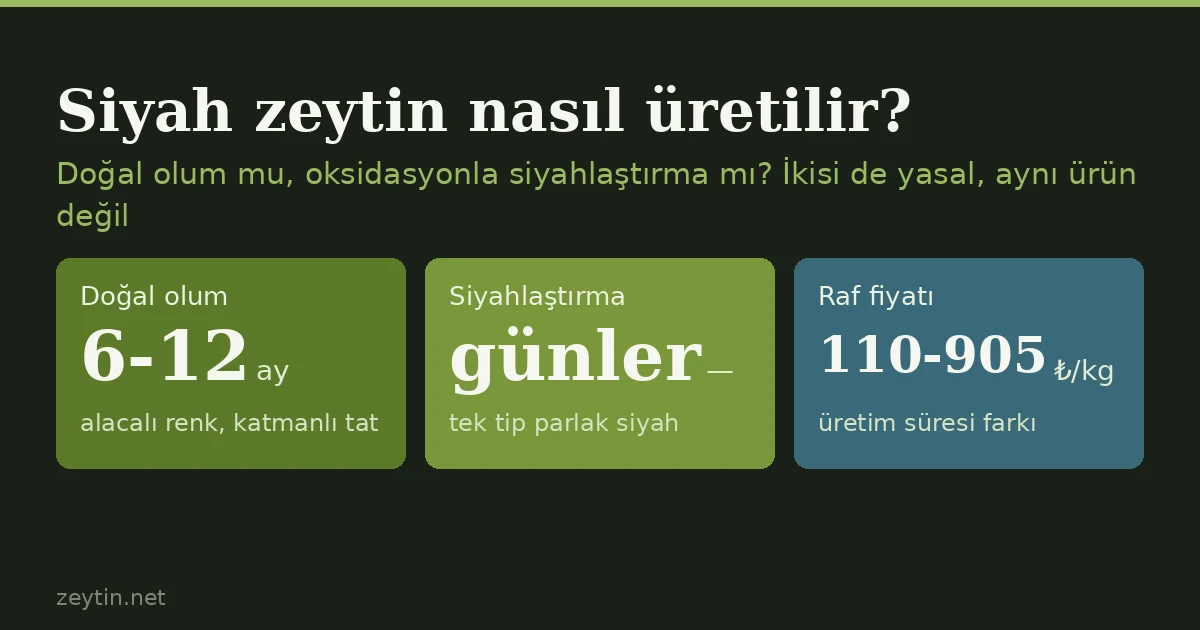
How are black table olives made? Natural ripening versus blackening
Two different black olives sit on the shelf: ripened on the tree and brined, or picked green and blackened by oxidation. Both lawful, but not the same product.
Article
How are black table olives made? Natural ripening versus blackening
Two different black olives sit on the shelf: ripened on the tree and brined, or picked green and blackened by oxidation. Both lawful, but not the same product.
 Article
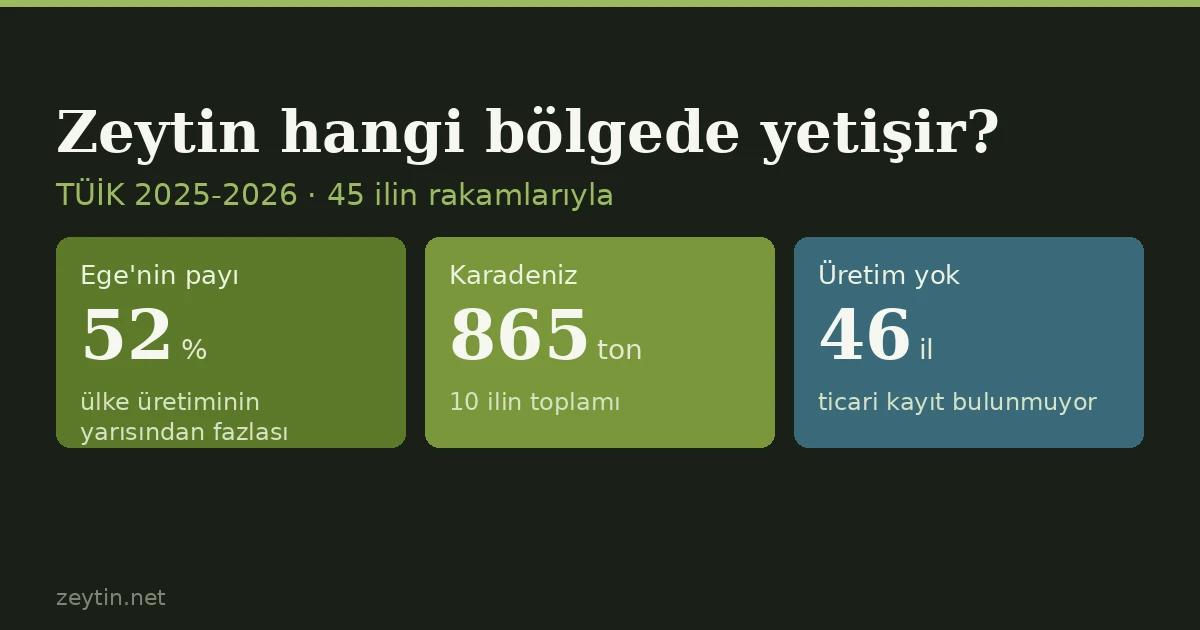
Where do olives grow in Turkey? The picture in 45 provinces
The Aegean alone produces half the national crop; ten Black Sea provinces together manage 865 tonnes. In 46 provinces there is no commercial production at all.
Article
Where do olives grow in Turkey? The picture in 45 provinces
The Aegean alone produces half the national crop; ten Black Sea provinces together manage 865 tonnes. In 46 provinces there is no commercial production at all.
 Article
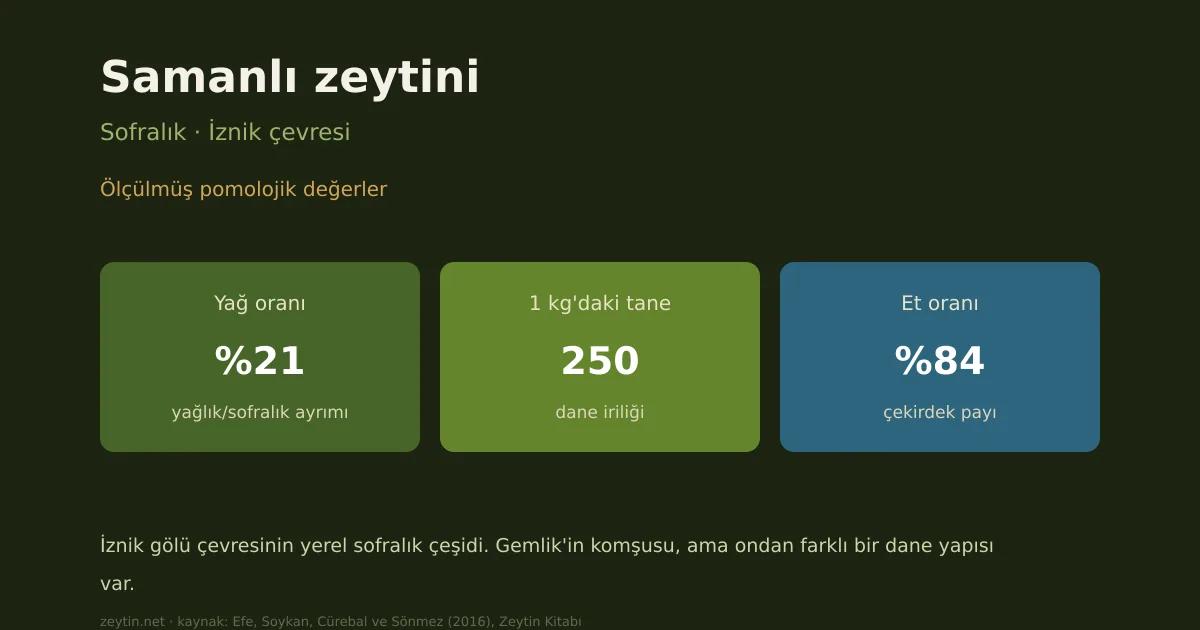
Samanlı olive: characteristics, oil content and growing areas
The local table variety around Lake İznik — Gemlik's neighbour, with a different fruit structure.
Article
Samanlı olive: characteristics, oil content and growing areas
The local table variety around Lake İznik — Gemlik's neighbour, with a different fruit structure.