Where does an olive sapling come from? From cutting to laboratory
Most table olive varieties will not root, and those that do are clones of one another — defenceless against disease. Tissue culture reports up to 85% success in vitro, but zeatin is expensive.
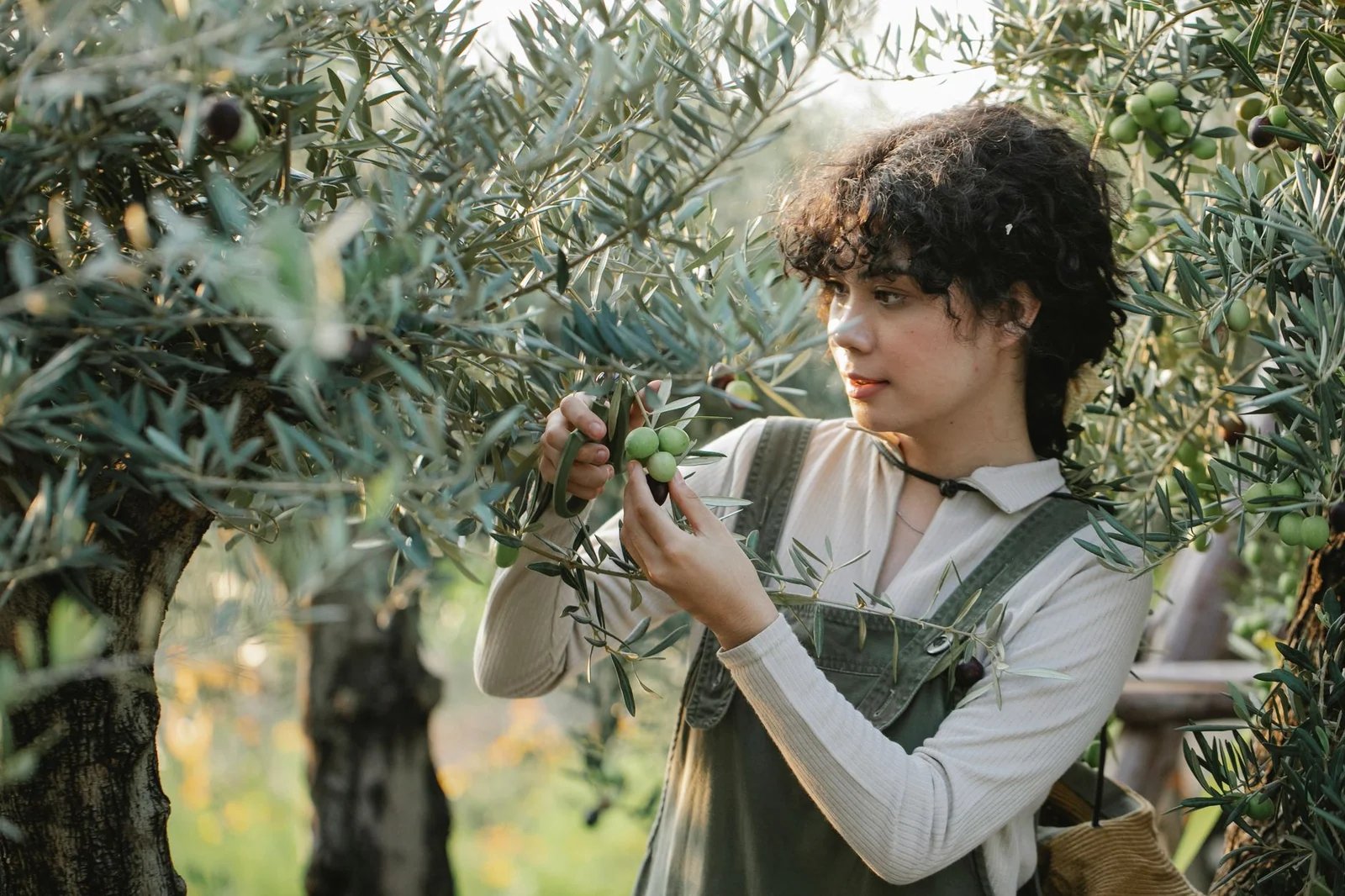
When you buy an olive sapling, what you hold is not a plant grown from seed. Almost certainly it is a copy of another tree.
That is a deliberate choice in olive growing. But it brings two problems with it: some varieties cannot be propagated this way at all, and those that can are becoming ever more identical to one another.
How the olive is propagated today
Most olive-growing countries use three routes:
| Method | How | Result |
|---|---|---|
| Rooting cuttings | leafy stems or cuttings are rooted | a clone of the mother tree |
| Grafting | stem shoots grafted onto seedling or clonal stocks | a clone of the mother tree |
| Seed | a seedling from the stone | a new, different individual |
The third is not used in practice. The reason is clear: the olive's maturation phase is very long, and seedlings lose traits through segregation. You would wait years without knowing what your tree will give — and it almost certainly will not carry the mother tree's characteristics.
Propagation by cuttings spread from the mid-1950s, particularly in countries like Spain where grafting is not used, and it is now the source of more than 70% of planting material.
We covered rooting cuttings and the wild rootstock in a separate article.
Problem one: some varieties will not root
Propagation by cuttings has a limit, and it shows up in exactly the varieties most in demand:
t; Rooting is very difficult or entirely impossible in the varieties known as table olives.
And even where rooting occurs, the newly formed roots are frequently not functional. For those genotypes, grafting remains the only workable method of clonal propagation.
The trouble is that grafting does not solve the problem of scale: every sapling needs its own rootstock and its own operation.
Problem two: everyone is a copy of everyone
Propagation by cuttings generally produces clones of a single individual. The consequence, in the source's words:
t; Individuals with entirely identical genetic make-up become defenceless against various diseases.
This is agriculture's best-known fragility. If every tree in a grove is genetically identical, a disease reaching one can reach all of them — because none carries a different resistance.
In Turkey, the intensive planting of Gemlik under certified-sapling support, or the turn to a handful of Spanish varieties in high-density systems, enlarges the same risk.
Why conventional breeding is not enough
"Let us develop a new and better variety" is not easily said in olives. Conventional breeding has been largely unsuccessful in the species, for structural reasons:
- The olive tree's long maturation phase — seeing a result takes years
- Difficult fruit set — pollination and incompatibility problems
- Irregular seed germination rates
A breeder may wait decades to see the outcome of a single cross. That makes breeding far slower in olives than in other fruit species.
What tissue culture does
Micropropagation (in vitro propagation) produces new plants from a small piece of the parent — a bud, a leaf stalk, a node — in sterile laboratory conditions.
The first work on olives dates to the mid-1970s, and the culture media used have been refined ever since. The most common is OM (Olive Medium), alongside olive-adapted derivatives of MS medium.
What the method promises in olives:
| Problem | What tissue culture offers |
|---|---|
| Table varieties that will not root | success of up to 85% reported for in vitro rooting |
| Scale | large numbers of plants, commercially, in a short time |
| Genetic uniformity | allows selection among somaclonal variations |
| Old / monumental trees | propagation of historic trees becomes possible |
The third row matters especially: tissue culture does not only make copies. The small variations arising during culture can be selected among — giving both rapid propagation and a limited source of diversity.
Why it has not spread: cost
If the method has been known since the 1970s, why is every sapling not produced in a laboratory?
The answer comes down to one item: zeatin.
The most widely used plant growth regulator for obtaining shoots in olive micropropagation is zeatin, a natural cytokinin. And achieving high multiplication rates in olives requires it at very high concentrations.
t; Because zeatin is expensive, it raises the production cost of in vitro olive propagation.
When cheaper regulators (BA, TDZ, kinetin) were tried, olives produced short stems and excessive basal callus — the cheap alternatives do not give the result wanted.
This is a familiar situation for biotechnology in agriculture: the method works; the economics do not.
It is done anyway: the Italian case
Commercial application exists despite the cost. OM medium is used to produce more than 50 olive genotypes commercially under in vitro conditions in Italy, delivering high-quality production and rapid plant growth.
The figure of fifty genotypes is significant: it shows tissue culture can serve not just a handful of commercial varieties but genetic resource conservation as well.
That was the explicit aim of work in Lebanon: conserving local olive genetic resources and propagating from the buds of millennia-old monumental trees.
Where Turkey stands
Turkey has work of its own. Özden et al. (2010) propagated nodal buds taken from old trees of the Edremit oil genotype in vitro. Different carbon sources and growth regulators were tested, with propagation carried out both on semi-solid medium and in a temporary immersion bioreactor (TIS) system.
The result: in liquid OM medium containing mannitol, the TIS system broke apical dominance in the stems and lateral stems developed — meaning more shoots, and more saplings.
That single study shows the method works under Turkish conditions. But it has not turned into a commercial-scale application.
Why it matters
Tissue culture looks like a remote laboratory subject. But the three practical problems it connects to are very concrete:
1. Monumental trees. The genetics of a centuries-old tree disappear when that tree dies. If it will not root from cuttings, there is no way to rescue it. Tissue culture provides one.
2. Unmeasured local genotypes. As local genotypes in south-eastern Anatolia are replaced by standard varieties, they vanish. Conserving a genotype depends on being able to propagate it.
3. Disease risk. As groves narrow to a single variety, fragility grows. Restoring genetic diversity means making unpropagatable varieties propagatable.
So tissue culture in olives is not a question of "more saplings" — it is a question of holding on to disappearing diversity.
Summary
- The olive is propagated mainly by clone: cuttings and grafts
- Most table varieties will not root; even when they do, the roots may not function
- Clonal production reduces genetic diversity and raises disease risk
- Conventional breeding is very slow in olives: long maturation, difficult fruit set, irregular germination
- Tissue culture reports success of up to 85% for in vitro rooting
- The obstacle to its spread is not technical but cost — zeatin is expensive
- More than 50 genotypes are produced commercially this way in Italy
- Turkey has work on the Edremit genotype, but no commercial scale
Sources
- Çiftçi, Z., Ay, M. & Sakar, E. (2020) — Tissue Culture Studies in Olive Plants in the World and Turkey, Turkish Journal of Agriculture - Food Science and Technology 8(3): 645-650
- Rugini, E. (1984) — OM (Olive Medium) and in vitro rooting
- Rugini, E. & Baldoni, L. (2004) — the cost of zeatin
- Rugini et al. (2006) — commercial in vitro production in Italy
- Özden et al. (2010) — Edremit genotype, TIS bioreactor study
- Fabbri et al. (2004) — propagation methods in olive
- Qrunfleh et al. (1994) — somaclonal variation and selection
- Chalak et al. (2014) — in vitro propagation of monumental trees
One rating per visitor; you can change yours at any time. Ratings are real reader votes — no seeded or default scores.
Related
 Article
Choosing certified olive saplings: labels, documents and variety
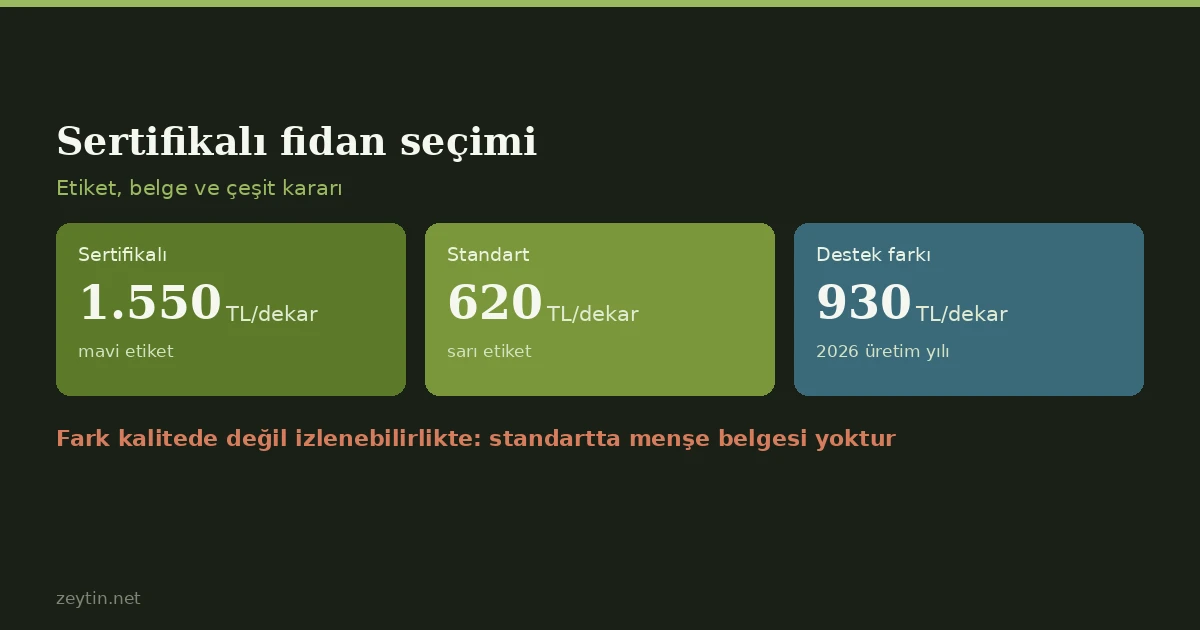
Label colour shows the certificate class: blue certified, yellow standard. The difference is traceability, not quality. The support gap is 930 lira per decare. Four questions that settle variety choice.
Article
Choosing certified olive saplings: labels, documents and variety
Label colour shows the certificate class: blue certified, yellow standard. The difference is traceability, not quality. The support gap is 930 lira per decare. Four questions that settle variety choice.
 Article
Frost damage in olive trees: signs, risk factors and what to do after a frost
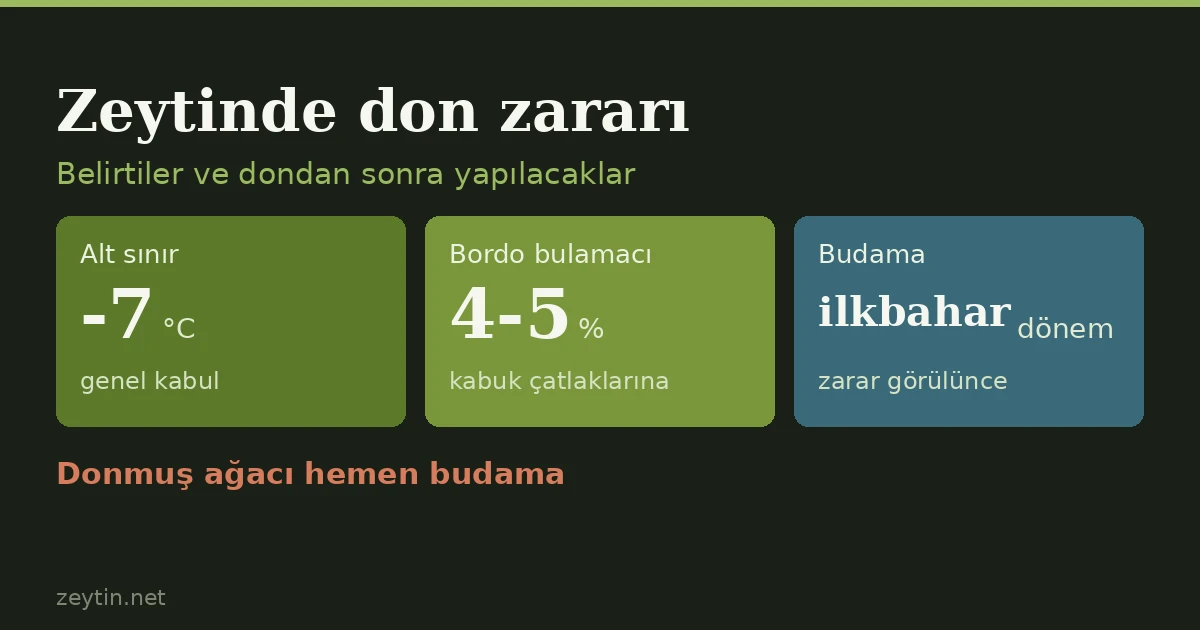
The generally accepted lower limit for olives is around -7 °C, but damage does not depend on the thermometer alone: how long the cold lasts, sudden drops, humidity, tree age and nutrition all matter. Here are the signs of frost damage on leaves, shoots, bark and fruit, ways to reduce the risk and which job to do when after a frost.
Article
Frost damage in olive trees: signs, risk factors and what to do after a frost
The generally accepted lower limit for olives is around -7 °C, but damage does not depend on the thermometer alone: how long the cold lasts, sudden drops, humidity, tree age and nutrition all matter. Here are the signs of frost damage on leaves, shoots, bark and fruit, ways to reduce the risk and which job to do when after a frost.
 Article
Irrigating Olives: When, How Much, How
Olive water requirements, critical periods, drip system layout, deficit irrigation and water quality.
Article
Irrigating Olives: When, How Much, How
Olive water requirements, critical periods, drip system layout, deficit irrigation and water quality.
 Article
What to do for olive trees after harvest: a November-to-March care guide
The work in the grove does not end with the olive harvest; next year's crop is prepared in exactly these months. From collecting fallen fruit and protecting harvest wounds to region-specific peacock spot sprays, the right pruning time, autumn feeding and winter soil work, here is what needs doing after harvest.
Article
What to do for olive trees after harvest: a November-to-March care guide
The work in the grove does not end with the olive harvest; next year's crop is prepared in exactly these months. From collecting fallen fruit and protecting harvest wounds to region-specific peacock spot sprays, the right pruning time, autumn feeding and winter soil work, here is what needs doing after harvest.