Choosing certified olive saplings: labels, documents and variety
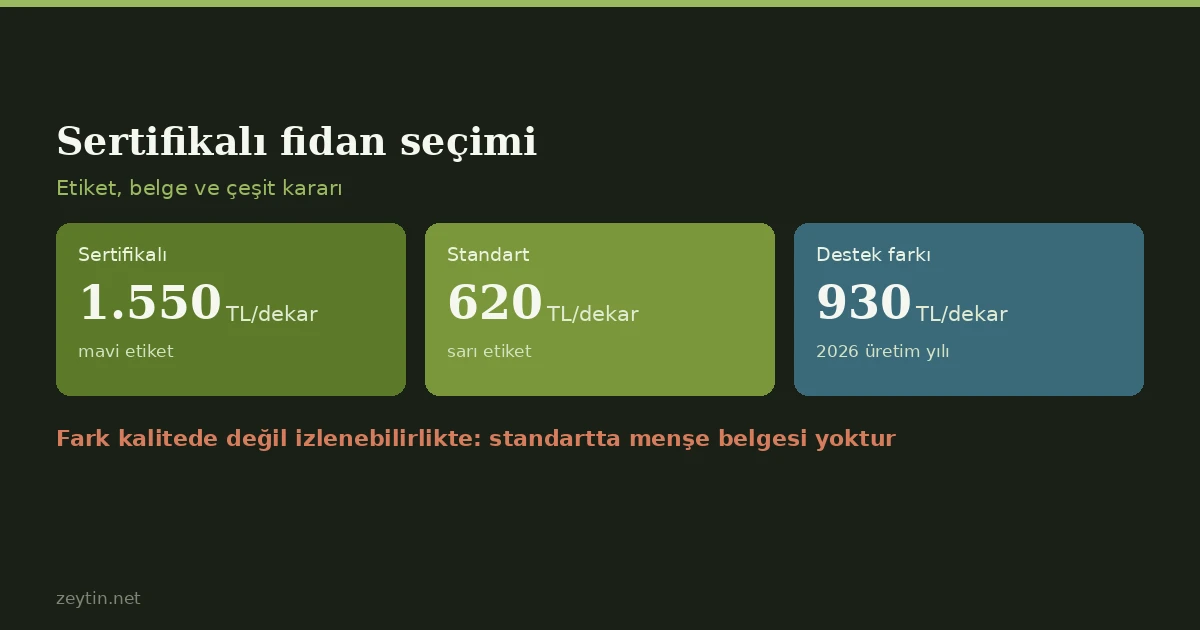
Label colour shows the certificate class: blue certified, yellow standard. The difference is traceability, not quality. The support gap is 930 lira per decare. Four questions that settle variety choice.
Establishing an olive grove is a decision that outlasts thirty years. When the wrong variety or a poor sapling is chosen, it takes three or four years to find out and correcting it means pulling the grove up. This article covers the documents to check when buying saplings, and the questions that settle the choice of variety.
What a certified sapling means
Sapling production in Türkiye is subject to certification. The certificate is the official document showing that a sapling is true to name and has passed defined health checks. It is issued by the Seed Registration and Certification Centre (TTSM), part of the Ministry of Agriculture and Forestry.
One detail is worth knowing: since 6 July 2023, the issuing of seedling, sapling and propagation material certificates has been transferred to the Karacabey Seedling and Sapling Test Centre — with the olive expressly excluded. For olives, the process stays with TTSM.
Certificate classes and label colours
A sapling's class is identified by the colour of its label — the first thing to look at in a nursery:
| Class | Label colour | Meaning |
|---|---|---|
| Pre-basic | White with a purple band | Top of the chain — the source of mother material |
| Basic | White | Mother stock produced from pre-basic |
| Certified | Blue | The class actually sold to growers |
| Standard | Yellow | Trueness to name guaranteed by the producer |
A grower will normally be choosing between blue (certified) and yellow (standard).
The real difference between certified and standard
These two are often confused. The difference is not a claim about quality but about traceability.
Certified saplings are produced from propagation material taken from certified mother units. Their origin is documented and the stock they came from is on record. In olives, certified material is checked across rootstock-variety combinations for the agents requiring laboratory analysis.
Standard saplings are produced from mother stock whose trueness to name is guaranteed by the producer, without a certificate of origin. The claim "this is Gemlik" belongs to the nurseryman; no documented chain backs it.
A standard sapling is not illegal or inherently poor — a good nursery's standard saplings can be entirely sound. But if something goes wrong you have no document to fall back on, and in a thirty-year investment that distinction matters.
The difference in support payments
State support follows the same split. For the 2026 production year, domestic certified sapling use support is:
| Sapling class | Support (TL per decare) |
|---|---|
| Certified | 1,550 |
| Standard | 620 |
The gap is 930 lira per decare, which in most cases covers the price difference of certified stock. The condition is that the sapling was produced domestically and carries a certificate issued by TTSM or the Karacabey Test Centre.
Olives also have a specific provision: contiguous olive groves may qualify for support when established on marginal agricultural land using certified or standard saplings of designated oil varieties. The conditions change from year to year, so confirm the current communiqué with your provincial or district agriculture directorate before planting.
What to check when buying
The label. The sapling must carry one, and the variety name on it must match what you ordered. Do not buy unlabelled saplings.
Age and size. Potted olive saplings are usually sold at one to three years. A very large sapling is not an advantage: establishment rates fall and the root system may have deformed in the pot.
Root condition. When removed from the pot, roots should not be circling at the base. Circling shows the sapling was held too long in its container and will impair later root development.
The graft union. On a grafted sapling the union should be distinct and sound, with no bark splitting or exudate.
The stem. A single, straight stem is preferable; a sapling that has thrown many shoots from the base complicates training.
Health. Do not buy saplings with peacock spot lesions on the leaves or knots on the branches. A single knotted sapling carries the bacterium into the grove — see olive knot disease.
The real decision: which variety?
Which variety to plant matters as much as the paperwork. Four questions settle it:
1. What are you producing? Oil, table and dual-purpose varieties differ. A large-fruited variety like Domat is for stuffed green table olives; a small-fruited one like Koroneiki is for oil. Fruit weight and flesh ratio measurements are given on the variety pages.
2. Does your region suit that variety? Two climatic limits apply: winter cold tolerance and chilling requirement. The olive needs a set period of winter cold to form flower buds; without it, the tree will not flower the following year. See the chilling requirement in olives.
3. What will pollinate it? Most olive varieties are self-incompatible or set poorly on their own pollen, and a single-variety grove crops badly. A suitable pollinator must be interplanted; which variety needs which is noted on the variety pages.
4. What system are you planting? Traditional spacing and high-density planting call for different varieties. High-density systems are built on small-fruited, early-bearing, machine-harvestable varieties — which is why Spanish varieties dominate them. See building a high-density olive grove and planting density: how many trees per decare.
Three common mistakes
"It worked for my neighbour." A neighbour's grove may sit at a different altitude, on different soil, with a different frost risk. Variety choice is specific to the site.
Planting a single variety. Without a pollinator the trees grow and flower but set little fruit — a mistake that only becomes apparent four or five years later.
Cheap unlabelled saplings. Saplings are a small line in the cost of establishing a grove. Beside soil preparation, irrigation and four years of care, the price difference is minor. What is lost if the variety turns out wrong is those four years.
One rating per visitor; you can change yours at any time. Ratings are real reader votes — no seeded or default scores.
Related
 Article
How do you let an olive grove on shares? What the contract should say
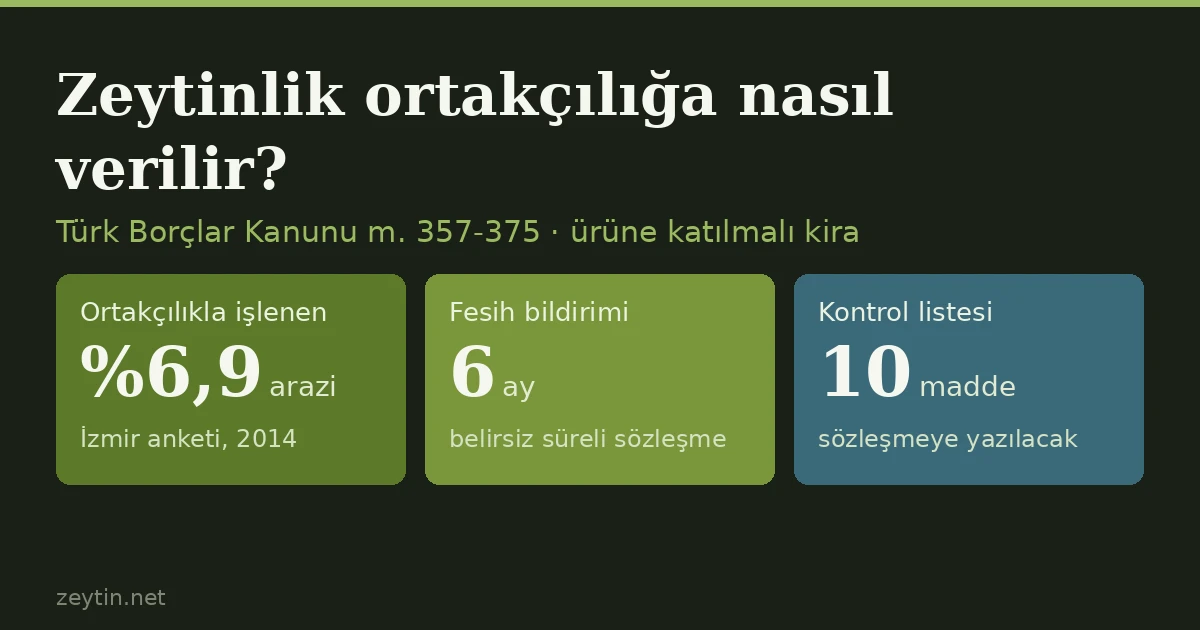
In Türkiye, letting an olive grove on shares is a "share-cropping lease" under the Code of Obligations; if the share is not agreed, local custom applies. Whether the share is in olives or oil, who pays which costs, a term of at least two harvests, pruning consent, frost years, unharvested fruit, what happens if the grove is sold and the headman-approved lease needed for ÇKS: a ten-point checklist with the relevant articles.
Article
How do you let an olive grove on shares? What the contract should say
In Türkiye, letting an olive grove on shares is a "share-cropping lease" under the Code of Obligations; if the share is not agreed, local custom applies. Whether the share is in olives or oil, who pays which costs, a term of at least two harvests, pruning consent, frost years, unharvested fruit, what happens if the grove is sold and the headman-approved lease needed for ÇKS: a ten-point checklist with the relevant articles.
 Article
When does picking olives lose money? The per-kilo harvest threshold
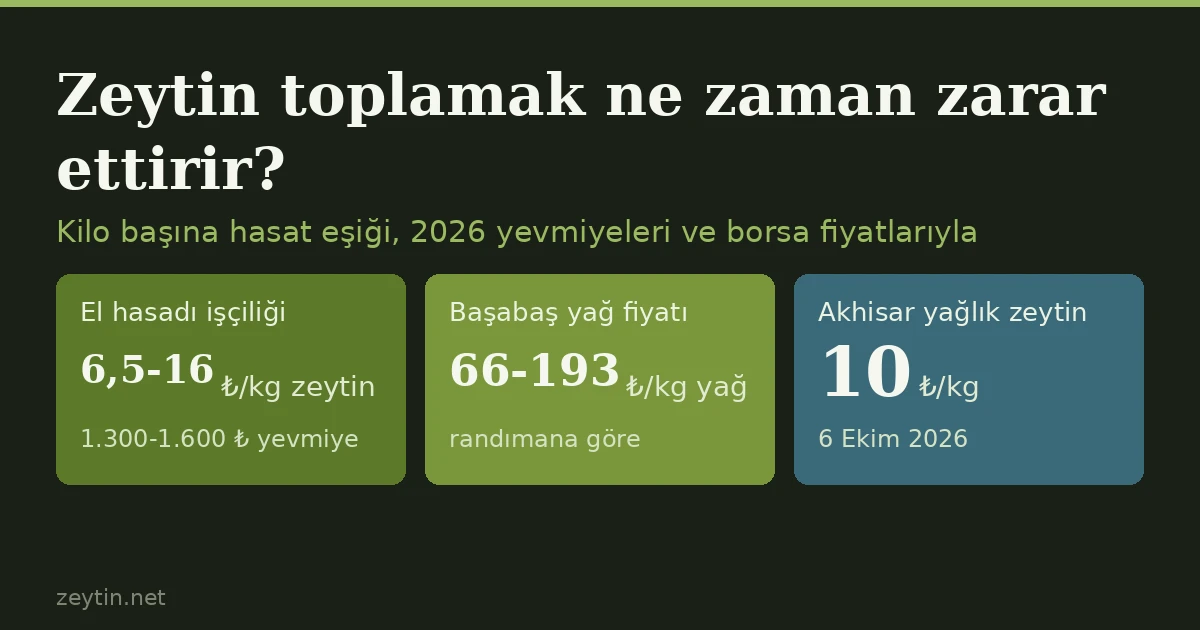
Hand-picking labour now costs 6.5-16 TL per kilo of olives. That band is the threshold for growers who sell the fruit; for those who press, break-even oil is 66-193 TL/kg. Built from 2026 wages, milling fees and exchange registrations, with the cost of leaving fruit on the tree.
Article
When does picking olives lose money? The per-kilo harvest threshold
Hand-picking labour now costs 6.5-16 TL per kilo of olives. That band is the threshold for growers who sell the fruit; for those who press, break-even oil is 66-193 TL/kg. Built from 2026 wages, milling fees and exchange registrations, with the cost of leaving fruit on the tree.
 Article
Where does an olive sapling come from? From cutting to laboratory
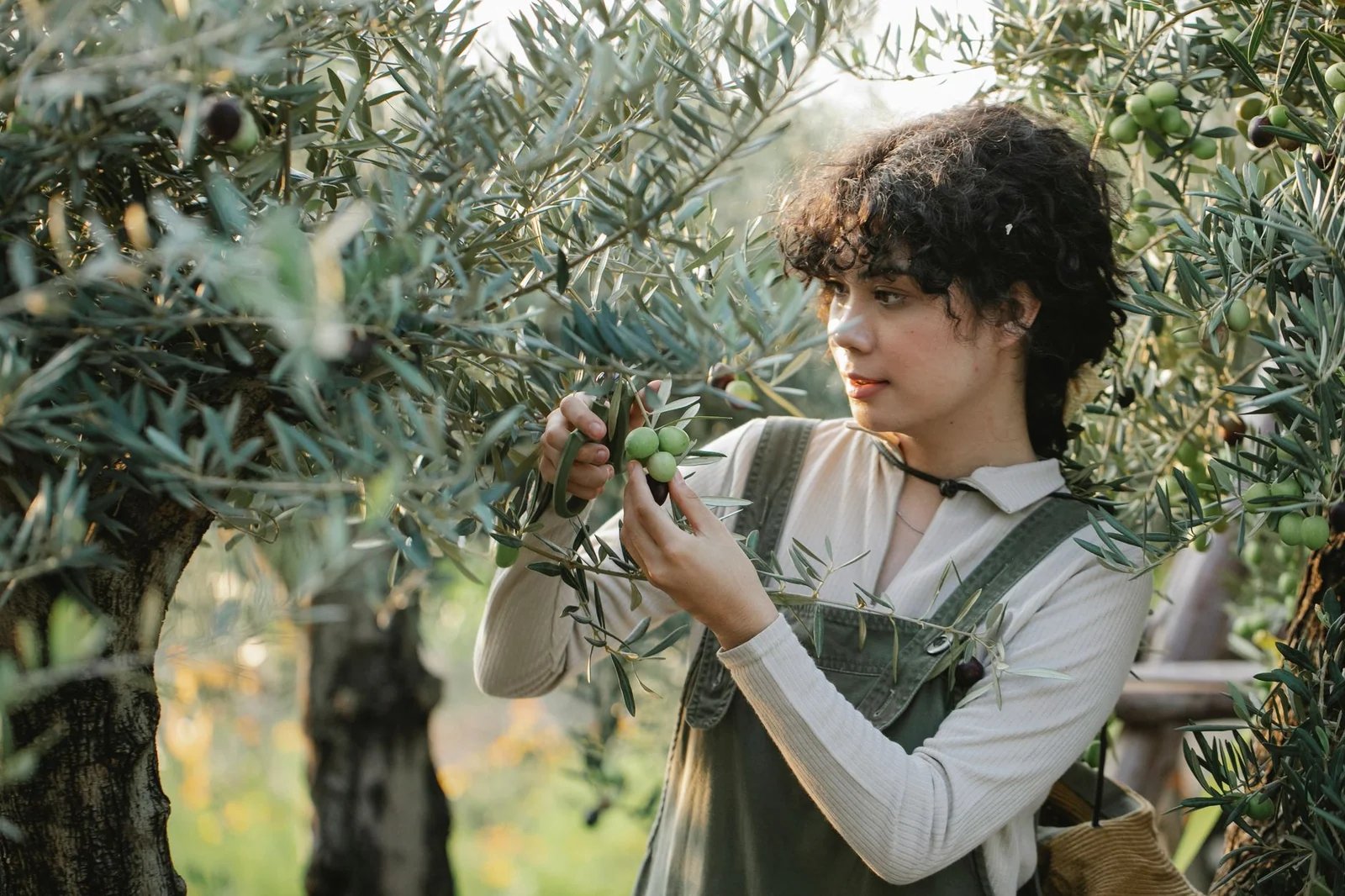
Most table olive varieties will not root, and those that do are clones of one another — defenceless against disease. Tissue culture reports up to 85% success in vitro, but zeatin is expensive.
Article
Where does an olive sapling come from? From cutting to laboratory
Most table olive varieties will not root, and those that do are clones of one another — defenceless against disease. Tissue culture reports up to 85% success in vitro, but zeatin is expensive.
 Article
Irrigating Olives: When, How Much, How
Olive water requirements, critical periods, drip system layout, deficit irrigation and water quality.
Article
Irrigating Olives: When, How Much, How
Olive water requirements, critical periods, drip system layout, deficit irrigation and water quality.