Olive peacock spot: symptoms and a region-by-region spray calendar
The commonest of olive tree diseases: concentric rings on the leaf, shedding, a shrubby tree. Yield falls 20-25%; spray timing varies by region.
If you see dark spots in concentric rings on your olive leaves, the tree has peacock spot (Spilocaea oleagina). Türkiye's technical instruction ranks it, alongside the olive fruit fly, as one of the two "principal pests and diseases".
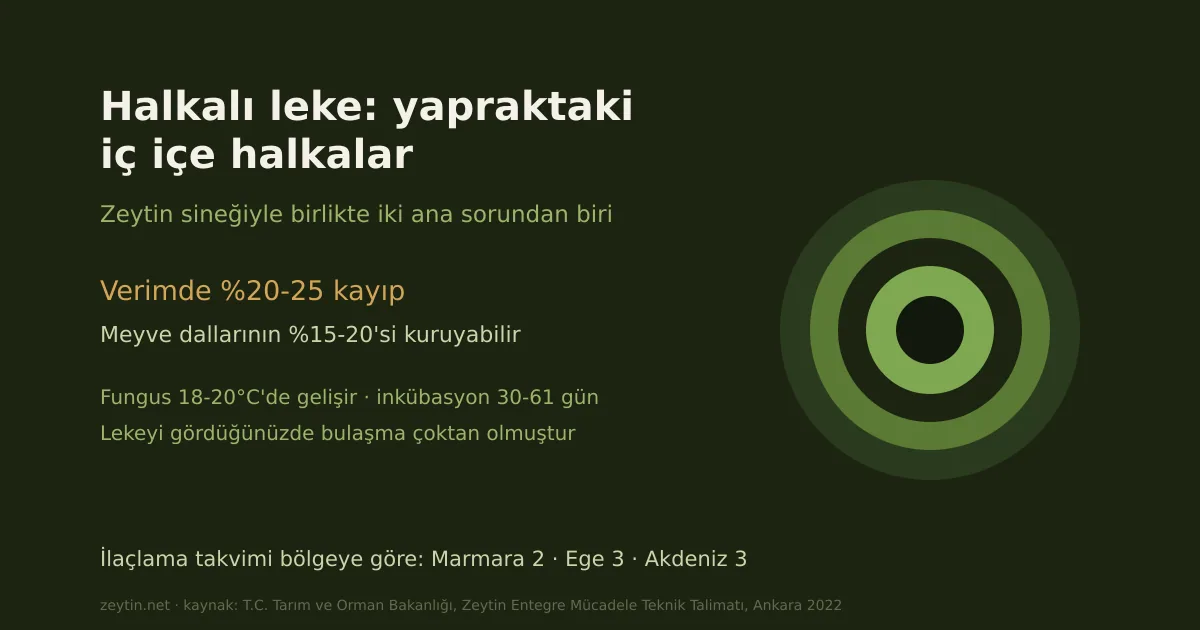
The damage is less visible than the fly's but more insidious: yield falls by 20-25%, and 15-20% of fruiting branches can dry out.
How to recognise it
The first sign appears in spring, on the upper surface of the leaves: round, blackish-grey dots. Around each dot a sequence then forms:
1. A dark spot in the centre
2. A ring in the normal leaf colour around it
3. A second, paler ring enclosing that
4. Another dark ring on the outside
That is where the disease gets its name. A single leaf may carry 2-30 spots, each 8-10 mm across.
Later the leaves yellow and fall. In epidemic years shedding begins in spring and the tree takes on a shrub-like appearance — bare, reduced to twigs. The result is poor fruit set and early fruit drop. Weakened trees also show dieback in shoots and thin branches.
Which groves get it?
This disease is largely about where the grove was planted. The risk profile the instruction describes:
| Factor | Risk condition |
|---|---|
| Temperature | Optimum 18-20°C. Cannot develop below 9°C or above 30°C |
| Season | Regions with wet springs and autumns |
| Terrain | Valley bottoms, heavy, water-holding soil, sites near the sea |
| Grove layout | Densely planted, unpruned, poorly ventilated, shaded |
| Fertilising | Excess nitrogen |
On irrigated, humid, heavy soils and in groves near the sea it appears every year. Cool, wet springs make an epidemic year.
In Türkiye it occurs in the Aegean, Marmara and Mediterranean regions. Its hosts are the cultivated and wild olive.
How it spreads
The fungus overwinters in dried fallen leaves on the ground, or in diseased leaves still on the tree. Infection travels by conidiospores, and spread peaks in spring.
The incubation period is 30-61 days. That figure matters: the spot you see today is the result of an infection one to two months old. Spraying when you see spots is already late; the programme runs on a calendar.
Cultural measures
Here cultural measures matter more than spraying, because the source of the problem is the environment:
- Do not plant a grove on valley bottoms, heavy water-holding soils, or humid, poorly ventilated sites. The most effective measure is not to plant where the disease is invited.
- If the grove is already on wet ground, open drainage channels.
- Fertilise and irrigate to good practice, and avoid excess nitrogen.
- Prune so that air and light reach into the tree; clear out dry branches and twigs.
- Gather and burn or bury the fallen spotted leaves — that is where the fungus overwinters.
The first and last points share a logic: the disease lives not inside the tree but in the humidity around it and in the leaves on the ground.
Spray calendar — it varies by region
Timing for this disease differs by region, and the instruction gives three separate programmes:
| Region | Applications |
|---|---|
| Marmara | 1. Just before autumn shoots appear 2. After flower clusters become distinct, before the flowers open |
| Aegean | 1. Just before autumn shoots appear 2. Just before spring shoots appear 3. After flower clusters become distinct, before the flowers open |
| Mediterranean | 1. After harvest 2. Just before spring shoots appear 3. After flower clusters become distinct, before the flowers open |
⚠ The instruction adds a specific note for the Aegean: every application should fall immediately before or immediately after rainfall.
Where a forecast-and-warning system is installed, spraying follows the alerts from the electronic forecasting units, beginning when disease severity and infection levels peak.
⚠ No product names or doses are given in this article. The plant protection products and doses appear in Annex 4 of the Ministry's instruction, and registrations change over time. Before treating, consult the current list of licensed products and your Provincial or District Directorate of Agriculture and Forestry, and follow the label exactly.
Summary
- Peacock spot is, with the olive fruit fly, one of the two principal problems of the olive.
- Sign: concentric rings on the upper leaf surface, 8-10 mm across, 2-30 per leaf.
- Consequence: leaf fall, a shrubby tree, 20-25% yield loss, dieback in 15-20% of fruiting branches.
- The fungus does best at 18-20°C; it cannot develop below 9°C or above 30°C.
- Incubation is 30-61 days — by the time you see the spot the infection is old; the programme is calendar-driven.
- Greatest risks: heavy wet soil, dense planting, unpruned trees, excess nitrogen, proximity to the sea.
- The core of cultural control: pruning for airflow and destroying fallen spotted leaves.
- The spray calendar varies by region: two applications in Marmara, three in the Aegean and the Mediterranean.
Source
t; Republic of Türkiye, Ministry of Agriculture and Forestry, General Directorate of Agricultural Research and Policies, Department of Plant Health Research. Olive Integrated Pest Management Technical Instruction. Ankara, 2022.
Related reading: Olive fruit fly control · Twenty trees per decare, or 250? · How to grow an olive tree
One rating per visitor; you can change yours at any time. Ratings are real reader votes — no seeded or default scores.
Related
 Article
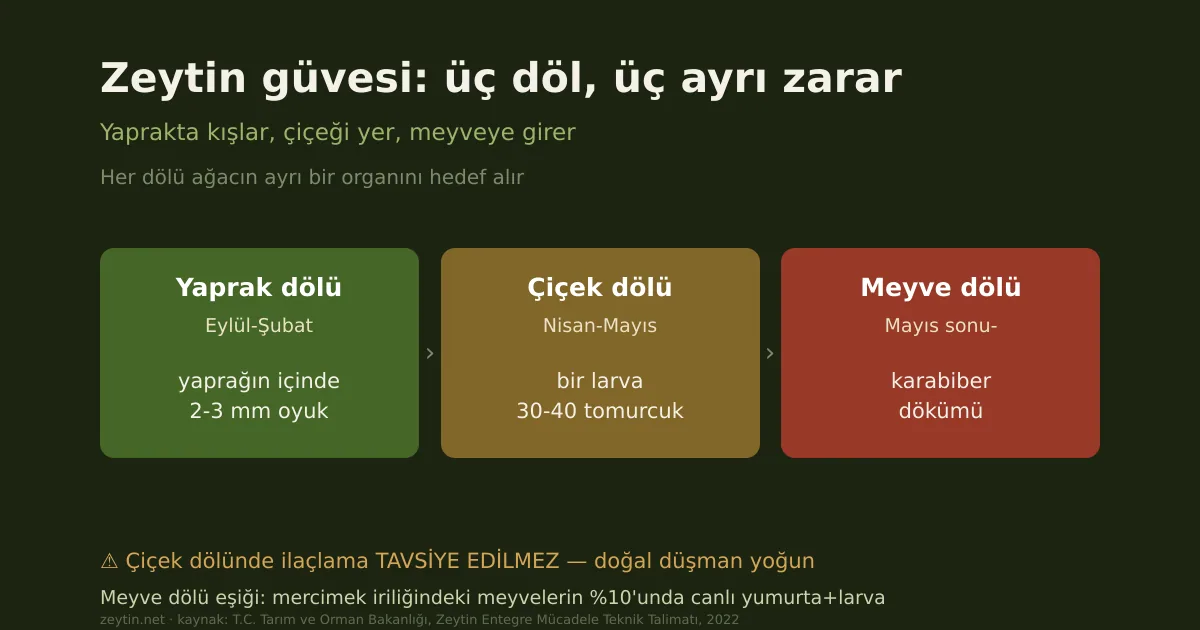
The olive moth: three generations, three kinds of damage
The olive pest with three generations: it winters in the leaf, eats the flowers, enters the fruit. One larva can take 30-40 buds.
Article
The olive moth: three generations, three kinds of damage
The olive pest with three generations: it winters in the leaf, eats the flowers, enters the fruit. One larva can take 30-40 buds.
 Article
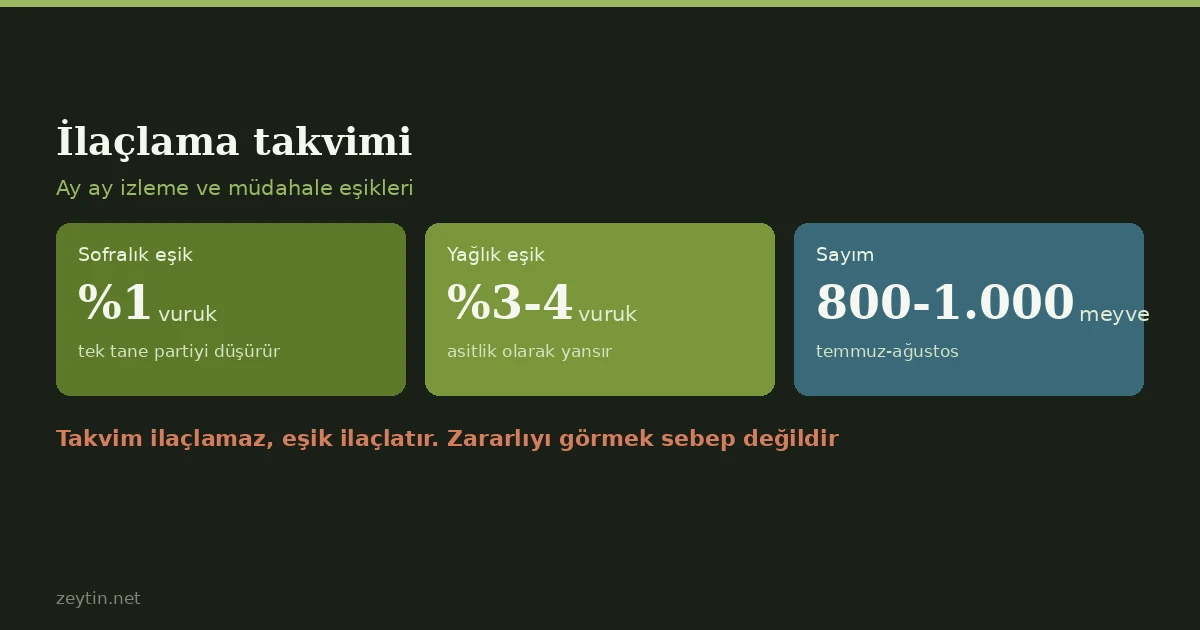
The olive pest calendar and intervention thresholds
Month by month: which pest is at which stage, and when to count. Fly infestation thresholds, black scale shoot counts, and the three regional programmes for peacock spot.
Article
The olive pest calendar and intervention thresholds
Month by month: which pest is at which stage, and when to count. Fly infestation thresholds, black scale shoot counts, and the three regional programmes for peacock spot.
 Article
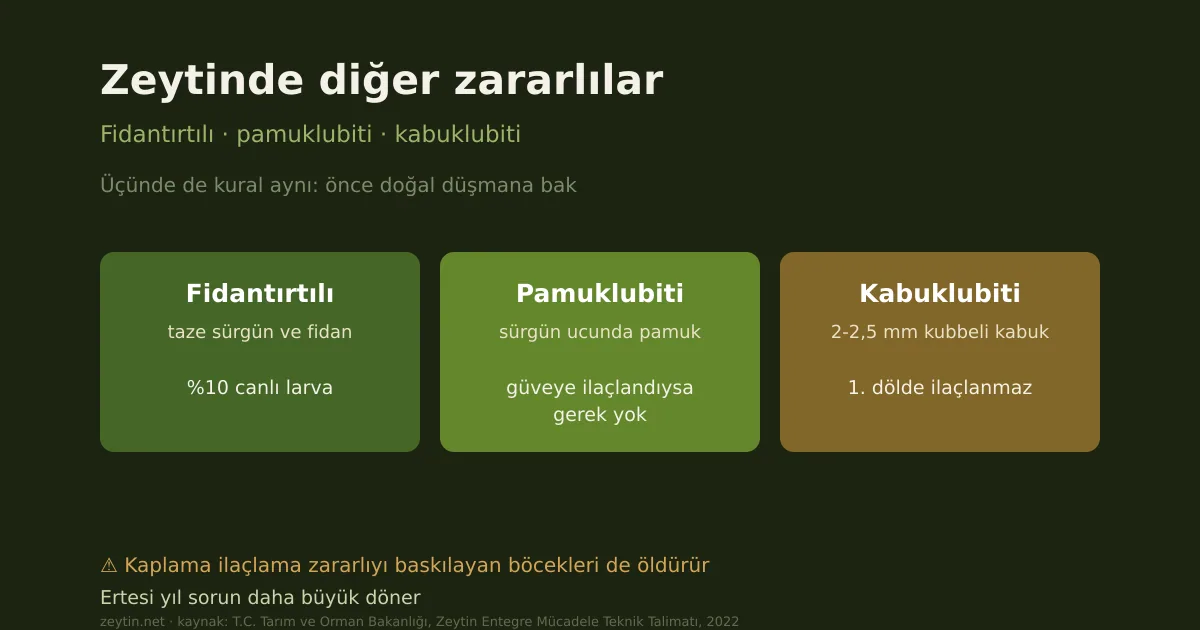
Other olive pests: jasmine moth, psyllid and olive scale
Three olive pests overshadowed by the fruit fly: the jasmine moth on tender shoots, the cottony psyllid, and olive scale.
Article
Other olive pests: jasmine moth, psyllid and olive scale
Three olive pests overshadowed by the fruit fly: the jasmine moth on tender shoots, the cottony psyllid, and olive scale.
 Article
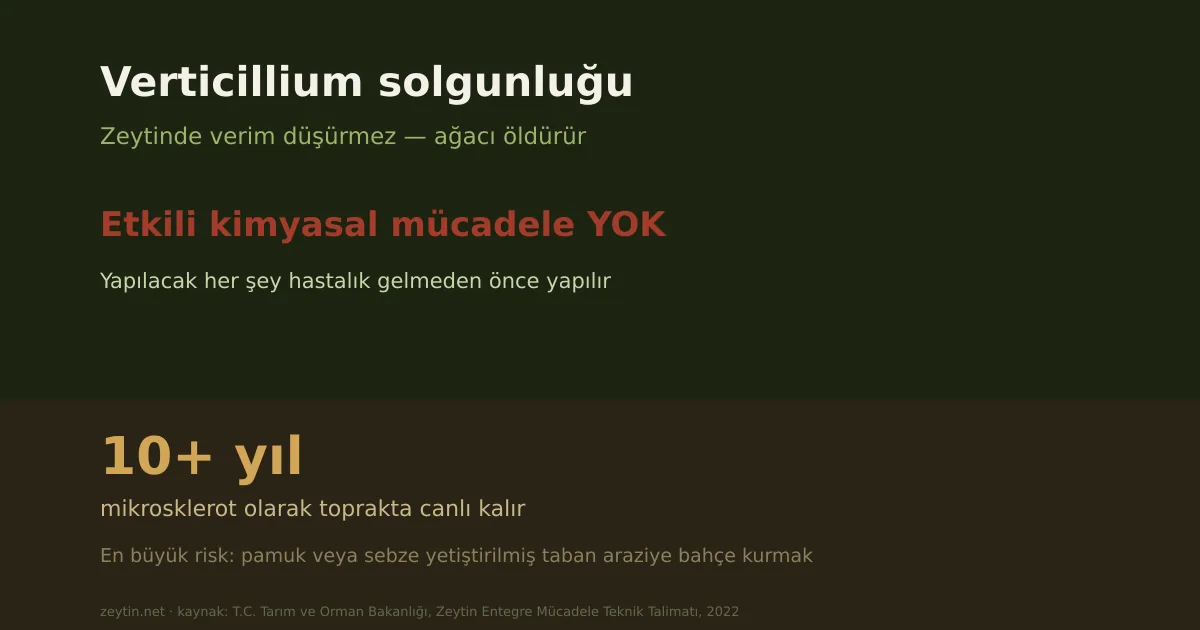
Verticillium wilt: the disease that kills the tree and has no cure
The olive tree disease that kills: it survives over 10 years in the soil, blocks the vessels, and has no effective chemical control.
Article
Verticillium wilt: the disease that kills the tree and has no cure
The olive tree disease that kills: it survives over 10 years in the soil, blocks the vessels, and has no effective chemical control.