The olive moth: three generations, three kinds of damage
The olive pest with three generations: it winters in the leaf, eats the flowers, enters the fruit. One larva can take 30-40 buds.
The olive moth (Prays oleae) is not an ordinary pest: it has three generations a year, and each attacks a different organ of the tree. It winters inside the leaf, eats the flower buds in spring, and enters the fruit in summer.
Control therefore is not a single calendar — it depends on knowing which generation you are dealing with.
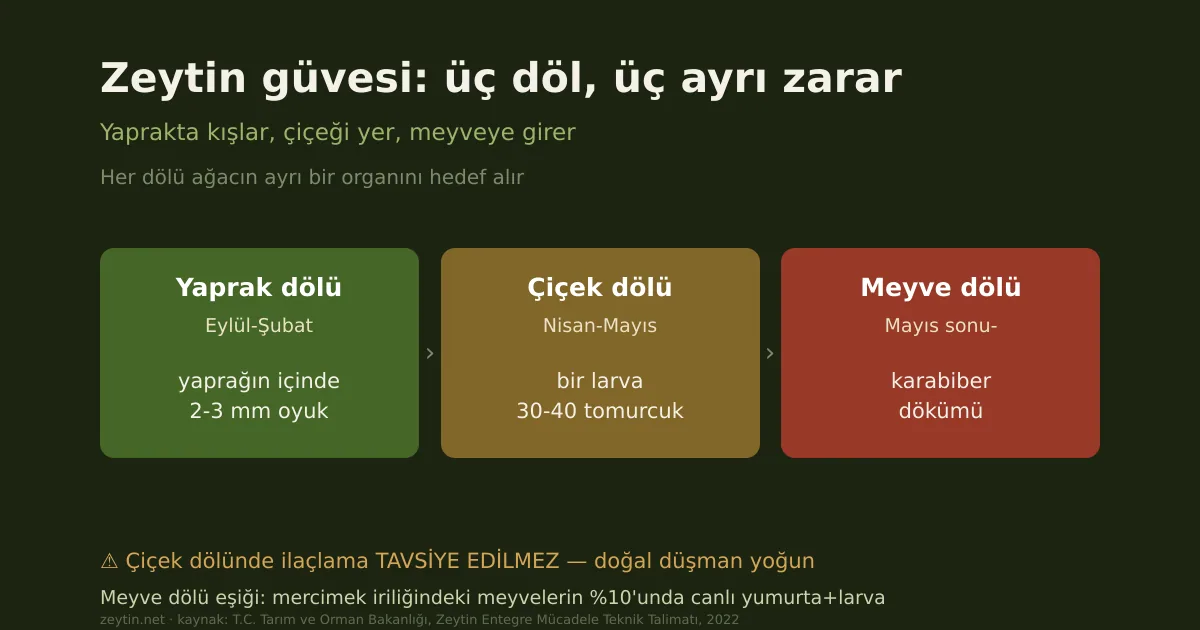
Three generations, three kinds of damage
| Generation | Period | What it damages |
|---|---|---|
| Leaf generation (phyllophagous) | Eggs Sept-Dec, winter in the leaf, emerges late Feb | Leaf epidermis, tender shoot tips |
| Flower generation (anthophagous) | April-May | Flower buds — one larva takes 30-40 buds |
| Fruit generation (carpophagous) | Late May-early June | Fruit — "peppercorn drop" and pre-harvest shedding |
Leaf generation — where it overwinters
Moths from larvae that fed in the fruit lay their eggs from September to December on the upper surface of the leaves. Eggs hatch in 8-16 days depending on temperature; the young larva bores straight under the leaf epidermis, feeds in the fleshy tissue between the two epidermal layers, excavates a cavity 2-3 mm long and overwinters there.
From late February it leaves the chamber and feeds on tender shoot tips and leaves. On maturing it pupates — gluing two leaves together, folding a single leaf, or spinning a cocoon among the terminal leaves. Moths emerge from late March to early April.
Flower generation — one larva, 30-40 buds
In April and May the eggs go onto flower buds and bud stalks. They hatch in 8-10 days and the larva enters the bud.
Over 10-15 days of development a single larva can damage 30-40 buds. On completing development the larvae bind buds and flowers together in a web of their own silk and pupate inside it. Moths emerge within 7-10 days.
Fruit generation — the serious one
When the fruit reaches the size of a large peppercorn (late May to early June), eggs are laid on the sepals of the fruit. Usually one egg per fruit.
Hatching within a week, the larva enters at the base of the fruit stalk and works towards the stone. On the way in it breaks the connection between stalk and fruit — the fruit shrivels, blackens and drops. This is called "peppercorn drop". Such fruit has not yet formed oil and is a total loss.
A second wave of shedding comes at exit: the larva matures in 2.5-3.5 months and leaves the fruit to pupate, cutting a visible hole near the stalk. That hole usually severs stalk from fruit, and the fruit drops within days.
Larvae leaving the fruit pupate under bark on trunk and branches, in cracks and crevices, or in the soil. Pupation takes 10 days; moths emerge from September to December and the cycle begins again in the leaves.
Why heavy in some groves and absent in others?
The instruction's answer is striking. The olive moth becomes a problem particularly in:
- Isolated olive areas
- Certain microclimates
- Areas sprayed heavily in previous years, where the natural balance has been broken
That last point matters: over-spraying manufactures this pest. Studies in Türkiye have identified 12 parasitoids and 8 predators of the olive moth — Chrysoperla carnea, Orius species, Scymnus ladybirds and a series of parasitoid wasps. Full-cover spraying kills them too, and the moth is left with a free run.
Control
Biotechnical: pheromone traps
When the olive buds begin to swell, in late March to early April, mass trapping is carried out with one delta-type pheromone trap per three trees.
Chemical: do not spray the flower generation
The instruction's advice here is clear and runs against instinct:
t; The flower generation carries abundant predators and parasitoids. For this reason spraying in this period is not recommended.
The exception: in years of light crop, if damage to leaves and new shoots exceeds 10% at the start of the season, a treatment may be applied 7-10 days after the first moths are caught in the flower generation.
The preference is to treat only the fruit generation. Its threshold:
| Inspection | Threshold |
|---|---|
| Fruit at lentil size | Live "egg + larva" in 10% |
⚠ No product names or doses are given in this article. Plant protection products and doses appear in Annex 4 of the Ministry's instruction and registrations change. Consult the current licensed product list and your Provincial or District Directorate of Agriculture and Forestry before treating.
Hosts
Besides the cultivated and wild olive, its hosts include mock privet (Phillyrea), jasmine (Jasminum) and privet (Ligustrum). Hedge plants along the grove boundary therefore matter.
How to recognise it
| Stage | Size | Appearance |
|---|---|---|
| Adult moth | 7-8 mm long 13-16 mm wingspan | Silvery; black spots on the forewings, silvery fringes at the margins; antennae 3-4 mm, hair-like |
| Egg | 0.5 mm | Flattened dome, patterned like a honeycomb; transparent at first, dirty white to yellowish near hatching |
| Larva | 8-10 mm | Dirty white to yellowish (varying with what it feeds on), a band along each side, usually well covered in hairs |
| Pupa | — | In a loosely woven, visible white cocoon |
Summary
- The olive moth has three generations a year: leaf, flower, fruit.
- It overwinters in a 2-3 mm cavity it excavates inside the leaf.
- In the flower generation one larva consumes 30-40 buds.
- The fruit generation causes two waves of drop: "peppercorn drop" on entry, and the stalk-base hole on exit.
- ⚠ Spraying the flower generation is not recommended — natural enemies are abundant then.
- Fruit generation threshold: live egg + larva in 10% of lentil-sized fruit.
- Biotechnical: late March to early April, one delta pheromone trap per three trees.
- ⚠ Heavy spraying multiplies this pest: it has 12 parasitoids and 8 predators, and they die too.
Source
t; Republic of Türkiye, Ministry of Agriculture and Forestry, General Directorate of Agricultural Research and Policies, Department of Plant Health Research. Olive Integrated Pest Management Technical Instruction. Ankara, 2022.
Related reading: Olive fruit fly control · Olive peacock spot · The olive harvest: when and how
One rating per visitor; you can change yours at any time. Ratings are real reader votes — no seeded or default scores.
Related
 Article
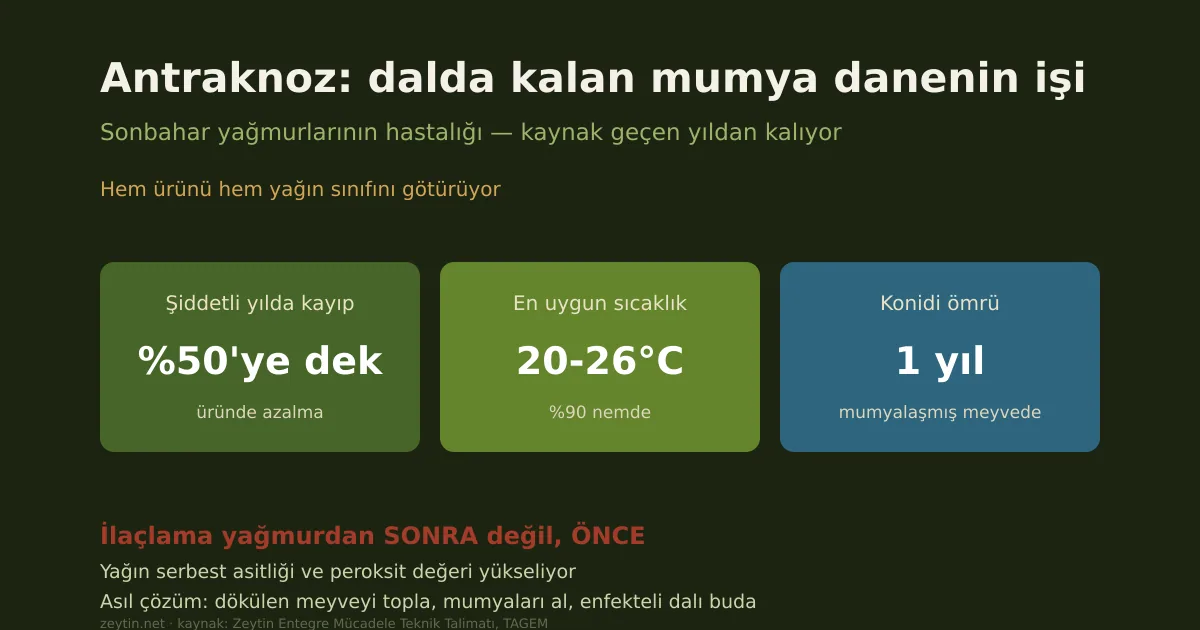
Olive anthracnose: the disease of the mummified fruit left on the branch
Up to 50% crop loss in bad years. The source is last year's mummified fruit still on the branch, and the spray goes on before the autumn rains, not after.
Article
Olive anthracnose: the disease of the mummified fruit left on the branch
Up to 50% crop loss in bad years. The source is last year's mummified fruit still on the branch, and the spray goes on before the autumn rains, not after.
 Article
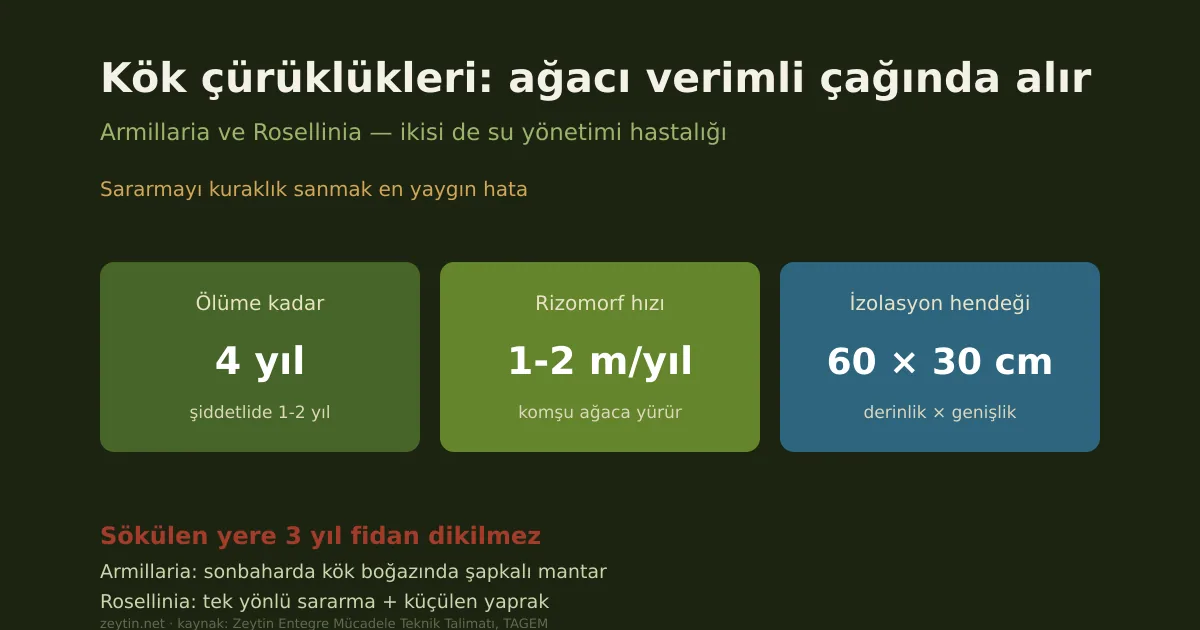
Olive root rots: Armillaria and Rosellinia
Mistaking the yellowing for drought is the common error. Two soil-borne fungi kill the tree in its prime; there is no chemical cure — the work is water management and isolation.
Article
Olive root rots: Armillaria and Rosellinia
Mistaking the yellowing for drought is the common error. Two soil-borne fungi kill the tree in its prime; there is no chemical cure — the work is water management and isolation.
 Article
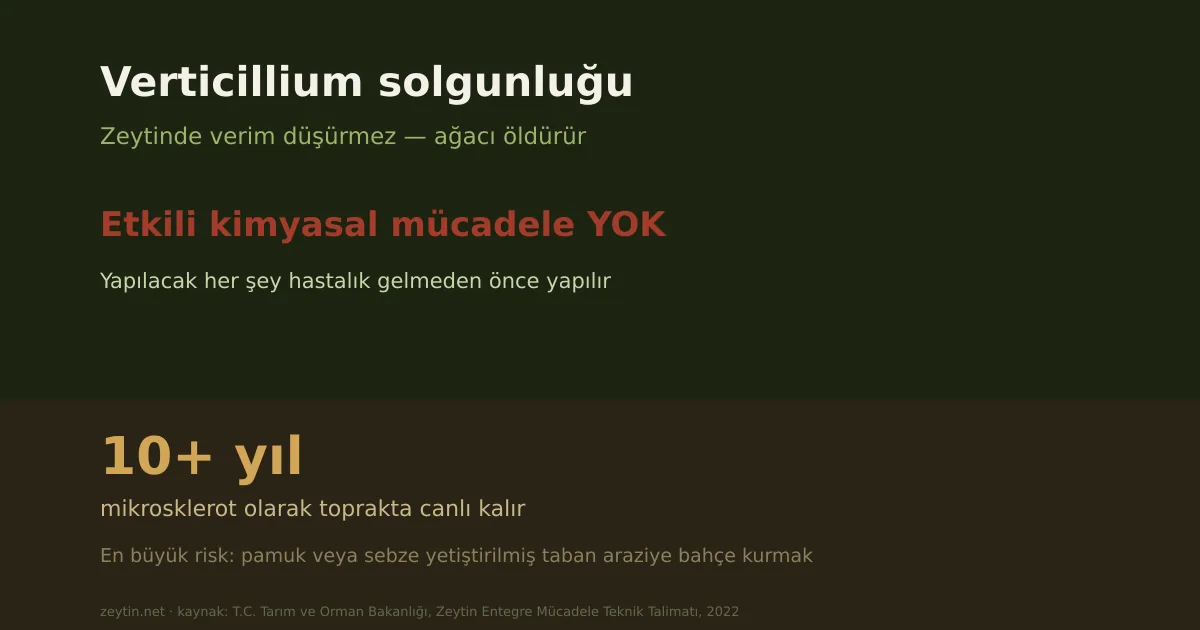
Verticillium wilt: the disease that kills the tree and has no cure
The olive tree disease that kills: it survives over 10 years in the soil, blocks the vessels, and has no effective chemical control.
Article
Verticillium wilt: the disease that kills the tree and has no cure
The olive tree disease that kills: it survives over 10 years in the soil, blocks the vessels, and has no effective chemical control.
 Article
The olive fruit fly: sting thresholds, traps and a control calendar
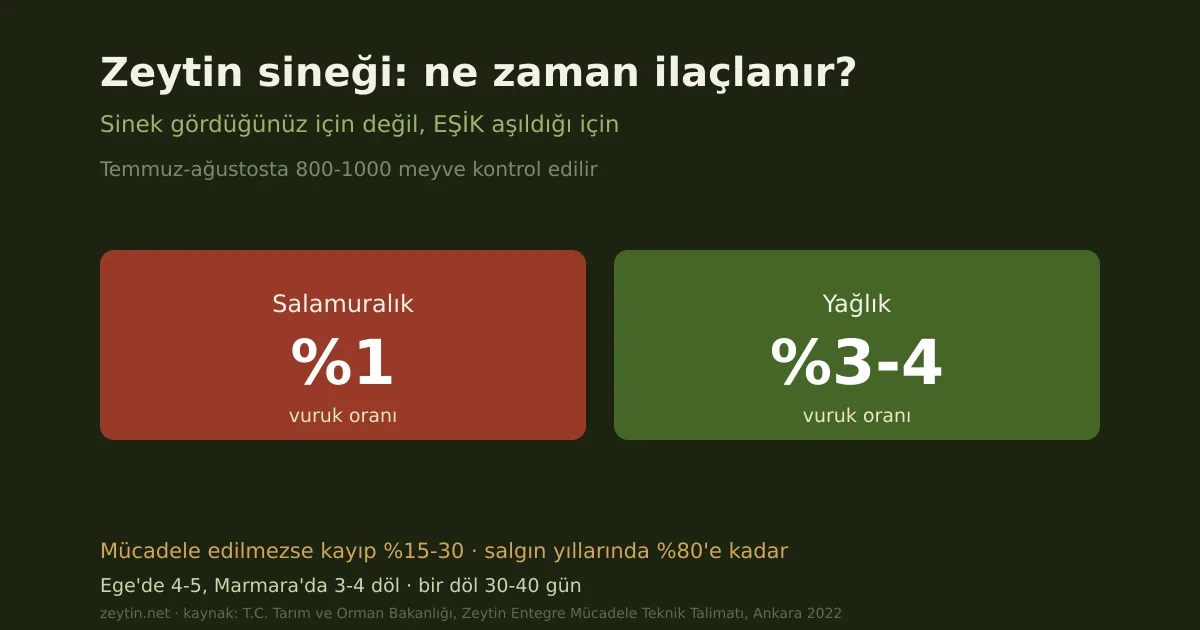
The olive pest that costs most: losses of 15-30% if left alone. Sting threshold 1% for table varieties, 3-4% for oil.
Article
The olive fruit fly: sting thresholds, traps and a control calendar
The olive pest that costs most: losses of 15-30% if left alone. Sting threshold 1% for table varieties, 3-4% for oil.