The olive pest calendar and intervention thresholds
Month by month: which pest is at which stage, and when to count. Fly infestation thresholds, black scale shoot counts, and the three regional programmes for peacock spot.
The answer to "when do I spray?" in an olive grove is not a calendar but a count. Even so, you need to know which pest is at which stage in which month — because if you do not count at the right time, you miss the threshold. This article brings the site's detailed pest pages together into a single annual sequence.
Two rules for this calendar
First: no product names or doses appear here. Licensed plant protection products and their doses are set out in the Turkish Ministry of Agriculture and Forestry's Plant Protection Technical Instructions, and licences change. Consult the current approved product list and your provincial or district agriculture directorate before applying anything.
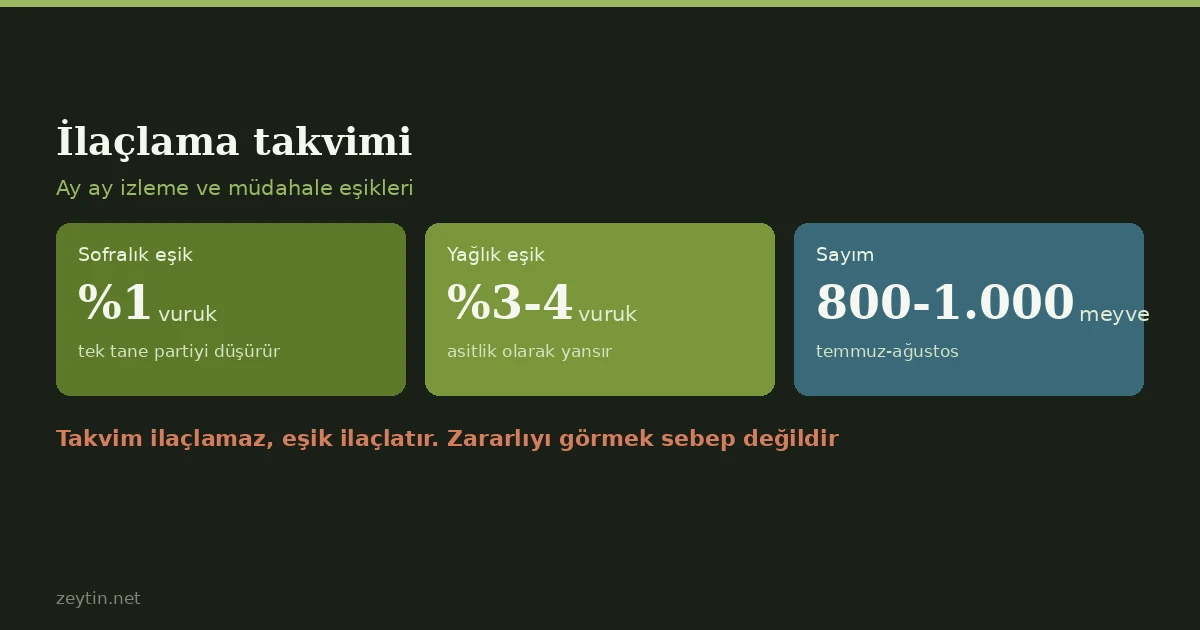
Second: calendars do not spray, thresholds do. The months below tell you when to look, not when to spray. Seeing a pest is not a reason to spray; exceeding the threshold is.
The year at a glance
| Month | What is happening | What to do |
|---|---|---|
| December – January | Fly pupating in soil; moth's leaf generation overwintering inside leaves | Pruning, clearing harvest residues |
| February | Moth leaf generation emerges (late February) | Finish pruning; remove knotted branches |
| March | Soil warming; fly adults preparing to emerge | Peacock spot spray before spring shoots (Aegean/Mediterranean) |
| April | Moth's flower generation in the buds | Inspect flower clusters |
| May | Flowering; black scale eggs beginning to hatch | Pre-flowering peacock spot spray; shoot counts |
| June | Moth's fruit generation; fly numbers rising | Hang traps; watch for early fruit drop |
| July | Fly season begins — fruit accumulating oil | Trap counts and infestation counts |
| August | Peak fly pressure | Counts continue; intervene if threshold exceeded |
| September | Fly continuing; moth leaf generation laying | Keep counting; plan early harvest |
| October – November | Harvest | Peacock spot spray before autumn shoots |
Winter: December – February
No spraying in these months; the work is reducing next year's pressure.
The olive fruit fly overwinters as a pupa 2–5 cm down in the soil, or as an adult in groves and scrub. Cultivating the soil and clearing fallen fruit directly reduces the number of adults emerging in spring.
The moth's leaf generation overwinters inside a 2–3 mm mine it excavates within the leaf. Nothing can be done about it in winter, but knowing it emerges in late February marks the start of spring monitoring.
For olive knot, winter pruning is critical. Galled branches are removed and taken out of the grove, and pruning tools disinfected between trees. See olive knot disease.
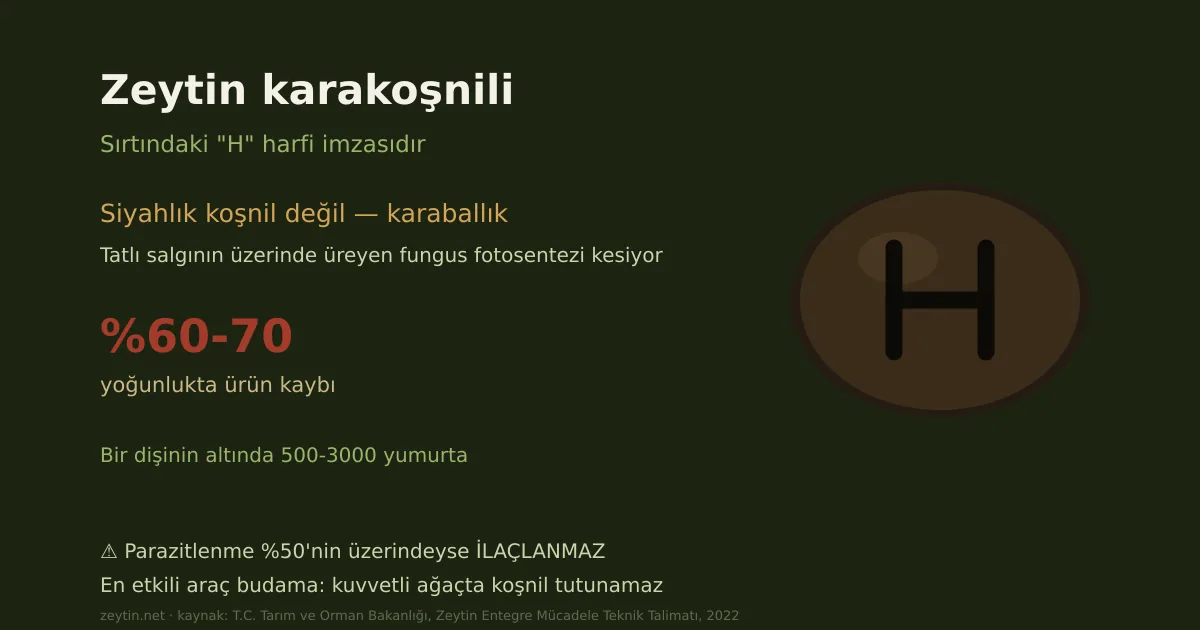
For black scale the main measure is also pruning. A dense, airless canopy is what the scale prefers; as set out in black scale and sooty mould, airflow through the canopy alone lowers the pressure.
Spring: March – May
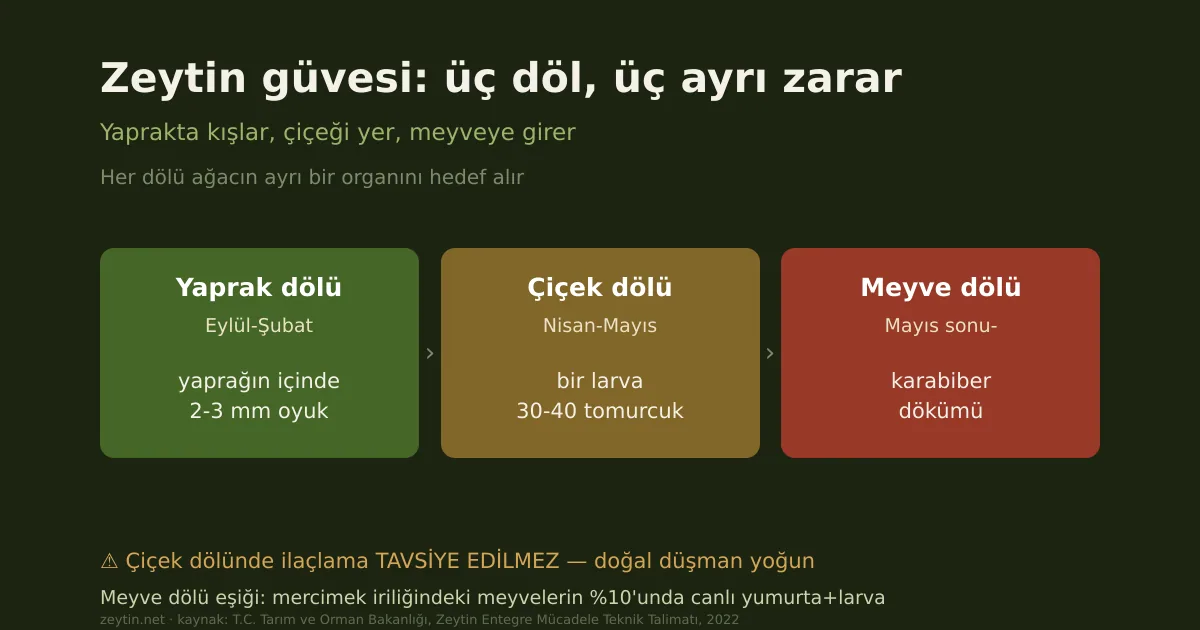
The moth's flower generation feeds on flower buds in April and May. A single larva can destroy 30–40 buds, making this the most critical window for moth control. See the olive moth's three generations.
Black scale shoot counts are done in this period. Shoots of 20–25 cm are taken from four sides of representative trees. If there are 4–6 adult female scales per 80–100 cm of shoot, the threshold has been passed. If natural enemy parasitism exceeds 50%, spraying is unnecessary. Timing follows egg hatch: the first application at 50% hatch, the second at 90%. Summer white oils, least harmful to beneficials, take priority.
The spring leg of the peacock spot programme also falls here — but it varies by region; see the separate table below.
Summer: June – August
The busiest part of the year, and the olive fruit fly's season.
Fly adults begin emerging once soil temperature reaches 10 °C. Females mate in late June, when the fruit becomes suitable for egg laying. One female can lay 200–250 eggs. A generation completes in 30–40 days: 4–5 generations a year in the Aegean, 3–4 around the Sea of Marmara.
The intervention threshold is the heart of the matter. When trap catches begin rising in July and August, 800–1,000 fruits are inspected and the infestation rate calculated:
| Product | Threshold for chemical control |
|---|---|
| Table olives | 1% |
| Oil olives | 3–4% |
The table threshold is far lower because a single infested fruit can condemn a table lot; in oil fruit the same damage shows up as acidity, and tolerance is higher. See olive fruit fly control.
The chemical-free way to reduce fly pressure is early harvest. Infestation rises every week the fruit hangs; on how this bears on harvest timing see when to harvest olives.
Autumn: September – November
Harvest season. The fly persists into September, and infestation keeps climbing in groves left unpicked.
The moth's leaf generation lays on the upper leaf surface between September and December. The moth you see in autumn is the source of next year's flower generation.
The autumn leg of peacock spot control falls here. Because the disease spreads with moisture, the relationship between spraying and rainfall is critical.
Peacock spot: the regional programme
There is no single calendar for this disease; the instructions give three programmes:
| Region | Applications |
|---|---|
| Marmara | 1. Just before autumn shoots appear 2. After flower clusters are distinct, before flowers open |
| Aegean | 1. Just before autumn shoots appear 2. Just before spring shoots appear 3. After flower clusters are distinct, before flowers open |
| Mediterranean | 1. After harvest 2. Just before spring shoots appear 3. After flower clusters are distinct, before flowers open |
For the Aegean the instructions add a specific note: all applications should fall immediately before or after rainfall. See olive peacock spot disease.
Thresholds on one page
| Pest | Count | Threshold |
|---|---|---|
| Olive fruit fly | Infestation rate in 800–1,000 fruits | Table 1% · Oil 3–4% |
| Black scale | 20–25 cm shoots from four sides | 4–6 adult females per 80–100 cm of shoot |
| Black scale (natural enemies) | Parasitism rate | Above 50%, spraying unnecessary |
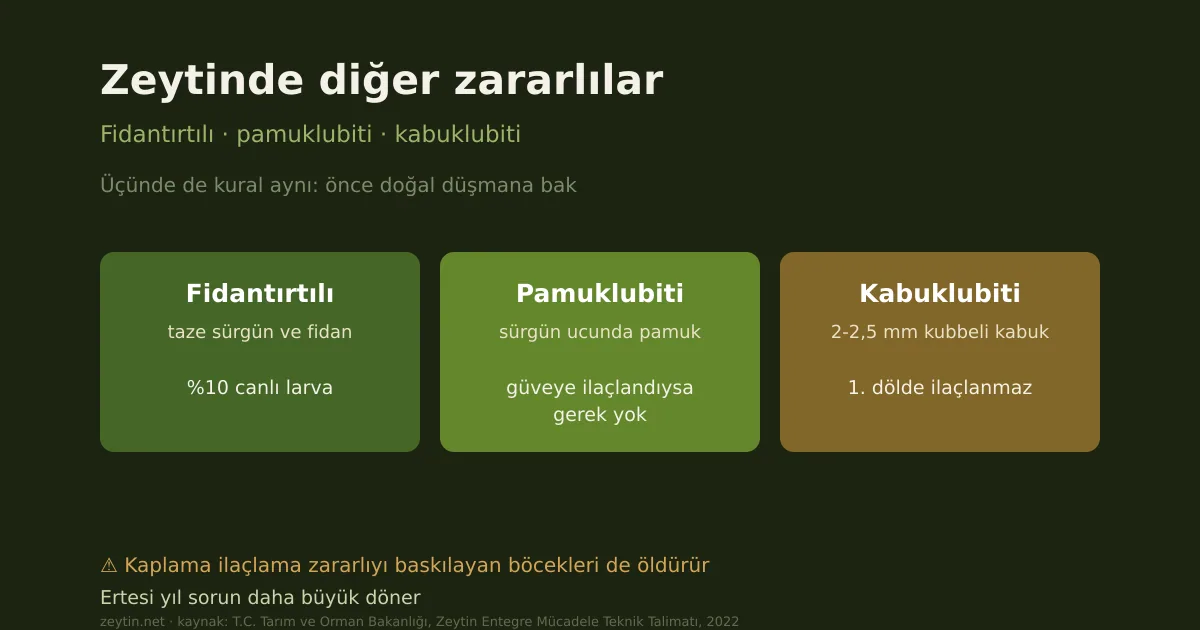
For other pests — olive leaf moth, psyllid, olive scale — see other olive pests.
The rule that does not change
The way to spray less in an olive grove is not a better pesticide but better counting. Every application made without measuring the threshold does three things at once: it raises costs, kills natural enemies and accelerates resistance. Spraying a grove where scale parasitism already exceeds 50% hits not the pest but the system suppressing it.
For the full annual work cycle — pruning, fertilising and irrigation included — see the olive calendar.
One rating per visitor; you can change yours at any time. Ratings are real reader votes — no seeded or default scores.
Related
 Article
The olive moth: three generations, three kinds of damage
The olive pest with three generations: it winters in the leaf, eats the flowers, enters the fruit. One larva can take 30-40 buds.
Article
The olive moth: three generations, three kinds of damage
The olive pest with three generations: it winters in the leaf, eats the flowers, enters the fruit. One larva can take 30-40 buds.
 Article
Herbicide-free weed management in olive groves: from cover crops to autonomous robots
Managing weeds rather than eliminating them: cover crops, mulch, grazing, flame weeding and AI-assisted precision farming — five tools and a practical order for combining them.
Article
Herbicide-free weed management in olive groves: from cover crops to autonomous robots
Managing weeds rather than eliminating them: cover crops, mulch, grazing, flame weeding and AI-assisted precision farming — five tools and a practical order for combining them.
 Article
Olive black scale and sooty mould: the H on its back
The olive pest behind sooty mould: a scale with an H on its back. Losses of 60-70%; if parasitism tops 50%, do not spray.
Article
Olive black scale and sooty mould: the H on its back
The olive pest behind sooty mould: a scale with an H on its back. Losses of 60-70%; if parasitism tops 50%, do not spray.
 Article
Other olive pests: jasmine moth, psyllid and olive scale
Three olive pests overshadowed by the fruit fly: the jasmine moth on tender shoots, the cottony psyllid, and olive scale.
Article
Other olive pests: jasmine moth, psyllid and olive scale
Three olive pests overshadowed by the fruit fly: the jasmine moth on tender shoots, the cottony psyllid, and olive scale.