Other olive pests: jasmine moth, psyllid and olive scale
Three olive pests overshadowed by the fruit fly: the jasmine moth on tender shoots, the cottony psyllid, and olive scale.
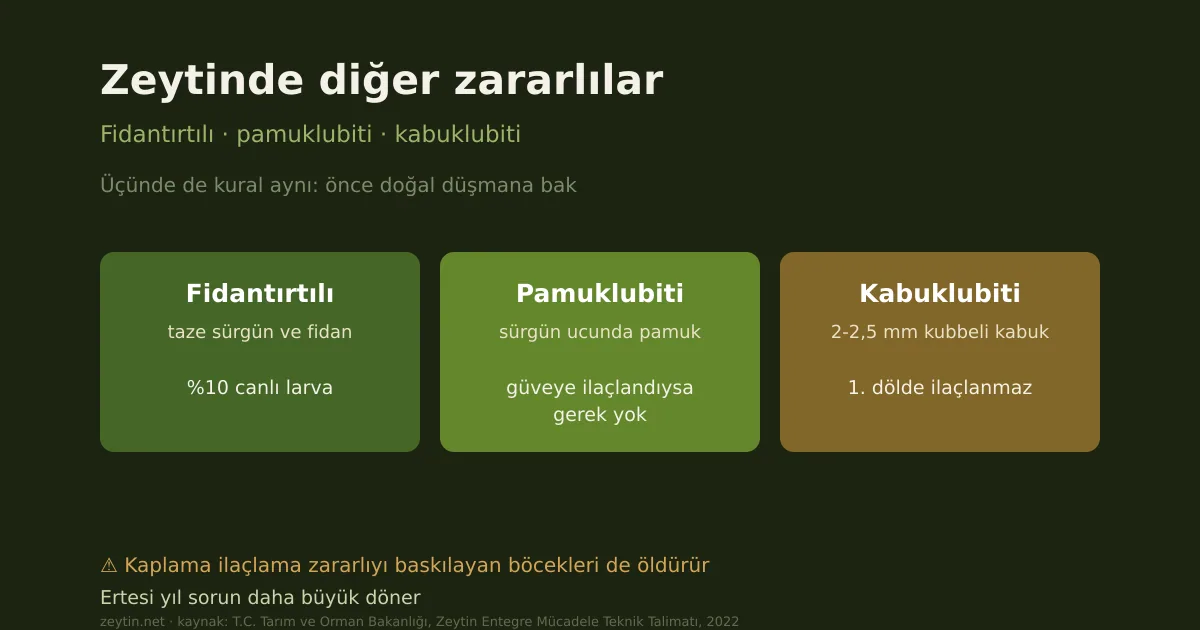
Beyond the fruit fly and the moth there are other pests. In some years and some groves these three overtake the fly — and the essence of control is the same for all three: protect the natural enemies, stop the unnecessary spraying.
Jasmine moth (Palpita unionalis)
Its main target, as its Turkish name says, is nursery stock and tender shoots. In heavy years it moves onto the fruit.
Recognition
The adult moth is bright white with a 22-33 mm wingspan; a fine brown band runs along the upper edge of the forewings with four black spots of differing size along it.
The egg is 0.9 mm, laid on both surfaces of tender leaves, usually along a vein — sometimes singly, sometimes in clusters of 10, 40 or up to 120.
The larva is yellow on hatching, turning green; three pairs of short hairs beside each segment and a pair of black spots on each of the first two. Mature larva 20-25 mm.
Damage
Young larvae leave a lace-like feeding pattern on tender leaves. After the third instar they become voracious and can consume a leaf entirely. They will strip all the tender shoots of nursery trees and, on mature trees, the new shoots that would bear next year's crop.
Where populations run very high they move at veraison onto unripe fruit: gnawing through the skin and eating the flesh down to the stone.
The year's cycle
It overwinters below ground, or in mild years as a final-instar larva between leaves it has bound together. First adults appear from late May to mid-June. It is active at dusk and hides among the shoots by day.
In the groves of Bursa it produces two overlapping generations and one partial generation across August, September and October-November. On Mediterranean coasts the count rises to 3-6 generations.
Control
- Destroy the other hosts around the grove: ash, jasmine, privet, mock privet.
- Winter tillage — it brings the larvae overwintering in the soil to the surface on cold days.
- ⚠ Clear and burn the water shoots. First-instar larvae particularly favour the suckers from trunk and root; removing them cuts the population directly.
- Avoid excess nitrogen and irrigation — producing tender shoots is feeding the pest.
- Use certified nursery stock.
Threshold: treatment is decided when checks show 10% live larvae or infested shoots.
Timing: spray at dusk — that is when the insect is active.
Olive psyllid (Euphyllura spp.)
If you see white masses like tufts of cotton wool at the shoot tips, this is it.
Recognition
The adult is 2-3 mm and resembles a small cicada; large head, red eyes, dirty-yellow to pale green wings, green abdomen. The egg is 0.3 mm, attached to plant tissue by a short stalk.
Larvae are flattened, 2 mm, and exude a honey-like waxy substance of very fine filaments from the body. Those filaments gather like a ball of cotton — hence the Turkish name.
Damage
Larvae suck sap on the flower clusters, bud stalks and shoot tips. The result: tree and shoots weaken, and flowers and flower buds drop.
It does most harm in humid weather when spring is wet, in poorly managed groves, and during flowering.
E. phillyrea has one generation a year, E. straminea 3-4. It is widespread in every olive region of Türkiye.
Control
- Irrigate, fertilise and prune to good practice; pruning debris must be destroyed.
- ⚠ If the grove has been treated against the olive moth, no separate treatment is needed for this pest.
- If treatment is needed, spray only the badly affected branches — this preserves the natural balance.
- Best timing: the period beginning 10 days after the first cottony masses appear at the shoot tips and running to flowering.
This pest has 2 parasitoids and 13 predators recorded in Türkiye — Chilocorus, Anthocoris, Orius, Chrysoperla carnea and a series of Miridae. Full-cover spraying wipes that list out.
Olive scale (Parlatoria oleae)
Recognition
The adult female's scale is rounded oval and domed, ranging from whitish cream to dark ash grey; 2-2.5 mm long. The dark green to blackish larval scale sits at the edge of, or beyond, the female's.
Lift the scale and you find an oval adult female in dark violet or purple — the surest identification. The male is 1 mm, pinkish violet, with a single pair of wings.
Control — two generations, two different decisions
The instruction draws a sharp distinction here:
| Generation | Decision |
|---|---|
| First (on leaves and shoots) | ⚠ Not treated except at very high populations. This preserves the natural enemies |
| Second | Treated against the larvae only if the population is high and parasitism is below 50% |
Timing for the second generation: from late July or early August, egg-bearing females are inspected; treatment goes on when 50% of eggs have hatched (adults of the second generation reaching 70-80%).
⚠ If parasitism is as high as 50%, the second generation should not be treated chemically.
Cultural measures
- Irrigation, fertilising and pruning to good practice; destroy the pruning debris.
- ⚠ Poles and props taken from infested trees must not be used on clean ones — the easiest way to carry the pest by hand.
- Use certified nursery stock.
- One unusual item: to improve the effectiveness of natural enemies, dusty tracks along the grove edge should be tarred or asphalted. Dust hampers the beneficial insects.
What the three have in common
| Pest | When not to spray |
|---|---|
| Jasmine moth | Below 10% live larvae / infested shoots |
| Olive psyllid | If the grove was treated against the olive moth |
| Olive scale | Always in the first generation; in the second if parasitism exceeds 50% |
All three have long lists of natural enemies. The logic the instruction repeats for each of them is the same: full-cover spraying kills the pest and the insects that hold it down; next year the problem returns bigger.
⚠ No product names or doses are given in this article. Plant protection products and doses appear in Annex 4 of the Ministry's instruction and registrations change. Consult the current licensed product list and your Provincial or District Directorate of Agriculture and Forestry before treating.
Source
t; Republic of Türkiye, Ministry of Agriculture and Forestry, General Directorate of Agricultural Research and Policies, Department of Plant Health Research. Olive Integrated Pest Management Technical Instruction. Ankara, 2022.
Related reading: Olive fruit fly control · The olive moth · Olive black scale and sooty mould · Olive peacock spot
One rating per visitor; you can change yours at any time. Ratings are real reader votes — no seeded or default scores.
Related
 Article
Olive knot: galls, warts and a bacterium that enters through wounds
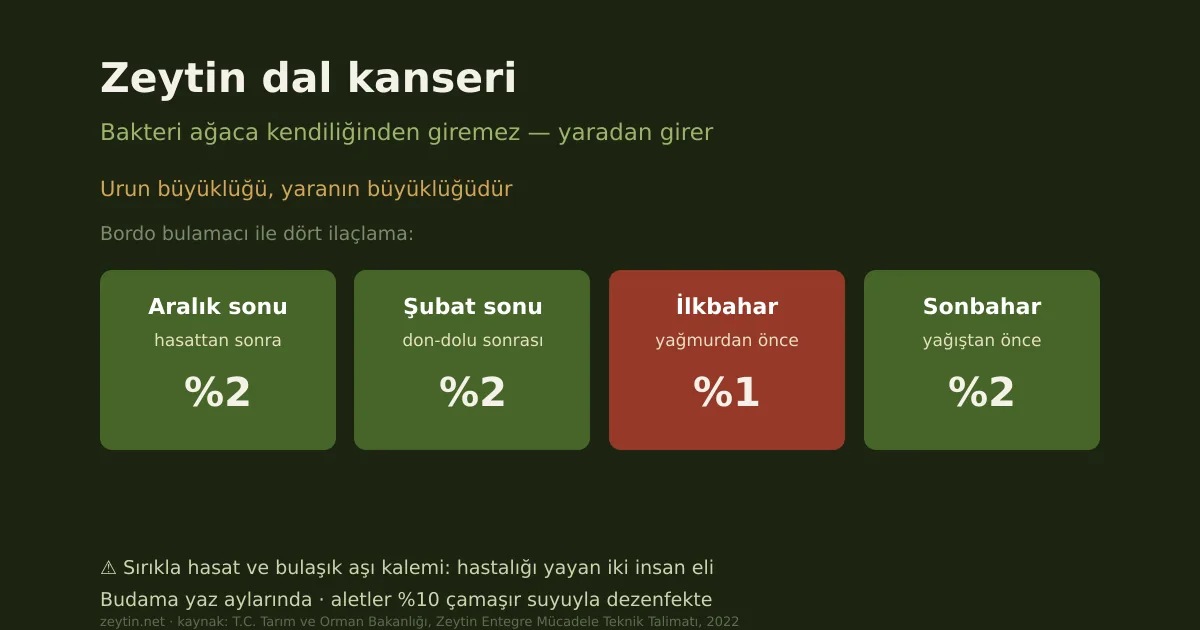
The bacterial canker among olive tree diseases that enters through wounds: galls and warts. Pole harvest and pruning errors spread it.
Article
Olive knot: galls, warts and a bacterium that enters through wounds
The bacterial canker among olive tree diseases that enters through wounds: galls and warts. Pole harvest and pruning errors spread it.
 Article
Olive black scale and sooty mould: the H on its back
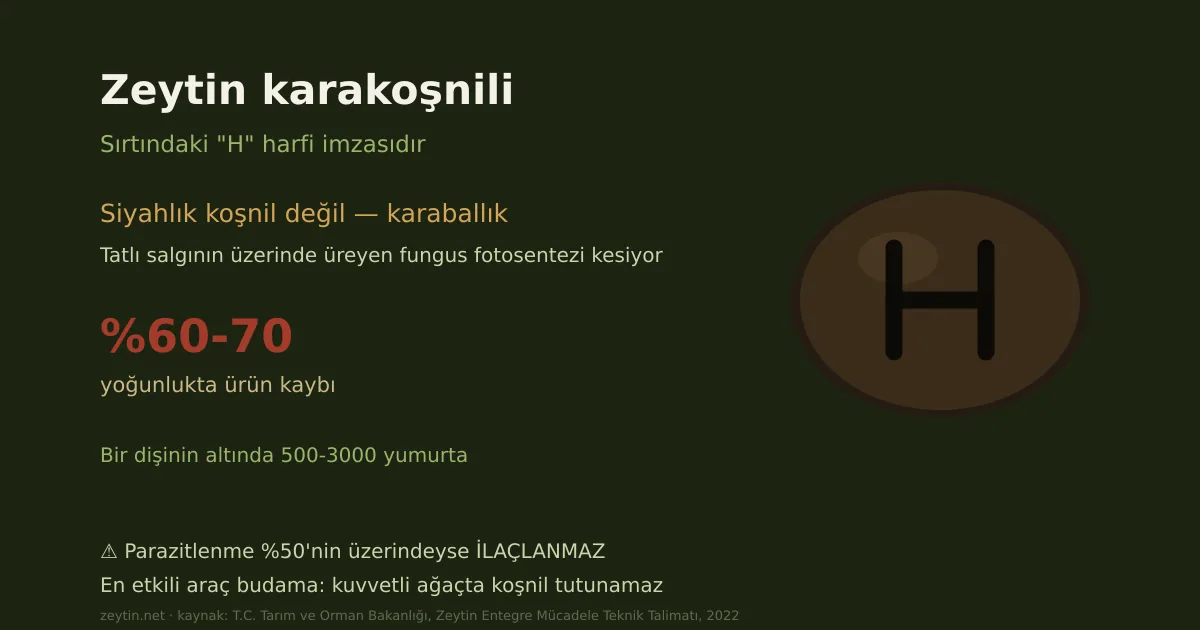
The olive pest behind sooty mould: a scale with an H on its back. Losses of 60-70%; if parasitism tops 50%, do not spray.
Article
Olive black scale and sooty mould: the H on its back
The olive pest behind sooty mould: a scale with an H on its back. Losses of 60-70%; if parasitism tops 50%, do not spray.
 Article
Weeds in the olive grove: bare soil is not the goal
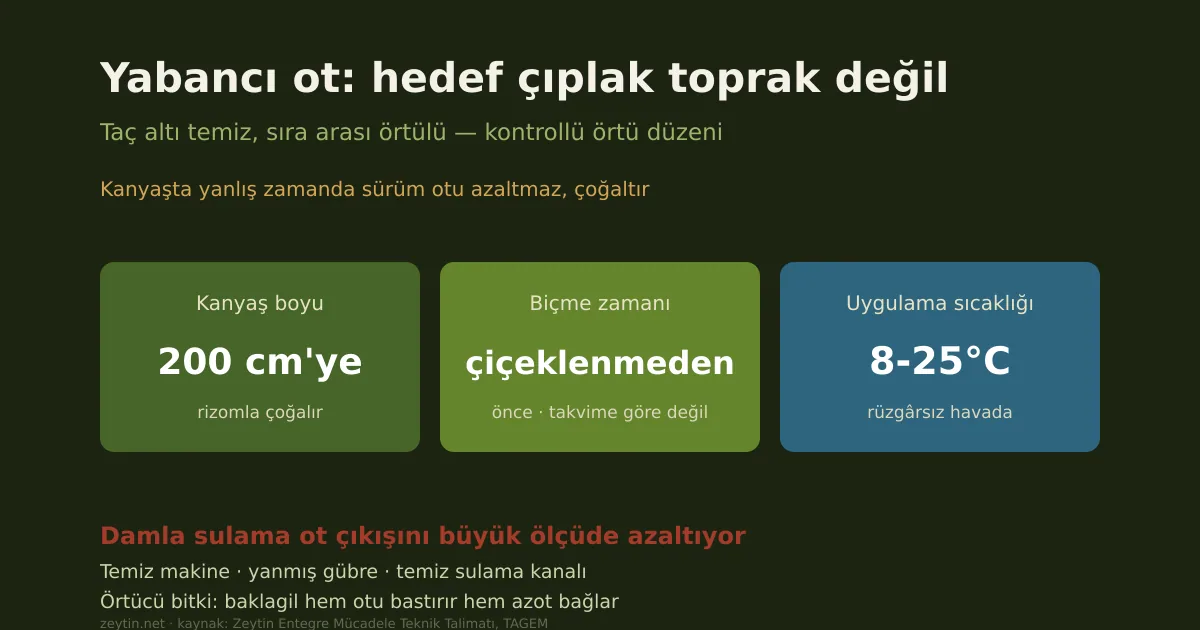
Johnson grass, Bermuda grass and fat hen. With perennials, ill-timed tillage spreads them while mowing stops the seed. Clean under the canopy, covered between rows.
Article
Weeds in the olive grove: bare soil is not the goal
Johnson grass, Bermuda grass and fat hen. With perennials, ill-timed tillage spreads them while mowing stops the seed. Clean under the canopy, covered between rows.
 Article
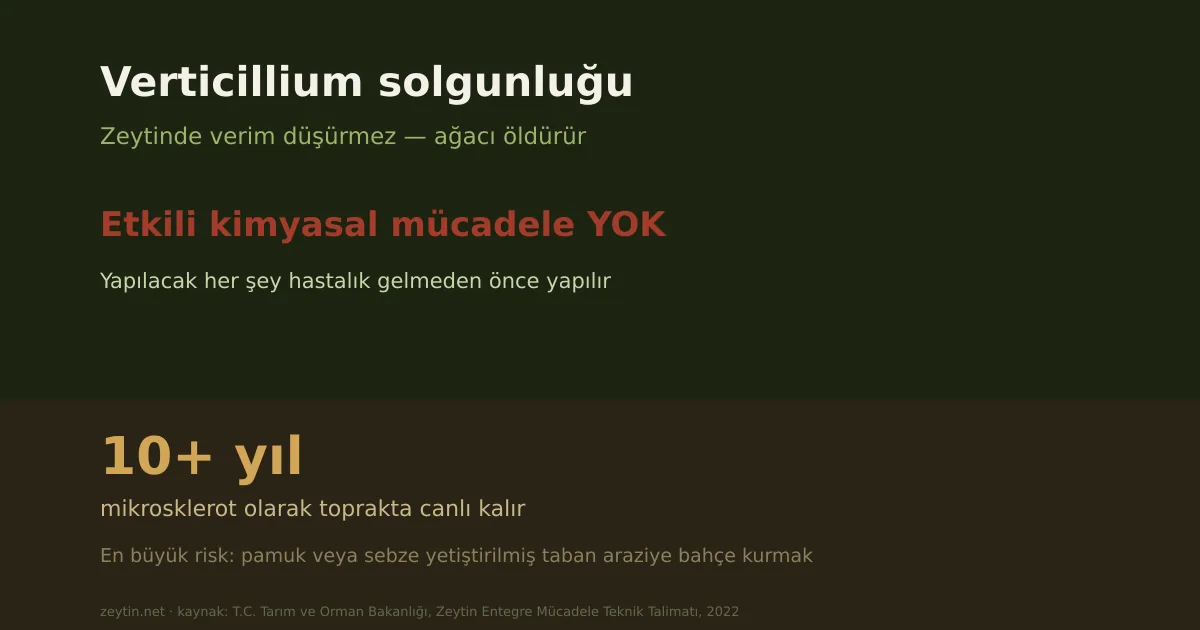
Verticillium wilt: the disease that kills the tree and has no cure
The olive tree disease that kills: it survives over 10 years in the soil, blocks the vessels, and has no effective chemical control.
Article
Verticillium wilt: the disease that kills the tree and has no cure
The olive tree disease that kills: it survives over 10 years in the soil, blocks the vessels, and has no effective chemical control.