Verticillium wilt: the disease that kills the tree and has no cure
The olive tree disease that kills: it survives over 10 years in the soil, blocks the vessels, and has no effective chemical control.
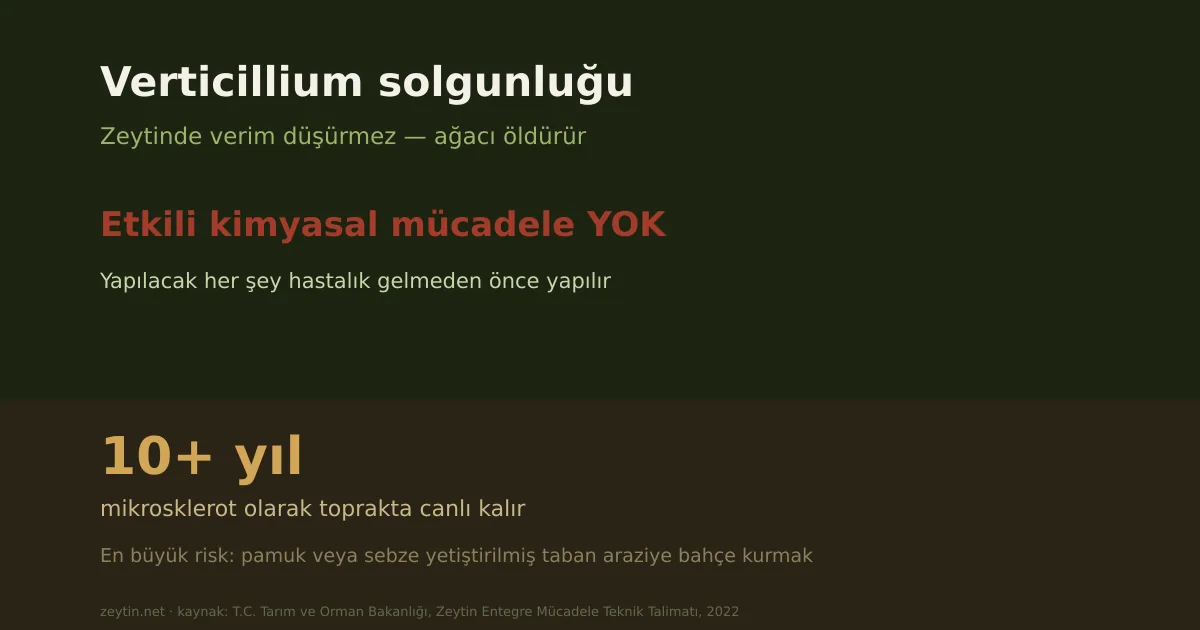
Most olive diseases cut the yield. Verticillium wilt kills the tree — and there is no effective chemical control against it.
The Ministry's section on this disease ends with a single sentence: "There is no effective method of chemical control against this disease." Everything you can do about it must therefore be done before it arrives.
Why is it so hard?
The pathogen (Verticillium dahliae) is a soil-borne fungus. It overwinters in the soil and in plant debris as mycelium or microsclerotia.
The critical figure: as microsclerotia the fungus can stay alive in the soil for more than 10 years.
So "clear the grove and replant" does not work. Once the soil is infested, it stays infested for a decade.
The fungus enters through the roots, colonises the cortex, passes through the endodermis into the xylem and blocks the conducting vessels. Water no longer reaches the leaves. The wilt comes both from that blockage and from toxins the fungus produces.
Two symptom types
Acute wilt
Seen from late winter into early spring:
- Shoots and branches dry out suddenly — on one side of the tree or several
- Bark turns a purplish violet starting from the main branch, then spreads through the tree
- A longitudinal cut through such a branch shows the xylem turned dark chestnut
- A cross-section sometimes shows the vessels necrotic in a ring
- Leaves, shoots and branches lose their green for pale brown and curl backwards along the midrib
Cutting into a branch is the most reliable diagnosis here — from outside it can look like frost or drought damage, but the chestnut colour in the vessels looks like nothing else.
Chronic wilt
Begins in spring, and the symptoms on the flowers usually appear before those on the leaves. If infection occurs at the start of flowering, some flowers drop. Mummified flower buds dry and stay hanging on the tree.
Can the tree recover?
Partly. The instruction notes something interesting:
t; The olive is a tree capable of renewing itself. In trees showing chronic wilt the severity may decrease and recovery may be seen.
But that recovery comes not from repairing the diseased tissue but from isolating that region and putting functional tissue in its place. The course of the disease is therefore independent from one season to the next — a tree that looks bad this year may look better next, or the reverse. Do not judge on a single year's observation.
The biggest risk: the field's history
This is the instruction's most important warning:
t; The disease is seen mostly in groves established on valley-bottom land where cotton or vegetables were grown in previous years.
The reason is the host list. V. dahliae infects:
Olive · stone fruits · almond · pistachio · grapevine · barberry · maple · horse chestnut · elm · blackberry · watermelon · strawberry · cotton · okra · hops · tomato · pepper · aubergine · potato · sunflower · begonia · rose · weeds
Planting an olive grove on a former cotton field, or on ground that grew tomatoes, peppers and aubergines, means finding the disease already there.
The fungus grows best at 25-28°C but survives in cooler soils too. Within the grove it spreads through irrigation water and tillage, as infested soil is carried to clean ground.
In Türkiye it occurs in every olive-growing region, above all the Aegean.
What to do — all of it preventive
- Use healthy planting material and nursery stock.
- Establish groves on land where the disease has not been seen before.
- If you must plant on ground that grew host crops: first grow *cereals that are not hosts of V. dahliae — barley, oats, wheat — for at least two years*.
- Keep tillage shallow and outside the tree's canopy projection — wounding roots opens the door.
- Fertilise according to leaf and soil analysis; avoid excess nitrogen (rapid growth increases susceptibility).
- No flood irrigation, no over-watering; use drip irrigation.
- ⚠ Never intercrop — it raises the risk of infection and spread.
- Control weeds (they are hosts too).
- Prune wilted and dead branches back to healthy wood and remove them from the grove. ⚠ Pruning must be finished before the leaves fall — fallen diseased leaves add to the soil inoculum.
- Disinfect pruning tools with 10% sodium hypochlorite (household bleach).
- Solarisation for 6-8 weeks may be applied to reduce the fungus in the soil.
Summary
- Verticillium dahliae is soil-borne; as microsclerotia it survives more than 10 years in the soil.
- It blocks the conducting vessels, causing yield loss and tree death.
- Acute type: sudden dieback, purplish violet bark, dark chestnut vessels in section.
- Chronic type: flower symptoms come first, mummified buds stay hanging on the tree.
- The tree can partly recover, so one year's observation misleads.
- Greatest risk: planting on valley-bottom land that grew cotton or vegetables.
- If unavoidable, grow cereals for two years first.
- ⚠ No intercropping, no flood irrigation, no excess nitrogen.
- ⚠⚠ There is no effective chemical control. Prevention is the only weapon.
Source
t; Republic of Türkiye, Ministry of Agriculture and Forestry, General Directorate of Agricultural Research and Policies, Department of Plant Health Research. Olive Integrated Pest Management Technical Instruction. Ankara, 2022.
Related reading: Olive knot · Olive peacock spot · Olive fruit fly control
One rating per visitor; you can change yours at any time. Ratings are real reader votes — no seeded or default scores.
Related
 Article
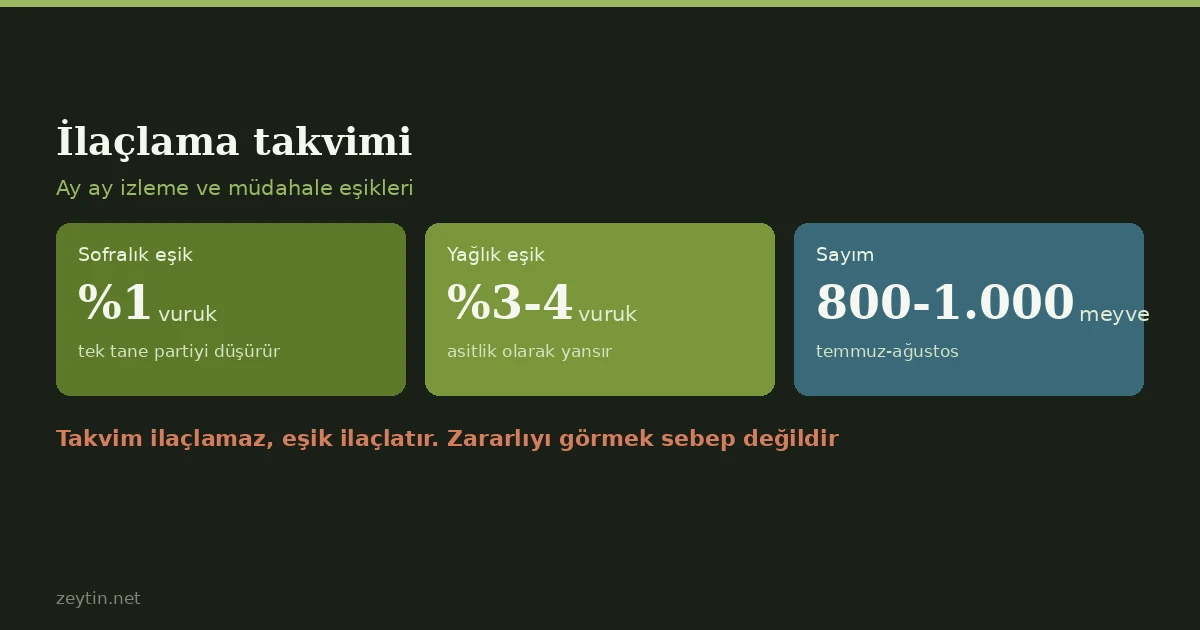
The olive pest calendar and intervention thresholds
Month by month: which pest is at which stage, and when to count. Fly infestation thresholds, black scale shoot counts, and the three regional programmes for peacock spot.
Article
The olive pest calendar and intervention thresholds
Month by month: which pest is at which stage, and when to count. Fly infestation thresholds, black scale shoot counts, and the three regional programmes for peacock spot.
 Article
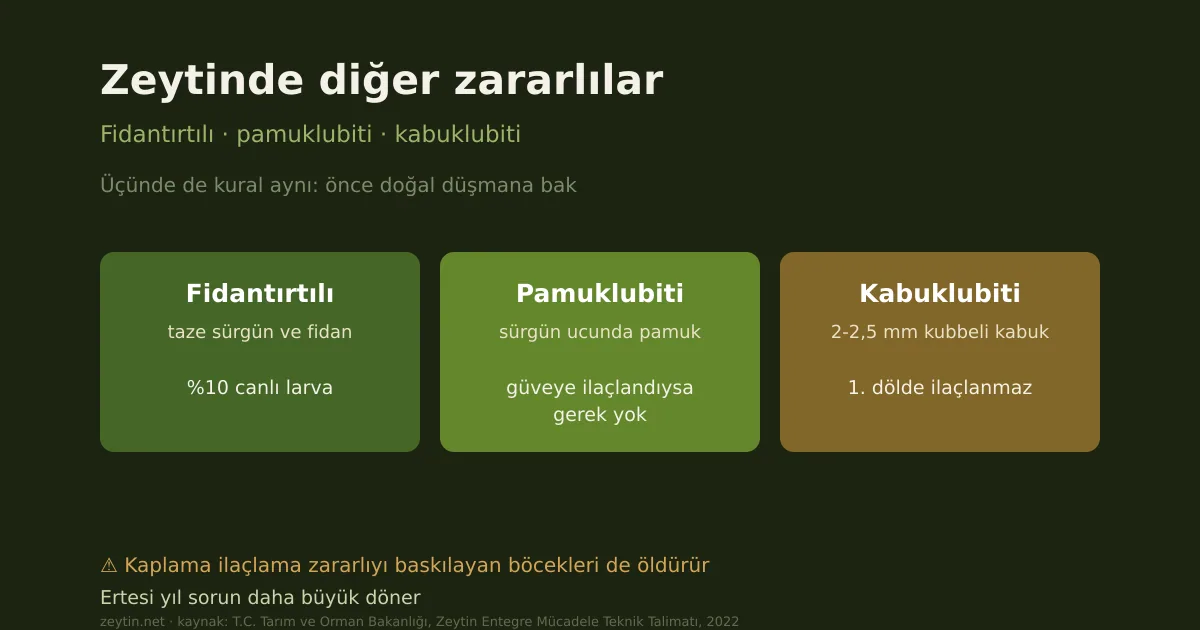
Other olive pests: jasmine moth, psyllid and olive scale
Three olive pests overshadowed by the fruit fly: the jasmine moth on tender shoots, the cottony psyllid, and olive scale.
Article
Other olive pests: jasmine moth, psyllid and olive scale
Three olive pests overshadowed by the fruit fly: the jasmine moth on tender shoots, the cottony psyllid, and olive scale.
 Article
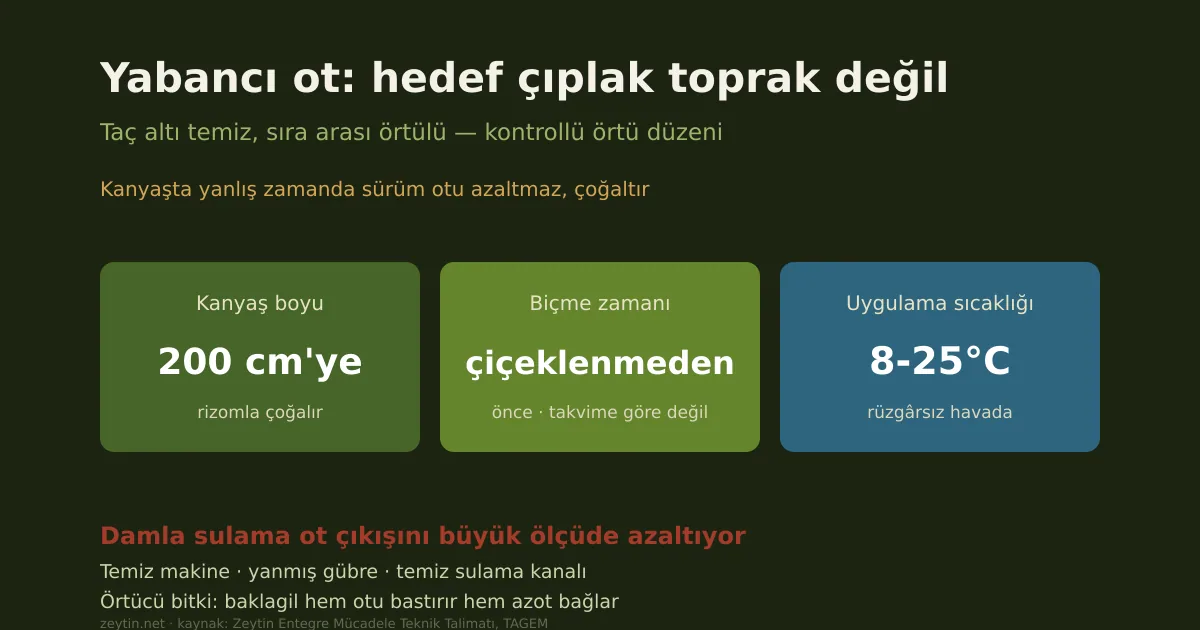
Weeds in the olive grove: bare soil is not the goal
Johnson grass, Bermuda grass and fat hen. With perennials, ill-timed tillage spreads them while mowing stops the seed. Clean under the canopy, covered between rows.
Article
Weeds in the olive grove: bare soil is not the goal
Johnson grass, Bermuda grass and fat hen. With perennials, ill-timed tillage spreads them while mowing stops the seed. Clean under the canopy, covered between rows.
 Article
The olive moth: three generations, three kinds of damage
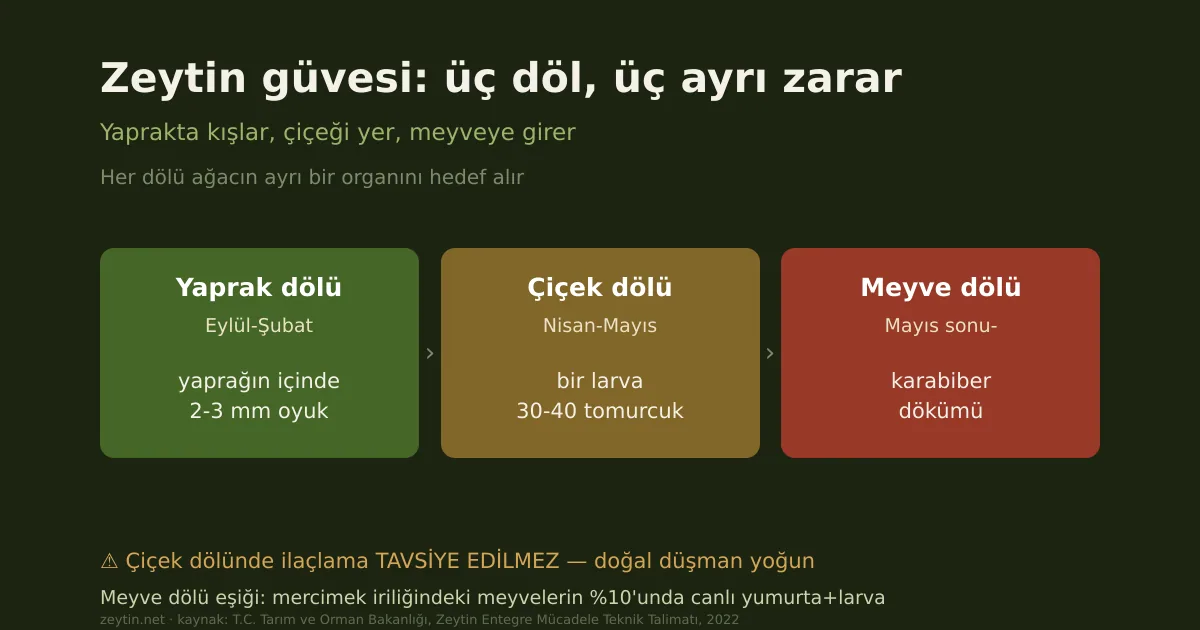
The olive pest with three generations: it winters in the leaf, eats the flowers, enters the fruit. One larva can take 30-40 buds.
Article
The olive moth: three generations, three kinds of damage
The olive pest with three generations: it winters in the leaf, eats the flowers, enters the fruit. One larva can take 30-40 buds.