Türkiye leaves an off year as Tunisia enters one: opposite phase in the Mediterranean
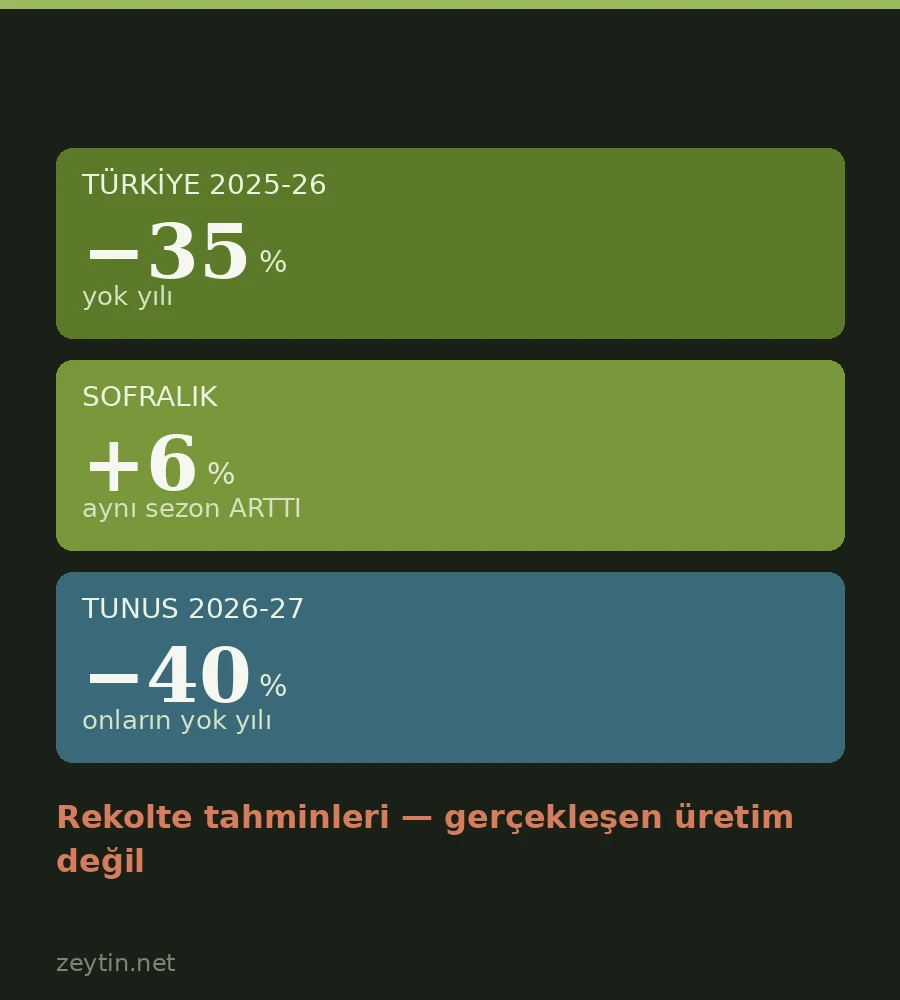
Türkiye's crop fell 35% in 2025-26, yet table olives rose and the drop was far from even: Aydın −8%, Bursa −50%. Tunisia is in the opposite phase, down 40% for 2026-27. The two countries sit in opposite halves of the cycle, and that shapes the bulk olive oil market.
Olives carry a heavy crop one year and a light one the next. We treated that in our alternate-bearing piece as a single country's problem. What makes this season interesting is where each country sits in the wave: Türkiye is coming out of an off year, Tunisia is going into one.
Türkiye's off year
| Season | Total trees | Olives | Table | For oil | Olive oil | Per tree |
|---|---|---|---|---|---|---|
| 2024-25 | 204,437,000 | 3,600,000 t | 700,000 t | 2,850,000 t | 475,000 t | 20.9 kg |
| 2025-26 | 210,608,251 | 2,450,000 t | 740,000 t | 1,710,000 t | 310,000 t | 13.9 kg |
Source: UZZK — Ulusal Resmî Tespit Heyeti Raporu — a pre-harvest crop estimate, not realised output.
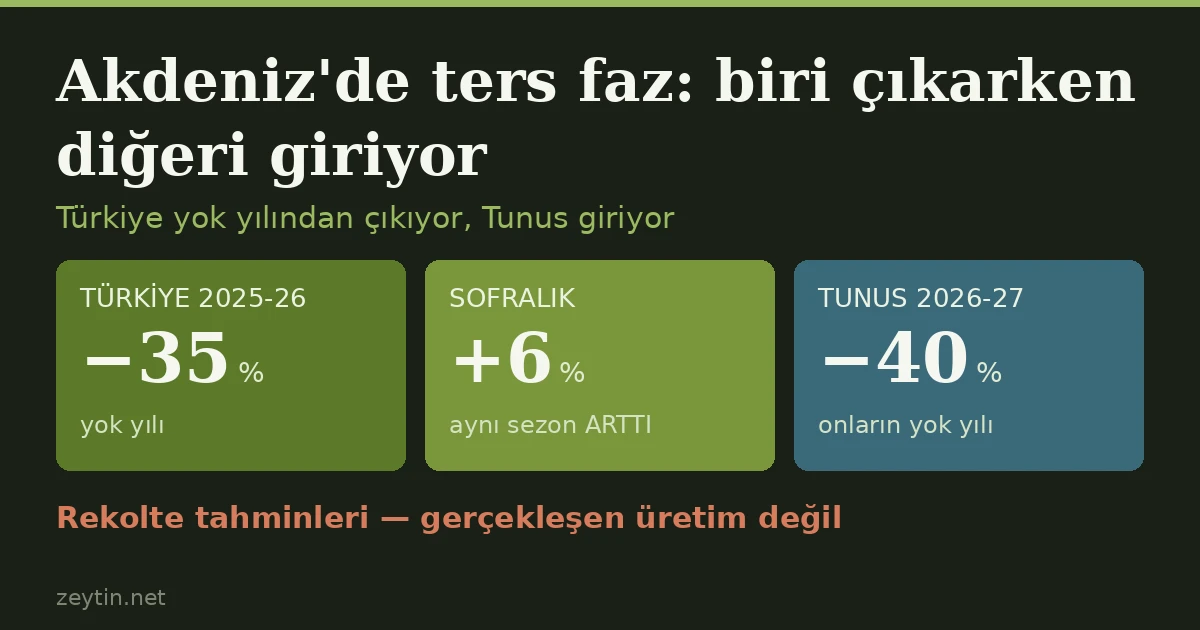
Total output fell 35%. That is the textbook case of alternate bearing. Two details, however, are not in the textbook.
1. Table olives went up
While the total fell 35%, the share set aside for the table rose from 700,000 to 740,000 tonnes. In a light year the fruit that does set is larger and better; growers steer it toward the higher-value table market.
The consequence shows up in oil: the quantity sent for pressing fell 40%, and olive oil output dropped from 475,000 to 310,000 tonnes. The fall in oil is steeper than the fall in the crop. Every kilo that moves to the table is a kilo out of the oil.
2. The drop did not land evenly
An off year is not one national event. It arrives with different force grove by grove and province by province:
| Province | 2024-25 | 2025-26 | Change | Table olives |
|---|---|---|---|---|
| Çanakkale | 170,800 | 81,895 | −52% | −48% |
| Bursa | 280,720 | 140,847 | −50% | −37% |
| Manisa | 623,493 | 320,045 | −49% | −27% |
| İzmir | 485,275 | 376,021 | −23% | +8% |
| Muğla | 174,376 | 159,183 | −9% | +39% |
| Aydın | 478,484 | 439,278 | −8% | +45% |
The Marmara line (Çanakkale, Bursa) and Manisa roughly halved, while Aydın and Muğla barely moved. Same season, same country, a sixfold difference.
The practical consequence: "Türkiye's crop" read as a single number misleads. For a grower in Aydın, 2025-26 was an ordinary season; for one in Bursa, half the crop was gone. The national average describes neither. We made the same warning about mistaking exchange volume for the harvest.
Tunisia is in the opposite phase
In the same week Tunisia's National Chamber of Olive Producers announced 300,000 tonnes for 2026-27 — down from 500,000 last season. −40%. The stated reason is the same: alternate bearing.
But the calendars do not line up:
| Season | Türkiye | Tunisia |
|---|---|---|
| 2024-25 | on year (3.6 mn t) | — |
| 2025-26 | off year (2.45 mn t) | on year (500,000 t oil) |
| 2026-27 | on year expected | off year (300,000 t oil) |
In the season when Türkiye produced little, Tunisia produced a lot; in the season when Türkiye should produce a lot, Tunisia will produce little. The two countries are in opposite phase.
Why it matters
Türkiye and Tunisia meet in the same market with the same product: bulk olive oil going to Spanish and Italian bottlers. Opposite phase works in both directions there.
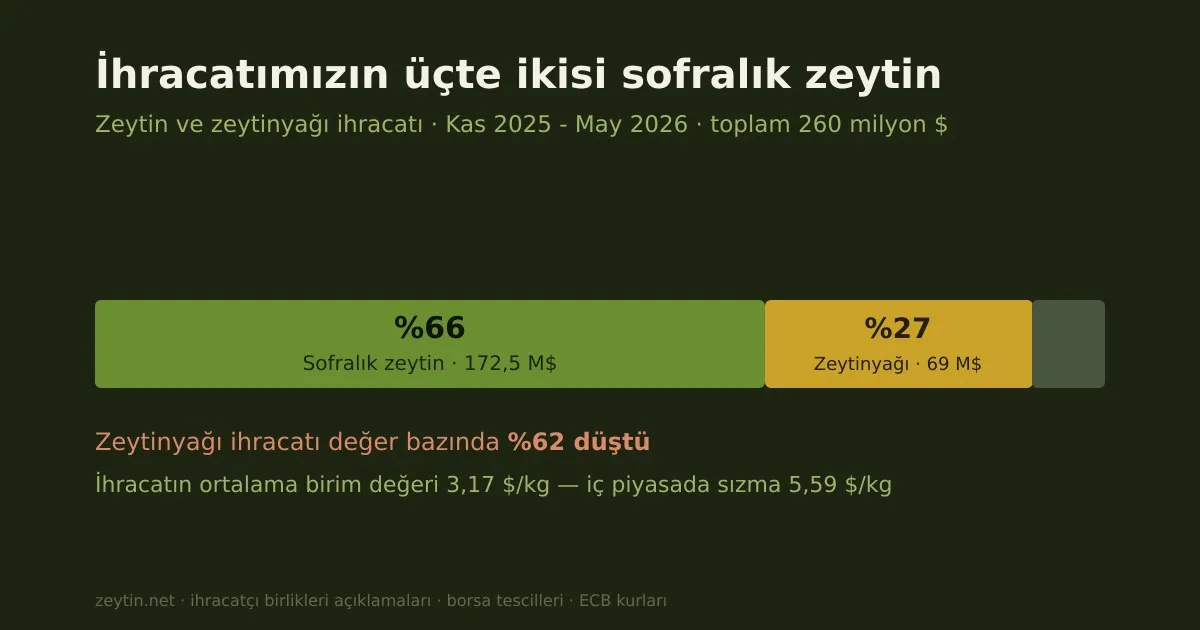
The season that worked against Türkiye has just passed. In 2025-26 our output halved while Tunisia was in the market with a large crop — we had little to sell and the price was held down by a competitor's abundance. That is the background to our olive oil exports falling 62% in value.
2026-27 may run the other way. As Türkiye enters an on year, Tunisia's withdrawal of 200,000 tonnes opens a gap our surplus could fill. That is part of the answer to the question of where a high crop gets sold.
⚠ The gap will not fall to us on its own. In the same period the United States applies a 12.5% additional tariff to Turkish goods, and Andalusia is asking the EU for measures against North African imports. The advantage on the supply side runs alongside obstacles on the demand side.
Reading with care
⚠ "On year" for 2026-27 is an inference, not a published forecast. It rests on the alternate-bearing rhythm and the last three seasons. UZZK's 2026-27 crop estimate was being prepared in the field as this was written; this page will be updated when the figure arrives.
⚠ Alternate bearing is not the only determinant. Drought, frost, the olive fruit fly and harvest labour can spoil an on year too. The rhythm gives a tendency, not a guarantee.
⚠ The Türkiye figures are UZZK's season-based crop estimate, not TurkStat's calendar-year realised output. The two do not measure the same thing; see the olive page.
One rating per visitor; you can change yours at any time. Ratings are real reader votes — no seeded or default scores.
Related
 Article
Alternate bearing: one year yes, one year no
Olive oil output can swing from 40,000 to 200,000 tonnes. Why alternate bearing happens, how it breaks prices and exports, and how its amplitude can be reduced.
Article
Alternate bearing: one year yes, one year no
Olive oil output can swing from 40,000 to 200,000 tonnes. Why alternate bearing happens, how it breaks prices and exports, and how its amplitude can be reduced.
 Article
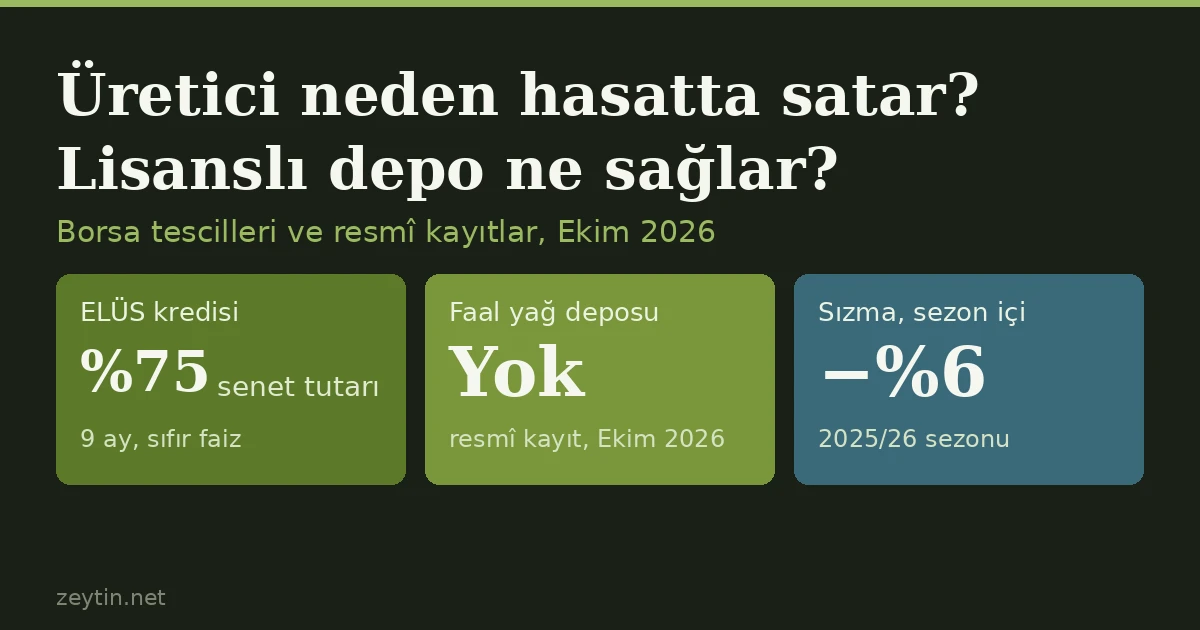
Why do small olive growers sell at harvest? What do licensed warehouses and electronic receipts offer?
Exchange records show that prices do not bottom out at harvest every year; the real issue is the cost of waiting. Licensed warehouses and electronic receipts (ELÜS) are the legal way to raise cash without selling the oil: interest-free loans up to 75% of the receipt, storage fee support and tax exemptions. But as of October 2026, official records show no licensed olive oil warehouse with an operating permit.
Article
Why do small olive growers sell at harvest? What do licensed warehouses and electronic receipts offer?
Exchange records show that prices do not bottom out at harvest every year; the real issue is the cost of waiting. Licensed warehouses and electronic receipts (ELÜS) are the legal way to raise cash without selling the oil: interest-free loans up to 75% of the receipt, storage fee support and tax exemptions. But as of October 2026, official records show no licensed olive oil warehouse with an operating permit.
 Article
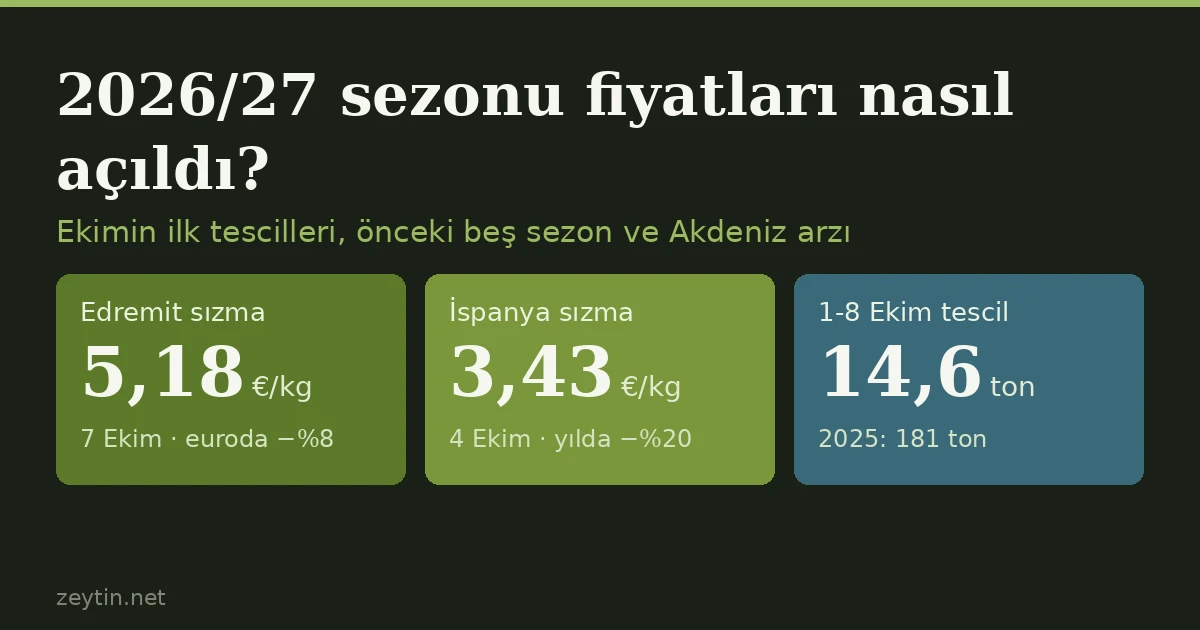
How did olive oil prices open the 2026/27 season?
The first exchange registrations of October 2026 compared with the same weeks of the previous five seasons, in lira and euros: Edremit extra virgin is up 4% in lira and down 8% in euros; Spanish producer prices fell 20% in a year. The opening is thin, and Spain is the only major producer with an official supply figure.
Article
How did olive oil prices open the 2026/27 season?
The first exchange registrations of October 2026 compared with the same weeks of the previous five seasons, in lira and euros: Edremit extra virgin is up 4% in lira and down 8% in euros; Spanish producer prices fell 20% in a year. The opening is thin, and Spain is the only major producer with an official supply figure.
 Article
Two thirds of our exports are table olives: the $260 million picture
In 2025-26, 66% of exports were table olives and 27% oil. Average unit value $3.17/kg — the added value sits inside the packaging.
Article
Two thirds of our exports are table olives: the $260 million picture
In 2025-26, 66% of exports were table olives and 27% oil. Average unit value $3.17/kg — the added value sits inside the packaging.