Tunisia's output falls from 500,000 to 300,000 tonnes — revenue may hold
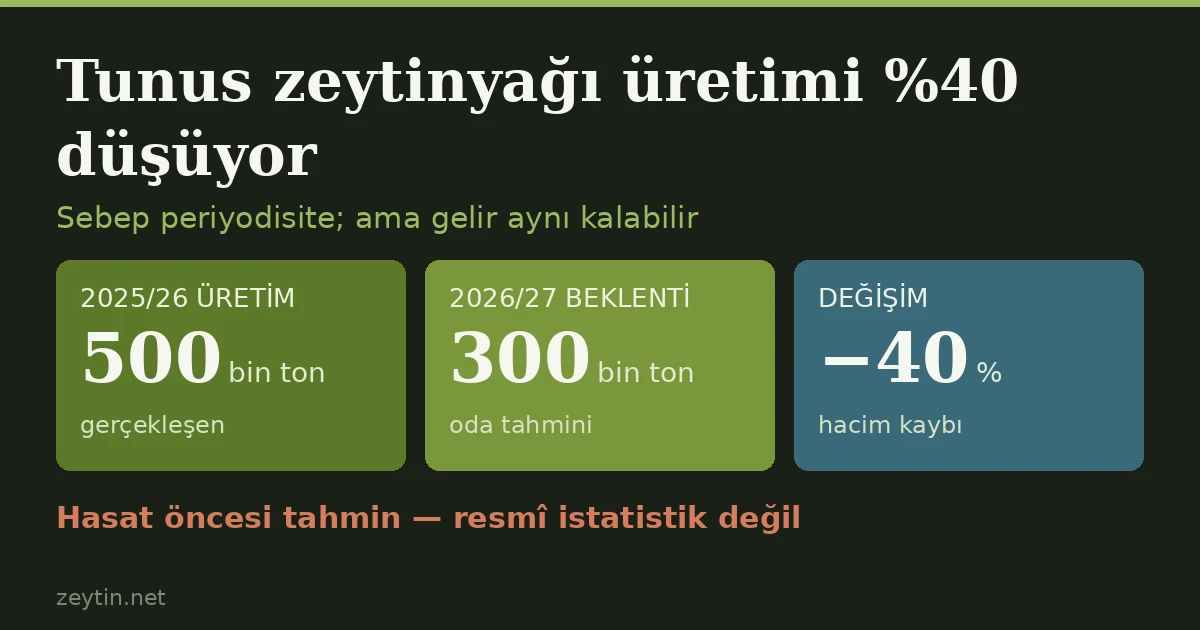
Tunisia's National Chamber of Olive Producers expects olive oil output to fall from 500,000 to 300,000 tonnes in 2026/27, citing alternate bearing. Revenue is still expected to match last season because prices are higher. Türkiye's most direct bulk competitor is shrinking.
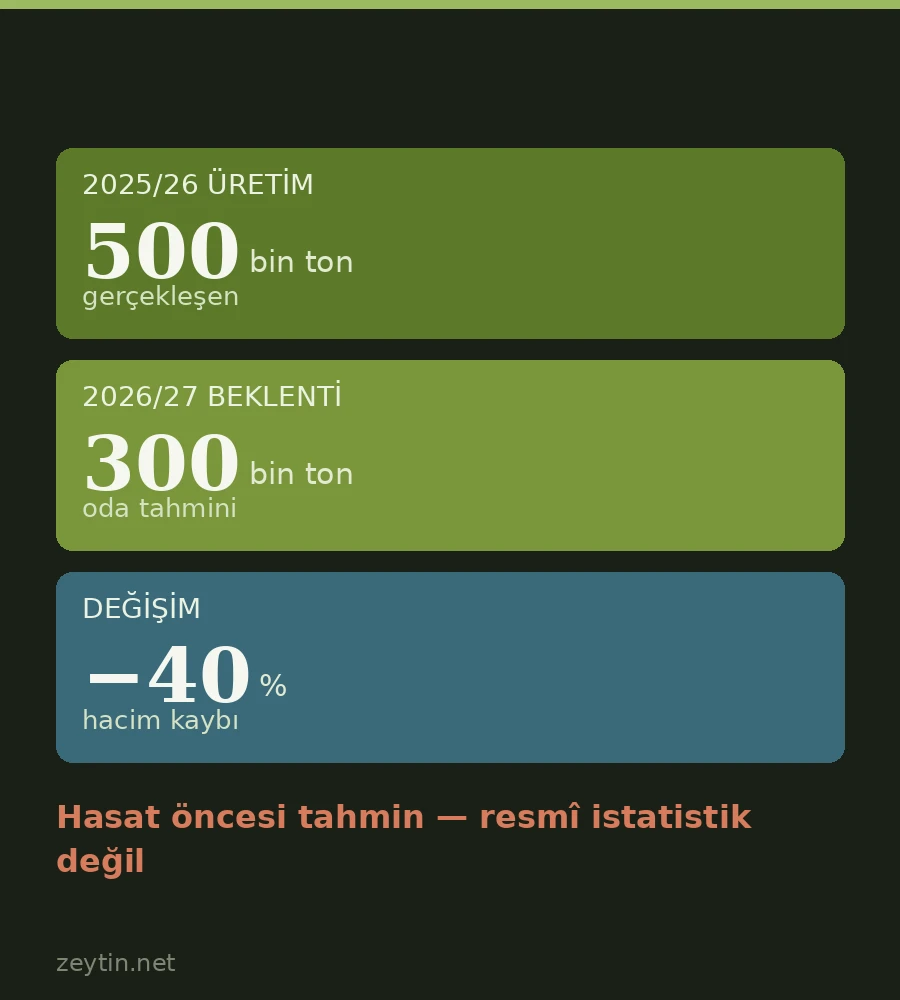
When we covered Tunisia's 368,000-tonne export season, we noted that an unusually large crop stood behind that volume. That season has now closed. Najeh Saïdi Hamed, president of Tunisia's National Chamber of Olive Producers, gave the new season's forecast to Mosaique FM: 300,000 tonnes.
The number
| Season | Olive oil production |
|---|---|
| 2025/26 (actual) | 500,000 t |
| 2026/27 (forecast) | 300,000 t |
| Change | −40% |
For scale: Tunisia exported 368,000 tonnes in the first nine months of last season. Exports take more than three quarters of production — Tunisia is not a country that consumes what it makes, it is a country that sells it. A 200,000-tonne drop in output comes straight out of exportable volume.
The cause is the cycle, not drought
Hamed attributes the decline to alternate bearing: an olive tree that carries a heavy crop follows it with a light year while it recovers. This is not an external shock like disease or drought; it is the tree's own rhythm.
The distinction has a practical consequence. A drought-driven fall can persist into the following year; a cycle-driven fall is normally followed by a recovery. This is the bottom of a swing, not a permanent loss.
The real news is in the second sentence
Hamed's second statement matters more than the first: while output falls 40%, revenue is expected to match last season, because international prices are higher.
This is the basic mechanism of the olive oil market, and it works in reverse too: a big crop does not rescue income. That is precisely what Türkiye experienced last season — volume rose while export value fell.
Tunisia's expectation is the same equation read from the other direction: volume falls, unit price rises, total revenue holds. What reaches the grower's pocket depends, in both cases, on how much price compensates for volume.
⚠ This is an expectation, not a guarantee. The assumption that prices will rise depends on the rest of the Mediterranean not producing a large crop at the same time.
What it means for Türkiye
1. Our most direct bulk competitor is shrinking. Roughly 86% of Tunisia's exports are bulk. Turkish exporters compete for the same tanks, not the same shelves: the bulk market feeding Spanish and Italian bottlers. Removing 200,000 tonnes of supply from that market opens room for Turkish oil.
2. The ground under the Andalusian dispute is shifting. We covered Andalusia's objection to North African imports last week; Tunisia was the main source of the supply being complained about. That supply is now contracting. The grounds for a protection measure weaken — though the request itself, once set in motion as a regulatory process, may continue.
3. Algeria does not fill the gap. Algeria's record expectation of 150,000 tonnes sounds large but is smaller than the 200,000 tonnes Tunisia is losing, and Algeria consumes most of its output domestically. Across North Africa, supply is falling on net.
Reading with care
⚠ 300,000 tonnes is a forecast made before harvest. In olives, pre-harvest estimates and final figures diverge widely; we have written separately about why mistaking exchange volume for the harvest misleads — the same caution applies to forecasts.
⚠ The figure is olive oil, not olives. Table olives are a separate account.
⚠ The statement comes from a trade chamber president, not a statistical agency. End-of-season figures from ONAGRI, Tunisia's official agricultural observatory, may differ; last season's export data came from ONAGRI.
One rating per visitor; you can change yours at any time. Ratings are real reader votes — no seeded or default scores.
Related
 Article
Marmarabirlik opens crop declarations on 21 September: no declaration, no purchase
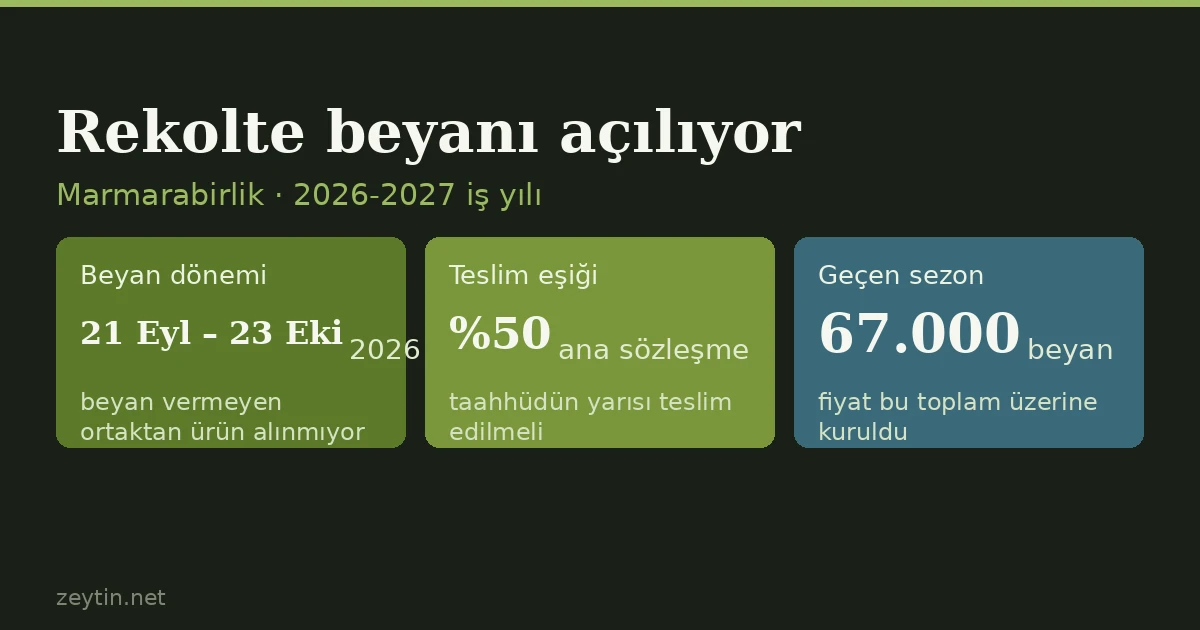
Crop declarations for the 2026-27 business year open on 21 September and close on 23 October at cooperatives affiliated with Marmarabirlik, Türkiye's largest table olive cooperative union. Members who do not file cannot sell to the cooperative, and the declared figure is a binding commitment covering oil olives too. In Orhangazi some 300 members are close to expulsion under the union's fifty-percent delivery rule.
Article
Marmarabirlik opens crop declarations on 21 September: no declaration, no purchase
Crop declarations for the 2026-27 business year open on 21 September and close on 23 October at cooperatives affiliated with Marmarabirlik, Türkiye's largest table olive cooperative union. Members who do not file cannot sell to the cooperative, and the declared figure is a binding commitment covering oil olives too. In Orhangazi some 300 members are close to expulsion under the union's fifty-percent delivery rule.
 Article
Olive oil exports still down 62% at the end of August: bulk loses 73%
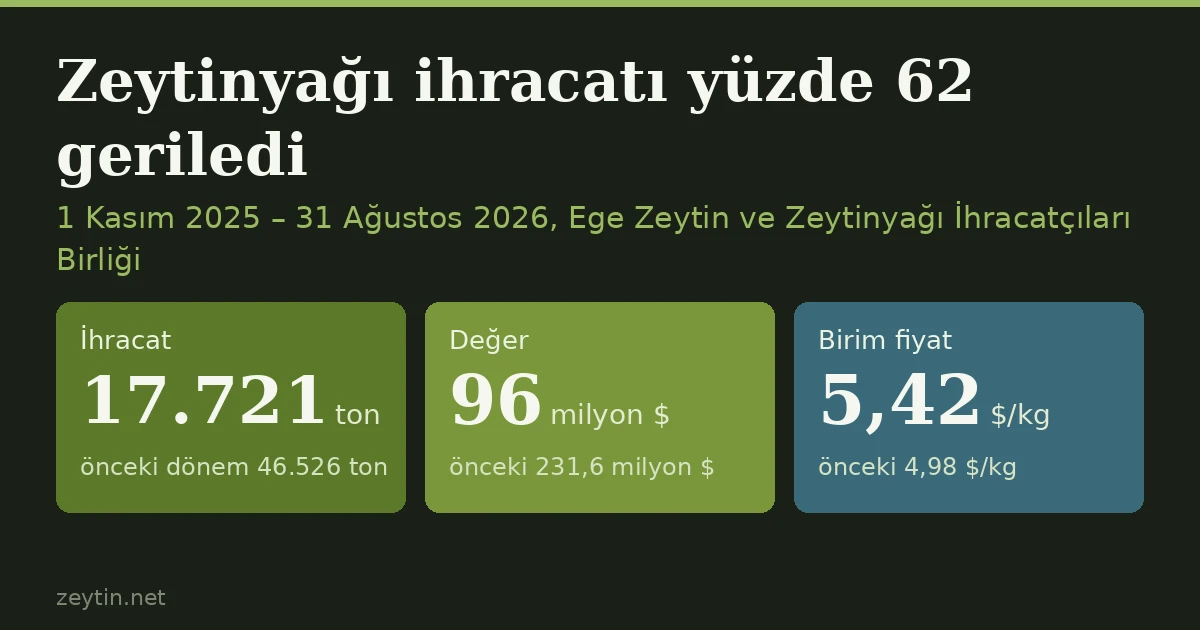
According to the Aegean Olive and Olive Oil Exporters' Association, olive oil exports between 1 November 2025 and 31 August 2026 fell 62% in volume and 59% in value. Bulk sales lost 73%, the US market 70%. Table olives, by contrast, held their ground.
Article
Olive oil exports still down 62% at the end of August: bulk loses 73%
According to the Aegean Olive and Olive Oil Exporters' Association, olive oil exports between 1 November 2025 and 31 August 2026 fell 62% in volume and 59% in value. Bulk sales lost 73%, the US market 70%. Table olives, by contrast, held their ground.
 Article
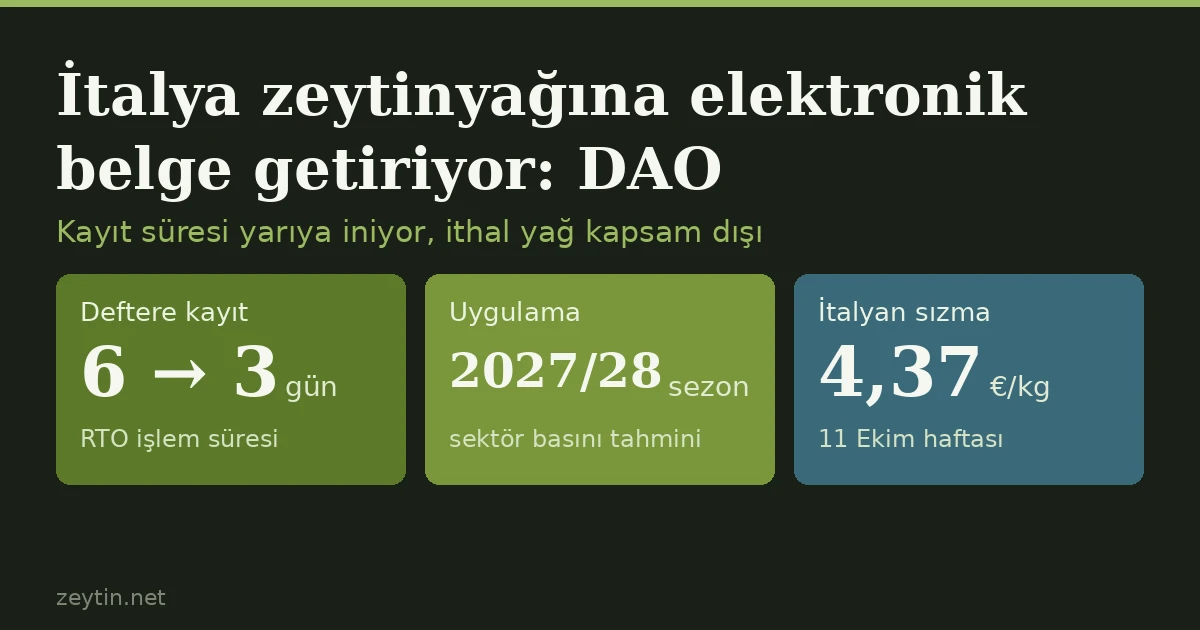
Italy to track olive oil with an electronic document: first positive response from the regions on the DAO, imported oil left out
A draft decree announced on 9 October by Italian agriculture minister Lollobrigida introduces the DAO, an electronic accompanying document that links olive and olive oil movements to the SIAN and RTO systems and cuts the register deadline from six days to three. According to the growers' committee, the state-regions conference gave a first positive response on 15 October. But the document only tracks domestic oil leaving a facility; oil from other EU states and third countries will keep entering with conventional paperwork. The trade press expects it to apply from the 2027/28 season.
Article
Italy to track olive oil with an electronic document: first positive response from the regions on the DAO, imported oil left out
A draft decree announced on 9 October by Italian agriculture minister Lollobrigida introduces the DAO, an electronic accompanying document that links olive and olive oil movements to the SIAN and RTO systems and cuts the register deadline from six days to three. According to the growers' committee, the state-regions conference gave a first positive response on 15 October. But the document only tracks domestic oil leaving a facility; oil from other EU states and third countries will keep entering with conventional paperwork. The trade press expects it to apply from the 2027/28 season.
 Article
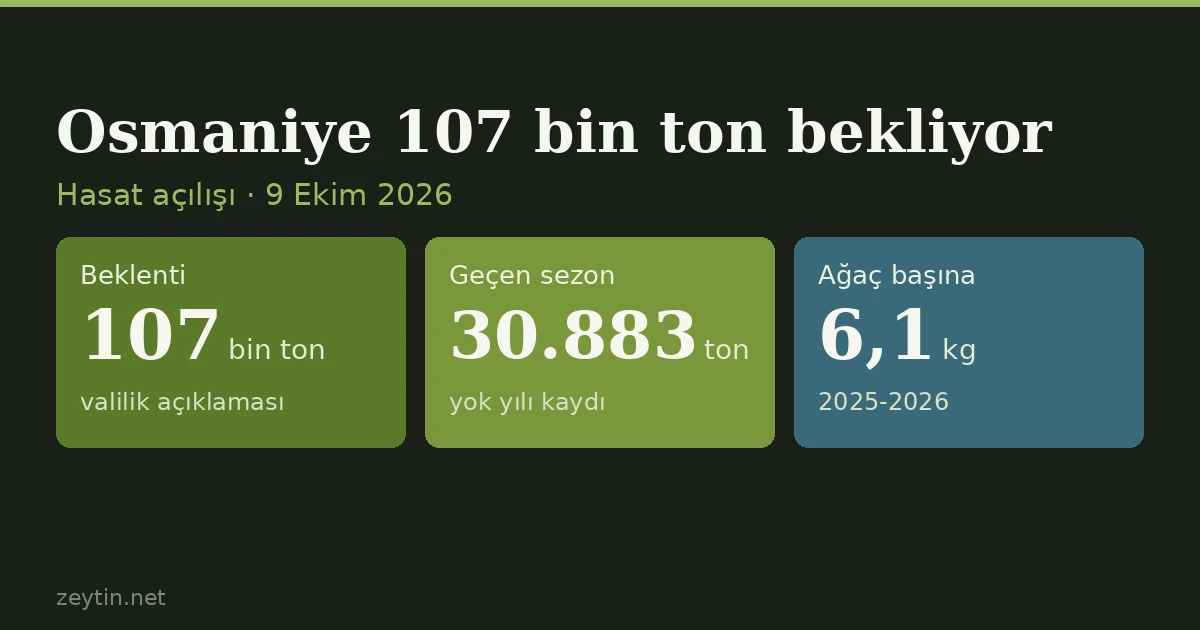
Osmaniye expects 107,000 tonnes: 3.5 times last season, in line with on-year averages
The governor's office in Osmaniye says the province's roughly 10 million olive trees are expected to yield more than 107,000 tonnes this year. That is 3.5 times last season — but 2025-2026 was an off year, and the forecast is consistent with on-year yields. Small discrepancies remain in tree counts and ranking.
Article
Osmaniye expects 107,000 tonnes: 3.5 times last season, in line with on-year averages
The governor's office in Osmaniye says the province's roughly 10 million olive trees are expected to yield more than 107,000 tonnes this year. That is 3.5 times last season — but 2025-2026 was an off year, and the forecast is consistent with on-year yields. Small discrepancies remain in tree counts and ranking.