What permits do you need to sell your own olive oil?
Having your own olives pressed for your own household is subject to no registration at all; the moment you start selling, you are operating a food business. Olive fruit is a primary product, pressed oil is not — and the whole documentation regime follows from that distinction. Olive oil falls under the registration regime, and the document required is the food establishment registration certificate; applications go to the provincial or district directorate and are examined within fifteen working days. Bulk sales are prohibited and packaging and labelling are compulsory. The belief that small producers are exempt does not hold for oil.

The grower who takes olives to the mill and comes home with tins of oil usually has the same question in mind: can I sell some of this, and if so what do I need? The answer changes entirely according to the state in which the product is sold. Turkish food law places olive fruit and olive oil in two different categories, and the whole distinction follows from that.
First the dividing line: primary product or processed food?
The definitions article of Law No. 5996 on Veterinary Services, Plant Health, Food and Feed describes primary products as "products of primary production, including products obtained from the soil and from animal husbandry as well as products obtained by hunting and fishing". Primary production itself includes the harvest.

On that basis:
- The olives you pick from the tree are a primary product.
- The oil pressed from them is not a primary product; it is a processed food.
The distinction sounds technical, but the entire documentation regime rests on it. Selling olives by the sack and selling oil by the tin do not carry the same obligations.
The one case that falls outside: personal consumption
The Regulation on Registration and Approval Procedures of Food Establishments, published in the Official Gazette of 17 December 2011, excludes five kinds of place in its scope article. Two of them concern us:
- places where primary production is carried out for personal consumption,
- places where food is prepared, processed and stored for personal consumption.
So having your own olives pressed for your own household and consuming the oil through the year is subject to no registration at all. Making oil at home falls through the same door. What changes is the moment you begin to sell part of that oil: at that point it is no longer personal consumption, it is operating a food business.
If you are going to sell: the food establishment registration certificate
The same regulation divides establishments in two. Those listed in its Annex 1 are subject to approval; an establishment subject to approval obtains a conditional approval certificate before it starts operating, and the process includes an on-site official control. Every establishment outside Annex 1 is subject to registration. Producing and selling olive oil falls under registration.
The document issued to an establishment within the registration regime is called the food establishment registration certificate (işletme kayıt belgesi). It carries a registration number coded in the form described in the annex to the regulation.
| What you are doing | Status |
|---|---|
| Having your own olives pressed for your own household | Outside the scope of the regulation |
| Selling olive fruit in small quantities direct to consumers | Primary product — a registration printout from the relevant authority is accepted |
| Bottling pressed oil and selling it | Registration certificate required |
| Selling the oil online or to retailers | Registration certificate required |
How the application works
The article of the regulation on registration procedure sets out a short sequence:
1. The file. Food-producing operators apply with the information and documents listed in Annex 3 of the regulation; warehouse, retail and mass catering operators apply under Annex 2.
2. Form of application. The application may be made with a wet signature or electronically with an electronic signature. The addressee is the competent authority — in practice the provincial or district directorate of agriculture and forestry.
3. Examination. The competent authority examines the application within fifteen working days.
4. The certificate. If the information and documents are complete, the registration certificate is issued with the fields of activity set out in the annex to the regulation.
5. Deficiencies. If the file is incomplete or incorrect, it is returned to the applicant in writing with the deficiency stated.
What the certificate is tied to, and when it lapses
This is the most frequently overlooked article. The registration certificate is valid for the trade name, the natural or legal person, the establishment address and the field of activity written on it. If any of those details changes, the certificate loses its validity.
In practice: you cannot move to a different address on the same certificate, an old certificate stops working when you change the form of the company, and widening the field of activity — adding table olives to oil sales, for instance — requires the certificate to be reissued. In the event of a change, the original certificate must be submitted with a petition and the relevant documents to the competent authority within three months.
If all or part of the activity is suspended, that too must be notified within three months.
Selling in bulk is prohibited
On the olive oil side there is a rule that is independent of the registration certificate and perfectly clear. The Turkish Food Codex communiqué on olive oil and olive pomace oil states that products offered directly to the final consumer "may not be placed on the market without being made into prepacked form".
Selling oil by the litre out of a drum — at the door, at a market stall or in a shop — is therefore contrary to the regulation. If it is to be sold, it is sold packaged and labelled. The packaging material itself must also comply with the regulation on materials and articles in contact with food, which means an old oil tin or an arbitrary plastic container will not do.
What the label must carry
The general rules come from the Turkish Food Codex regulation on food labelling and consumer information. The communiqué adds two rules specific to olive oil:
- The expression "cold pressed" may be used only for extra virgin and virgin olive oils obtained by percolation or centrifugation of the olive paste below 27 °C.
- If the label states the acidity or maximum acidity, then the peroxide value, the wax content and the specific extinction values under ultraviolet light must be printed in the same percentage and the same size.
The second is breached very often: a label carrying "acidity 0.3%" and nothing else does not comply.
The small producer exemption does not cover oil
The exceptions article of the regulation provides that for certain establishments a permit or registration printout obtained from the relevant authority is accepted in place of the registration certificate. One of the items on that list reads: "places supplying small quantities of primary products by their producer directly to the final consumer or directly to local retailers selling directly to the final consumer."
The key phrase there is primary product. Olive fruit falls inside it; pressed and packaged olive oil does not. The word-of-mouth belief that "small producers are exempt" is not correct for olive oil.
The cooperative route
Carrying the burden of registration, packaging, labelling and analysis alone can be heavy for a small grower. That is why many producers deliver their oil to a cooperative rather than packaging it under their own name; the obligations for packaging, labelling, registration and marketing then rest with the cooperative's legal personality.
Reading this carefully
This article describes the framework of the legislation and is not legal advice. Before applying, it is necessary to obtain the current list of documents from your provincial or district directorate of agriculture and forestry, since the documents required are set in annexes that can be amended.
The registration certificate does not replace a tax registration, a business opening and operating licence, or a trade registry entry. The regulation says as much in its own text: obtaining these certificates does not remove the obligation to obtain permits or licences issued by other public institutions under their own legislation. The separate "food production permit" that used to be required has been cancelled with all its effects.
The article references rest on the texts in force of the Regulation on Registration and Approval Procedures of Food Establishments and of the communiqué on olive oil and olive pomace oil. The regulation has been amended many times, so whether a particular article has been repealed should be checked against the current consolidated text.
One rating per visitor; you can change yours at any time. Ratings are real reader votes — no seeded or default scores.
Related
 Article
North Aegean Olive Oils: a registration stricter than the food codex
The mark of ten localities rather than one district — and unusually, it sets tighter limits than the national standard on peroxide, FAEE, waxes and K270.
 Article
How to Tell Good Olive Oil
Bitterness is a mark of quality, not a defect. Colour tells you nothing. The three attributes tasting panels look for, and a simple test at home.
 Article
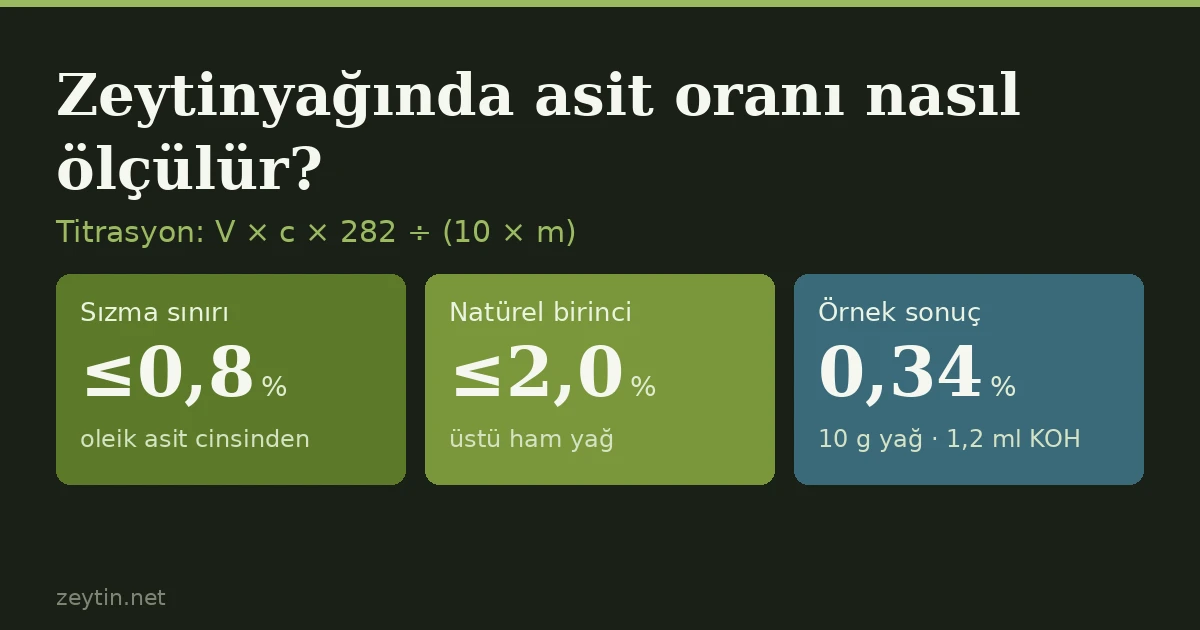
How is olive oil acidity measured? Titration, the formula and taking a sample
Olive oil acidity is measured in a laboratory by titration: the oil is dissolved in a solvent, free fatty acids are neutralised with potassium hydroxide, and the percentage is calculated as oleic acid from the amount used. The formula, a worked example, sampling and the limits of home test kits.
 Article
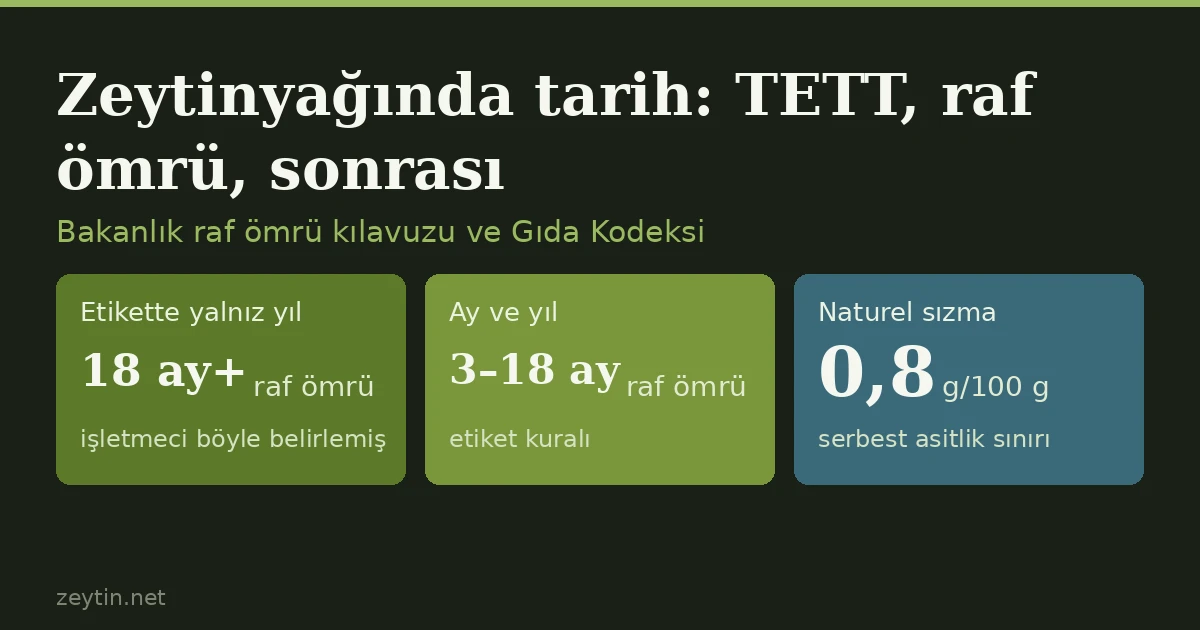
Does olive oil have a use-by date? Best-before dates, shelf life and oil past its date
Olive oil carries a best-before date, not a use-by date. Under the Turkish ministry's shelf-life guideline, oil past that date may be consumed, sold or donated if it was stored properly and its appearance, smell and taste are normal. Shelf life is set by the operator rather than by legislation — and even the format of the date reveals how long it is.