What is a malaxer? The tank where olive paste is kneaded, and the 27 °C limit
A malaxer is the stainless steel kneading tank where crushed olive paste is slowly mixed so that oil droplets can merge. Time and temperature decide both yield and aroma, and this is also where the limit for "cold extraction" is drawn.
Anyone touring an olive mill easily recognises the crusher and the decanter: one is noisy, the other spins fast. The long, lidded tanks lined up between them attract far less attention. Those tanks are called malaxers, and a large part of the quality of a bottle of oil is decided there, quietly.
In brief
A malaxer is the kneading tank where crushed olive paste is slowly mixed. It is usually made of stainless steel, lies horizontally and contains a slowly turning shaft with a spiral or paddles. The tank has a double wall, and water running through that jacket controls the temperature of the paste.
The word comes from French malaxeur, from Latin malaxare, "to soften, to knead". Italians call the same machine a gramola. The process itself is called malaxation.
Why is it needed?
In the paste that leaves the crusher, oil is dispersed through the fruit tissue as millions of tiny droplets. If the paste went straight to the decanter, a significant share of those droplets could not be separated from water and solids and would leave with the pomace.
Three things happen during kneading:
1. Droplets merge. Slow mixing lets small oil droplets collide and form larger ones. Larger drops separate more easily in the centrifuge.
2. The emulsion breaks. The emulsion formed between oil and fruit water during crushing partly breaks down.
3. Aroma develops. The fruit's own enzymes, especially the lipoxygenase pathway, produce the volatile compounds that smell of cut grass and green leaves at this stage. The "green" aroma of extra virgin oil is largely a product of crushing and kneading.
Time and temperature: a bargain between yield and quality
A malaxer has two settings, and both leave the producer with the same dilemma.
| Setting | If increased | If reduced |
|---|---|---|
| Temperature | Oil separates more easily and yield rises; aroma and polyphenols start to be lost | Aroma is preserved; some oil stays in the pomace |
| Time | Droplets merge better; the paste is exposed to oxygen for longer | Less oxidation; separation may be incomplete |
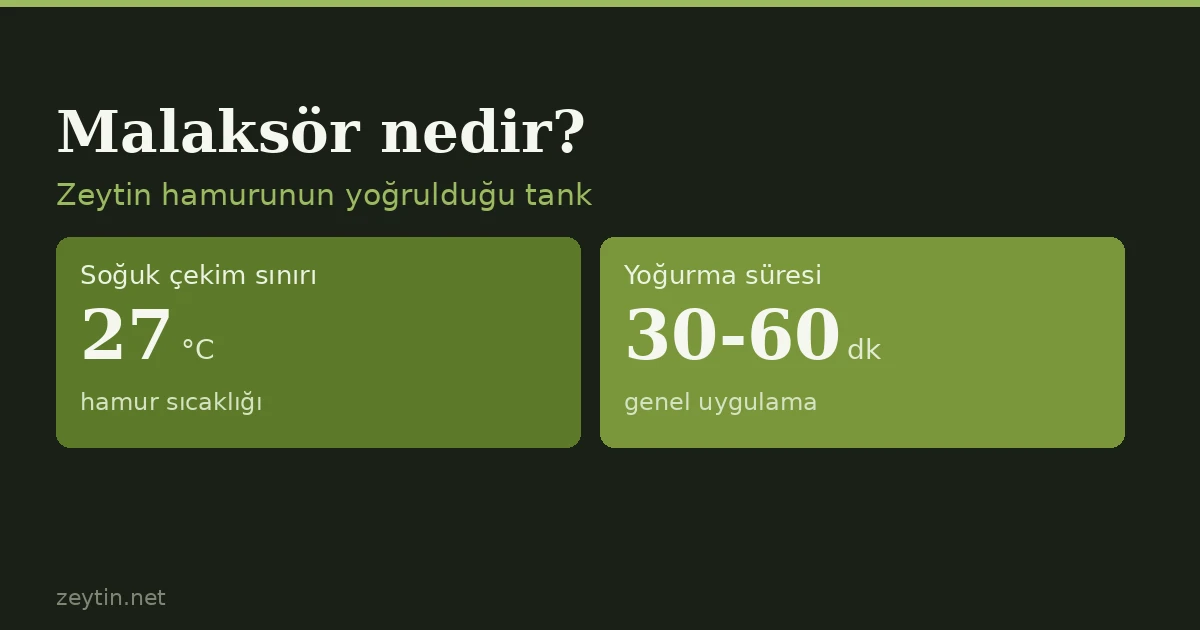
In practice, malaxation usually lasts between half an hour and an hour. The exact time depends on the variety, the ripeness of the fruit and the texture of the paste. Ripe, soft fruit separates faster; green, early harvest fruit gives up its oil less readily.
The 27 °C limit and "cold extraction"
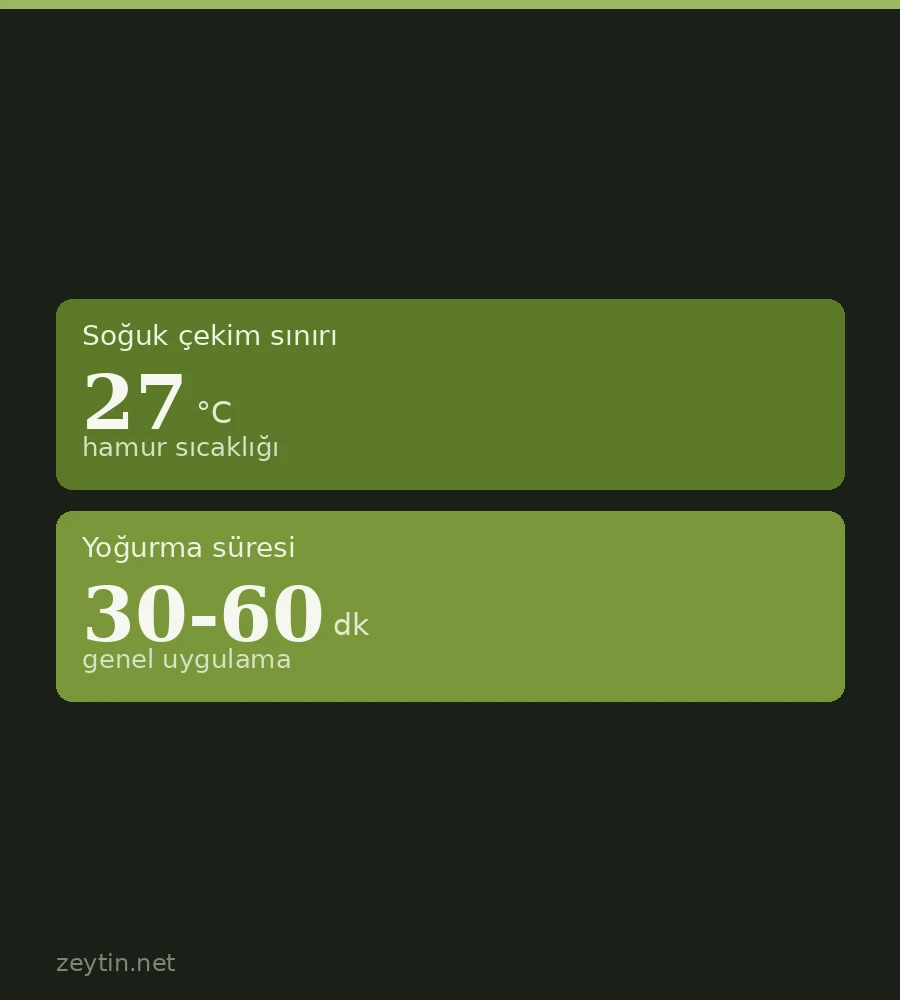
The limit behind the words "cold pressed" or "cold extraction" on labels is largely drawn in the malaxer. European Union rules accept these terms for oils whose paste stayed below 27 °C throughout processing. "Cold pressed" is used for traditional press systems and "cold extraction" for continuous centrifuge systems.
Going above that limit is not forbidden; the label simply cannot be used. Some producers raise the temperature to increase yield from pastes that separate poorly. The result is more oil, but a flatter taste. Our step-by-step guide to how cold-pressed olive oil is made covers this stage under kneading.
Closed malaxers and oxygen
Older malaxers were open at the top or had loose lids. Because the paste stayed in contact with air for a long time, oxidation accelerated and shelf life suffered. Quality-focused mills today use tanks with tightly sealed lids, and in some the air above the paste is replaced with nitrogen. The aim is to allow the enzyme reactions that create aroma while limiting damage from oxygen.
Difficult paste: water and talc
Some varieties and some harvest periods produce a "difficult paste". In paste that is very watery or very oily, with a creamy texture, the droplets simply refuse to merge. The producer has two options. The first is to add lukewarm water to the malaxer or decanter; this helps separation, but part of the polyphenols leaves the oil with the water. The larger volume of water used in three-phase systems is one of the reasons their oil usually has a lower polyphenol content. The second is micronised talc, a processing aid allowed by the regulations. Talc helps break the emulsion, does not remain in the oil and is not an additive that has to be declared on the label.
What happens after the malaxer?
The kneaded paste is pumped to the decanter, a horizontal centrifuge that separates it by density into oil, water and pomace. The difference between two-phase and three-phase systems appears at this stage: in three-phase systems the vegetation water flows out separately, while in two-phase systems it leaves with the pomace as a wet waste. The oil then passes through a vertical centrifuge and goes into a settling tank.
What does it mean for consumers?
An oil's aroma, bitterness and polyphenol content do not depend only on variety and harvest time. The same olives kneaded at a different temperature and for a different length of time can produce noticeably different oil. That is why a grower choosing a mill has good reason to ask: "At what temperature, and for how many minutes?"
Reading notes
There is no single correct value for kneading time and temperature; the ranges here reflect general practice. The term is also explained alongside other production words in our olive glossary.
One rating per visitor; you can change yours at any time. Ratings are real reader votes — no seeded or default scores.
Related
 Article
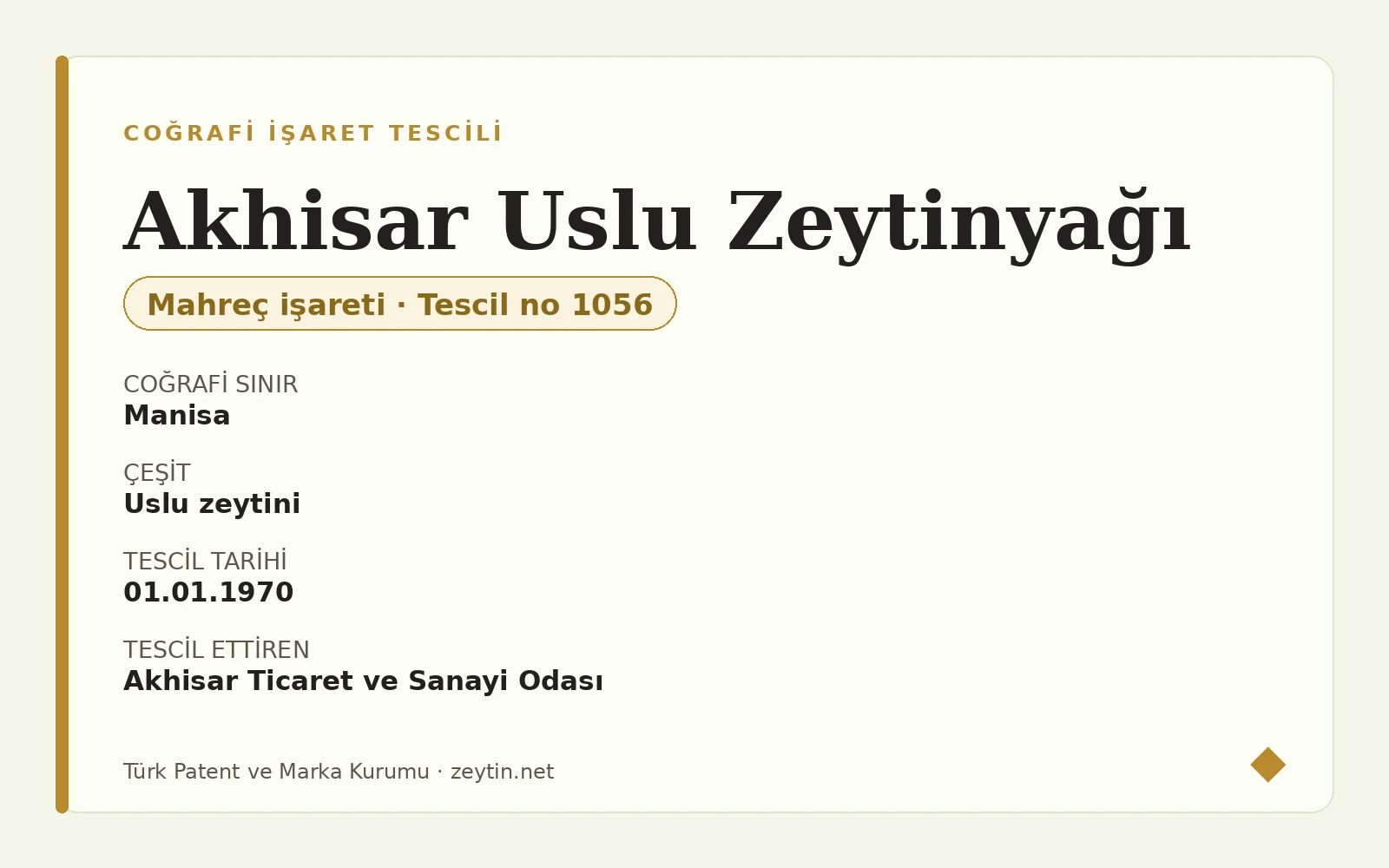
Akhisar Uslu Olive Oil: oil from a black table cultivar
Registered in 2017. Uslu is principally a table cultivar; the certificate protects its oil separately. β-sitosterol sits in a very narrow 87.36-87.39% band.
Article
Akhisar Uslu Olive Oil: oil from a black table cultivar
Registered in 2017. Uslu is principally a table cultivar; the certificate protects its oil separately. β-sitosterol sits in a very narrow 87.36-87.39% band.
 Article
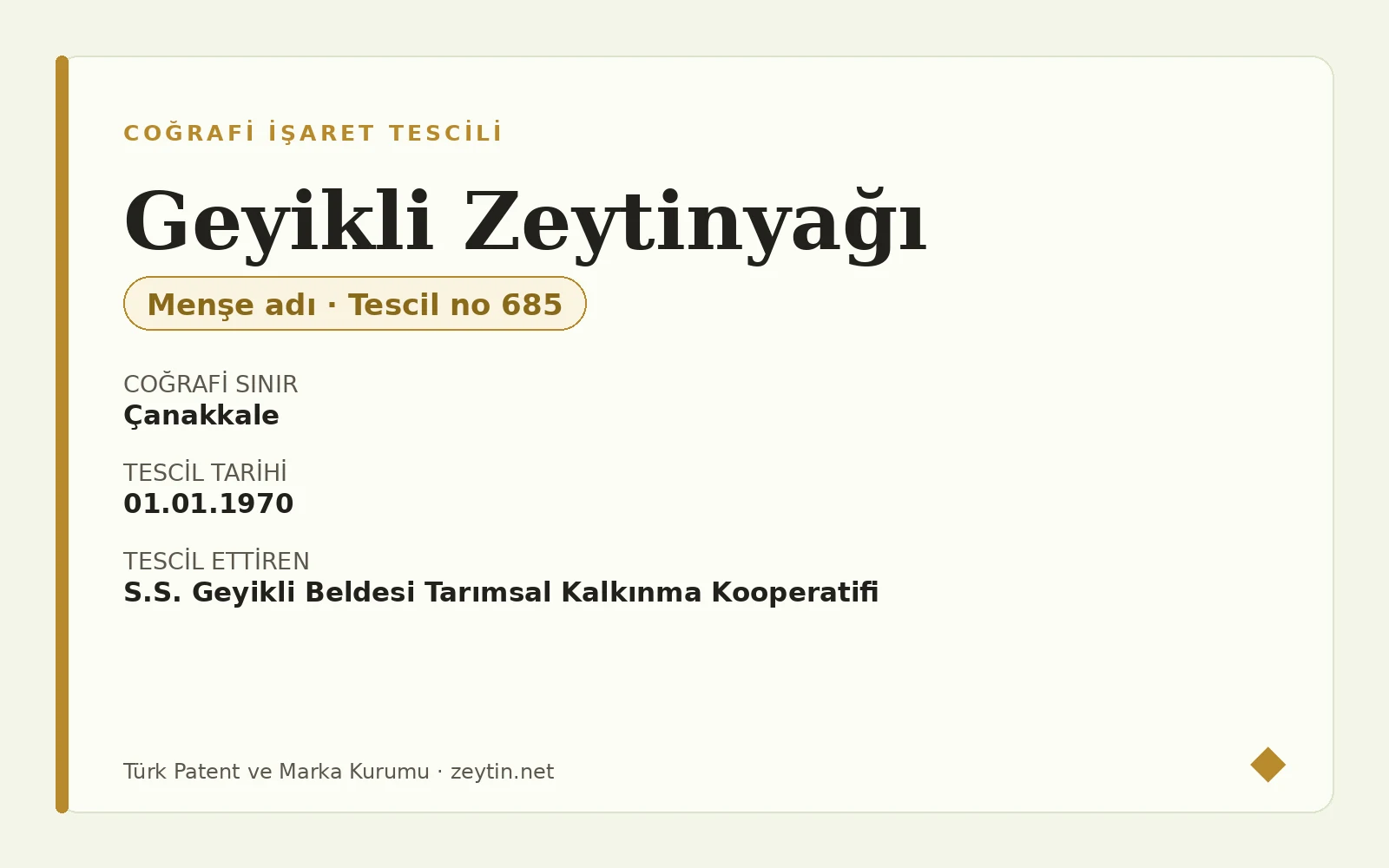
Geyikli Olive Oil: a registration that names its pollinators
Registered in 2020. From the Ayvalık cultivar; the certificate also records Gemlik and Hanım Parmağı as pollinators in the groves. Limits are set on 16 aroma compounds.
Article
Geyikli Olive Oil: a registration that names its pollinators
Registered in 2020. From the Ayvalık cultivar; the certificate also records Gemlik and Hanım Parmağı as pollinators in the groves. Limits are set on 16 aroma compounds.
 Article
Burhaniye Olive Oil: two thousand years attested by the Adramytteion excavations
Registered in 2021. The certificate grounds two thousand years of olive growing in the excavation of an ancient city, and sets separate sensory thresholds for early and ripe harvest.
Article
Burhaniye Olive Oil: two thousand years attested by the Adramytteion excavations
Registered in 2021. The certificate grounds two thousand years of olive growing in the excavation of an ancient city, and sets separate sensory thresholds for early and ripe harvest.
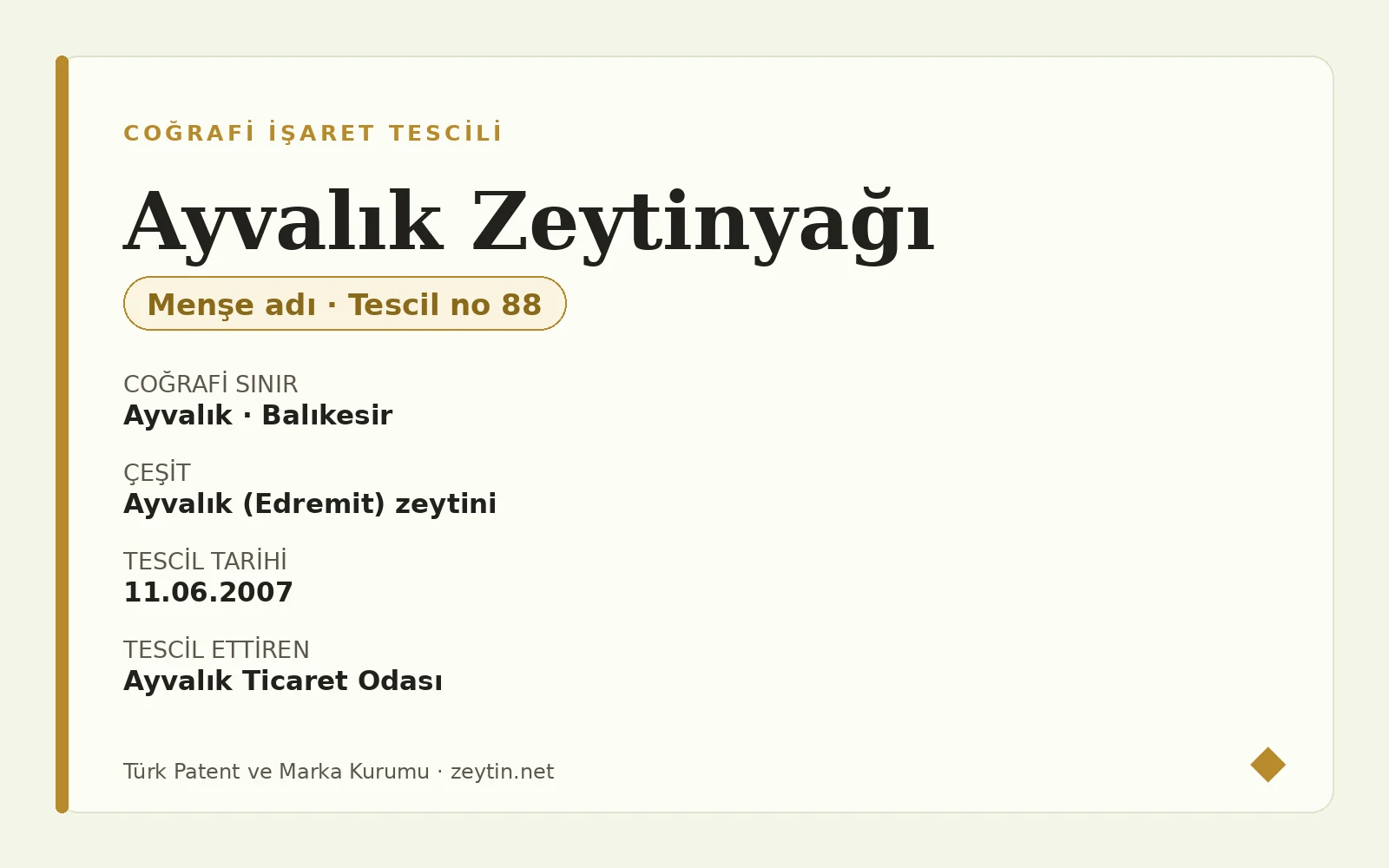 Article
The Ayvalık Olive Oil designation of origin: the chemical profile in the certificate
Registered in 2007. The certificate carries tables of fatty acids, sterols and phenolics — the ranges within which an oil counts as Ayvalık Olive Oil are set out in figures.
Article
The Ayvalık Olive Oil designation of origin: the chemical profile in the certificate
Registered in 2007. The certificate carries tables of fatty acids, sterols and phenolics — the ranges within which an oil counts as Ayvalık Olive Oil are set out in figures.