Akhisar's crop tripled and Domat olives fell from 100 to 40-45 lira: 40-60 lira at the producer, 450-500 lira on the shelf
According to a 20 November 2026 report, the olive crop in Akhisar has tripled on last year; a producer says Domat olives fell from 100 to 40-45 lira per kilogram. Olives at 40-60 lira at the producer reach 450-500 lira on shelves; a sector representative expects no rise in olive oil prices soon.
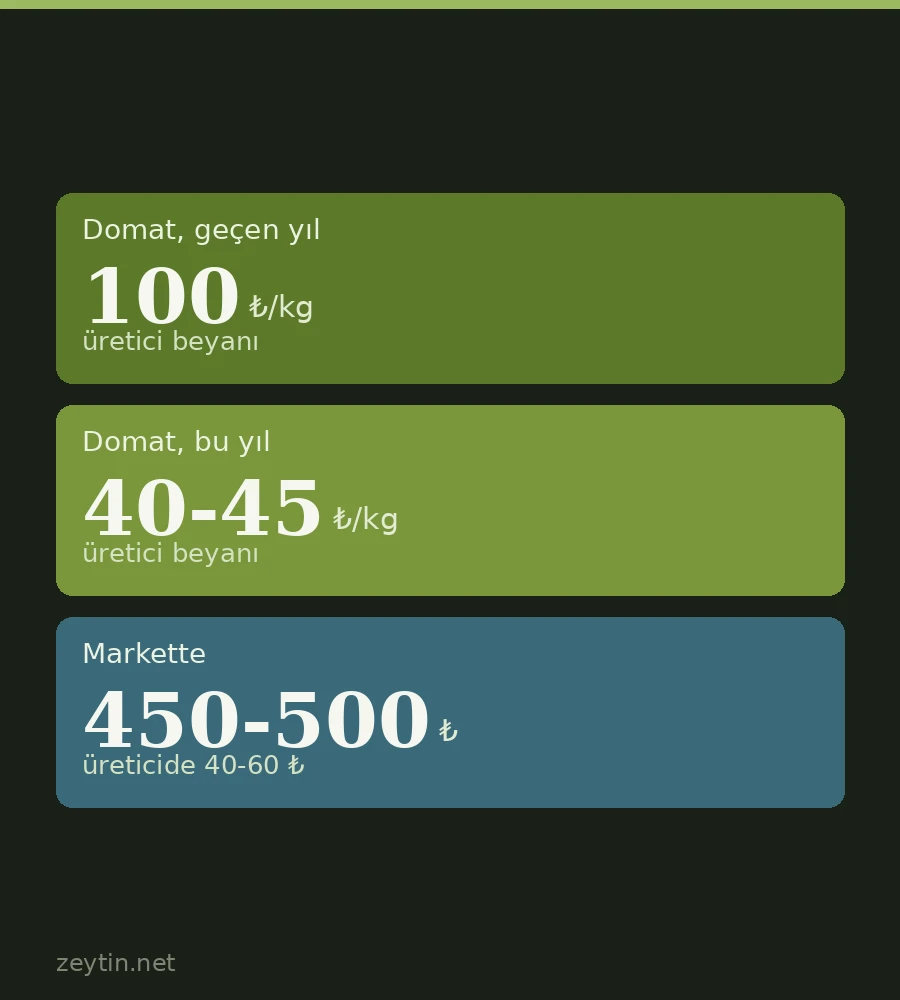
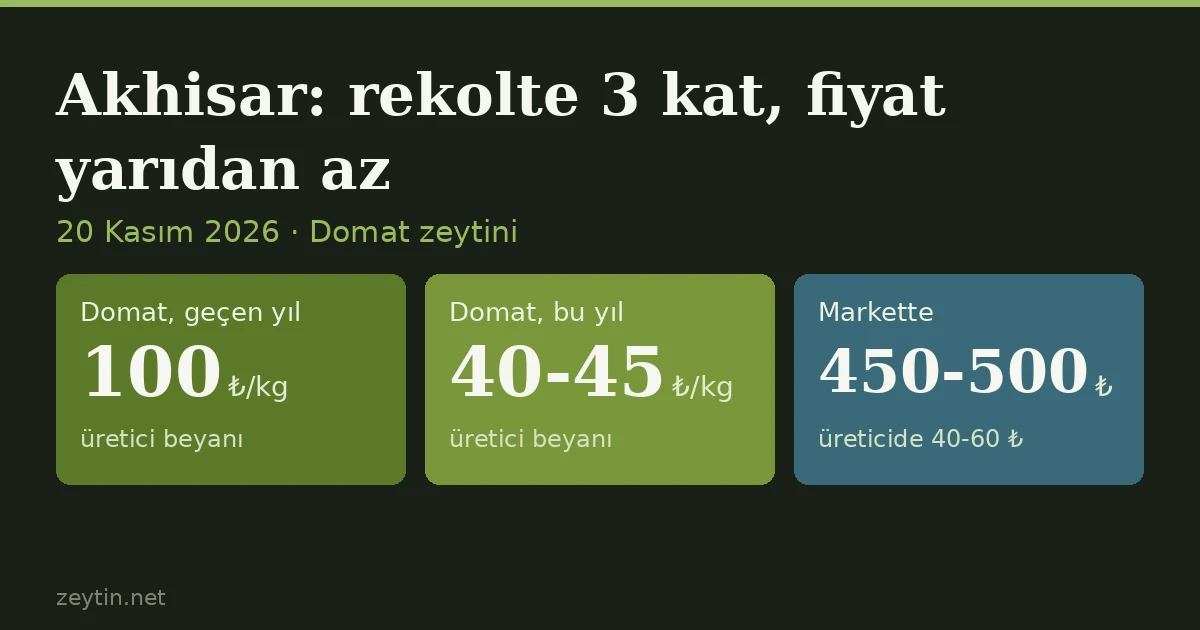
While the olive harvest and olive oil production continue in Akhisar, in Manisa province, sector representatives do not expect olive oil prices to rise in the near term, according to a report dated 20 November 2026. The main figures in the report are these: the olive crop in the district has risen threefold on last year, Domat olives that sold for 100 lira per kilogram last year are trading at 40-45 lira this year, and olives that fetch 40-60 lira at the producer reach 450-500 lira on supermarket shelves.
What the report says
| Item | What the report says |
|---|---|
| Crop | Three times last year's |
| Domat olives, last year | 100 lira/kg (producer Erol Aydın) |
| Domat olives, this year | 40-45 lira/kg (producer Erol Aydın) |
| Producer price | Between 40 and 60 lira |
| Market price | Up to 450-500 lira; 500 lira for pepper-stuffed olives, against a producer price of 50-60 lira |
| Yield | About 6 kg of olives for 1 kg of olive oil (producer Erol Aydın) |
| Price outlook | No rise expected in the near term (olive oil producer Tuncay Bilen) |
How did the price change?
A simple calculation comes out of the two figures in the report: a fall from 100 lira to 40-45 lira in Domat olives is a drop of between 55 and 60 percent. This is a comparison relayed by one producer; the report does not state the size grade of the fruit, although in Domat the price varies by up to a factor of four with grade. In the list announced on 6 October at the opening of the season, the double grade was 60 lira, grade 1 was 50 and grade 2 was 40; 40-45 lira falls in the lower half of that range. The producer also says similar prices have formed for oil olives. The oil-olive item in the October list was 10 lira, while in Marmarabirlik's list the oil-olive price had fallen to 40 lira. The three figures belong to different products, varieties and dates, so they cannot be compared directly.
The gap between field and shelf
The comparison highlighted in the headline, 40-60 lira against 450-500 lira, shows a spread of roughly 7.5 to 12.5 times. In the one concrete example the producer gives, pepper-stuffed olives are 500 lira on the shelf against 50-60 lira at the producer: roughly 8.3 to 10 times. These calculations have a limit as a comparison: raw olives in the field and a processed, packaged product on the shelf are not the same thing, and the difference includes processing, packaging, transport, tax and retail margin. The report also does not say which unit and which brand the shelf price applies to; we assumed kilograms. The finding of a "spread" therefore points in the right direction, but this report cannot tell us how much of it goes to whom.
What does the sector representative say?
Tuncay Bilen, owner of Gizem Zeytinyağı, which operates in the Dereköy neighbourhood and holds gold medals from Europe, said that despite producing quality goods "we cannot get what our product deserves, neither in oil nor in olives". Touching on the importance of inspections in price formation, Bilen said prices should form in a healthier way from production until they reach the consumer. His statement that they do not expect olive oil prices to rise in the near term is a forecast; the report gives no concrete data as its basis.
Bilen also pointed to producer support in Italy and Spain: "In Italy, farmers are given 1,700 euros of support per tonne of oil," he said, adding that the support given in Türkiye "remained very low" and was removed. The figure is Bilen's statement; we have not verified it, and the report does not explain which support was removed. For the export-side support under discussion, see our report on the export support package written the same day.
What does a threefold crop mean?
The base year needs to be kept in mind when reading a threefold increase. According to the official assessment of the National Olive and Olive Oil Council, olive oil production in Türkiye fell from 475,000 tonnes in 2024/25 to 310,000 tonnes in 2025/26; last season was an off year nationwide. Part of the rise in Akhisar may come from this low base; the report gives neither the reason for the increase nor a figure in tonnes, so this is our own assessment. The same base effect may be at work in the price: the 100 lira at which Domat sold last year may have been a tight-supply price. That too is our own interpretation; the report does not explain the reason for the comparison.
In October producers in the district halted the harvest and protested the announced purchase prices. This report shows that the picture has not changed as the harvest has advanced, or at least that it has not improved from the producer's point of view.
What the report does not say
- The size of the crop in tonnes and its official source.
- Which size grade and which buyer the 40-45 lira Domat price belongs to.
- Which product, brand and unit the market price was given for.
- Any view from the Chamber of Agriculture, the Commodity Exchange or the Ministry on these prices.
- The data behind the expectation of no price rise.
Why this matters
Akhisar is Türkiye's main centre for table olives; the end-of-harvest picture in the district will determine producers' earnings for the rest of the season. As the crop grows the price falls, while the shelf price does not fall at the same speed. Until it is measured how much of this spread comes from processing and distribution costs and how much from price formation, the debate will remain one-sided. We will update the article when new purchase prices and official crop figures are announced as the harvest advances.
One rating per visitor; you can change yours at any time. Ratings are real reader votes — no seeded or default scores.
Related
 Article
Tunisia sold 381,000 tonnes of olive oil in ten months: 85.5% in bulk, half of it to Spain and Italy
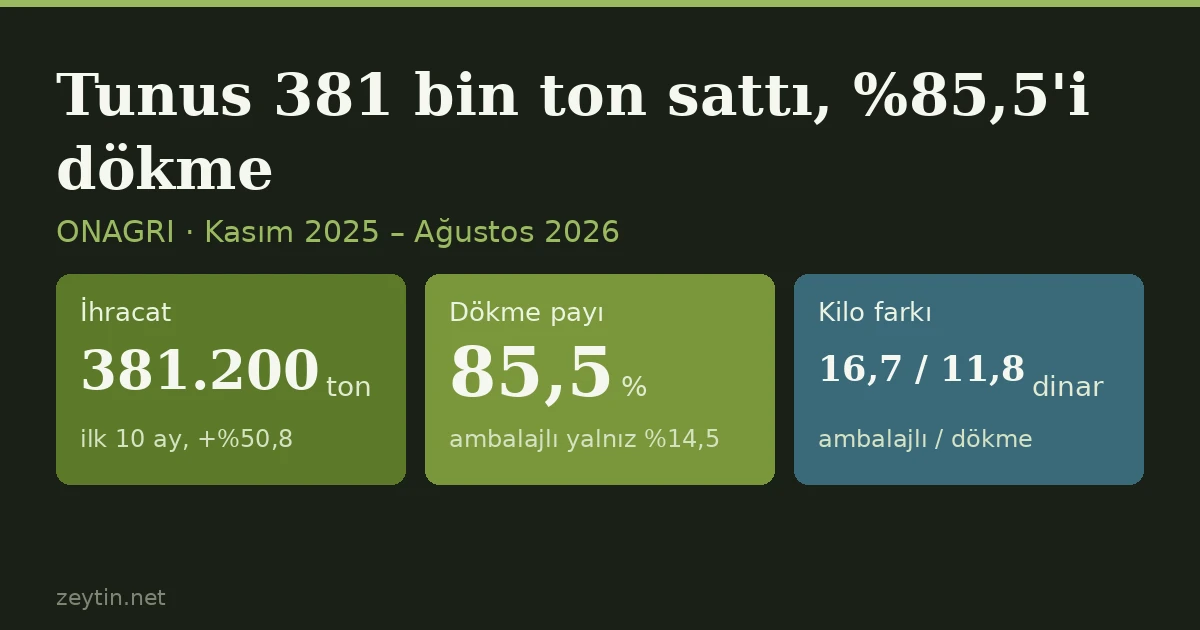
According to the National Observatory of Agriculture (ONAGRI), Tunisia exported 381,200 tonnes of olive oil in the first ten months of the 2025/26 season — volumes up 50.8% and receipts up 41.2% year on year. But 85.5% of it left the country in bulk, and more than half went to Spain and Italy. Packaged oil averaged 16.7 dinars per kilo against 11.8 for bulk. Production is set to fall 40% next season, which changes the bulk market Turkish exporters face.
 Article
In Spain the cost sits above the price: €5.31 in a traditional grove, €3.46 at the gate
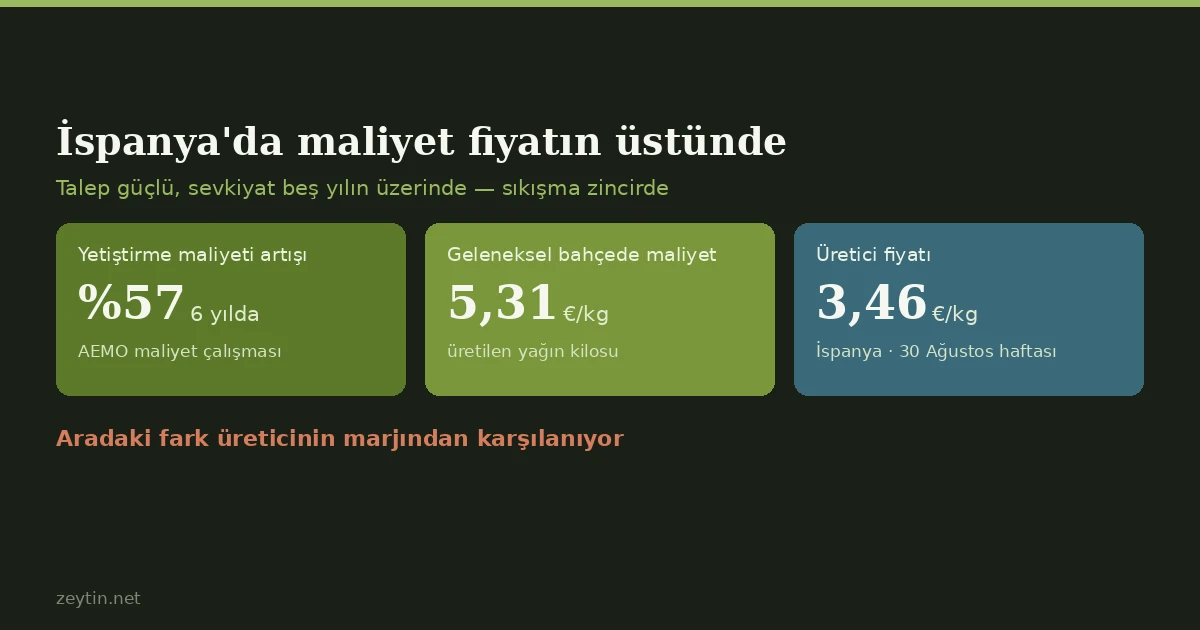
Olive cultivation costs have risen 57% in six years and reach €5.31 per kilogram in the most traditional groves, according to an AEMO study. The same week, Spain's producer price was €3.46. The Andalusian cooperative federation, with 342,000 members, is asking not for aid but for a change to the Food Chain Law.
 Article
Andalusia finally puts a number on it: 1.26 million tonnes of olive oil, up 24%
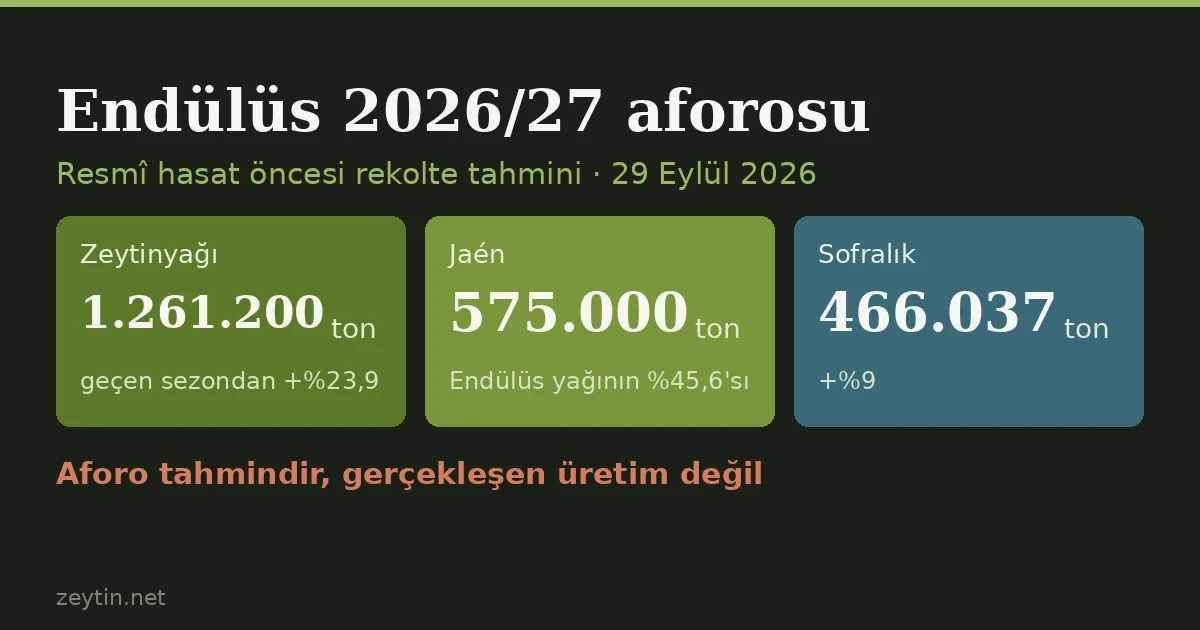
Andalusia's agriculture ministry published its 2026/27 aforo on 29 September in Mengíbar: 1,261,200 tonnes of olive oil, 23.9% above last season and 44% above the five-year average. The heat warning growers raised in early September made it into the forecast's own reasoning. Four times Turkey's entire season output is entering an already soft price environment.
 Article
"Not definitive until November": Andalusian growers push back on the crop estimate
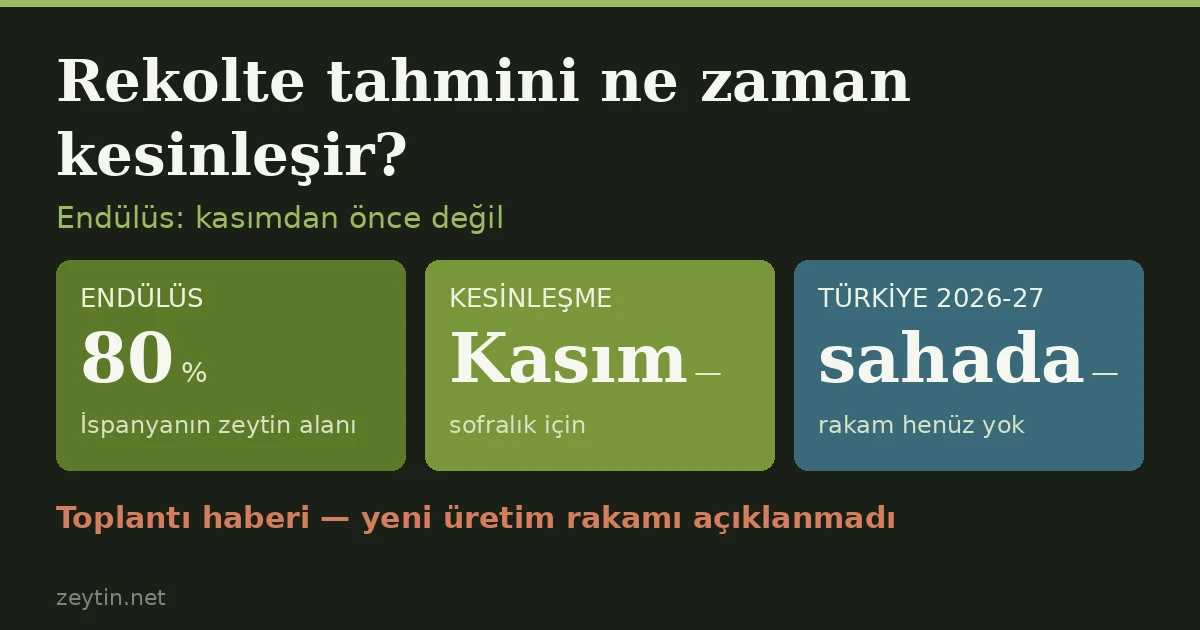
Andalusia's agriculture ministry called its first crop estimate "high production"; cooperatives and COAG in Seville objected: recent heat will affect the crop and the estimate is not definitive until November. Türkiye is making its 2026-27 estimate in the field the same week — the same caution applies here.