Opening prices in Akhisar: 60 lira for double Domat, 10 lira for milling olives
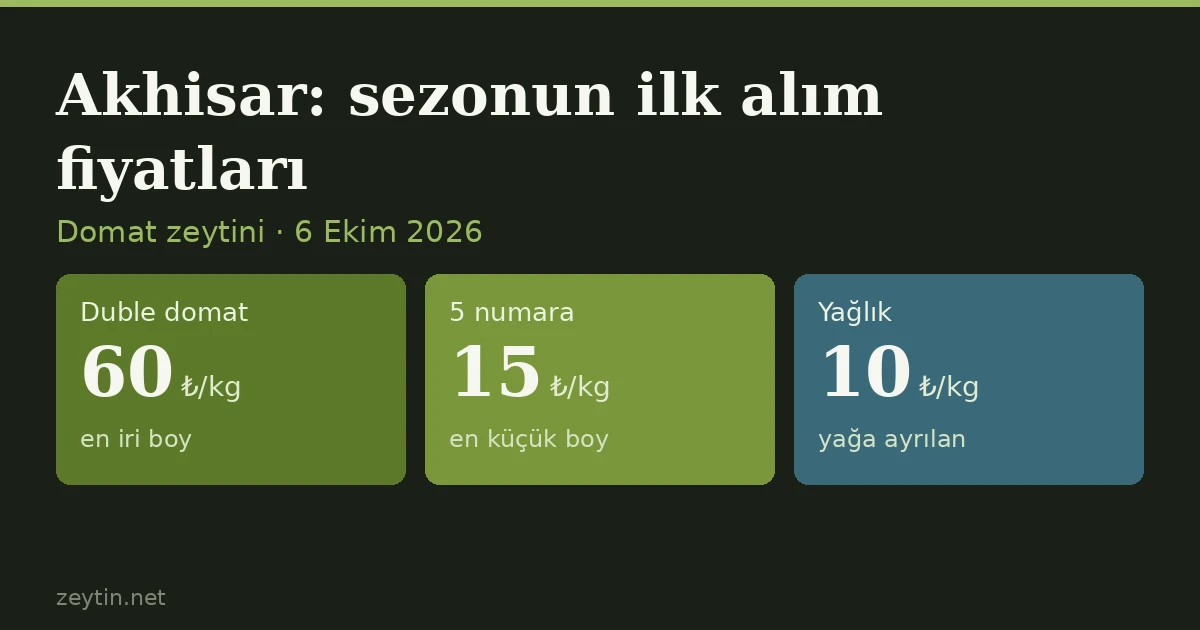
The season's first purchase prices for Domat olives have formed in Akhisar: 15 to 60 lira a kilo by size, and 10 lira for fruit sold for milling. The local chamber of agriculture says prices are below last year's and has called for a joint table. Farm input costs rose 27.6% over the same period.
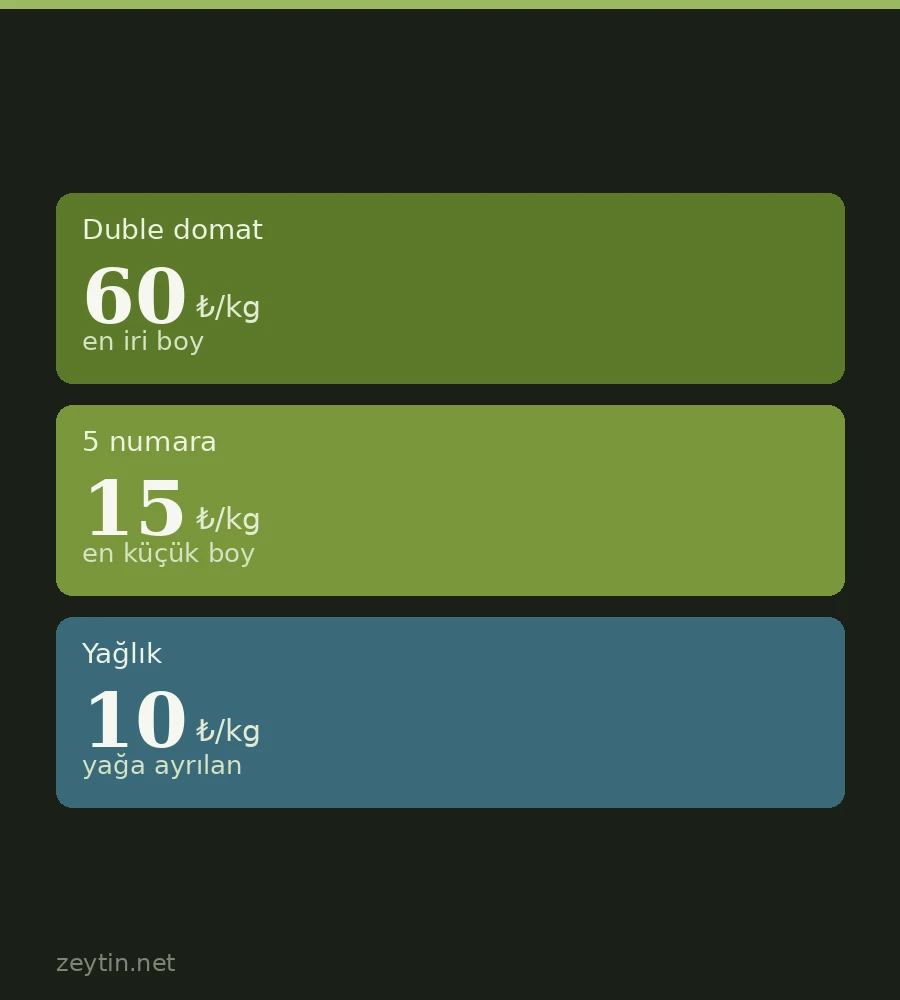
Harvest has begun in Akhisar, Türkiye's centre for table olives, and the season's first purchase prices have formed. According to the list published on 6 October, Domat olives — the first variety to be picked — are being bought at between 15 and 60 lira a kilo, depending on fruit size.
Opening prices by size
| Grade | Purchase price |
|---|---|
| Double | 60 ₺/kg |
| Grade 1 | 50 ₺/kg |
| Grade 2 | 40 ₺/kg |
| Grade 3 | 35 ₺/kg |
| Grade 4 | 25 ₺/kg |
| Grade 5 | 15 ₺/kg |
| For milling | 10 ₺/kg |
The spread shows why size governs everything in this variety: there is a fourfold difference between double and grade 5. Domat has a large fruit and a stone that is small relative to the flesh, which makes it the raw material of the stuffed-olive industry. Fruit too small to be pitted and stuffed falls into a far cheaper market even though it came off the same tree. Olives diverted to milling sit at the very bottom, because Domat is a table variety and was never an economic choice for oil.
The chamber calls for a joint table
A day before the prices appeared, on 5 October, the chairman of the Akhisar Chamber of Agriculture, Ahmet Akbuğa, issued a written appeal. He describes a generous year in both yield and quality, with many groves in an on-year — and then states that the abundance in the grove is not reaching the grower's income.
The most concrete sentence concerns the price level itself: purchase prices are below even last year's and beneath what production costs require. The chamber wants every institution involved to meet before the harvest advances, and lists six demands: production costs to be set out transparently; the financing squeeze during harvest to be eased, so that growers are not forced to sell cheaply purely for immediate cash; purchasing, processing and storage capacity in cooperatives to be strengthened; domestic consumption and exports to be developed together; predictability in export markets; and a long-term olive programme.
The appeal carries a warning as well. Young groves that have not yet come into bearing will enter production in the coming years, so the processing and storage infrastructure that a growing capacity will demand needs to be prepared now rather than after the fruit leaves the grove. A comparable call came from the oil side in September, when the Edremit Chamber of Commerce asked for support of at least 50 lira a litre.
What happened on the cost side
A low price says little on its own; it has to be set against cost. According to the Turkish Statistical Institute's agricultural input price index, input prices rose 27.62% year on year in July, with the sharpest increase — 33.07% — in the fertiliser and soil improvers group. The agricultural producer price index rose 21.91% year on year in August.
The gap of roughly six points between those two indices sums up the grower's position this season: inputs are rising faster than the crop they produce. A large harvest does not close that gap, because the abundance itself is what pushes the price down.
The distance between grove and shelf
In this site's retail survey on 8 October, green table olives on supermarket shelves ranged from 194 to 1,470 lira a kilo across 24 products, averaging 380 lira. In the same days, grade 5 Domat was being bought in the grove at 15 lira and double Domat at 60.
⚠ These are not two prices for the same thing. Between them sit brining, losses, sorting, packaging, cold chain, distribution and tax, and the shelf product is usually differentiated by brand, stuffing or size class. Even so, the size of the distance explains why domestic consumption and added value appear near the top of the chamber's list of demands.
The reference price is still missing
In the Marmara basin the reference price for table olives is set by the cooperative union, and no purchase price announcement appears to have been made for this season yet. Declarations, meanwhile, keep coming in: in Orhangazi, growers' crop declarations passed 4,200 tonnes in the first ten days, with roughly 70,000 tonnes of production expected in the district.
When the union does publish its price, it will also shape the floor under the prices merchants offer on the open market. The Akhisar list is the photograph taken before that moment: prices formed in the first days of harvest, before supply has fully arrived.
Why the world market matters here
The 10-lira milling price is not only a function of the variety. It also reflects where the oil market is heading. Spain expects 1.6 million tonnes of olive oil in 2026/27, and Spanish extra virgin had slipped to €3.43/kg in the week of 4 October. When the largest supply in the world is abundant, every kilo diverted to milling in Türkiye negotiates from a weaker position.
As harvest accelerates in the coming weeks, more fruit will reach the market. The direction of prices will depend on how deeply the buying side — the union, merchants and industry — purchases while supply loads in. As for Domat's geographical indication, the privilege a registration confers only becomes real when the registered product is priced separately; the opening list shows no sign of that distinction.
One rating per visitor; you can change yours at any time. Ratings are real reader votes — no seeded or default scores.
Related
 Article
Olive fruit fly warning before harvest in Aydın: check groves, spray only above the threshold
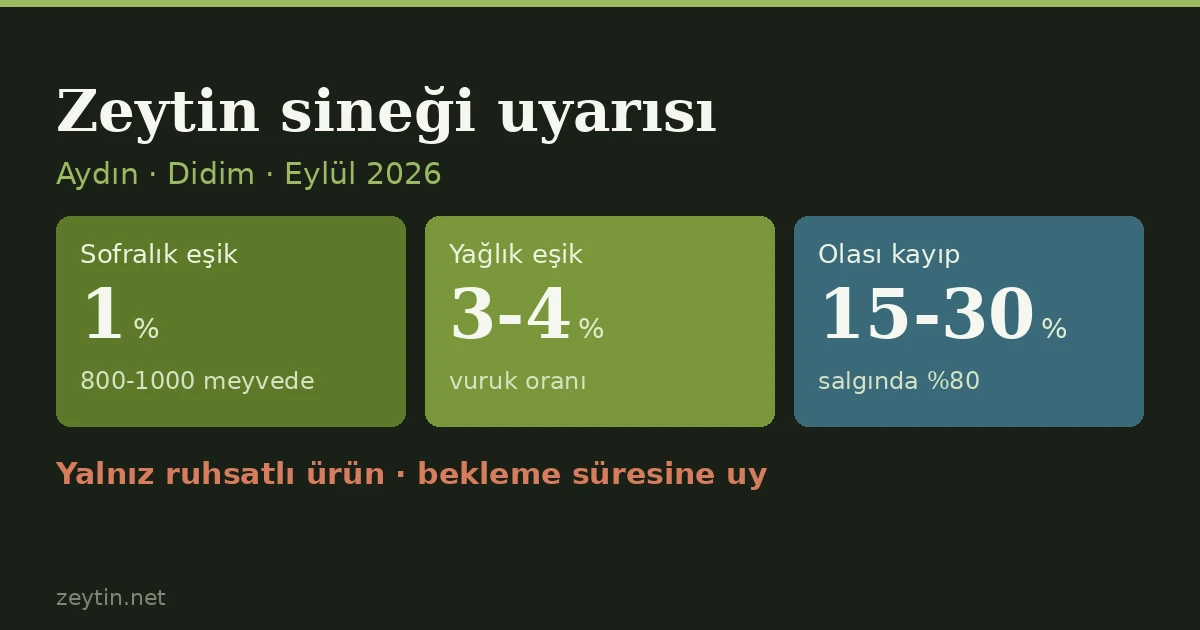
The Didim District Directorate of Agriculture and Forestry, together with the Aydın Provincial Directorate, has warned growers about the olive fruit fly ahead of the harvest. Growers were asked to check groves regularly, monitor pest density and, if needed, act only with products licensed for olives and at the right time. Fly pressure rising in autumn cuts both yield and oil quality.
Article
Olive fruit fly warning before harvest in Aydın: check groves, spray only above the threshold
The Didim District Directorate of Agriculture and Forestry, together with the Aydın Provincial Directorate, has warned growers about the olive fruit fly ahead of the harvest. Growers were asked to check groves regularly, monitor pest density and, if needed, act only with products licensed for olives and at the right time. Fly pressure rising in autumn cuts both yield and oil quality.
 Article
Crop forecast climbs as the minimum-price debate returns: what the exchange numbers say
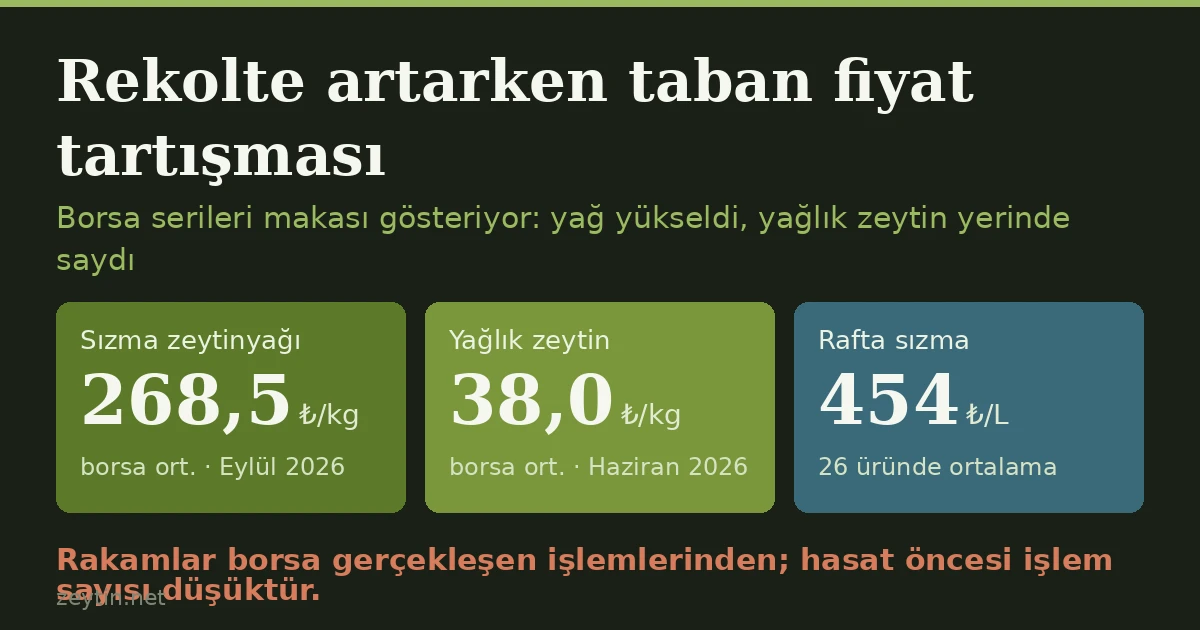
With the 2026 harvest approaching, crop forecasts are up 40 percent in some provinces and growers want a floor price. Our exchange series shows why the dispute is really about olives, not oil.
Article
Crop forecast climbs as the minimum-price debate returns: what the exchange numbers say
With the 2026 harvest approaching, crop forecasts are up 40 percent in some provinces and growers want a floor price. Our exchange series shows why the dispute is really about olives, not oil.
 Article
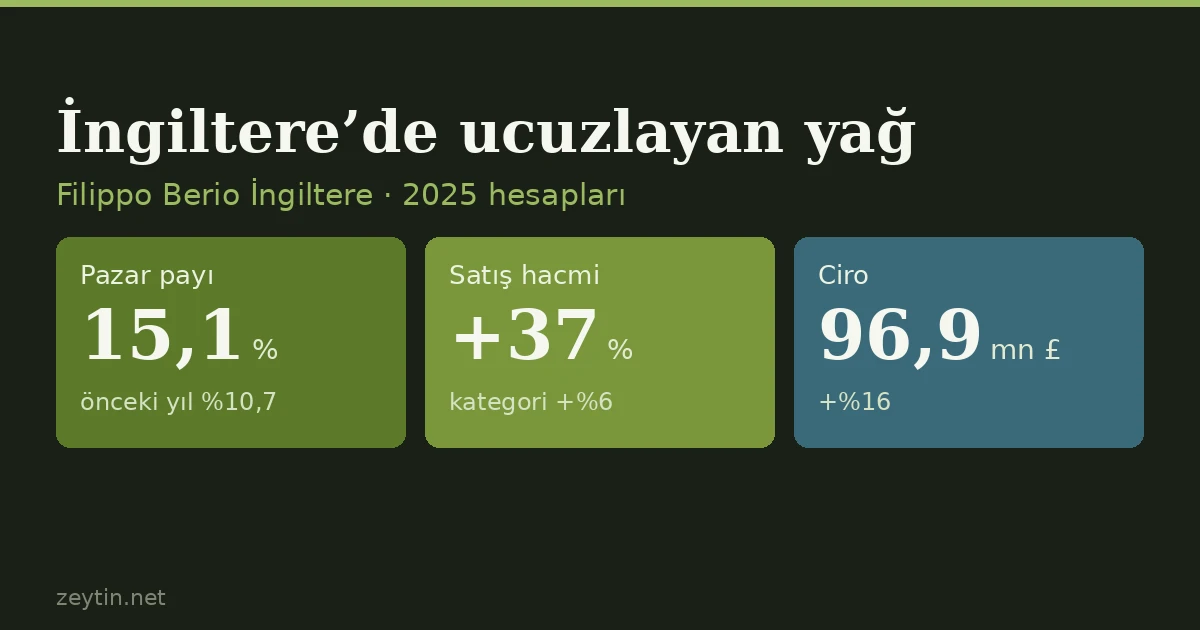
Olive oil got cheaper in the UK and Filippo Berio lifted its share to 15%
The 2025 accounts of Filippo Berio's UK company show how falling prices reached the shelf: volumes up 37%, revenue up 16%, market share from 10.7% to 15.1%. The category grew 6% and lower wholesale costs were passed on to shoppers.
Article
Olive oil got cheaper in the UK and Filippo Berio lifted its share to 15%
The 2025 accounts of Filippo Berio's UK company show how falling prices reached the shelf: volumes up 37%, revenue up 16%, market share from 10.7% to 15.1%. The category grew 6% and lower wholesale costs were passed on to shoppers.
 Article
Andalusia moves against North African imports: 76% of what arrives is extra virgin
Andalusia's farm sector objects that more than 76% of the olive oil imported into the region in early 2026 was extra virgin. The regional minister has requested exceptional measures under Article 195 of the EU regulation. Türkiye could meet the same door.
Article
Andalusia moves against North African imports: 76% of what arrives is extra virgin
Andalusia's farm sector objects that more than 76% of the olive oil imported into the region in early 2026 was extra virgin. The regional minister has requested exceptional measures under Article 195 of the EU regulation. Türkiye could meet the same door.