Olive oil got cheaper in the UK and Filippo Berio lifted its share to 15%
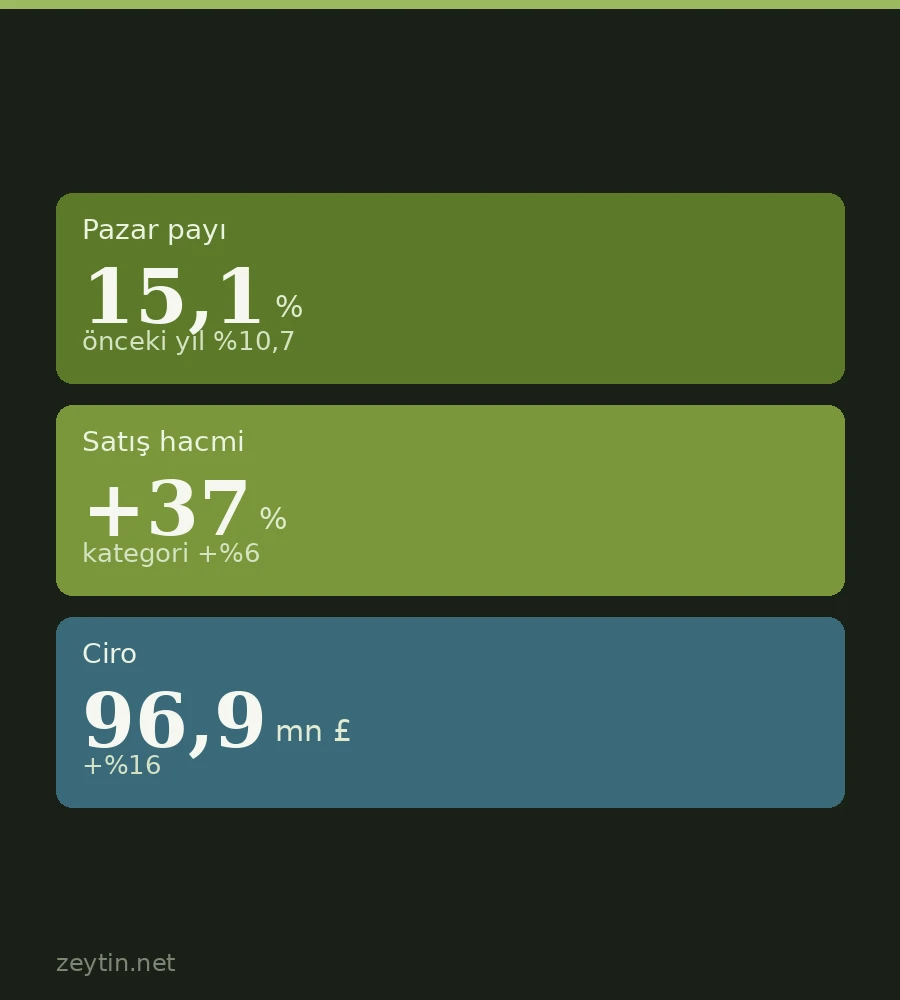
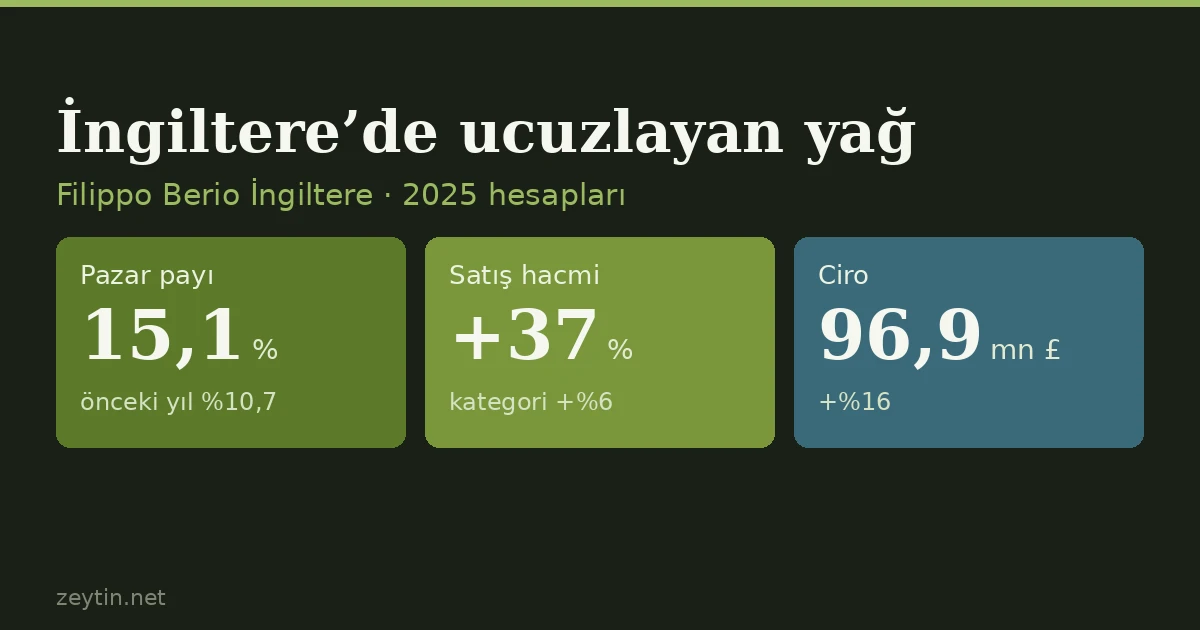
The 2025 accounts of Filippo Berio's UK company show how falling prices reached the shelf: volumes up 37%, revenue up 16%, market share from 10.7% to 15.1%. The category grew 6% and lower wholesale costs were passed on to shoppers.
The retreat of olive oil prices from their early-2024 peak is described as a loss in producing countries. In consuming countries the same fall tells a different story. The accounts for the year to 31 December 2025 of the UK company of the Italian-rooted Filippo Berio brand show, in figures, how cheaper oil reached the shelf.
The figures
| Filippo Berio UK | 2025 | vs previous year |
|---|---|---|
| Market share | 15.1% | +4.4 pts (10.7%) |
| Volume | — | +37% |
| Revenue | £96.9m | +16% |
| Operating profit | £3.9m | +16.9% |
The UK olive oil category grew by about 6% in volume in the same year, so most of the brand's growth came from share taken from rivals rather than from new shoppers.
Whose brand is Filippo Berio?
The brand was founded in 1867 in Lucca, Tuscany. Today it is a brand of the Salov group, in which the Chinese food company Bright Food bought a majority stake in 2015. The oil in its bottles is blended from oils bought in several Mediterranean countries. The company's cost therefore follows the Mediterranean wholesale price, not one country's harvest, and that flexibility is why it could pass a wholesale fall on to the shelf quickly.
The UK is one of the brand's strongest markets. Olive oil there is sold mostly from supermarket shelves, often on promotion, and a difference of a few pounds can decide which bottle a shopper picks. The 37% volume gain is a result of that price sensitivity.
Why volume and revenue diverged
Bottles sold rose 37% while revenue rose only 16%, which means the unit price fell sharply. The accounts state the reason plainly: lower wholesale costs were passed on to customers. Gross margin narrowed slightly, but the volume gain was enough to lift operating profit.
A simple calculation: if volume rose 1.37 times and revenue 1.16 times, average revenue per bottle fell by about 15% (1.16 ÷ 1.37 ≈ 0.85). The narrower gross margin suggests total costs did not fall as fast as the shelf price: packaging, transport and forward purchase contracts follow wholesale prices with a lag, so part of the discount came out of the company's own pocket; the 16.9% rise in operating profit shows volume more than paid it back.
The price picture is clear. European wholesale olive oil prices have roughly halved since the early-2024 peak. European Commission data put Spanish extra virgin at €3.49/kg in early September, and the IMF's August average was $6,262 per tonne. We follow these series in our weekly price bulletin.
Is demand coming back?
At the price peak, purchases fell noticeably in consuming markets such as the UK, Germany and the US, and some shoppers moved to sunflower and rapeseed oil. Filippo Berio's 2025 figures are among the first concrete company data showing that shoppers return once prices become reasonable.
Yet category growth of only 6% says the recovery is not complete. Most of the movement comes from brand switching and price-sensitive buyers. Brands that cut prices quickly gain share; those holding on to old prices lose it.
What it means for Türkiye
Recovering demand in consuming markets is a positive sign for exports, but the condition is price. British shoppers turned to cheaper Spanish and Italian branded oil. This season we saw Turkish exports fall sharply. Whether Turkish oil finds room in these markets depends on staying competitive in the price comparison with Europe.
The second lesson is about brands. The share Filippo Berio won is a gain a bulk seller cannot reach. Even as shelf prices fell, the branded product offset its margin with volume. In bulk trade a price fall is simply lost income. We looked at where the added value stays in the tree-to-shelf value chain.
The producer side
The same price fall triggered a debate in Spain about costs rising above prices, as we covered in Spain's olive growing costs. A fall that is a win for a brand in a consuming country is pressure on the farmer in a producing country. The two pictures should be read together.
The season ahead
Harvest estimates for 2026/27 will firm up in October and November. A good Mediterranean crop would keep pressure on wholesale prices and make shelf-price rises in consuming countries harder. In that case the share race among branded sellers continues, while for producing countries the harvest and minimum price debate grows more important. Price pressure in Greece is another link in the same chain.
Read with care
⚠ The figures come from one company's UK accounts. Market share relies on the retail measurement data used in the company's own report; other measurement firms may show different numbers.
⚠ The accounting period is 1 January – 31 December 2025. Prices eased further in 2026, and this year's figures are not yet published.
⚠ Revenue is in sterling. Euro and dollar exchange-rate moves make direct comparison with prices in producing countries harder.
One rating per visitor; you can change yours at any time. Ratings are real reader votes — no seeded or default scores.
Related
 Article
Field study for Şarköy olive oil: Tekirdağ's pick for "81 Provinces 81 Products"
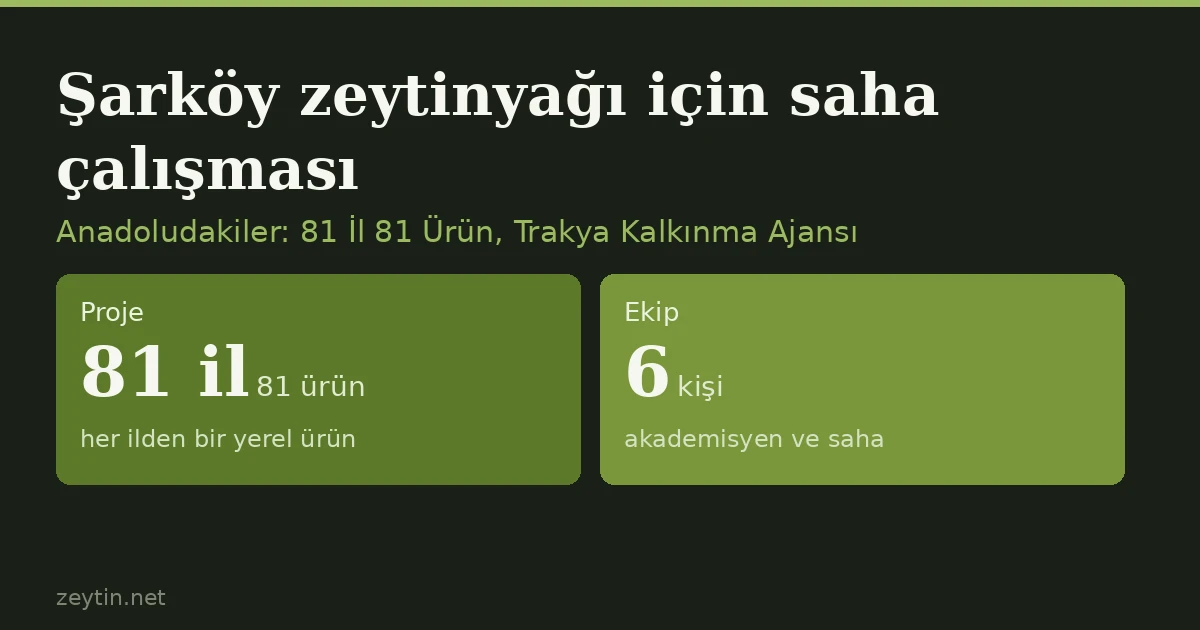
Şarköy olive oil has been chosen as Tekirdağ's product in the "Anatolians: 81 Provinces 81 Products" programme coordinated by the Ministry of Industry and Technology. The Thrace Development Agency and Namık Kemal University surveyed growers and businesses to map the value chain. The goal is branding; there is no geographical indication registration yet.
Article
Field study for Şarköy olive oil: Tekirdağ's pick for "81 Provinces 81 Products"
Şarköy olive oil has been chosen as Tekirdağ's product in the "Anatolians: 81 Provinces 81 Products" programme coordinated by the Ministry of Industry and Technology. The Thrace Development Agency and Namık Kemal University surveyed growers and businesses to map the value chain. The goal is branding; there is no geographical indication registration yet.
 Article
Olive oil exports still down 62% at the end of August: bulk loses 73%
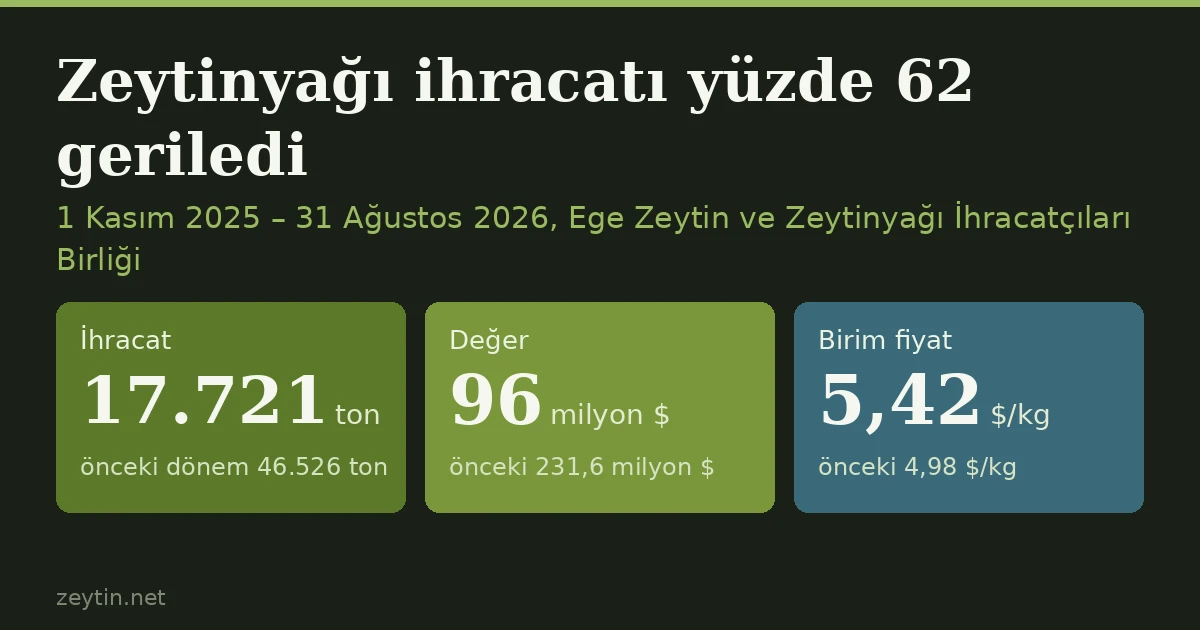
According to the Aegean Olive and Olive Oil Exporters' Association, olive oil exports between 1 November 2025 and 31 August 2026 fell 62% in volume and 59% in value. Bulk sales lost 73%, the US market 70%. Table olives, by contrast, held their ground.
Article
Olive oil exports still down 62% at the end of August: bulk loses 73%
According to the Aegean Olive and Olive Oil Exporters' Association, olive oil exports between 1 November 2025 and 31 August 2026 fell 62% in volume and 59% in value. Bulk sales lost 73%, the US market 70%. Table olives, by contrast, held their ground.
 Article
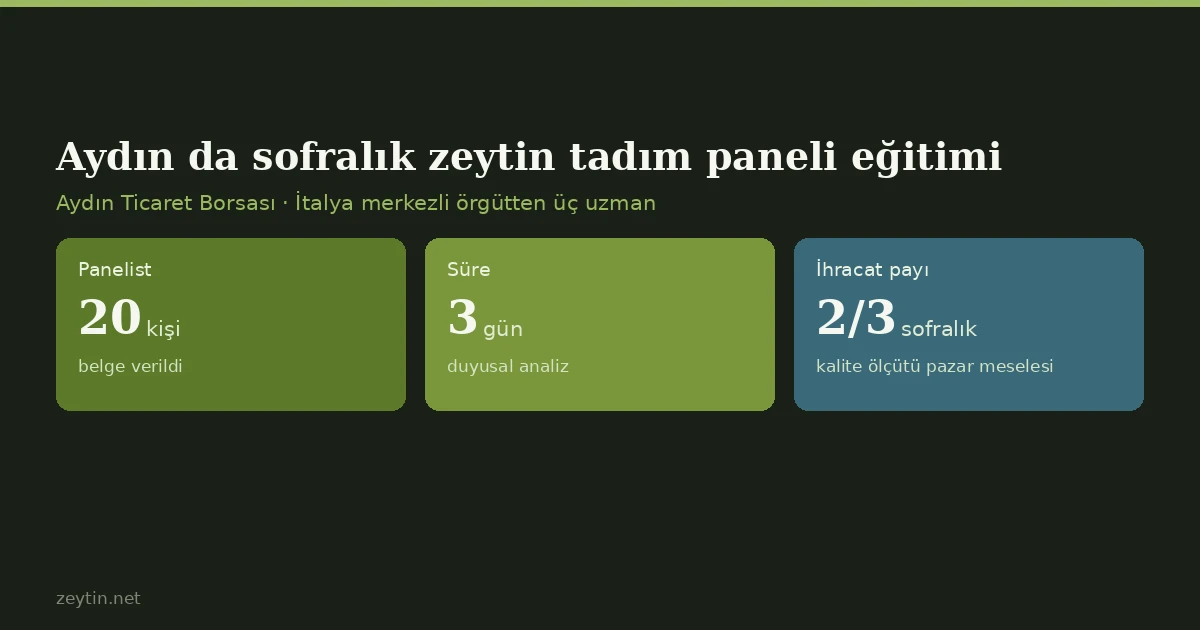
Table olive tasting panel training in Aydın
Aydın Commodity Exchange is extending its sensory analysis experience from olive oil to table olives, with 20 panellists trained over three days.
Article
Table olive tasting panel training in Aydın
Aydın Commodity Exchange is extending its sensory analysis experience from olive oil to table olives, with 20 panellists trained over three days.
 Article
The world's largest bottler is for sale: a €500 million race for Deoleo
Deoleo, owner of Bertolli and Carbonell, holds 22% of global bottled olive oil sales. Italy's Coricelli leads at €500 million, Spain's Dcoop cooperative at €470 million. The Spanish government regards the company as nationally strategic. Because Deoleo is a major bulk buyer, the outcome matters to Turkish exporters too.
Article
The world's largest bottler is for sale: a €500 million race for Deoleo
Deoleo, owner of Bertolli and Carbonell, holds 22% of global bottled olive oil sales. Italy's Coricelli leads at €500 million, Spain's Dcoop cooperative at €470 million. The Spanish government regards the company as nationally strategic. Because Deoleo is a major bulk buyer, the outcome matters to Turkish exporters too.