Greece opens the season at €4: no scarcity in the Mediterranean, but pressure on price
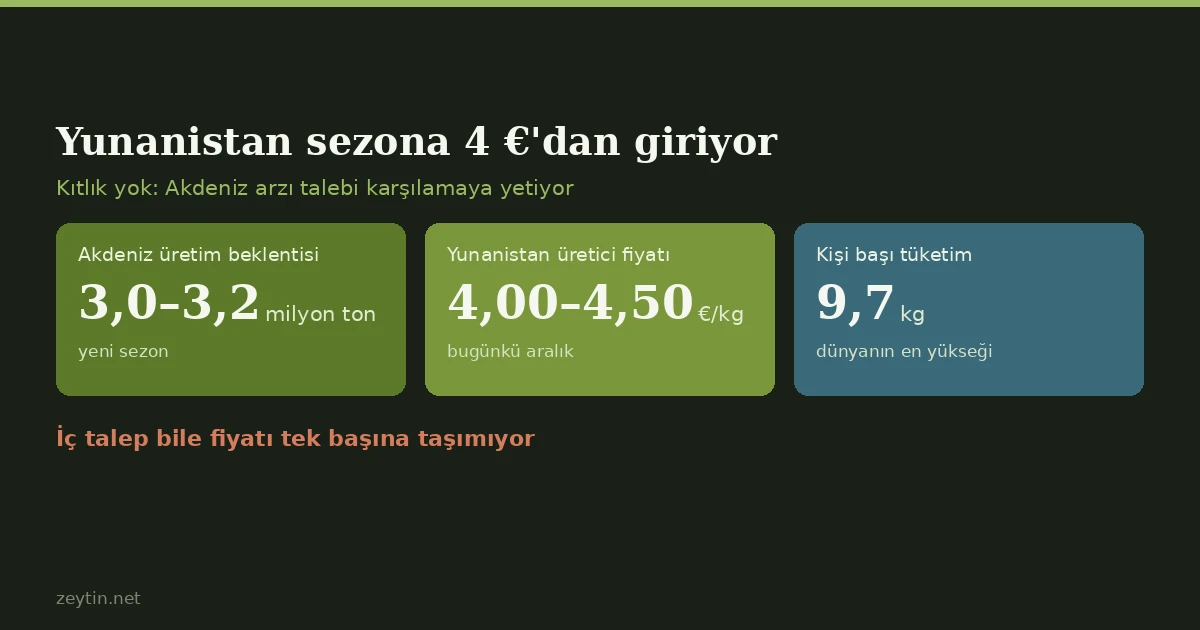
Manolis Giannoulis, president of the National Interprofessional Olive Oil Organization, expects the season to open at around €4 per kilogram. Mediterranean output is forecast at 3–3.2 million tonnes: no record, but enough to meet demand. The market is quiet, buyers are few, and costs plus North African imports keep the pressure on.
Greece's new olive oil season is opening on a picture in which price looks down rather than up. Manolis Giannoulis, president of the country's National Interprofessional Olive Oil Organization, says the season is expected to open at around €4 per kilogram. The market is currently quiet: few buyers, low domestic consumption, weak external demand.
The numbers
| Item | Value |
|---|---|
| Mediterranean output expected (new season) | 3.0–3.2 million t |
| Greek producer price (today) | €4.00–4.50/kg |
| Expected opening price | ~€4.00/kg |
| Greek per-capita consumption | 9.7 kg |
| Spanish producer price (30.08.2026) | €3.46/kg |
| Türkiye · Edremit registration (25.08.2026) | 254.33 TL/kg |
Not abundance — sufficiency
What is pulling the price down is not a record crop. Mediterranean output for the new season is expected between 3 and 3.2 million tonnes — not a boom, but enough to meet demand. What lifts prices in this market is the expectation of scarcity; the moment supply looks sufficient, that expectation disappears.
In Greece a second layer sits on top: few active buyers and thin trading volume. Growers are in no hurry to sell, and buyers are in no hurry to buy. In such periods the quoted price stops being a market price and becomes an indicator that has not been tested by a transaction.
The squeeze is in the same place: cost
The other half of the price pressure is on the production side. Harvesting and cultivation costs remain high, and that cost directly threatens the viability of olive growing. The logic is the same as in Spain: costs rise while prices fall, and the gap is absorbed by the grower's margin.
One difference matters. In Spain the cost is measured by a regular study and published per kilogram, so it can be set against price. In Greece the discussion stays at the level of "costs are high"; no comparable per-kilogram figure is public.
The cost of waiting
In a quiet market a grower's first instinct is to wait: prices will recover, and I will sell then. In olive oil that wait has a price, and the price grows with the calendar.
Oil sells at its highest polyphenol content and freshest aroma in the first months after harvest. Every month in storage pushes free acidity and peroxide value up and the sensory score down — faster still where temperature and light control are weak. The batch being held does not stay the same batch; it carries a risk of dropping a grade.
The second cost is the calendar itself. When the new harvest starts in October, oil held back competes on the same shelf with fresh oil. For a buyer, the difference between "last season" and "this season" is not only a label; it is leverage in the price negotiation.
A quiet market therefore leaves the grower a narrower window than it appears: waiting is free, but the longer the wait, the weaker — not stronger — the selling position.
North African pressure
The third factor is imports. The presence of cheap Tunisian olive oil in the European market is among the complaints of Greek producers. We wrote separately about Tunisia's export volume and its falling revenue per tonne: the issue is not that Tunisia sells dearly but that it is obliged to sell cheaply. That cheapness drags the reference price down across the EU market.
The Andalusian cooperatives' demand for oversight of duty-free quotas and the inward processing regime belongs to the same chain. The complaint in Athens and the one in Córdoba are the same: domestic costs rising while external price pressure persists.
Even 9.7 kilos is not enough
Greece's per-capita olive oil consumption is 9.7 kg, the highest in the world. That domestic demand is nonetheless described as low shows that even a market like this cannot carry the price alone. What sets the price in olive oil is not the size of domestic consumption but the ratio of export demand to supply.
There is a direct lesson here for Türkiye, where consumption is largely confined to producing regions; we treated this as the narrowness of the domestic market in our piece on structural problems. The Greek case shows that growing the domestic market is not by itself a price guarantee — but it is clearly a buffer: a 9.7-kilo home market means the oil has somewhere to go when exports stall.
Seen from Türkiye
The prices are strikingly close. Extra virgin was registered at 254.33 TL/kg on the Edremit exchange (25 August 2026); at the European Central Bank rate of 4 September (€1 = 56.2995 TL) that is about €4.52/kg. Greece's current range is €4.00–4.50. Growers in the two countries are seeing almost the same price in euro terms, while Spain sits below both at €3.46.
That proximity means direct competition in export markets. When two countries compete for the same shelf with different cost structures and different levels of branding, a similar producer price does not produce a similar outcome.
What to watch
The first real transaction price in October will confirm or break the €4 expectation. The second indicator is Spain's crop, which will largely decide whether Mediterranean supply settles at 3.2 million tonnes or below. The third is whatever step the EU takes on oversight of third-country imports.
One rating per visitor; you can change yours at any time. Ratings are real reader votes — no seeded or default scores.
Related
 Article
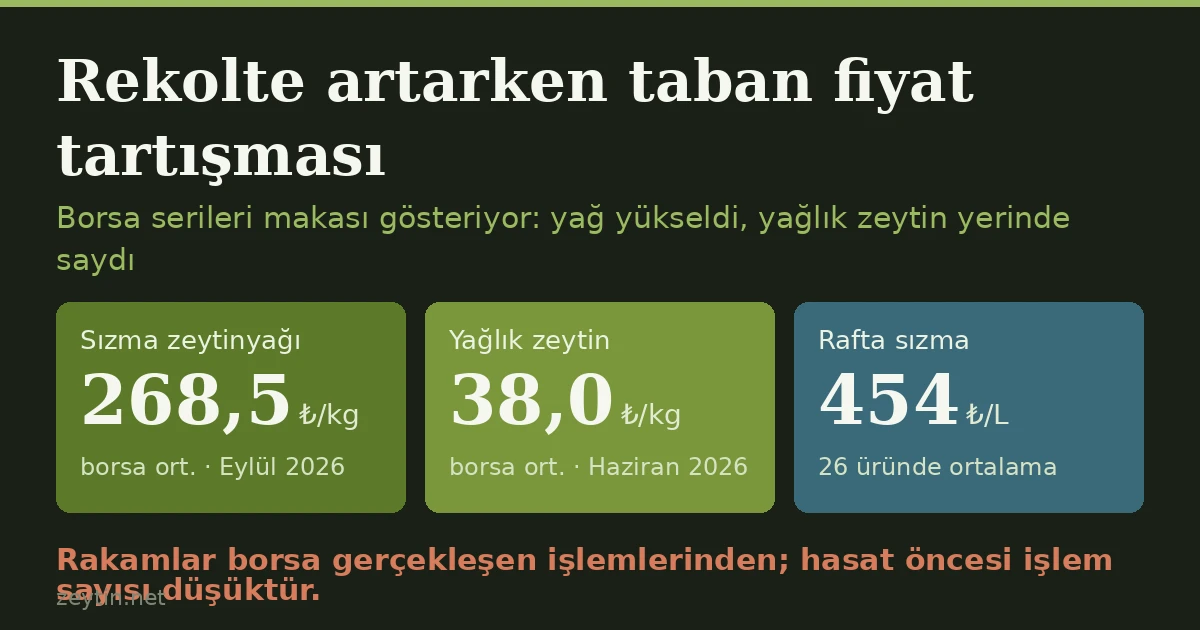
Crop forecast climbs as the minimum-price debate returns: what the exchange numbers say
With the 2026 harvest approaching, crop forecasts are up 40 percent in some provinces and growers want a floor price. Our exchange series shows why the dispute is really about olives, not oil.
Article
Crop forecast climbs as the minimum-price debate returns: what the exchange numbers say
With the 2026 harvest approaching, crop forecasts are up 40 percent in some provinces and growers want a floor price. Our exchange series shows why the dispute is really about olives, not oil.
 Article
Andalusia moves against North African imports: 76% of what arrives is extra virgin
Andalusia's farm sector objects that more than 76% of the olive oil imported into the region in early 2026 was extra virgin. The regional minister has requested exceptional measures under Article 195 of the EU regulation. Türkiye could meet the same door.
Article
Andalusia moves against North African imports: 76% of what arrives is extra virgin
Andalusia's farm sector objects that more than 76% of the olive oil imported into the region in early 2026 was extra virgin. The regional minister has requested exceptional measures under Article 195 of the EU regulation. Türkiye could meet the same door.
 Article
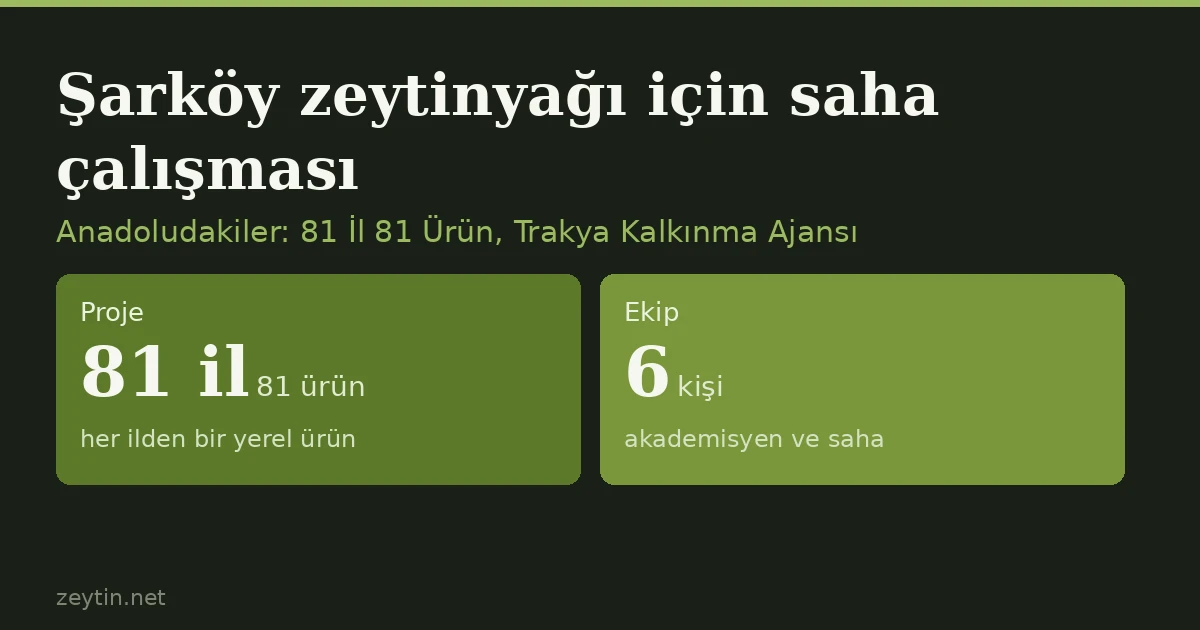
Field study for Şarköy olive oil: Tekirdağ's pick for "81 Provinces 81 Products"
Şarköy olive oil has been chosen as Tekirdağ's product in the "Anatolians: 81 Provinces 81 Products" programme coordinated by the Ministry of Industry and Technology. The Thrace Development Agency and Namık Kemal University surveyed growers and businesses to map the value chain. The goal is branding; there is no geographical indication registration yet.
Article
Field study for Şarköy olive oil: Tekirdağ's pick for "81 Provinces 81 Products"
Şarköy olive oil has been chosen as Tekirdağ's product in the "Anatolians: 81 Provinces 81 Products" programme coordinated by the Ministry of Industry and Technology. The Thrace Development Agency and Namık Kemal University surveyed growers and businesses to map the value chain. The goal is branding; there is no geographical indication registration yet.
 Article
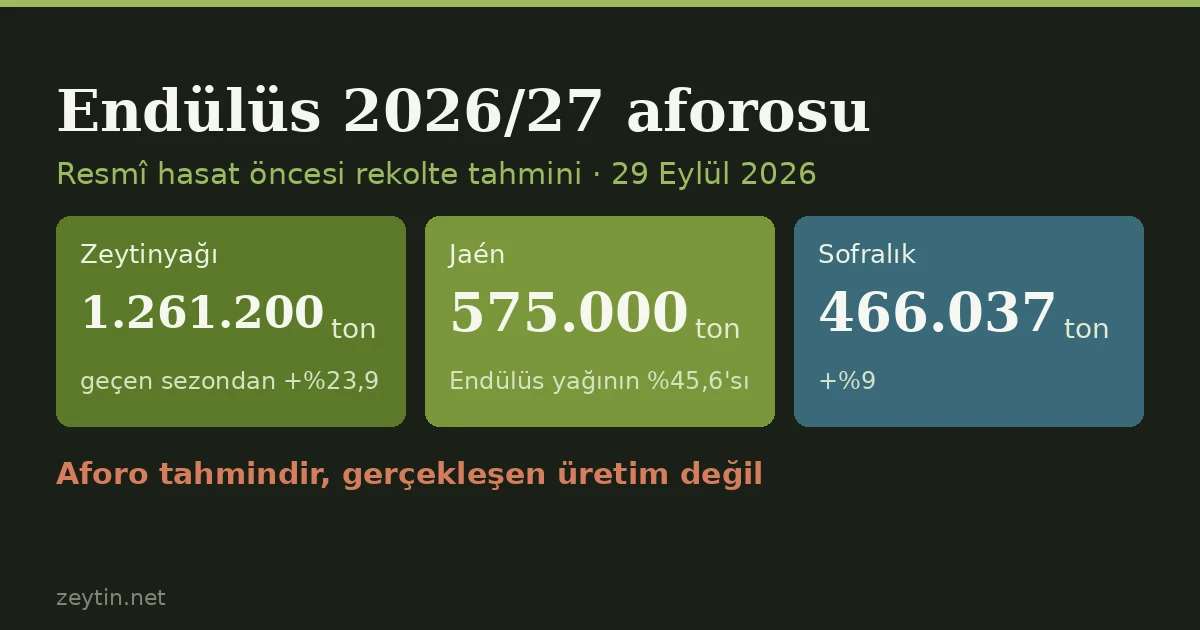
Andalusia finally puts a number on it: 1.26 million tonnes of olive oil, up 24%
Andalusia's agriculture ministry published its 2026/27 aforo on 29 September in Mengíbar: 1,261,200 tonnes of olive oil, 23.9% above last season and 44% above the five-year average. The heat warning growers raised in early September made it into the forecast's own reasoning. Four times Turkey's entire season output is entering an already soft price environment.
Article
Andalusia finally puts a number on it: 1.26 million tonnes of olive oil, up 24%
Andalusia's agriculture ministry published its 2026/27 aforo on 29 September in Mengíbar: 1,261,200 tonnes of olive oil, 23.9% above last season and 44% above the five-year average. The heat warning growers raised in early September made it into the forecast's own reasoning. Four times Turkey's entire season output is entering an already soft price environment.