"Jewels of the Adriatic": four countries choose to compete on quality, not volume
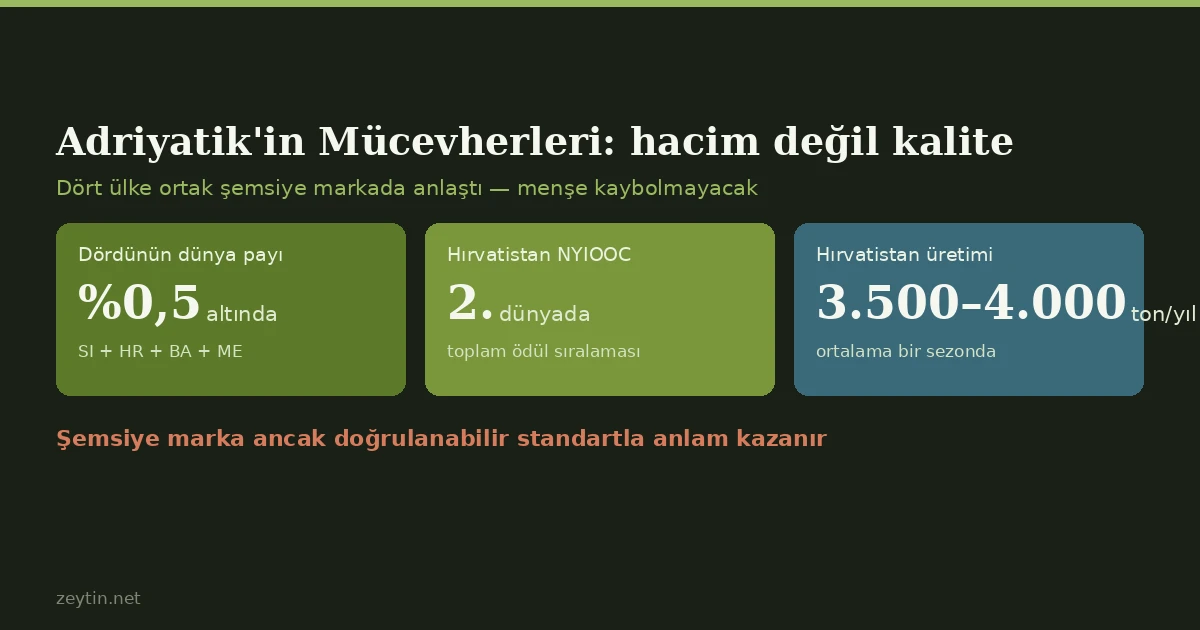
Slovenia, Croatia, Bosnia and Herzegovina and Montenegro together produce under 0.5% of the world's olive oil — yet Croatia finished second worldwide at the NYIOOC. A panel in Mostar proposed a shared umbrella brand: origin stays, common rules are the condition.
Put together, the olive groves of Slovenia, Croatia, Bosnia and Herzegovina and Montenegro produce barely half a percent of the world's olive oil. Producers in those four countries now propose to stop competing on volume and build a shared quality brand instead: "Jewels of the Adriatic."
The proposal was put forward at the first international panel of Eastern Adriatic countries, held during the inaugural Herz Olive Fest in Mostar, Bosnia and Herzegovina. The festival was held under the patronage of Borjana Krišto, chairwoman of the Council of Ministers of Bosnia and Herzegovina.
The numbers
| Country / item | Value |
|---|---|
| Croatia, annual output | 3,500–4,000 t |
| Slovenia, annual output | ~500 t |
| Montenegro, annual output | several hundred t |
| Bosnia and Herzegovina, annual output | 200–300 t |
| Combined share of world output | under 0.5% |
| Croatia at the NYIOOC | 2nd worldwide |
| Bosnia and Herzegovina awards (record) | 16 |
| Montenegro awards (record) | 9 |
No volume, but plenty of awards
The figures make the region's small scale plain. In an average year Croatia produces 3,500 to 4,000 tonnes, Slovenia around 500 tonnes and Montenegro several hundred. Despite the rapid expansion of olive growing in Herzegovina, Bosnia and Herzegovina produces only about 200 to 300 tonnes. Taken together, the four are close to a single day of Spanish output.
In international competition the picture inverts. At the most recent NYIOOC World Olive Oil Competition, Croatia finished second worldwide in total awards, while Bosnia and Herzegovina, with 16 awards, and Montenegro, with 9, recorded their best results to date.
Marko Ivanković, director of the Federal Agromediterranean Institute in Mostar, sums the region up in one line: "Our oils, from northern Istria to southern Ulcinj, regularly rank among the best in the world." He lists the common ground too: karst, abundant sunshine, the harsh bora wind and a tradition stretching back thousands of years.
What the brand would be — and would not
The name proposed at the panel is "Jewels of the Adriatic," and it rests on one condition: every participating product would continue to carry a clear indication of its country of origin. The aim is not to erase national identities but to establish a recognisable regional framework that gives producers from small countries visibility in international markets.
Rok Babič, of the Institute for Olive Growing at the Science and Research Centre in Koper, puts the sequence the other way round: "Before choosing a name, we have to ask whom we want to reach, what those people value and why the oils of the Eastern Adriatic should interest them."
His definition of the brand goes beyond the product: "We are not selling a guest only a bottle of oil, but a landscape, people, varieties, tradition, knowledge and the experience of a particular place."
The panel's shared conclusion is clear: an umbrella brand can carry small countries into larger markets — but only if it is backed by clear and verifiable quality standards. As Babič put it, the name "could be an excellent starting point, but its real value would come from outstanding quality, common rules and the authentic stories of the people who produce these oils."
Who was at the table
The composition of the panel shows the proposal is more than an association-level wish. It was moderated by Nedjeljko Jusup. Croatia was represented by Nebojša Jerković, a consultant and olive oil specialist from the Neretva Valley who also sits on the management board of Croatia's National Common Agricultural Policy Network. Slovenia was represented by the young researchers Rok Babič and Karlo Kopjar from the Koper institute; Montenegro by Ivan Ilić, president of the Boka Olive Growers Association, and Ćazim Alković, president of the Bar Olive Growers Association and Montenegro's representative to the International Olive Council in Madrid.
The panel's central argument follows from that line-up: taken individually, these countries have neither the production volumes nor the marketing budgets to be visible in major global markets. What they can offer together is a cluster large producers find difficult to replicate — an extraordinary diversity of indigenous varieties, thousands of years of tradition and a distinctive karst landscape.
Pests do not recognise borders
The panel's second agenda was technical. Ivanković says climate change is no longer theoretical: drought increasingly affects the groves, extreme heat can persist from flowering through ripening and harvest, and new pests are emerging that do not recognise national borders.
That last point ties the shared brand to a technical necessity: if pests ignore borders, monitoring and control cannot respect them either. The panel also discussed agricultural drones and smart technologies for plant protection, olive oil agritourism, and the creation of a single cross-border Trans-Adriatic Olive Oil Route.
Seen from Türkiye
The proposal points to a familiar gap. Türkiye holds a large number of geographical indication registrations for olives and olive oil — but a registration is a legal label, not a story told in the market. We measured what twenty-five registrations are actually doing separately: the number of registrations rises without the number of names consumers recognise rising with it.
That is exactly where the Adriatic proposal is interesting. The four countries are building common rules and a common narrative ahead of the label; origin is not lost but carried under the umbrella. The equivalent question here is this: with Ayvalık, Milas, Mut, North Aegean and the rest each registered separately, is there any recognisable framework that presents all of them together in export markets?
What to watch
Two things will decide whether the proposal amounts to more than a name: whether a verifiable quality standard is actually written, and whether the four countries run it through a joint institution or leave it at association level. Without a standard, an umbrella brand is a slogan standing next to a list of awards.
One rating per visitor; you can change yours at any time. Ratings are real reader votes — no seeded or default scores.
Related
 Article
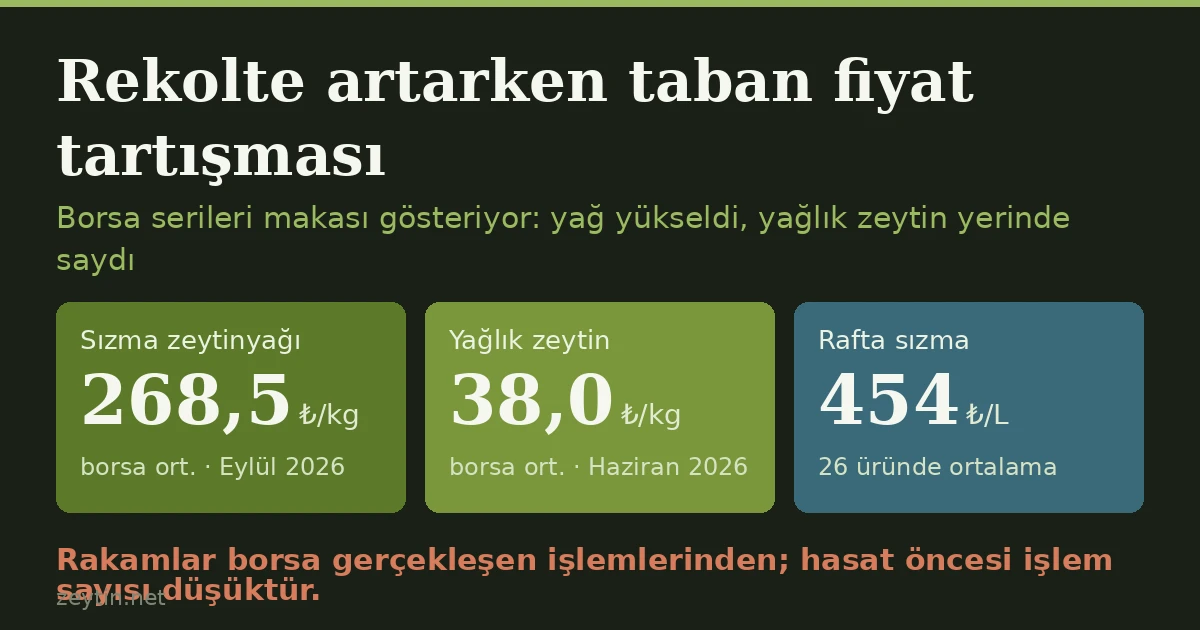
Crop forecast climbs as the minimum-price debate returns: what the exchange numbers say
With the 2026 harvest approaching, crop forecasts are up 40 percent in some provinces and growers want a floor price. Our exchange series shows why the dispute is really about olives, not oil.
Article
Crop forecast climbs as the minimum-price debate returns: what the exchange numbers say
With the 2026 harvest approaching, crop forecasts are up 40 percent in some provinces and growers want a floor price. Our exchange series shows why the dispute is really about olives, not oil.
 Article
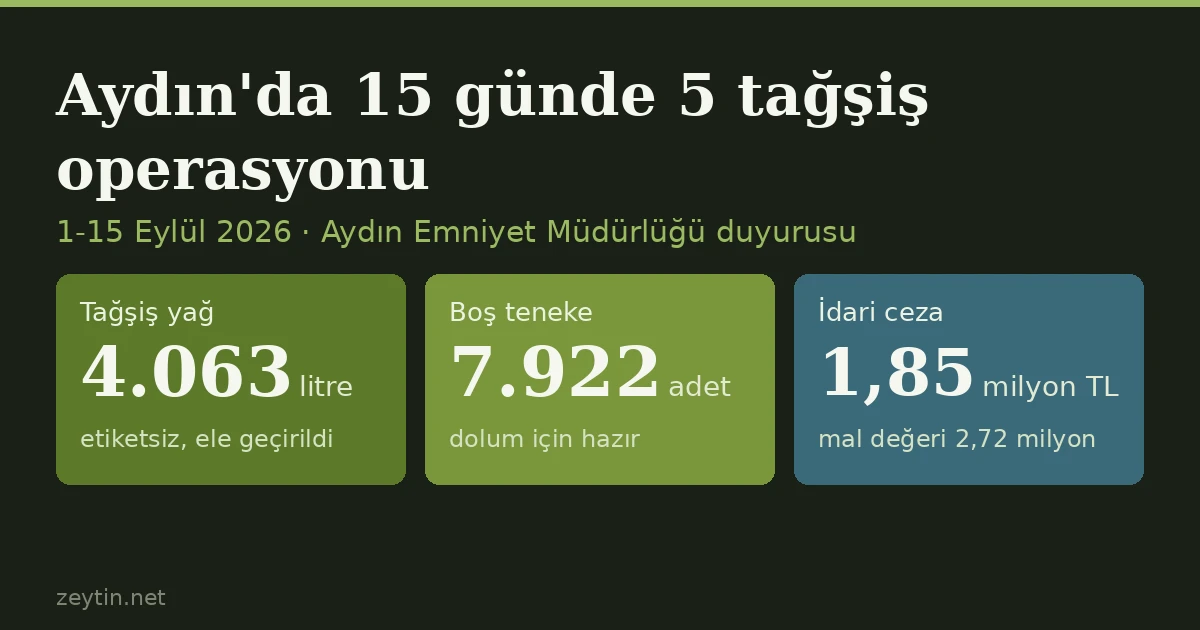
Five adulteration raids in 15 days in Aydın: 4,063 litres of oil, 7,922 empty tins
Police in Aydın say five operations between 1 and 15 September 2026 seized 4,063 litres of unlabelled adulterated oil and 7,922 empty tins. The goods were valued at about 2.72 million lira and the administrative fines totalled 1.85 million lira. The number of empty tins was nearly double the litres of oil seized.
Article
Five adulteration raids in 15 days in Aydın: 4,063 litres of oil, 7,922 empty tins
Police in Aydın say five operations between 1 and 15 September 2026 seized 4,063 litres of unlabelled adulterated oil and 7,922 empty tins. The goods were valued at about 2.72 million lira and the administrative fines totalled 1.85 million lira. The number of empty tins was nearly double the litres of oil seized.
 Article
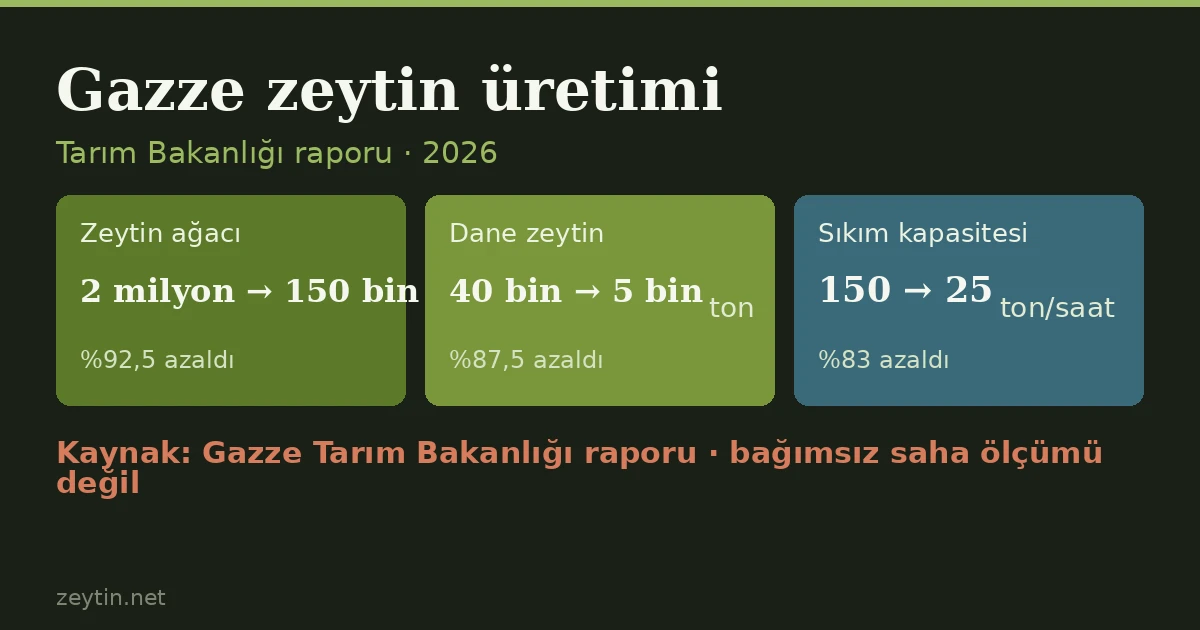
Gaza's olive report: 150,000 trees left of two million, production down 87.5%
According to a report from Gaza's Ministry of Agriculture, olive groves have shrunk from 50,000 dunums to 5,000 and the olive crop from 40,000 tonnes to 5,000. The loss is not confined to the grove: milling capacity has fallen from 150 tonnes an hour to 25, and the number of growers from 20,000 to 1,000.
Article
Gaza's olive report: 150,000 trees left of two million, production down 87.5%
According to a report from Gaza's Ministry of Agriculture, olive groves have shrunk from 50,000 dunums to 5,000 and the olive crop from 40,000 tonnes to 5,000. The loss is not confined to the grove: milling capacity has fallen from 150 tonnes an hour to 25, and the number of growers from 20,000 to 1,000.
 Article
Olive oil exports down 62% by value as a record harvest is expected
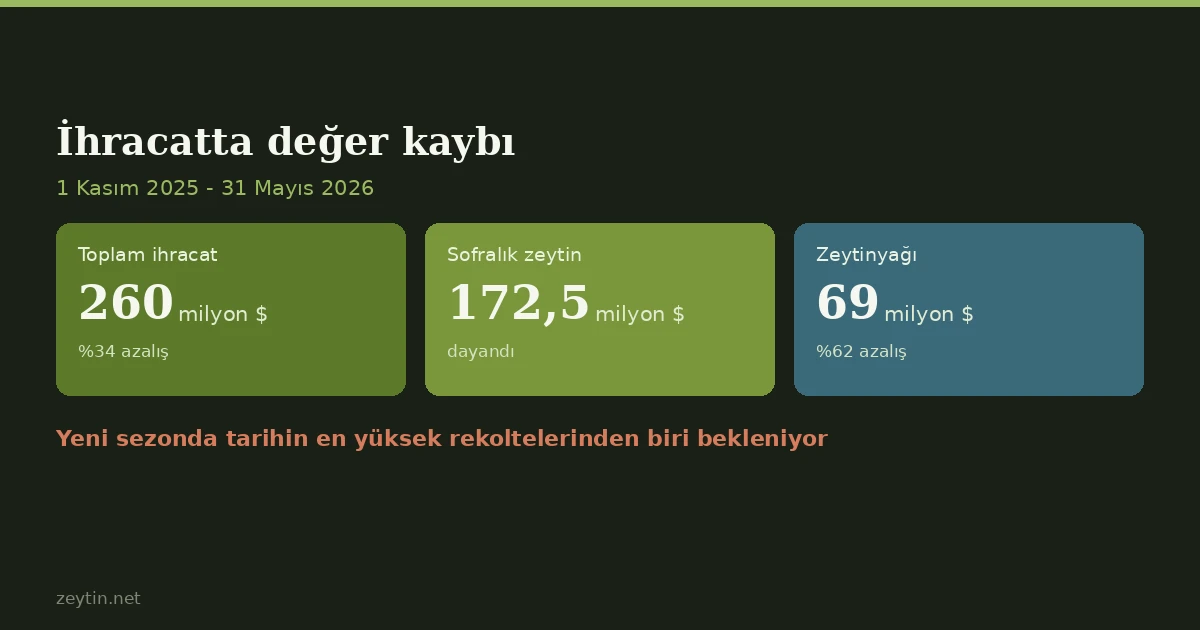
Olive and olive oil exports fell 34% to $260 million between 1 November 2025 and 31 May 2026. Table olives held at $172.5 million while olive oil dropped to $69 million. The target is a return to $1 billion.
Article
Olive oil exports down 62% by value as a record harvest is expected
Olive and olive oil exports fell 34% to $260 million between 1 November 2025 and 31 May 2026. Table olives held at $172.5 million while olive oil dropped to $69 million. The target is a return to $1 billion.