Five adulteration raids in 15 days in Aydın: 4,063 litres of oil, 7,922 empty tins
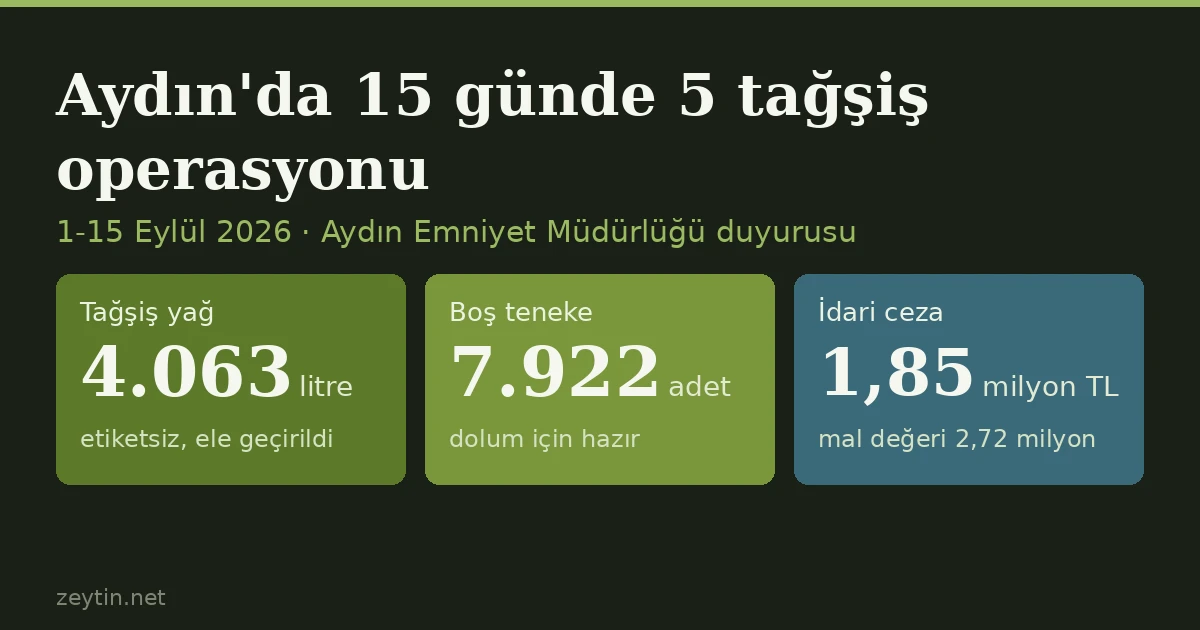
Police in Aydın say five operations between 1 and 15 September 2026 seized 4,063 litres of unlabelled adulterated oil and 7,922 empty tins. The goods were valued at about 2.72 million lira and the administrative fines totalled 1.85 million lira. The number of empty tins was nearly double the litres of oil seized.
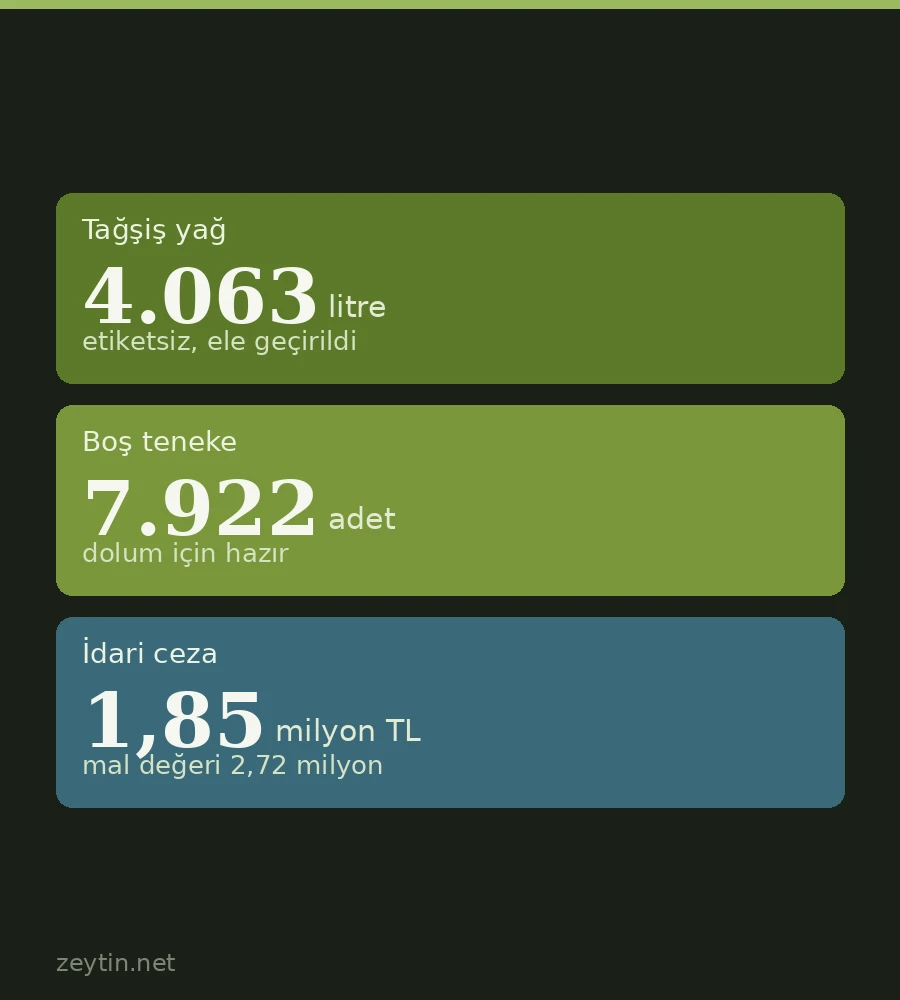
Olive oil fraud is back on the agenda in Aydın, one of Türkiye's largest olive-growing provinces, just as the new season opens. According to an announcement by the Aydın Police Department's Security Branch, officers carried out five separate operations against counterfeiting across the province between 1 and 15 September 2026. Taken one by one the figures look modest; placed side by side they describe a filling line.
What was seized
- 4,063 litres of unlabelled adulterated oil
- 7,922 empty tins, which according to the statement had been identified as packaging for filling adulterated oil
- An estimated market value of about 2.72 million lira for the seized goods
- Proceedings opened against five people
- Administrative fines totalling 1.85 million lira
"Fake olive oil" or "adulterated oil"?
The wording in the official statement is "unlabelled adulterated oil". That is not the same as saying the seized product was olive oil. Adulteration means adding to a product something that does not belong in it, or selling a different oil under that product's name. In olive oil this usually takes the form of cheap seed oil blended into what is sold as extra virgin, and sometimes of a product that is not olive oil at all. We set out the methods, and what a buyer can actually check, in olive oil fraud and adulteration.
The word "unlabelled" carries information of its own. No producer, no batch number, no filling date, no analysis history. An oil without traceability loses, the moment it enters the market, any answer to the question of who made it.
More tins than litres
The most striking part of the announcement is the ratio between two numbers. The oil seized came to 4,063 litres. The empty tins seized came to 7,922 — nearly double the number of litres. The volume of the tins was not disclosed, but if they were the five-litre tins common in the Turkish market, that packaging stock points to a filling capacity several times larger than the oil actually found.
That pattern suggests the operations may have caught the filling chain before the product reached the market: the packaging ready, the filling pending, the oil not yet fully delivered. A firmer reading has to wait for the outcome of the investigation.
The timing is not an accident
It matters that the raids fell in the first half of September. New-season olive oil is not yet on the market; the 2026/27 season has only just opened with the first harvests. The gap between the old season's dwindling stock and the new season's oil is exactly the window in which adulteration moves most freely. The same picture repeats in every interval where prices are high and supply is tight.
Price, moreover, is no longer a measure of trust on its own. As we reported earlier, adulterated oil can carry a higher shelf price than the genuine product. Being expensive does not make a product real.
The fine is below the value of the goods
Put the two disclosed figures next to each other and the core of the deterrence debate appears: the seized goods were valued at 2.72 million lira, while the administrative fines came to 1.85 million lira. Looking only at the administrative side, the penalty falls below the value of the merchandise that was caught — and by definition it says nothing about the merchandise that was not.
This does not cover the judicial dimension of the case; proceedings against the five people are continuing, and criminal liability for adulterated foodstuffs is handled separately. But the ratio is the one to look at if you want to understand why adulteration is a repeat offence rather than a one-off. Where the expected gain exceeds the expected penalty, enforcement pressure has to come from frequency of inspection rather than from the size of the fine. The value of the batch that was not intercepted does not appear anywhere in that calculation.
What was not disclosed
The announcement leaves several questions the sector would want answered. It does not say which districts of the province the operations took place in. It does not say what the seized oil actually was — seed oil, a blend, and in what proportion — which will depend on laboratory results. And it does not say which channel or which provinces the product was being prepared for. Those three points decide whether this is a local matter or part of a wider distribution network, and none of them can be answered from the figures released so far.
What a buyer can do
Fake oil rarely reaches people from a supermarket shelf. It travels in tin sales, in deals through acquaintances, through the channel described as "coming straight from the village". A few simple rules cut the risk sharply:
- Do not buy an unlabelled tin. The label should carry a brand, a filling location, a batch number and a date.
- Ask for an invoice or delivery note. In unrecorded sales there is no counterparty left when something goes wrong.
- Do not treat price as proof. Both the cheap and the expensive can be adulterated.
- Report suspicions. In Türkiye, food safety complaints can be made to the 174 Alo Gıda line.
Why Aydın matters here
Aydın is among the provinces with the highest olive tree numbers in Türkiye and carries weight in both table olives and olive oil. Only days earlier the same province saw a pre-harvest olive fruit fly warning issued to growers. The effort spent on protecting quality at the production end is what an unlabelled tin at the filling end undoes — and the reputation damaged is the region's, not only the seller's.
Police said work to prevent counterfeit and non-compliant products from reaching the market is continuing across the province.
One rating per visitor; you can change yours at any time. Ratings are real reader votes — no seeded or default scores.
Related
 Article
Tunisia exported 368,000 tonnes of olive oil — but earned less per tonne
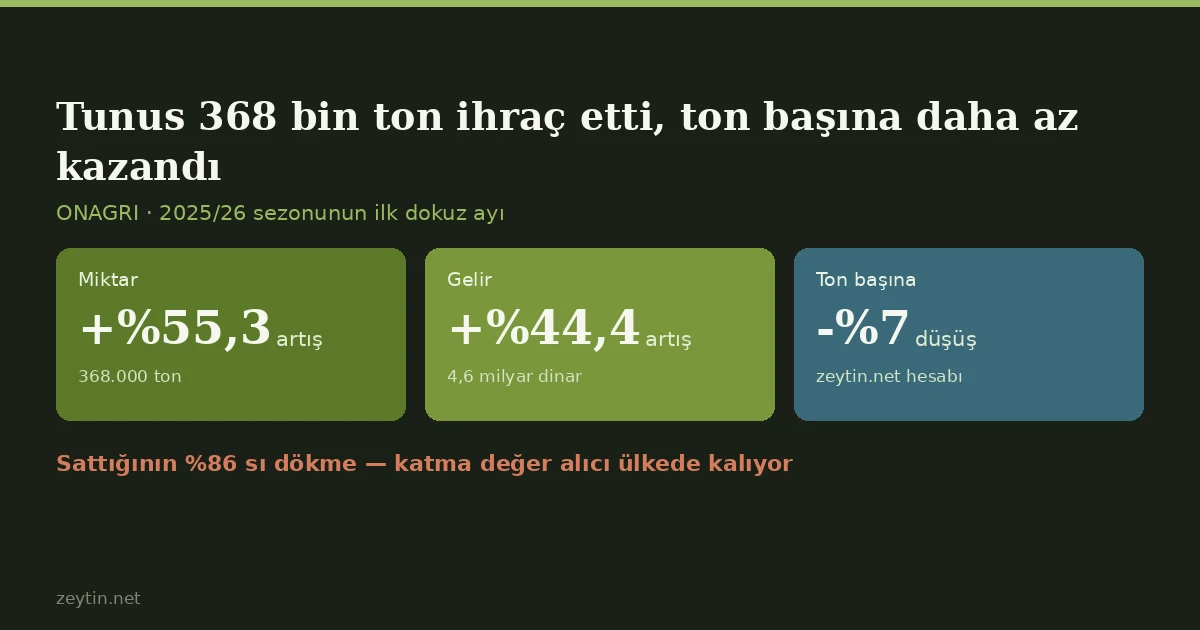
Tunisia's agriculture observatory ONAGRI reports olive oil exports up 55.3% by volume and 44.4% by value in the first nine months of 2025/26. The gap between the two means about 7% less earned per tonne.
Article
Tunisia exported 368,000 tonnes of olive oil — but earned less per tonne
Tunisia's agriculture observatory ONAGRI reports olive oil exports up 55.3% by volume and 44.4% by value in the first nine months of 2025/26. The gap between the two means about 7% less earned per tonne.
 Article
Adulterated olive oil costs more than the real thing: price is no longer a sign of authenticity
Diker, president of the Edremit Chamber of Agriculture, says adulterated oils sold online now exceed the wholesale price of genuine oil: wholesale starts at 240 lira, the fake sells above 300. Our exchange data complicates the picture — genuine extra virgin in Aydın is already 307.60 lira.
Article
Adulterated olive oil costs more than the real thing: price is no longer a sign of authenticity
Diker, president of the Edremit Chamber of Agriculture, says adulterated oils sold online now exceed the wholesale price of genuine oil: wholesale starts at 240 lira, the fake sells above 300. Our exchange data complicates the picture — genuine extra virgin in Aydın is already 307.60 lira.
 Article
The world's largest bottler is for sale: a €500 million race for Deoleo
Deoleo, owner of Bertolli and Carbonell, holds 22% of global bottled olive oil sales. Italy's Coricelli leads at €500 million, Spain's Dcoop cooperative at €470 million. The Spanish government regards the company as nationally strategic. Because Deoleo is a major bulk buyer, the outcome matters to Turkish exporters too.
Article
The world's largest bottler is for sale: a €500 million race for Deoleo
Deoleo, owner of Bertolli and Carbonell, holds 22% of global bottled olive oil sales. Italy's Coricelli leads at €500 million, Spain's Dcoop cooperative at €470 million. The Spanish government regards the company as nationally strategic. Because Deoleo is a major bulk buyer, the outcome matters to Turkish exporters too.
 Article
Andalusia moves against North African imports: 76% of what arrives is extra virgin
Andalusia's farm sector objects that more than 76% of the olive oil imported into the region in early 2026 was extra virgin. The regional minister has requested exceptional measures under Article 195 of the EU regulation. Türkiye could meet the same door.
Article
Andalusia moves against North African imports: 76% of what arrives is extra virgin
Andalusia's farm sector objects that more than 76% of the olive oil imported into the region in early 2026 was extra virgin. The regional minister has requested exceptional measures under Article 195 of the EU regulation. Türkiye could meet the same door.